Introduction to the Camp David Accords Word Search
The Camp David Accords were an important step toward peace in the Middle East. They were agreements reached in September 1978 after several days of private negotiations at Camp David, the official country retreat of the president of the United States. The talks brought together Egyptian President Anwar Sadat, Israeli Prime Minister Menachem Begin, and U.S. President Jimmy Carter, who acted as a mediator between the two leaders.
Egypt and Israel had fought several wars since the creation of Israel in 1948. One of the main areas of disagreement was the Sinai Peninsula, which Israel had captured from Egypt during the Six-Day War in 1967. Years of conflict had caused thousands of deaths, damaged economies, and created deep mistrust. Sadat believed that direct negotiations offered a better future than continued warfare, while Begin wanted stronger security guarantees for Israel.
The meetings at Camp David lasted from September 5 to September 17, 1978. Discussions were often difficult, and the leaders did not always meet face to face. President Carter and his advisers frequently carried messages and proposals between the Egyptian and Israeli delegations. After nearly two weeks, the three leaders announced that they had reached two basic agreements.
The first agreement created a framework for peace between Egypt and Israel. It called for Israel to withdraw from the Sinai Peninsula and for Egypt to recognize Israel as a legitimate country. It also proposed diplomatic relations, safer borders, and limits on military forces in parts of Sinai. These ideas led to the Egypt-Israel Peace Treaty, signed in Washington, D.C., on March 26, 1979.
The second agreement addressed the future of the West Bank, Gaza, and the Palestinian people. It suggested a period of limited Palestinian self-government, but many of its proposals were never fully carried out. Palestinians were not directly represented at the Camp David meetings, and the agreement did not solve the wider Israeli-Palestinian conflict.
The Camp David Accords were historically significant because Egypt became the first Arab country to officially recognize Israel. Sadat and Begin received the 1978 Nobel Peace Prize for their efforts. However, the agreements were controversial throughout the Arab world, and Egypt was temporarily isolated by several neighboring countries.
A Camp David Accords word search can help students review key people, locations, negotiations, and peace terms while learning why the agreements remain an important and debated moment in modern Middle Eastern history.
Related Word Searches:
Jimmy Carter | Cold War | Vietnam War | Cuban Missile Crisis | John F. Kennedy | Ronald Reagan
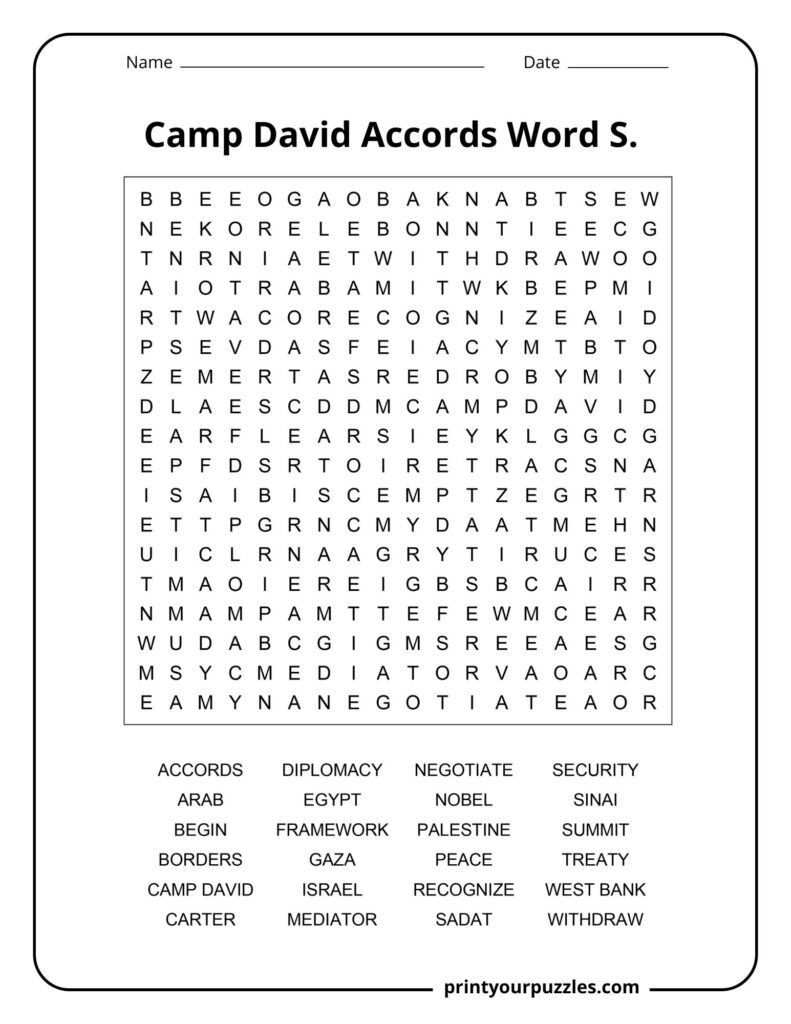
Medium Difficulty Word Search
Words to Find
ACCORDS, ARAB, BEGIN, BORDERS, CAMP DAVID, CARTER, DIPLOMACY, EGYPT, FRAMEWORK, GAZA, ISRAEL, MEDIATOR, NEGOTIATE, NOBEL, PALESTINE, PEACE, RECOGNIZE, SADAT, SECURITY, SINAI, SUMMIT, TREATY, WEST BANK, WITHDRAW
All Words Defined
ACCORDS – Agreements reached in 1978 that created a framework for peace between Egypt and Israel and encouraged further diplomatic negotiations in the Middle East.
ARAB – Term describing peoples and nations of the Arab world, many of which reacted strongly to Egypt’s decision to recognize and negotiate with Israel.
BEGIN – Menachem Begin, Israel’s prime minister, who negotiated with Anwar Sadat at Camp David and later signed the 1979 peace treaty with Egypt.
BORDERS – National boundaries discussed during negotiations, especially those involving Israel, Egypt, and the return of the Sinai Peninsula to Egyptian control.
CAMP DAVID – Presidential retreat in Maryland where Jimmy Carter hosted private negotiations between Egyptian and Israeli leaders during September 1978.
CARTER – Jimmy Carter, the United States president who mediated the negotiations, proposed compromises, and helped Sadat and Begin reach the historic agreements.
DIPLOMACY – The use of negotiation, discussion, and peaceful communication between governments to resolve disagreements without relying on warfare or military force.
EGYPT – Arab nation led by Anwar Sadat that became the first Arab country to officially recognize Israel after signing a peace treaty.
FRAMEWORK – General plan established by the accords to guide future peace negotiations, Israeli withdrawal from Sinai, and discussions concerning Palestinian self-government.
GAZA – Palestinian coastal territory included in proposals for limited self-government, although the accords did not produce a final settlement for its people.
ISRAEL – Country led by Menachem Begin that agreed to withdraw from the Sinai Peninsula in exchange for peace, recognition, and improved security.
MEDIATOR – Neutral person who helps opposing sides communicate and reach agreement, a role President Carter performed throughout the difficult Camp David negotiations.
NEGOTIATE – To discuss disagreements and possible solutions in order to reach an agreement, as Egypt and Israel did with American assistance.
NOBEL – International peace prize awarded jointly to Anwar Sadat and Menachem Begin in 1978 for their efforts to achieve peace.
PALESTINE – Term connected to the Palestinian people and territories, whose future was discussed but not fully resolved by the Camp David Accords.
PEACE – Central goal of the negotiations, aiming to end armed conflict between Egypt and Israel and create more stable relations.
RECOGNIZE – To officially accept another country’s existence and legitimacy, as Egypt agreed to do regarding Israel under the peace framework.
SADAT – Anwar Sadat, Egypt’s president, who pursued direct talks with Israel and signed the Camp David Accords despite strong regional criticism.
SECURITY – Protection from military attack or violence, a major Israeli concern addressed through borders, withdrawal plans, and limits on forces in Sinai.
SINAI – Desert peninsula captured by Israel in 1967 and gradually returned to Egypt after the accords and the later peace treaty.
SUMMIT – High-level meeting between national leaders, such as the Camp David gathering involving Carter, Sadat, and Begin in September 1978.
TREATY – Formal agreement signed by Egypt and Israel in 1979 that ended hostilities, established relations, and arranged Israel’s withdrawal from Sinai.
WEST BANK – Palestinian territory discussed in the accords as part of a proposed plan for limited self-government and future negotiations.
WITHDRAW – To remove military forces from occupied territory, as Israel agreed to do gradually from the Sinai Peninsula after the peace agreement.
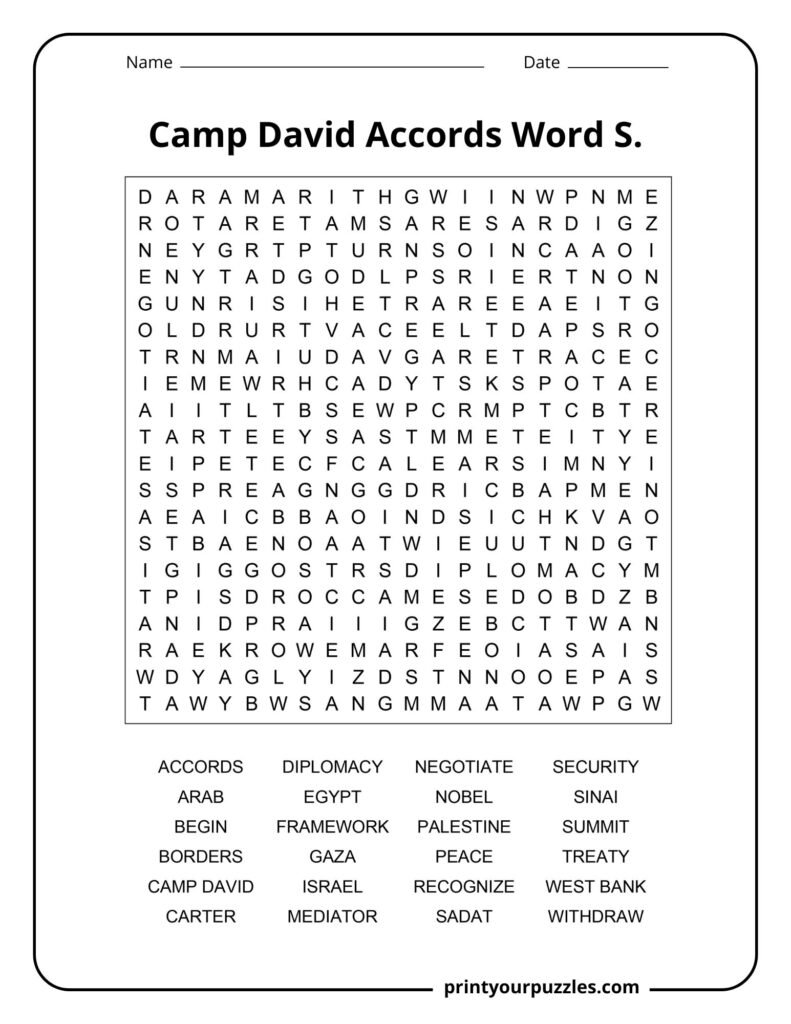
Hard Difficulty Word Search
Words to Find
ACCORDS, ARAB, BEGIN, BORDERS, CAMP DAVID, CARTER, DIPLOMACY, EGYPT, FRAMEWORK, GAZA, ISRAEL, MEDIATOR, NEGOTIATE, NOBEL, PALESTINE, PEACE, RECOGNIZE, SADAT, SECURITY, SINAI, SUMMIT, TREATY, WEST BANK, WITHDRAW
5 Key FAQs About the Camp David Accords
5 Curious "Did You Know?" Facts About the Camp David Accords