
Native Americans are the Indigenous peoples who lived across North America for thousands of years before European explorers and settlers arrived. They developed hundreds of distinct nations, languages, traditions, governments, and ways of life adapted to environments ranging from forests and plains to deserts, mountains, and coastal regions. Learning about Native Americans helps us understand that Indigenous history is not one single story, but a collection of many different cultures and experiences.
Before European contact, Native communities built villages and cities, farmed crops such as corn, beans, and squash, hunted and fished, traded across long distances, and created sophisticated political and social systems. Nations such as the Cherokee, Navajo, Sioux, Apache, Iroquois, Choctaw, and many others developed their own customs, religious beliefs, artistic traditions, and forms of leadership. Some communities lived mainly through agriculture, while others depended more heavily on hunting, fishing, gathering, or combinations of these activities.
European colonization dramatically changed Native American life. Disease, warfare, expanding settlements, and government policies caused enormous population losses and the seizure of Indigenous lands. During the nineteenth century, the United States government forced many Native peoples from their ancestral territories. The Indian Removal Act of 1830 contributed to forced migrations such as the Trail of Tears, during which thousands of Cherokee people suffered and died. Later policies placed many Indigenous communities on reservations and attempted to suppress Native languages and traditions.
Despite these hardships, Native American nations survived and preserved important parts of their cultures. Indigenous people served in the U.S. military, defended treaty rights, maintained traditional ceremonies, revitalized languages, and worked to protect tribal sovereignty. Today, hundreds of federally recognized tribes exist in the United States, each with its own history, identity, and relationship with the federal government.
The Native Americans word search is a fun and educational way to become familiar with key words connected to Indigenous history and culture. The puzzle highlights important nations, traditions, places, and historical ideas while encouraging readers to discover more about the many different Native peoples of North America. It also provides a starting point for learning about their contributions, their struggles to protect their lands and cultures, and the ways Native American communities continue to preserve their heritage and shape life in the United States today.
Related Word Searches:
Cherokee Nation | Indian Removal Act | Trail of Tears | Westward Expansion | Lewis and Clark | Manifest Destiny
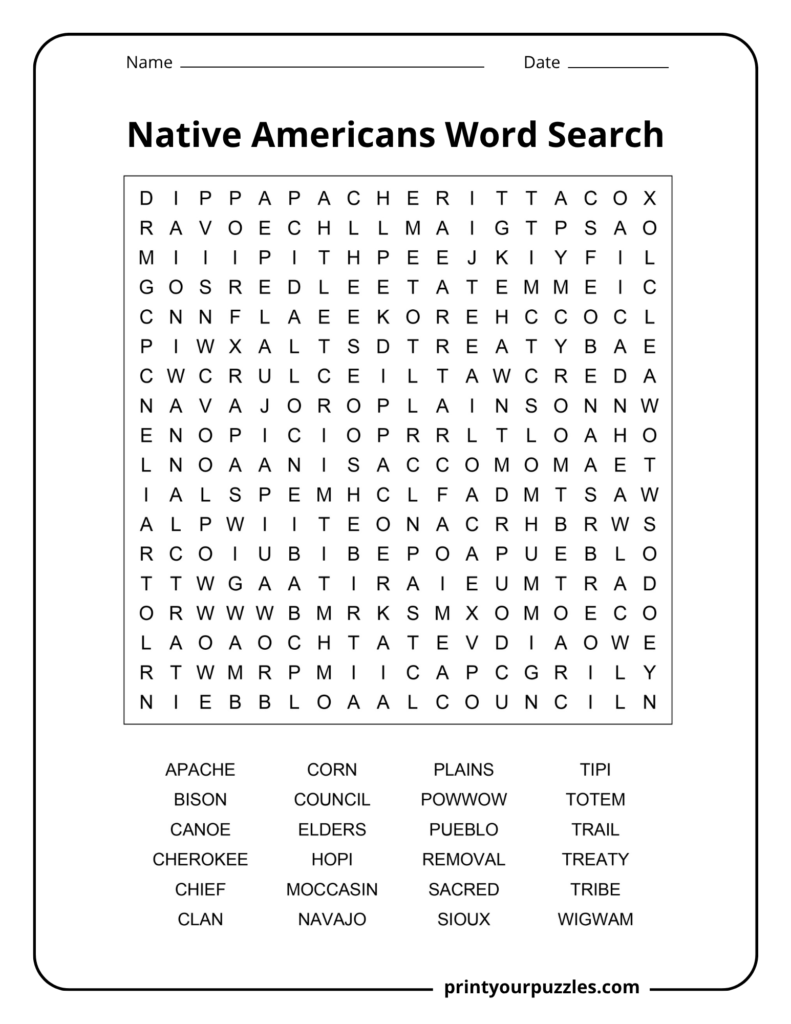
APACHE, BISON, CANOE, CHEROKEE, CHIEF, CLAN, CORN, COUNCIL, ELDERS, HOPI, MOCCASIN, NAVAJO, PLAINS, POWWOW, PUEBLO, REMOVAL, SACRED, SIOUX, TIPI, TOTEM, TRAIL, TREATY, TRIBE, WIGWAM
APACHE – Native American people traditionally living in the Southwest and southern Great Plains, known for skilled hunting, strong family networks, resistance to expansion, and distinctive cultural traditions.
BISON – Large grazing animal that provided many Plains peoples with food, hides, tools, shelter materials, and other necessities, making it central to their traditional way of life.
CANOE – Small watercraft traditionally made from materials such as birch bark or dugout logs, used by many Native peoples for transportation, fishing, hunting, trade, and travel.
CHEROKEE – Native American nation originally centered in the southeastern United States, with its own language and government, whose people suffered forced removal during the Trail of Tears.
CHIEF – Traditional leadership title often used for respected Native community leaders, although leadership systems differed greatly among nations and could involve councils, elders, or elected representatives.
CLAN – Family or kinship group found in many Native American societies, connecting people through shared ancestry and helping organize responsibilities, marriage customs, leadership, traditions, and community relationships.
CORN – Important crop cultivated by many Native American peoples for centuries, providing a major food source and often grown together with beans and squash in agricultural communities.
COUNCIL – Group of leaders, elders, or representatives who meet to discuss community matters, make decisions, resolve disputes, guide tribal affairs, and preserve traditions within Native nations.
ELDERS – Respected older community members who often preserve cultural knowledge, oral traditions, languages, ceremonies, and family histories while teaching younger generations about their heritage and responsibilities.
HOPI – Native American people of the Southwest, especially Arizona, known for long-established farming communities, pueblo villages, ceremonial traditions, artistic skills, and a strong connection to ancestral lands.
MOCCASIN – Traditional soft footwear made from animal hide and worn by many Native American peoples, with designs and construction methods varying according to region, climate, and cultural tradition.
NAVAJO – Native American nation of the Southwest, also known as Diné, recognized for sheep herding, weaving, silverwork, language traditions, and a large reservation spanning several states.
PLAINS – Vast grassland region of central North America where many Native peoples developed cultures connected with bison hunting, horses, seasonal movement, trade, warfare, and community life.
POWWOW – Social and cultural gathering where Native people may celebrate through dancing, singing, drumming, traditional clothing, food, crafts, and community activities while sharing and preserving heritage.
PUEBLO – Term describing both certain Native peoples of the Southwest and their traditional multi-story adobe communities, many of which have been continuously inhabited for hundreds of years.
REMOVAL – Forced relocation of Native peoples from ancestral homelands, especially during the nineteenth century, when United States policies displaced thousands to territories west of the Mississippi River.
SACRED – Describes places, objects, ceremonies, beliefs, or traditions considered spiritually important within Native cultures, although meanings and practices vary significantly among different Indigenous nations and communities.
SIOUX – Collective name commonly associated with Lakota, Dakota, and Nakota peoples of the northern Plains, known for distinct languages, cultural traditions, political organization, and historical resistance.
TIPI – Cone-shaped portable dwelling traditionally used by several Plains peoples, built with wooden poles and animal hides, designed for quick assembly and movement during seasonal travel and hunting.
TOTEM – Symbolic animal, plant, or natural figure associated with ancestry, identity, or spiritual meaning in some Native cultures, particularly among Indigenous peoples of the Pacific Northwest.
TRAIL – Path or route used for travel, trade, migration, hunting, or forced relocation, including historic routes connected with Native communities and events such as the Trail of Tears.
TREATY – Formal agreement between Native nations and governments concerning land, peace, rights, boundaries, or resources, many of which continue to influence legal and political relationships today.
TRIBE – Common term for a Native American political or cultural community with shared traditions, history, identity, or government, though many groups officially prefer the term nation.
WIGWAM – Dome-shaped dwelling traditionally built by some Native peoples of the Northeast and Great Lakes regions using wooden frames covered with bark, mats, hides, or other materials.
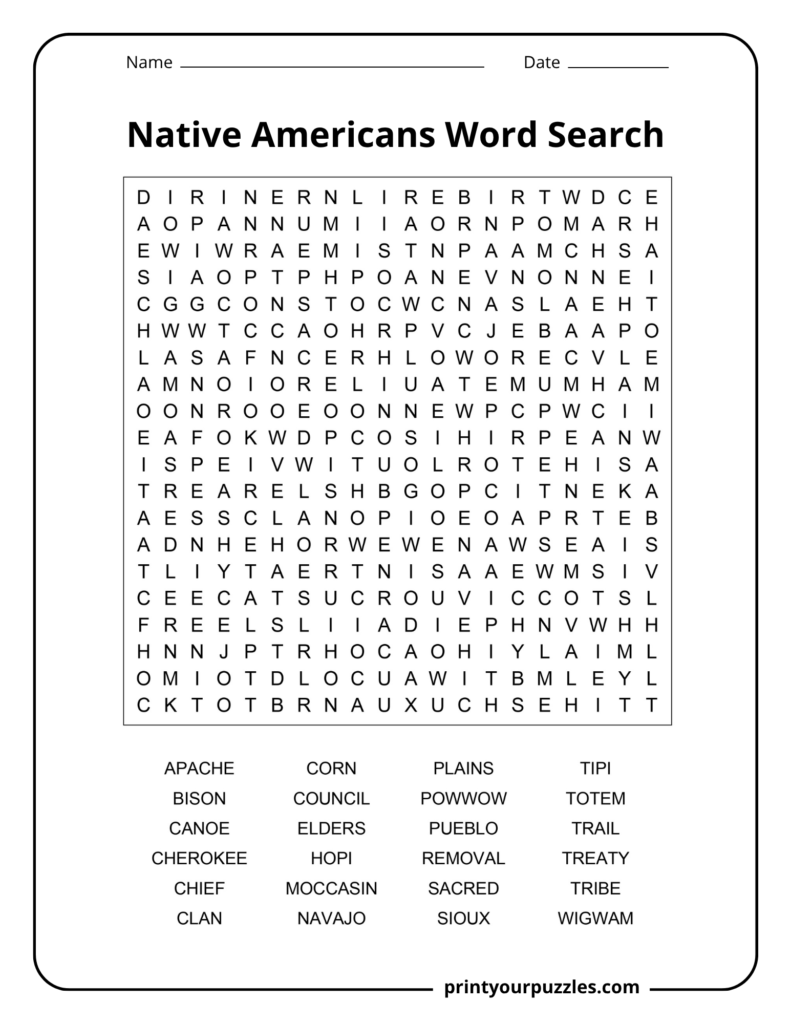
APACHE, BISON, CANOE, CHEROKEE, CHIEF, CLAN, CORN, COUNCIL, ELDERS, HOPI, MOCCASIN, NAVAJO, PLAINS, POWWOW, PUEBLO, REMOVAL, SACRED, SIOUX, TIPI, TOTEM, TRAIL, TREATY, TRIBE, WIGWAM
Native Americans are the Indigenous peoples of the United States, belonging to many distinct nations with their own languages, traditions, governments, histories, and cultural identities.
Native Americans lived throughout North America, adapting to diverse environments including plains, forests, deserts, mountains, coasts, and river valleys long before European settlement.
The Trail of Tears was the forced removal of the Cherokee and other Native peoples during the 1830s, causing suffering, displacement, disease, and thousands of deaths.
Many Native American communities cultivated corn, beans, squash, and other crops, while also hunting, fishing, and gathering foods according to their environment and traditions.
Yes. Hundreds of federally recognized Native American tribes exist today, maintaining governments, traditions, languages, communities, and legal relationships with the United States government.
Before European colonization, Native peoples spoke hundreds of distinct languages belonging to many language families, reflecting the extraordinary cultural diversity of Indigenous North America.
Many Indigenous farmers planted corn, beans, and squash together because the crops supported one another and provided important nutrients for Native American communities.
Sequoyah created the Cherokee syllabary in the early nineteenth century, allowing Cherokee people to read, write, publish newspapers, and preserve their language more effectively.
Bison provided Plains communities with food, clothing, shelter materials, tools, and other necessities, making the animal extremely important to traditional life and survival.
Many Native American nations maintain their own governments, courts, laws, and community institutions while preserving cultural traditions and exercising recognized rights of tribal sovereignty.