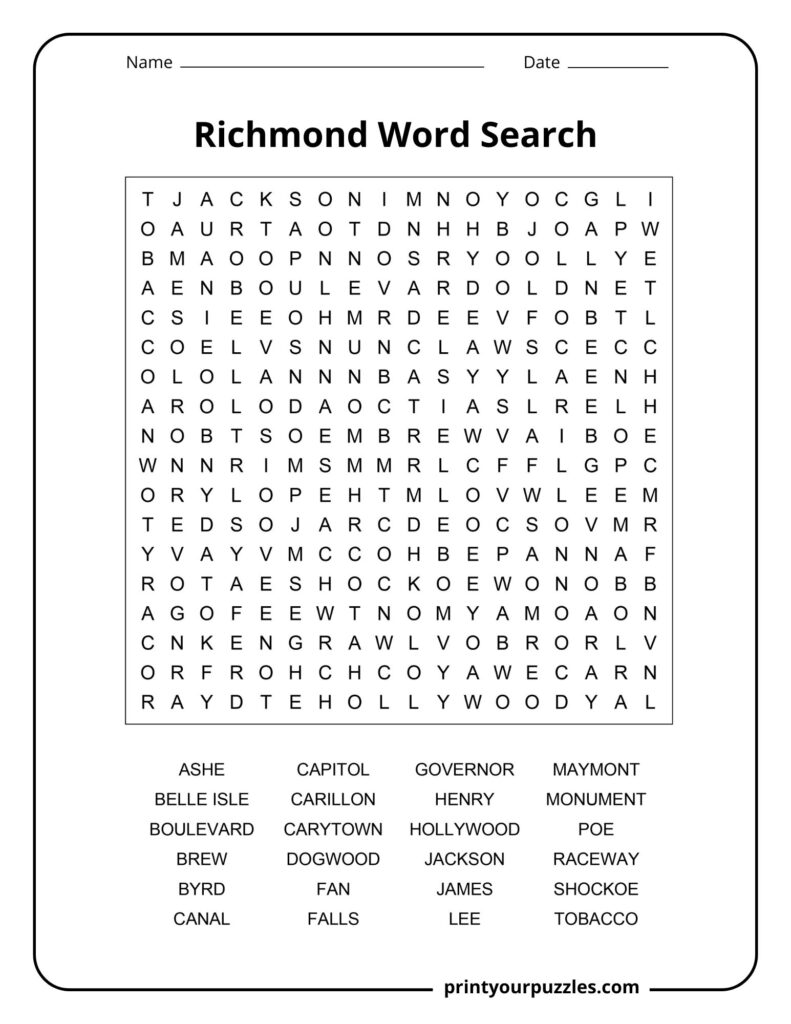
Introduction to the Richmond Word Search
Richmond is a city where layers of American history sit beside river trails, murals, museums, and lively neighborhoods. Virginia’s capital has played important roles in colonial development, the Civil War, industry, and modern culture, yet it also feels increasingly creative and outdoors-oriented.
The city grew along the James River, whose falls made Richmond an important location for trade, manufacturing, and transportation. In 1780, it became Virginia’s capital, replacing Williamsburg. Its political importance increased dramatically during the Civil War, when Richmond served as the capital of the Confederacy. Today, museums and historic sites examine that complicated past from a much broader range of perspectives.
One of the best places to explore Richmond’s history is the American Civil War Museum, which presents the conflict through military, political, social, and personal stories. The Virginia Museum of History & Culture offers an even wider view, covering centuries of life across the state.
Art has become one of Richmond’s defining strengths. The Virginia Museum of Fine Arts holds major collections of American, European, African, Asian, and decorative art, while the city’s streets are filled with murals and public artworks. Neighborhoods such as the Fan and Carytown add historic architecture, independent shops, cafés, and a strong local character.
The James River provides a completely different side of the capital. Visitors can walk or cycle along riverside trails, cross pedestrian bridges, enjoy views from Belle Isle, or even experience whitewater activities close to downtown. Few state capitals combine urban life and river recreation so directly.
Richmond’s food scene mixes classic Virginia traditions with modern creativity. Barbecue, oysters, ham, biscuits, Southern vegetables, and seafood from the Chesapeake region remain important, while newer restaurants highlight international cuisines, craft beer, and locally sourced ingredients.
Our Richmond word search can introduce readers to vocabulary connected with the James River, Civil War history, art, neighborhoods, food, and Virginia culture. Historic but never frozen in the past, Richmond offers a capital experience that combines serious history with a vibrant modern personality.
Related Word Searches:
Virginia | Raleigh | Annapolis | Charleston | Harrisburg
Medium Difficulty Word Search
Words to Find:
ASHE, BELLE ISLE, BOULEVARD, BREW, BYRD, CANAL, CAPITOL, CARILLON, CARYTOWN, DOGWOOD, FAN, FALLS, GOVERNOR, HENRY, HOLLYWOOD, JACKSON, JAMES, LEE, MAYMONT, MONUMENT, POE, RACEWAY, SHOCKOE, TOBACCO
All Words Defined
ASHE – Arthur Ashe, Richmond native and first African American man to win Wimbledon, US Open, and Australian Open. His statue stands on Monument Avenue as a civil rights icon.
BELLE ISLE – A 54-acre island park in the James River featuring ruins of a Civil War prison camp, rocky trails, views of Richmond’s skyline, and popular recreation areas.
BOULEVARD – The Boulevard is a major thoroughfare running through Richmond, home to The Diamond baseball stadium and connecting key neighborhoods through the city’s west side.
BREW – Richmond’s thriving craft beer scene features dozens of breweries including Hardywood, The Veil, and Triple Crossing, earning the city national recognition as a beer destination.
BYRD – Historic Byrd Theatre in Carytown opened in 1928, famous for its $4 second-run movies, Mighty Wurlitzer organ, and classic Art Deco architecture that draws cinema enthusiasts.
CANAL – The Canal Walk is a 1.25-mile urban park along the historic Haxall Canal and James River, featuring murals, history exhibits, and scenic views of downtown Richmond.
CAPITOL – Virginia State Capitol, designed by Thomas Jefferson in 1788, houses the oldest legislative body in the Western Hemisphere and features stunning neoclassical architecture overlooking the city.
CARILLON – The 56-bell carillon tower in Byrd Park stands 240 feet tall as a World War I memorial, offering panoramic city views and regular concerts from its bells.
CARYTOWN – A quirky nine-block shopping district nicknamed “Mile of Style” filled with independent boutiques, restaurants, cafes, and the beloved Byrd Theatre attracting locals and visitors alike.
DOGWOOD – The flowering dogwood is Richmond’s official city flower, blooming beautifully each spring throughout parks and neighborhoods, symbolizing the city’s natural beauty and Southern charm.
FAN – The Fan District is a historic neighborhood known for Victorian homes, tree-lined streets, vibrant arts scene, and proximity to Virginia Commonwealth University, embodying Richmond’s bohemian character.
FALLS – James River Falls create Class III and IV rapids running through downtown Richmond, offering urban whitewater rafting and kayaking unique among American cities of this size.
GOVERNOR – The Virginia Governor’s Mansion, built in 1813, is the oldest continuously occupied governor’s residence in the United States, hosting state functions and historical tours in Richmond.
HENRY – Patrick Henry, Virginia’s first governor and Revolutionary War orator, delivered his famous “Give me liberty or give me death” speech at Richmond’s St. John’s Church in 1775.
HOLLYWOOD – Hollywood Cemetery, founded in 1849, is the final resting place of Presidents Monroe and Tyler, Confederate President Jefferson Davis, and thousands overlooking the James River.
JACKSON – Jackson Ward, once called “Black Wall Street,” was America’s first African American neighborhood, producing business leaders, artists, and civil rights pioneers in Richmond’s historic East End.
JAMES – The James River flows through Richmond’s heart, providing recreation, history, and natural beauty while powering the city’s early industrial development and connecting it to the Chesapeake.
LEE – Robert E. Lee, Confederate general who lived in Richmond during the Civil War when the city served as the Confederate capital from 1861 to 1865.
MAYMONT – A 100-acre Victorian estate featuring Italian and Japanese gardens, a mansion museum, native wildlife exhibits, and free admission making it Richmond’s most beloved family attraction.
MONUMENT – Monument Avenue, a National Historic Landmark boulevard once lined with Confederate statues, now evolving to reflect Richmond’s complex history and featuring the Arthur Ashe monument.
POE – Edgar Allan Poe grew up in Richmond, attended the University of Virginia, and worked at the Southern Literary Messenger, with a museum downtown celebrating his literary legacy.
RACEWAY – Richmond Raceway hosts NASCAR races twice yearly, drawing huge crowds for stock car racing action at this three-quarter-mile D-shaped oval track in Henrico County.
SHOCKOE – Shockoe Bottom and Shockoe Slip are historic riverside districts featuring cobblestone streets, nightlife, dining, and sites connected to Richmond’s complex history including the former slave trade.
TOBACCO – Tobacco shaped Richmond’s economy for centuries, with massive warehouses and processing plants employing thousands, making the city a global tobacco capital until the industry’s modern decline.
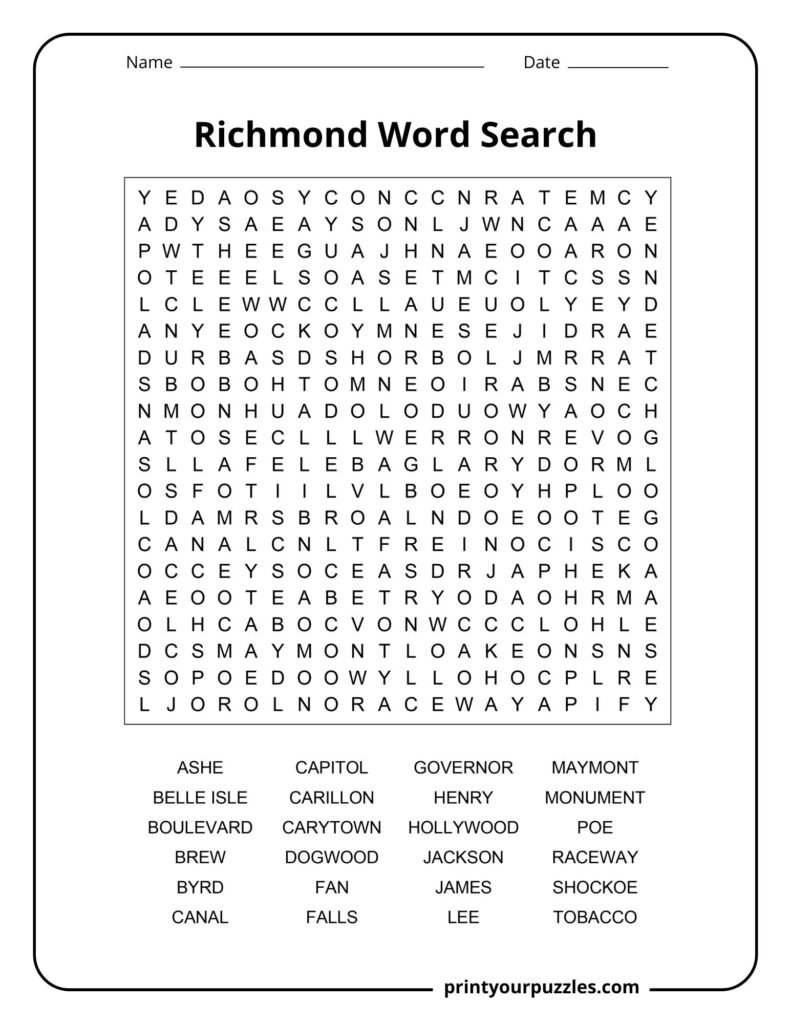
Hard Difficulty Word Search
Words to Find:
ASHE, BELLE ISLE, BOULEVARD, BREW, BYRD, CANAL, CAPITOL, CARILLON, CARYTOWN, DOGWOOD, FAN, FALLS, GOVERNOR, HENRY, HOLLYWOOD, JACKSON, JAMES, LEE, MAYMONT, MONUMENT, POE, RACEWAY, SHOCKOE, TOBACCO
6 Key FAQs About Richmond
5 Curious "Did You Know?" Facts About Richmond