
Millard Fillmore (1850–1853) became president during one of the most dangerous political moments before the Civil War. The United States had gained new western lands after the Mexican-American War, and the question of slavery in those territories was dividing the country. Fillmore did not enter office with the fame of a great general or the popularity of a national hero. Instead, he inherited a crisis. The Millard Fillmore word search gives students a way to explore a presidency closely tied to compromise, sectional tension, and the difficult choices of the 1850s.
Fillmore came from New York and rose from modest beginnings. He worked as a teacher, studied law, and became active in the Whig Party. Before entering the White House, he served in Congress and later became vice president under Zachary Taylor. When Taylor died suddenly in 1850, Fillmore took over at a time when Congress was debating how to hold the Union together.
The most important event of Fillmore’s administration was the Compromise of 1850. This package of laws admitted California as a free state, organized new western territories, settled a boundary dispute involving Texas, and ended the slave trade in Washington, D.C. However, it also included the Fugitive Slave Act, which required the return of escaped enslaved people and angered many Northerners.
Fillmore supported the compromise because he believed it could calm sectional conflict and preserve the Union. In the short term, it helped delay a national break. In the long term, however, the Fugitive Slave Act deepened moral and political divisions. Many Americans who had not been strongly involved in the slavery debate became more alarmed after seeing the law enforced in Northern communities.
Foreign affairs also formed part of Fillmore’s presidency. His administration sent Commodore Matthew Perry to Japan, helping open relations between Japan and the United States. This showed that even during a period of domestic tension, American interests were expanding across the Pacific.
This Millard Fillmore word search looks at compromise, slavery debates, California statehood, the Fugitive Slave Act, Union, and early U.S. relations with Japan. Fillmore’s presidency reminds students that political compromises can sometimes postpone conflict without truly solving the deeper problems beneath it.
Continue toward the Civil War and Reconstruction era with our Franklin Pierce word search, James Buchanan word search, Abraham Lincoln word search, and the full US Presidents Word Searches collection.
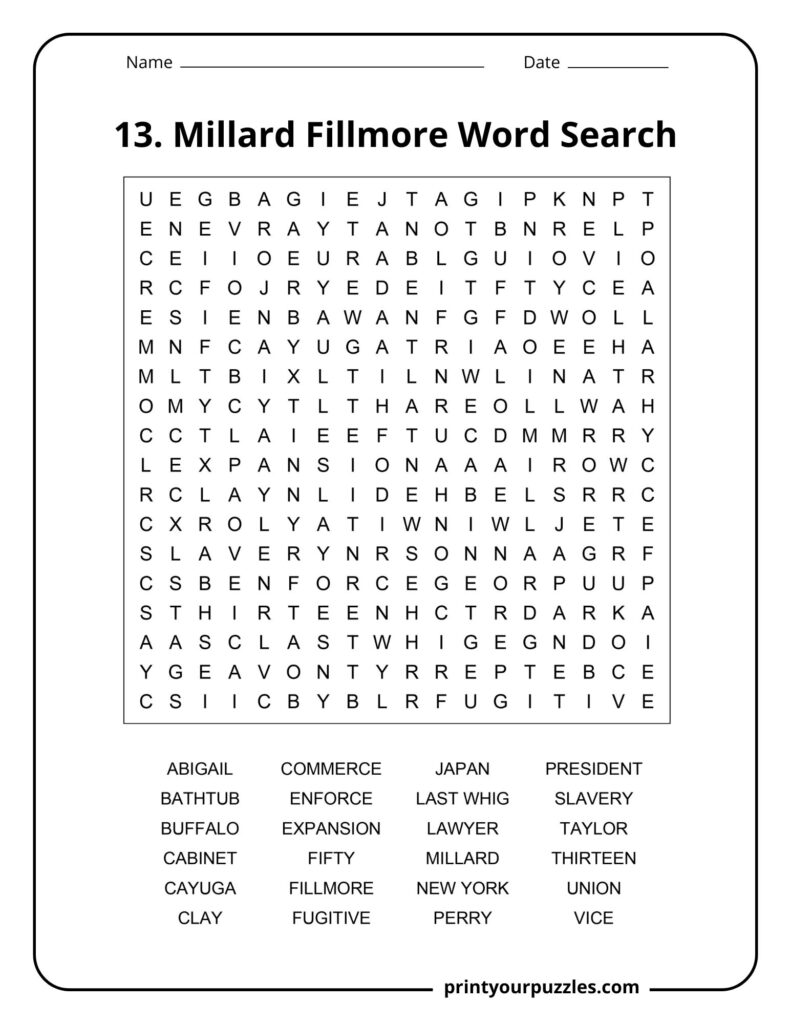
ABIGAIL, BATHTUB, BUFFALO, CABINET, CAYUGA, CLAY, COMMERCE, ENFORCE, EXPANSION, FIFTY, FILLMORE, FUGITIVE, JAPAN, LAST WHIG, LAWYER, MILLARD, NEW YORK, PERRY, PRESIDENT, SLAVERY, TAYLOR, THIRTEEN, UNION, VICE
ABIGAIL – Abigail Powers Fillmore, Millard’s wife and First Lady, was a former teacher who established the first permanent White House library during their residence there.
BATHTUB – A famous myth claims Fillmore installed the first White House bathtub, but this story was actually a hoax created by journalist H.L. Mencken in 1917.
BUFFALO – New York city where Fillmore lived and practiced law, serving as a prominent citizen and helping establish institutions like the Buffalo Historical Society.
CABINET – Fillmore’s presidential advisors, inherited from Taylor, included Daniel Webster as Secretary of State, helping navigate the turbulent sectional crisis of the early 1850s.
CAYUGA – Upstate New York county where Fillmore was born in poverty in 1800, beginning his journey from log cabin to the White House.
CLAY – Henry Clay, influential Whig leader and senator, crafted the Compromise of 1850 that Fillmore supported and signed into law as president.
COMMERCE – Fillmore promoted American trade expansion, notably sending Commodore Perry to Japan and supporting improved relations with China for commercial opportunities.
ENFORCE – Fillmore controversially enforced the Fugitive Slave Act strictly, believing it necessary to preserve the Union despite Northern opposition and personal antislavery sympathies.
EXPANSION – Fillmore’s presidency saw debates over territorial expansion westward and whether new territories would permit slavery, creating intense sectional tensions throughout America.
FIFTY – The Compromise of 1850 was a series of laws Fillmore signed that temporarily eased tensions between free and slave states over territory.
FILLMORE – Thirteenth U.S. President who assumed office after Zachary Taylor’s death, serving from 1850 to 1853 during a critical period of sectional crisis.
FUGITIVE – The Fugitive Slave Act of 1850, signed by Fillmore, required federal officials to assist in capturing escaped slaves, enraging Northern abolitionists significantly.
JAPAN – Fillmore authorized Commodore Matthew Perry’s expedition to Japan in 1852, which ultimately opened Japanese ports to American trade and diplomatic relations.
LAST WHIG – Fillmore was the final Whig Party president, as the party collapsed over slavery divisions shortly after his term ended in 1853.
LAWYER – Fillmore’s profession before politics, largely self-taught, he practiced law in Buffalo and became a successful attorney representing various clients throughout New York.
MILLARD – His given first name, Millard Fillmore was born in the Finger Lakes region of New York on January 7, 1800, to farming parents.
NEW YORK – Fillmore’s home state, where he served in the state legislature, U.S. House of Representatives, and as comptroller before becoming vice president.
PERRY – Commodore Matthew Perry led the naval expedition to Japan that Fillmore authorized, successfully opening trade relations in 1854 after Fillmore left office.
PRESIDENT – America’s thirteenth chief executive, Fillmore became president unexpectedly in July 1850 when Zachary Taylor died suddenly after only sixteen months in office.
SLAVERY – The defining issue of Fillmore’s presidency, as he tried balancing sectional interests through compromise while enforcing laws that protected Southern slaveholding interests.
TAYLOR – Zachary Taylor, Fillmore’s predecessor as president, died unexpectedly in 1850, elevating Vice President Fillmore to the presidency during a national crisis.
THIRTEEN – Fillmore’s numerical position as the thirteenth President of the United States, serving during the critical antebellum period before the Civil War erupted.
UNION – Fillmore’s primary goal was preserving the Union by supporting the Compromise of 1850, believing national unity outweighed sectional grievances over slavery.
VICE – Fillmore served as Vice President under Zachary Taylor from 1849 to 1850 before Taylor’s sudden death elevated him to the presidency.
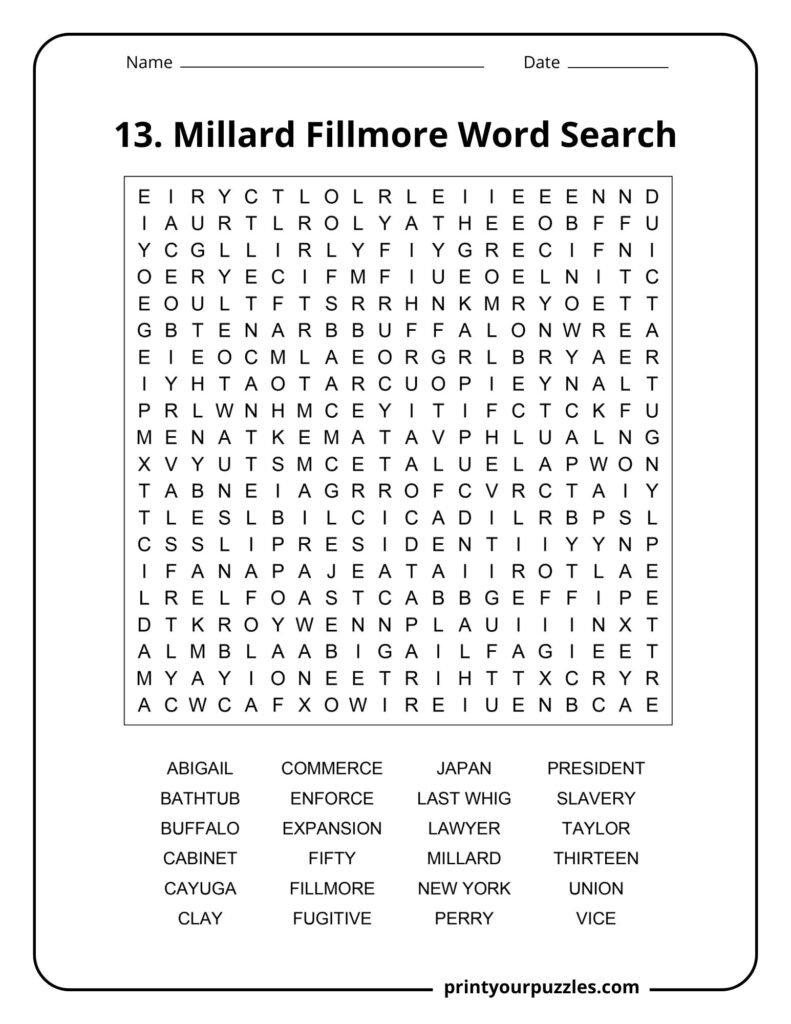
ABIGAIL, BATHTUB, BUFFALO, CABINET, CAYUGA, CLAY, COMMERCE, ENFORCE, EXPANSION, FIFTY, FILLMORE, FUGITIVE, JAPAN, LAST WHIG, LAWYER, MILLARD, NEW YORK, PERRY, PRESIDENT, SLAVERY, TAYLOR, THIRTEEN, UNION, VICE
Fillmore became president in July 1850 when President Zachary Taylor died suddenly after only sixteen months in office, elevating Vice President Fillmore to the presidency unexpectedly.
Signing and enforcing the Fugitive Slave Act of 1850, which required federal officials to capture escaped slaves, enraged Northern abolitionists and damaged his political reputation permanently.
A series of five laws that temporarily eased tensions between free and slave states over western territories, which Fillmore supported and signed to preserve the Union.
Yes, Fillmore ran unsuccessfully in 1856 as the Know-Nothing Party candidate, finishing third behind Democrat James Buchanan and Republican John C. Frémont with limited support.
Fillmore had minimal formal schooling and was largely self-educated. He apprenticed as a cloth maker before studying law independently and becoming a successful attorney in Buffalo.
For official administration records and historical biography, visit the Millard Fillmore page in the White House Archives. If you are planning a trip, check out the Millard Fillmore Presidential Site.
Millard Fillmore: Biography of a President by Robert J. Rayback. The most thorough biography of a forgotten president whose Compromise of 1850 briefly delayed the Civil War at enormous moral cost.
Contrary to popular myth, Fillmore did not install the first White House bathtub. This amusing legend was fabricated by journalist H.L. Mencken in 1917 as a hoax.
Abigail Powers was Fillmore’s schoolteacher when they first met. Despite their teacher-student relationship and two-year age difference, they married in 1826 and remained devoted partners.
Fillmore declined Oxford’s offer in 1855, stating he had no literary or scientific accomplishments worthy of recognition and couldn’t accept a degree written in Latin.
After his presidency, Fillmore became the first chancellor of the University of Buffalo in 1846, serving until 1874 and helping establish Buffalo’s cultural and educational institutions.
In 1856, Fillmore represented the anti-immigrant American Party, nicknamed “Know-Nothings,” finishing third and winning only Maryland in his unsuccessful comeback attempt for the presidency.