
James A. Garfield (1881) is often remembered for the tragedy that cut his presidency short, but his life was much larger than the few months he spent in the White House. He rose from poverty to become a teacher, scholar, Civil War officer, congressman, and national leader. His story reflects ambition, intelligence, public service, and the uncertainty of American politics during the Gilded Age. The James A. Garfield word search gives students a meaningful way to explore a president whose promise was never fully realized.
Garfield came from Ohio and grew up in modest circumstances. As a young man, he worked hard to educate himself and eventually became a teacher and college president. During the Civil War, he served in the Union Army and gained attention for his leadership. Later, as a member of Congress, he became known for his speaking ability, knowledge of finance, and strong views on national issues.
The presidential election of 1880 brought Garfield to power at a time when the Republican Party was divided between competing factions. Many political leaders argued over the spoils system, which gave government jobs to loyal party supporters. Garfield believed that public service should not simply be a reward for political loyalty, and this issue became one of the major themes surrounding his presidency.
His time in office began in March 1881, but it lasted only a few months. In July, Garfield was shot by Charles Guiteau, a disappointed office seeker who believed he deserved a government position. Garfield suffered for weeks before dying in September. His death shocked the nation and increased public pressure for civil service reform.
Although Garfield did not live long enough to carry out a full presidential program, his assassination helped expose the dangers of the spoils system. Soon after, the Pendleton Civil Service Reform Act began changing how many federal jobs were awarded, moving some positions toward merit rather than political favoritism.
This James A. Garfield word search covers education, Civil War service, Congress, party conflict, assassination, the spoils system, and the push for civil service reform. Garfield’s presidency was brief, but his life and death helped raise important questions about honesty, public service, and the future of American government.
Explore more Gilded Age presidents with our Rutherford B. Hayes word search, Chester A. Arthur word search, Benjamin Harrison word search, and the full US Presidents Word Searches collection.
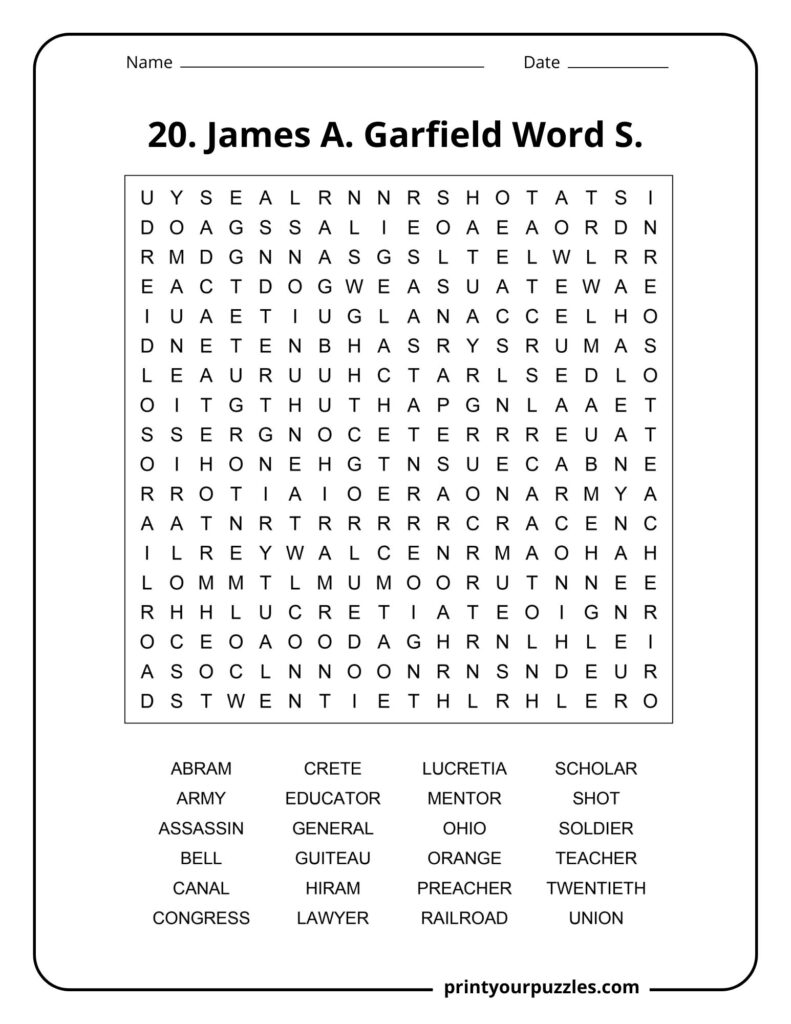
ABRAM, ARMY, ASSASSIN, BELL, CANAL, CONGRESS, CRETE, EDUCATOR, GENERAL, GUITEAU, HIRAM, LAWYER, LUCRETIA, MENTOR, OHIO, ORANGE, PREACHER, RAILROAD, SCHOLAR, SHOT, SOLDIER, TEACHER, TWENTIETH, UNION
ABRAM – James Abram Garfield’s first name, though he was commonly known as James. Abram was his given name at birth in Ohio in 1831.
ARMY – Garfield served as a major general in the Union Army during the Civil War, leading troops at battles including Middle Creek and Chickamauga before entering Congress.
ASSASSIN – Charles Guiteau shot President Garfield on July 2, 1881, at a Washington railroad station. Garfield died from complications eleven weeks later on September 19, 1881.
BELL – Alexander Graham Bell attempted to locate the bullet lodged in Garfield’s body using a metal detector he invented specifically for this purpose during treatment efforts.
CANAL – Garfield worked as a canal boat driver on the Ohio and Erie Canal as a teenager, an experience that helped shape his early work ethic.
CONGRESS – Garfield served nine terms in the U.S. House of Representatives from Ohio, becoming a powerful legislator and minority leader before his presidential election in 1880.
CRETE – Garfield was born in a log cabin in Orange Township, Cuyahoga County, Ohio, near the town of Crete, reflecting his humble frontier origins.
EDUCATOR – Before politics, Garfield was a teacher and later president of Hiram College in Ohio, demonstrating his deep commitment to education and intellectual pursuits throughout life.
GENERAL – Garfield rose to the rank of major general in the Union Army, one of the highest military ranks, before resigning to serve in Congress.
GUITEAU – Charles Julius Guiteau was the delusional office-seeker who assassinated President Garfield. He was convicted and executed by hanging in 1882 for the crime.
HIRAM – Garfield’s middle name was Hiram. He also served as president of Hiram College, a Disciples of Christ institution in Ohio where he taught earlier.
LAWYER – Garfield studied and practiced law in Ohio before entering politics, adding legal expertise to his skills as an educator, minister, and military officer.
LUCRETIA – Lucretia Rudolph Garfield was James Garfield’s wife, whom he married in 1858. She was a childhood friend and devoted partner throughout his political career.
MENTOR – Mentor, Ohio was Garfield’s home for many years. His estate, Lawnfield, located there, served as his residence and the first successful front-porch presidential campaign.
OHIO – Garfield’s home state where he was born, educated, practiced law, served in the state senate, and represented in the U.S. House of Representatives.
ORANGE – Orange Township in Cuyahoga County, Ohio was Garfield’s birthplace. He was born there in 1831 in a log cabin to a frontier farming family.
PREACHER – Garfield was an ordained minister in the Disciples of Christ church, regularly preaching sermons while working as an educator before his political career began.
RAILROAD – Garfield was shot at the Baltimore and Potomac Railroad Station in Washington, D.C., while waiting for a train to New England in July 1881.
SCHOLAR – Garfield was highly educated and intellectual, fluent in multiple languages including Latin and Greek, and deeply engaged in literature, mathematics, and classical studies.
SHOT – President Garfield was shot twice by assassin Charles Guiteau on July 2, 1881. The wounds and subsequent infections ultimately caused his death eleven weeks later.
SOLDIER – Garfield served as a Union soldier during the Civil War, rising through ranks based on his military leadership abilities and courage in multiple significant battles.
TEACHER – Before entering politics, Garfield worked as a teacher at various schools in Ohio, demonstrating his passion for education and intellectual development of young people.
TWENTIETH – James A. Garfield was the twentieth president of the United States, serving from March 4, 1881 until his death on September 19, 1881.
UNION – Garfield fought for the Union cause during the Civil War, staunchly supporting the Northern states’ efforts to preserve the nation and end slavery forever.
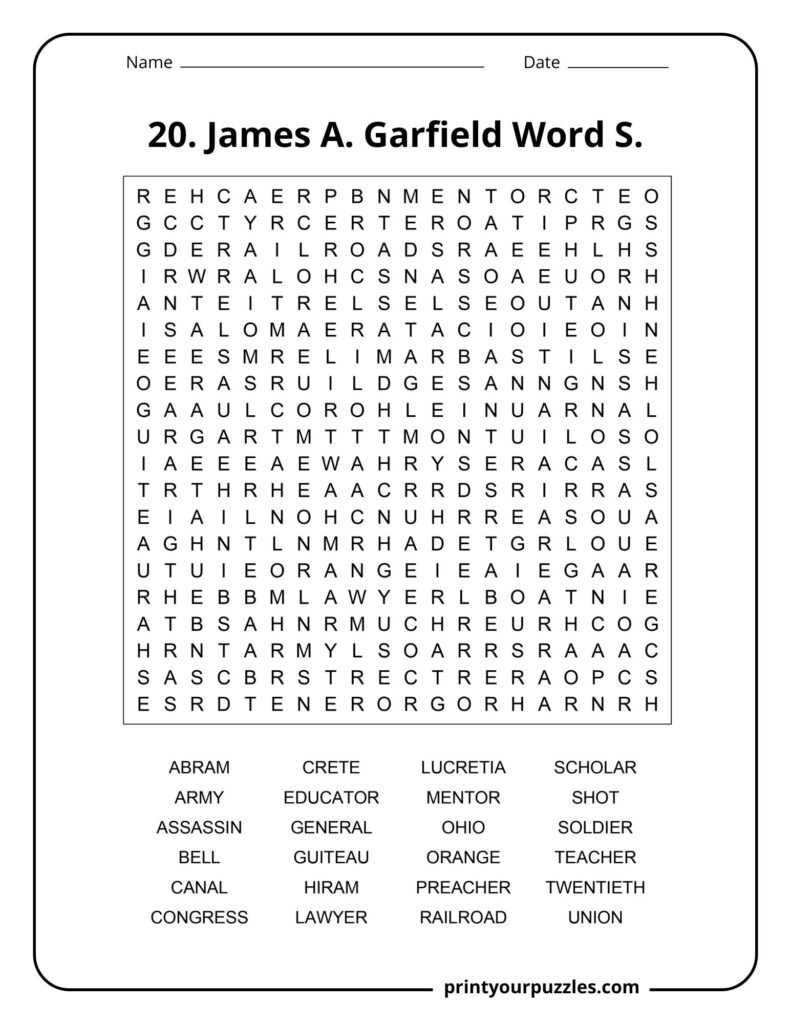
ABRAM, ARMY, ASSASSIN, BELL, CANAL, CONGRESS, CRETE, EDUCATOR, GENERAL, GUITEAU, HIRAM, LAWYER, LUCRETIA, MENTOR, OHIO, ORANGE, PREACHER, RAILROAD, SCHOLAR, SHOT, SOLDIER, TEACHER, TWENTIETH, UNION
Garfield served only 200 days as president, from March 4, 1881, until his death on September 19, 1881, making his presidency one of the shortest in American history.
Garfield was a teacher, college president, lawyer, preacher, Civil War general, and nine-term congressman from Ohio before winning the 1880 presidential election as a compromise candidate.
Charles Guiteau, a delusional office-seeker, shot Garfield at a Washington railroad station on July 2, 1881. Garfield died eleven weeks later from infections and complications from his wounds.
Garfield was a distinguished Civil War general, skilled legislator, and classical scholar fluent in multiple languages. He advocated for civil service reform and education, though his brief presidency limited achievements.
No, Abraham Lincoln was the first assassinated president in 1865. Garfield became the second in 1881. William McKinley would later become the third assassinated president in 1901.
For official administration records and historical biography, visit the James Garfield page in the White House Archives. If you are planning a trip, check out the official James A. Garfield National Historic Site.
Destiny of the Republic: A Tale of Madness, Medicine, and the Murder of a President by Candice Millard. A bestselling page-turner weaving together Garfield’s brilliance, his assassin’s madness, and the medical incompetence that killed him.
Garfield was ambidextrous and could allegedly write in Greek with one hand while writing in Latin with the other hand at the same time—a remarkable intellectual party trick.
Garfield was serving as a U.S. Representative from Ohio when he won the 1880 presidential election, making him the only sitting congressman ever elected directly to the presidency.
Doctors repeatedly probed Garfield’s wound with unsterilized instruments and unwashed hands, causing infections that probably killed him. The bullet itself had missed vital organs and wasn’t immediately fatal.
Eliza Garfield lived to see her son become president, attending his March 1881 inauguration ceremony—a first in American presidential history and a proud moment for the family.
Garfield was born in a humble log cabin in Orange Township, Ohio, in 1831, making him the last U.S. president born in such modest frontier circumstances.