
Returning to the White House after defeat is rare. Grover Cleveland (1893–1897) remains the only U.S. president to leave office and later come back for a second, non-consecutive term. That unusual achievement makes his story stand out, but his second presidency was far more difficult than his first. The Grover Cleveland word search gives students a way to examine a leader who faced economic panic, labor unrest, political division, and major debates over the role of the federal government.
Cleveland won the election of 1892 by defeating Benjamin Harrison, the same Republican who had beaten him four years earlier. Many voters still saw Cleveland as honest, independent, and serious about limiting government spending. But the country he returned to was entering one of the hardest economic periods of the nineteenth century.
The Panic of 1893 became the defining crisis of Cleveland’s second term. Banks failed, railroads collapsed, businesses closed, and unemployment spread across the nation. Many Americans wanted stronger federal action, but Cleveland continued to believe in limited government and financial discipline. His response pleased some supporters of conservative economic policy, but angered workers, farmers, and reformers who felt the government was not doing enough.
One of the most dramatic moments came during the Pullman Strike of 1894. Railroad workers protested wage cuts and poor conditions, and the strike disrupted mail service and transportation. Cleveland sent federal troops to Chicago, arguing that the government had to keep the mail moving and maintain order. Critics believed this showed the government siding with powerful business interests over workers.
Currency policy also divided the nation. Cleveland defended the gold standard, while many farmers and debtors supported the free coinage of silver, hoping it would increase the money supply and make debts easier to pay. This conflict weakened the Democratic Party and helped prepare the way for the election of 1896, when new political forces and new arguments about the economy became central.
His second term showed that Cleveland’s ideas about honesty and restraint were much harder to defend during economic disaster than during calmer years. This Grover Cleveland word search explores a presidency shaped by crisis rather than comeback alone. It reveals how the Gilded Age tested older ideas about limited government, business power, labor rights, and what Americans expected from a president during hard times.
Keep traveling through the Gilded Age and Progressive Era with our Benjamin Harrison word search, William McKinley word search, Theodore Roosevelt word search, and the full US Presidents Word Searches collection.
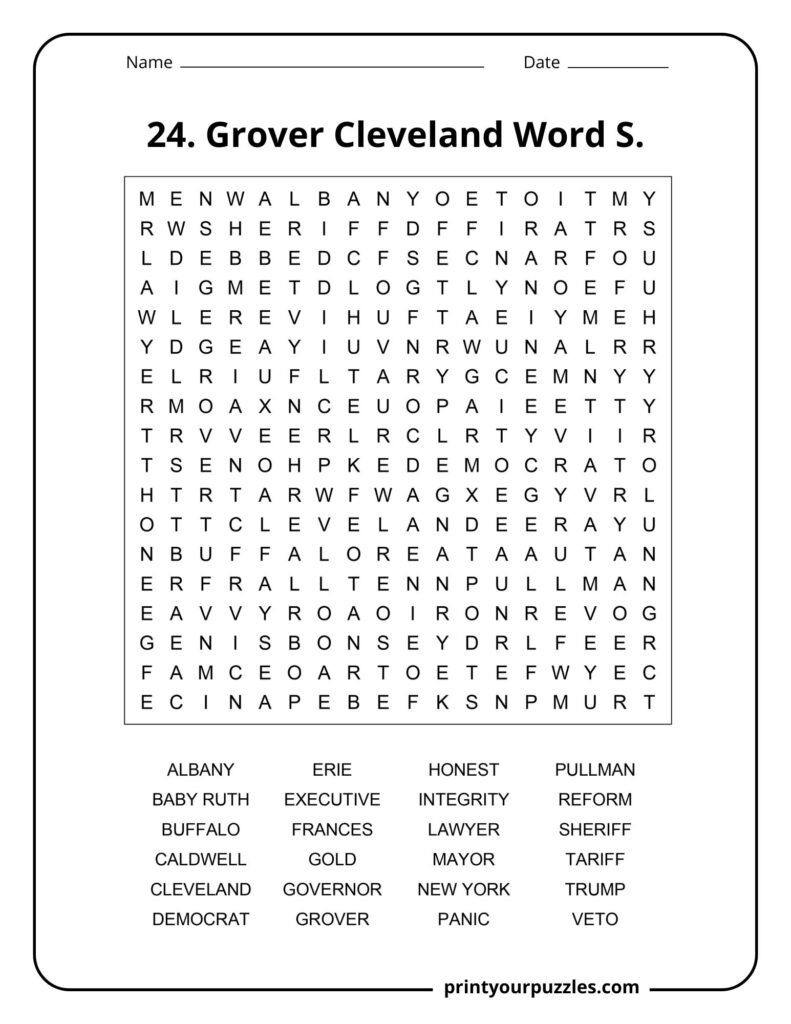
ALBANY, BABY RUTH, BUFFALO, CALDWELL, CLEVELAND, DEMOCRAT, ERIE, EXECUTIVE, FRANCES, GOLD, GOVERNOR, GROVER, HONEST, INTEGRITY, LAWYER, MAYOR, NEW YORK, PANIC, PULLMAN, REFORM, SHERIFF, TARIFF, TRUMP, VETO
ALBANY – Capital city of New York where Cleveland served as governor from 1883 to 1885, gaining national attention for his reform efforts and anti-corruption stance.
BABY RUTH – Cleveland’s daughter Ruth, born in the White House in 1891, who became famous as the president’s child and possibly inspired the candy bar’s name.
BUFFALO – New York city where Cleveland served as mayor in 1882, building his reputation as a reformer and honest public servant before becoming governor.
CALDWELL – Small New Jersey town where Stephen Grover Cleveland was born on March 18, 1837, the son of a Presbyterian minister in this community.
CLEVELAND – The president’s surname, honoring Stephen Grover Cleveland who served as America’s 22nd and 24th president, known for his unwavering integrity, reform efforts, and fierce independence.
DEMOCRAT – Cleveland’s political party affiliation, becoming the first Democratic president elected after the Civil War, breaking decades of Republican control of the presidency.
ERIE – Western New York county where Cleveland served as sheriff from 1871 to 1873, personally executing two criminals as required by his duties.
EXECUTIVE – Cleveland’s presidential role, known for his strong executive action, frequent use of veto power, and belief in limited but decisive presidential authority and responsibility.
FRANCES – Cleveland’s wife Frances Folsom, whom he married in 1886 in the White House, becoming the youngest First Lady at age twenty-one years old.
GOLD – The gold standard monetary policy Cleveland fiercely defended, believing it essential for economic stability despite political pressure to adopt silver-based currency instead.
GOVERNOR – Cleveland served as New York’s governor from 1883 to 1885, implementing civil service reforms and fighting corruption before winning the presidential election in 1884.
GROVER – Cleveland’s first name, though he was born Stephen Grover Cleveland and dropped “Stephen” early in life, preferring to be called simply Grover.
HONEST – Cleveland’s reputation for integrity and honesty, famously admitting to fathering an illegitimate child during his campaign, earning him the nickname “Grover the Good.”
INTEGRITY – Core characteristic defining Cleveland’s political career, refusing to compromise his principles for political gain and maintaining high ethical standards throughout his public
service.
LAWYER – Cleveland’s profession before entering politics, practicing law in Buffalo, New York, establishing himself as a hardworking and detail-oriented attorney in his community.
MAYOR – Cleveland served as Buffalo’s mayor in 1882, fighting corruption and earning the nickname “veto mayor” for blocking wasteful spending and corrupt contracts.
NEW YORK – State where Cleveland built his entire political career, progressing from sheriff to mayor to governor before becoming president of the United States.
PANIC – The Panic of 1893, a severe economic depression beginning during Cleveland’s second term, causing bank failures, unemployment, and challenging his presidential leadership significantly.
PULLMAN – The Pullman Strike of 1894, a nationwide railroad strike that Cleveland ended by sending federal troops, causing controversy and alienating many labor supporters permanently.
REFORM – Cleveland’s consistent political focus on governmental reform, fighting corruption, patronage, and wasteful spending throughout his career in public office at every level.
SHERIFF – Cleveland served as Erie County sheriff from 1871 to 1873, personally performing executions and demonstrating his commitment to fulfilling all duties of office.
TARIFF – Major policy issue during Cleveland’s presidency, as he fought to lower protective tariffs, believing high tariffs favored wealthy industrialists over ordinary American consumers.
TRUMP – Donald Trump, who became the second president in American history to serve two non-consecutive terms (45th and 47th), matching Cleveland’s unique achievement of winning the presidency twice with a gap between terms.
VETO – Cleveland’s signature presidential power, vetoing over 400 bills during his first term alone, more than all previous presidents combined, earning him lasting recognition.
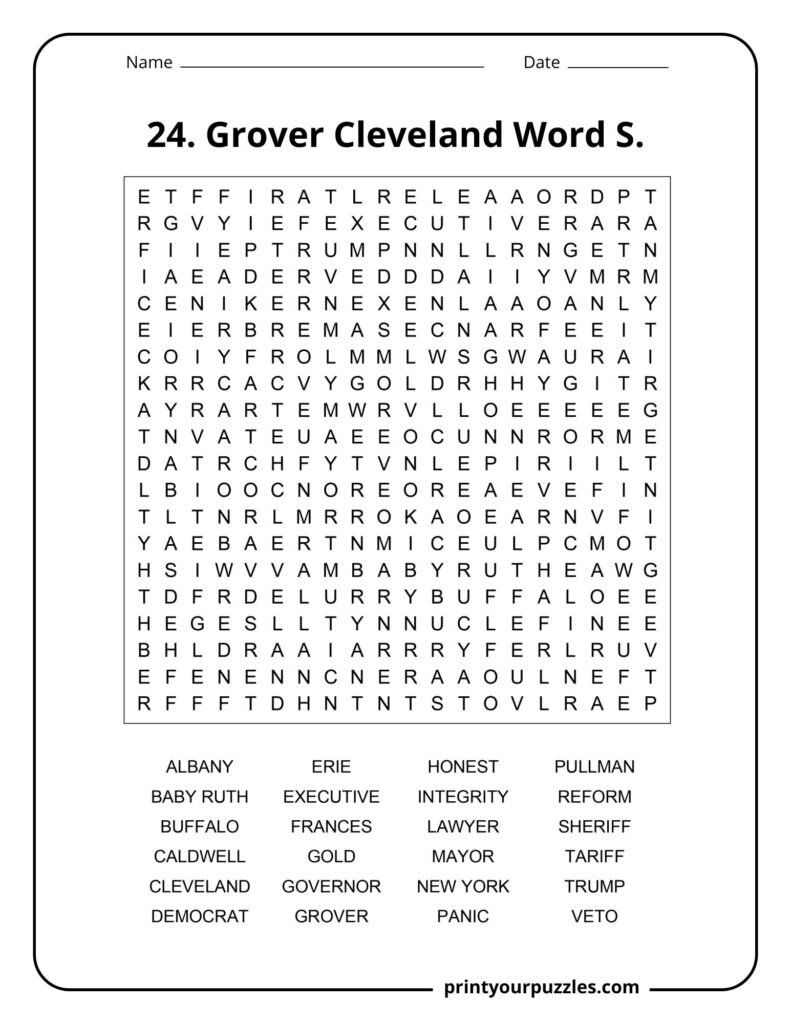
ALBANY, BABY RUTH, BUFFALO, CALDWELL, CLEVELAND, DEMOCRAT, ERIE, EXECUTIVE, FRANCES, GOLD, GOVERNOR, GROVER, HONEST, INTEGRITY, LAWYER, MAYOR, NEW YORK, PANIC, PULLMAN, REFORM, SHERIFF, TARIFF, TRUMP, VETO
Cleveland served two non-consecutive terms (1885-1889 and 1893-1897), losing reelection in 1888 but winning again in 1892, making him unique until Donald Trump’s similar achievement.
Cleveland sent federal troops to break the nationwide railroad strike over Governor John Altgeld’s objections, prioritizing mail delivery and interstate commerce but permanently alienating labor unions and many Democratic supporters.
Cleveland repealed the Sherman Silver Purchase Act in 1893 to protect the gold standard, believing it would stabilize the economy, but this deepened divisions within the Democratic Party.
Cleveland’s principled decisions during the depression—defending gold, breaking strikes, opposing tariff reform—made him deeply unpopular with his own party, leading Democrats to reject him in 1896.
Cleveland arranged a controversial deal with banker J.P. Morgan to purchase $65 million in gold bonds, saving Treasury reserves and preventing economic collapse but facing public accusations of favoring Wall Street.
For official administration records and historical biography, visit the Grover Cleveland page in the White House Archives. If you are planning a trip, check out the Grover Cleveland Birthplace.
An Honest President: The Life and Presidencies of Grover Cleveland by H. Paul Jeffers. Captures the only president to serve two non-consecutive terms—a man defined by stubborn integrity in an era of rampant political corruption.
During the 1895 gold crisis, Cleveland arranged a controversial private deal with banker J.P. Morgan to replenish Treasury gold reserves, preventing economic collapse but fueling public anger.
Esther Cleveland was born in the White House in 1893 during his second term, making her the only child of a sitting president born in the executive mansion.
Cleveland withdrew the Hawaiian annexation treaty, believing American businessmen had illegally overthrown Queen Liliuokalani, refusing to support what he considered an unjust territorial grab despite popular support.
Beyond the secret 1893 cancer surgery, Cleveland suffered from gout, obesity, and heart problems throughout his second term, but his administration successfully concealed his declining health.
By 1897, Cleveland’s unwavering principles during economic crisis made him so unpopular that his own Democratic Party abandoned him, though history later vindicated his courageous stands.