Introduction to the Theodore Roosevelt Word Search
Theodore Roosevelt (1901–1909) brought unusual energy to the presidency. He was a reformer, soldier, writer, explorer, conservationist, and public speaker who seemed to enjoy action in almost every form. When he entered the White House after William McKinley’s assassination, many political leaders expected him to be easier to control. Instead, Roosevelt became one of the most active and influential presidents of the early twentieth century. The Theodore Roosevelt word search gives students a lively way to explore a leader who changed how Americans viewed presidential power.
Roosevelt believed the president should do more than simply manage the government. He thought the White House could be a “bully pulpit,” a place from which a president could speak directly to the nation and push for reform. During the Progressive Era, many Americans worried about big business, unsafe food, poor working conditions, political corruption, and the growing gap between rich and poor. Roosevelt did not want to destroy business, but he believed powerful corporations should be regulated when they harmed the public interest.
One of his most famous domestic policies was the Square Deal. This idea focused on fairness for workers, consumers, and businesses. His administration took action against some monopolies, supported railroad regulation, and encouraged laws that improved food and drug safety. These reforms helped expand the role of the federal government in everyday American life.
Roosevelt also became one of the most important conservation presidents. He protected forests, wildlife refuges, national parks, and public lands, believing that natural resources should be preserved for future generations. This part of his legacy remains especially visible today, because many Americans still enjoy lands connected to early conservation efforts.
In foreign policy, Roosevelt wanted the United States to act with confidence. He supported building the Panama Canal, strengthened the navy, and believed in projecting American power overseas. His motto, often summarized as “speak softly and carry a big stick,” reflected his belief in diplomacy backed by strength. This approach was bold and sometimes controversial, especially in Latin America and the Caribbean.
Roosevelt left office in 1909, but his influence continued long after his presidency. This Theodore Roosevelt word search brings together reform, conservation, trust-busting, the Panama Canal, national parks, foreign policy, and Progressive Era politics. Roosevelt’s presidency shows how one energetic leader helped turn the modern presidency into a more powerful and public office.
Explore more Progressive Era presidents with our William McKinley word search, William Howard Taft word search, Woodrow Wilson word search, and the full US Presidents Word Searches collection.
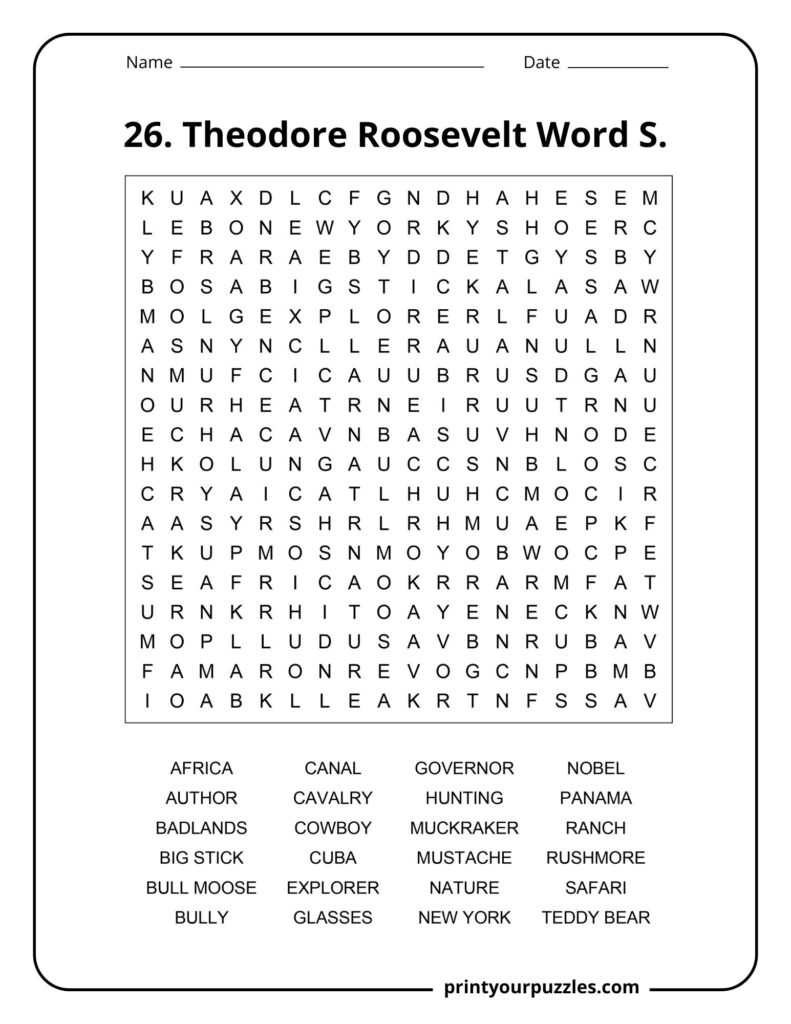
Medium Difficulty Word Search
Words to Find:
AFRICA, AUTHOR, BADLANDS, BIG STICK, BULL MOOSE, BULLY, CANAL, CAVALRY, COWBOY, CUBA, EXPLORER, GLASSES, GOVERNOR, HUNTING, MUCKRAKER, MUSTACHE, NATURE, NEW YORK, NOBEL, PANAMA, RANCH, RUSHMORE, SAFARI, TEDDY BEAR
All Words Defined
AFRICA – Roosevelt embarked on a famous African safari expedition in 1909 after his presidency, collecting specimens for museums and writing about his adventures in the wilderness.
AUTHOR – Roosevelt wrote over thirty-five books throughout his life, including works on history, nature, hunting, and his autobiography, establishing himself as a prolific writer.
BADLANDS – The rugged Dakota Territory region where Roosevelt owned cattle ranches and retreated after personal tragedy, shaping his conservation philosophy and outdoor lifestyle.
BIG STICK – Roosevelt’s foreign policy philosophy summarized as “speak softly and carry a big stick,” emphasizing diplomatic negotiation backed by strong military power and readiness.
BULL MOOSE – The Progressive Party nickname from Roosevelt’s 1912 third-party presidential campaign, named after his claim he felt “as strong as a bull moose” despite assassination attempt.
BULLY – Roosevelt’s favorite exclamation meaning “excellent” or “wonderful,” reflecting his enthusiastic, energetic personality and positive outlook on challenges and adventures he encountered.
CANAL – Roosevelt championed the construction of the Panama Canal, considering it one of his greatest achievements in connecting the Atlantic and Pacific oceans for trade.
CAVALRY – Roosevelt led the First U.S. Volunteer Cavalry Regiment, famously known as the Rough Riders, during the Spanish-American War in Cuba’s San Juan Hill battle.
COWBOY – Roosevelt embraced the cowboy lifestyle during his ranching years in Dakota Territory, developing his rugged persona and love for the American West’s outdoor life.
CUBA – Site of Roosevelt’s military fame during the Spanish-American War where he and the Rough Riders charged up San Juan Hill in eighteen ninety-eight.
EXPLORER – Roosevelt led expeditions including the River of Doubt exploration in Brazil’s Amazon rainforest, demonstrating his adventurous spirit and scientific curiosity throughout his life.
GLASSES – Roosevelt wore distinctive pince-nez spectacles throughout his life, becoming an iconic part of his image despite his attempts to appear physically robust and vigorous.
GOVERNOR – Roosevelt served as New York’s governor from 1899 to 1900, implementing progressive reforms before becoming William McKinley’s vice president and eventual successor as
president.
HUNTING – Roosevelt was an avid hunter throughout his life, pursuing big game across continents while paradoxically also championing wildlife conservation and establishing national parks.
MUCKRAKER – Term Roosevelt coined for investigative journalists who exposed corruption and social problems, though he believed some went too far in their sensationalist reporting methods.
MUSTACHE – Roosevelt’s thick, distinctive walrus mustache became one of his most recognizable features, contributing to his memorable and commanding physical appearance throughout his political career.
NATURE – Roosevelt was passionate about conservation, establishing five national parks, eighteen national monuments, and numerous wildlife refuges, protecting millions of acres for future generations.
NEW YORK – Roosevelt served as New York City’s police commissioner and later the state’s governor, launching his political career and implementing significant progressive reforms.
NOBEL – Roosevelt won the 1906 Nobel Peace Prize for mediating the end of the Russo-Japanese War, becoming the first American president to receive this honor.
PANAMA – Roosevelt acquired rights and oversaw construction of the Panama Canal, revolutionizing global shipping by connecting the Atlantic and Pacific oceans through Central America.
RANCH – Roosevelt owned the Elkhorn and Maltese Cross cattle ranches in Dakota Territory, where he lived as a cowboy and developed his conservation ethics.
RUSHMORE – Roosevelt is one of four presidents immortalized on Mount Rushmore in South Dakota, recognizing his significant contributions to American expansion and conservation efforts.
SAFARI – Roosevelt’s 1909-1910 African safari expedition collected thousands of specimens for the Smithsonian Institution while satisfying his passion for adventure and natural history.
TEDDY BEAR – The stuffed toy bear was named after Roosevelt following a 1902 hunting incident where he refused to shoot a captured bear, inspiring a toymaker’s creation.
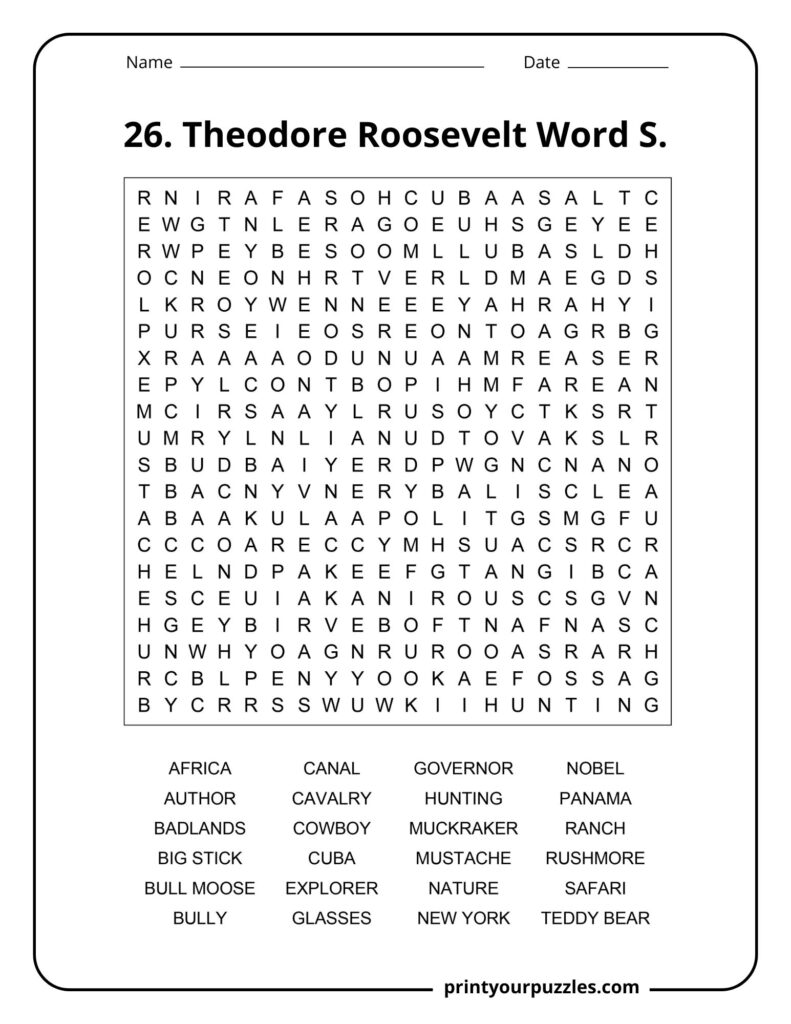
Hard Difficulty Word Search
Words to Find:
AFRICA, AUTHOR, BADLANDS, BIG STICK, BULL MOOSE, BULLY, CANAL, CAVALRY, COWBOY, CUBA, EXPLORER, GLASSES, GOVERNOR, HUNTING, MUCKRAKER, MUSTACHE, NATURE, NEW YORK, NOBEL, PANAMA, RANCH, RUSHMORE, SAFARI, TEDDY BEAR
7 Key FAQs About Theodore Roosevelt
5 Curious "Did You Know?" Facts About Theodore Roosevelt