
William Howard Taft (1909–1913) never fit the image of a restless, dramatic president. He was more comfortable with law, courts, administration, and careful decision-making than with the public excitement that surrounded Theodore Roosevelt. Yet Taft’s presidency is important because it shows a different side of the Progressive Era: reform through legal action, government structure, and constitutional limits. The William Howard Taft word search gives students a way to explore a president whose influence reached beyond the White House.
Taft had one of the most unusual careers in American public life. Before becoming president, he worked as a judge, served as governor-general of the Philippines, and became secretary of war under Roosevelt. He admired efficient government and believed deeply in the rule of law. Unlike Roosevelt, who often used the presidency as a powerful public platform, Taft preferred a more cautious and legalistic approach.
Even so, Taft continued several Progressive reforms. His administration filed many antitrust cases against large corporations, including actions involving major business combinations. In fact, Taft’s government pursued more antitrust cases than Roosevelt’s had, although he received less public credit for it. He also supported the Sixteenth Amendment, which allowed a federal income tax, and the Seventeenth Amendment, which provided for the direct election of senators.
Taft’s presidency also included controversy. He angered many Progressives by supporting the Payne-Aldrich Tariff, which did not lower tariffs as much as reformers wanted. Conservation disputes also damaged his relationship with Roosevelt’s supporters. These disagreements split the Republican Party and helped prepare the way for the dramatic election of 1912, when Roosevelt ran against Taft as a Progressive Party candidate.
Foreign policy under Taft became associated with “Dollar Diplomacy.” This approach encouraged American investment overseas, especially in Latin America and Asia. Supporters saw it as a way to promote stability and trade, while critics viewed it as too closely tied to business interests and American influence abroad.
After leaving office, Taft achieved something no other president has done: he became Chief Justice of the United States. This William Howard Taft word search examines courts, antitrust law, constitutional amendments, tariffs, diplomacy, party division, and public service. Taft’s career reminds students that American leadership can be shaped as much by law and institutions as by speeches and personality.
Keep learning about the Progressive Era with our Theodore Roosevelt word search, Woodrow Wilson word search, William McKinley word search, and the full US Presidents Word Searches collection.
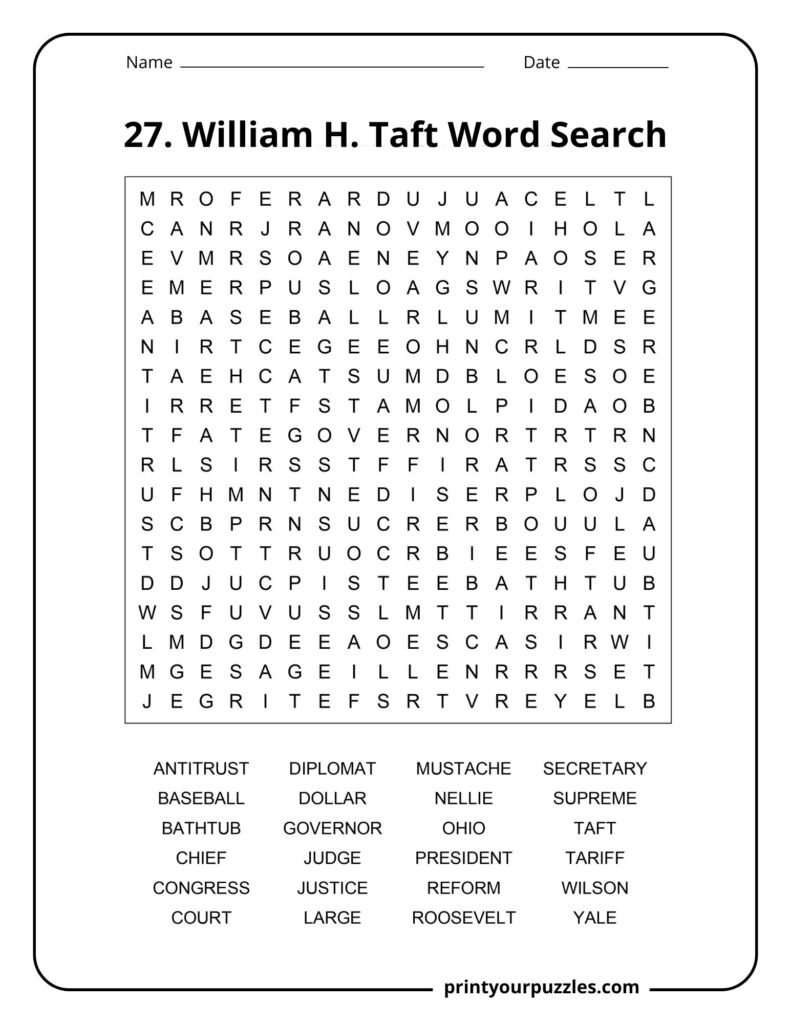
ANTITRUST, BASEBALL, BATHTUB, CHIEF, CONGRESS, COURT, DIPLOMAT, DOLLAR, GOVERNOR, JUDGE, JUSTICE, LARGE, MUSTACHE, NELLIE, OHIO, PRESIDENT, REFORM, ROOSEVELT, SECRETARY, SUPREME, TAFT, TARIFF, WILSON, YALE
ANTITRUST – Taft vigorously prosecuted monopolies under the Sherman Antitrust Act, filing ninety lawsuits against trusts, actually surpassing Theodore Roosevelt’s trust-busting efforts during his presidency.
BASEBALL – Taft established the presidential tradition of throwing the ceremonial first pitch at baseball games, beginning this custom on Opening Day in nineteen-ten.
BATHTUB – A famous story claims Taft got stuck in the White House bathtub due to his considerable size, requiring installation of a larger custom tub.
CHIEF – After his presidency, Taft became Chief Justice of the United States Supreme Court, the only person to lead both executive and judicial branches.
CONGRESS – Taft struggled with Congress during his presidency, particularly battling progressive Republicans who opposed his conservative policies and compromise approaches to legislation
and reform.
COURT – Taft served on the Supreme Court from nineteen twenty-one to nineteen thirty, fulfilling his lifelong dream of leading America’s highest judicial body.
DIPLOMAT – Taft served as a diplomat in various capacities, including as first Governor-General of the Philippines, helping establish American colonial administration there.
DOLLAR – Taft’s “Dollar Diplomacy” policy promoted American financial interests abroad, using economic power rather than military force to extend United States influence internationally.
GOVERNOR – Taft was the first civilian Governor-General of the Philippines from nineteen-oh-one to nineteen-oh-four, overseeing the American colonial government there.
JUDGE – Before becoming president, Taft served as a federal judge, which was his preferred career path and greatest passion throughout his life.
JUSTICE – Taft achieved his ultimate ambition by becoming Chief Justice, considering this role more fulfilling than his presidency and serving with distinction.
LARGE – Taft was America’s heaviest president, weighing over three hundred pounds at his peak, making his physical size a notable characteristic.
MUSTACHE – Taft was the last president to wear a mustache while in office, and the last to sport any facial hair whatsoever.
NELLIE – Helen “Nellie” Herron Taft was his ambitious wife who strongly encouraged his political career and suffered a stroke during his presidency.
OHIO – Taft was born in Cincinnati, Ohio in eighteen fifty-seven, representing the Buckeye State’s strong tradition of producing American presidents.
PRESIDENT – Taft served as the twenty-seventh President of the United States from nineteen-oh-nine to nineteen thirteen, between Roosevelt and Wilson.
REFORM – Taft pursued progressive reforms including antitrust enforcement, tariff legislation, and government efficiency, though often disappointing more radical reformers with his approach.
ROOSEVELT – Theodore Roosevelt was Taft’s predecessor, mentor, and later rival who split the Republican Party by challenging Taft in nineteen twelve.
SECRETARY – Taft served as Secretary of War under Theodore Roosevelt from nineteen-oh-four to nineteen-oh-eight before winning the presidency himself.
SUPREME – The Supreme Court was Taft’s true passion; he became Chief Justice after his presidency, calling it his greatest achievement.
TAFT – William Howard Taft was the only American to serve as both President and Chief Justice of the Supreme Court.
TARIFF – The Payne-Aldrich Tariff of nineteen-oh-nine was controversial legislation that disappointed progressives and damaged Taft’s popularity among reformers.
WILSON – Woodrow Wilson defeated Taft in the nineteen twelve election after Roosevelt’s third-party candidacy split the Republican vote between them.
YALE – Taft graduated from Yale University in eighteen seventy-eight, maintaining strong lifelong connections to his alma mater in New Haven, Connecticut.
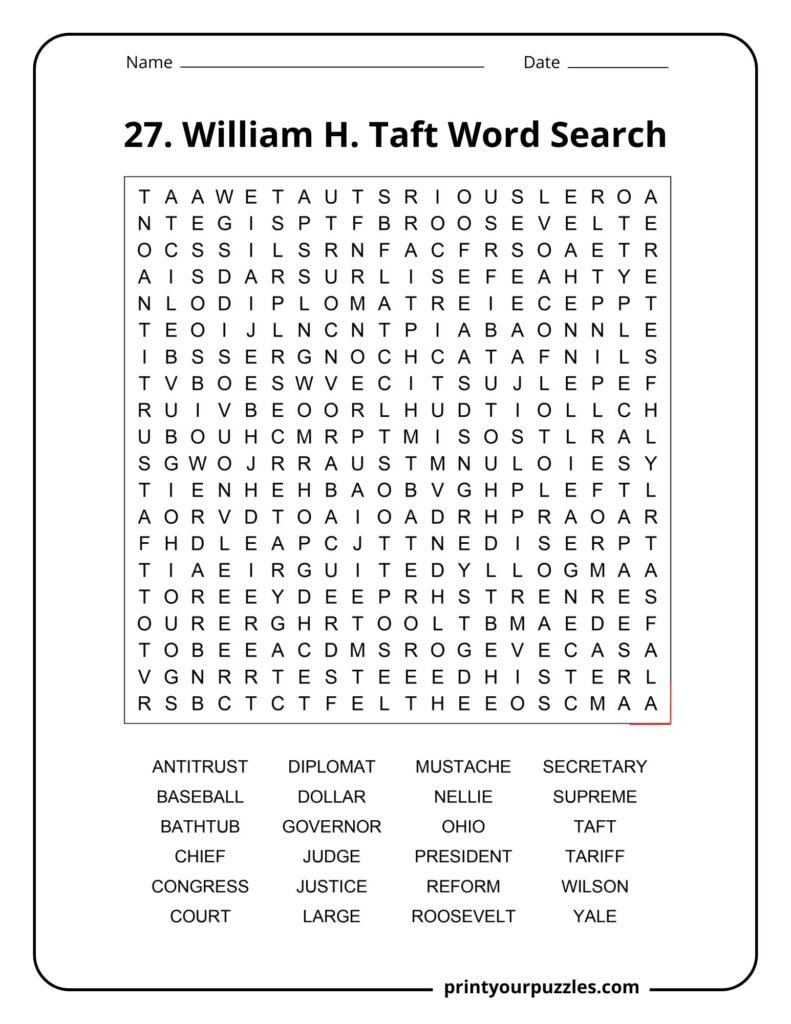
ANTITRUST, BASEBALL, BATHTUB, CHIEF, CONGRESS, COURT, DIPLOMAT, DOLLAR, GOVERNOR, JUDGE, JUSTICE, LARGE, MUSTACHE, NELLIE, OHIO, PRESIDENT, REFORM, ROOSEVELT, SECRETARY, SUPREME, TAFT, TARIFF, WILSON, YALE
Taft is the only person in American history to serve as both President and Chief Justice of the Supreme Court, leading both executive and judicial branches.
This famous story is likely apocryphal, though Taft did weigh over three hundred pounds and required a specially enlarged bathtub installed in the White House.
Roosevelt felt Taft abandoned progressive reforms and grew too conservative. Their bitter split led Roosevelt to challenge Taft in nineteen twelve, dividing the Republican Party.
Taft became Chief Justice of the Supreme Court in nineteen twenty-one, his dream job, serving with distinction until nineteen thirty and considering it more fulfilling.
Dollar Diplomacy promoted American economic interests and investments abroad, using financial influence rather than military intervention to expand United States power, particularly in Latin America and Asia.
For official administration records and historical biography, visit the William Howard Taft page in the White House Archives. If you are planning a trip, check out the William Howard Taft National Historic Site.
The Bully Pulpit: Theodore Roosevelt, William Howard Taft, and the Golden Age of Journalism by Doris Kearns Goodwin. Goodwin illuminates Taft through his tender-turned-fraught friendship with Roosevelt, giving rare spotlight to a president few biographers have covered.
In nineteen-ten, Taft became the first president to throw out a ceremonial first pitch at a baseball game, establishing a beloved tradition continued by presidents.
Taft called his Supreme Court appointment “the greatest honor of my life,” finding judicial work more fulfilling than his presidency, which he found politically exhausting and stressful.
Taft’s distinctive handlebar mustache made him the final president with facial hair; every president since nineteen thirteen has been clean-shaven, marking a fashion shift.
Through diet and exercise, Taft successfully shed considerable weight after his presidency ended, improving his health significantly during his later Supreme Court years and beyond.
Despite serving only four years as president, Taft appointed six justices to the Supreme Court, more than most presidents, significantly shaping America’s judicial future.