Introduction to the Dwight D. Eisenhower Word Search
Dwight D. Eisenhower (1953–1961) arrived in the White House with the prestige of a victorious general. As Supreme Allied Commander in Europe during World War II, he had helped direct the D-Day invasion and became one of the most respected military leaders of his time. Yet his presidency was not built on constant drama. Instead, Eisenhower often preferred steadiness, balance, and careful management during an anxious Cold War age. The Dwight D. Eisenhower word search gives students a thoughtful way to explore a president who valued calm strength.
Eisenhower’s background made him different from many career politicians. Born in Texas and raised in Kansas, he graduated from West Point and spent most of his life in the army. His wartime leadership made him famous around the world, and both major political parties saw him as a powerful presidential candidate. In 1952, he ran as a Republican and won easily, promising to end the Korean War and provide stable leadership.
Foreign policy was central to his presidency. He oversaw the end of active fighting in Korea, managed Cold War tensions with the Soviet Union, and relied on a strategy that included nuclear deterrence, alliances, diplomacy, and intelligence operations. His administration also faced crises involving Suez, Hungary, Taiwan, and the growing competition in space after the Soviet launch of Sputnik.
At home, Eisenhower presided over a period often remembered for prosperity, suburban growth, television, automobiles, and expanding middle-class life. One of his greatest domestic achievements was the Interstate Highway System, which transformed travel, commerce, defense planning, and the American landscape. It connected cities, suburbs, farms, military bases, and businesses in ways that shaped daily life for generations.
Civil rights became an important test of his leadership. In 1957, Eisenhower sent federal troops to Little Rock, Arkansas, to enforce school desegregation after the Supreme Court’s Brown v. Board of Education decision. His administration also signed civil rights legislation, though many activists believed stronger action was needed.
Near the end of his presidency, Eisenhower warned Americans about the growing influence of the “military-industrial complex.” This Dwight D. Eisenhower word search examines Cold War leadership, highways, prosperity, civil rights, military experience, space competition, and the responsibilities of power in the nuclear age.
Complete this Great Depression, World War II, and Early Cold War group with our Harry S. Truman word search, Franklin D. Roosevelt word search, Calvin Coolidge word search, and the full US Presidents Word Searches collection.
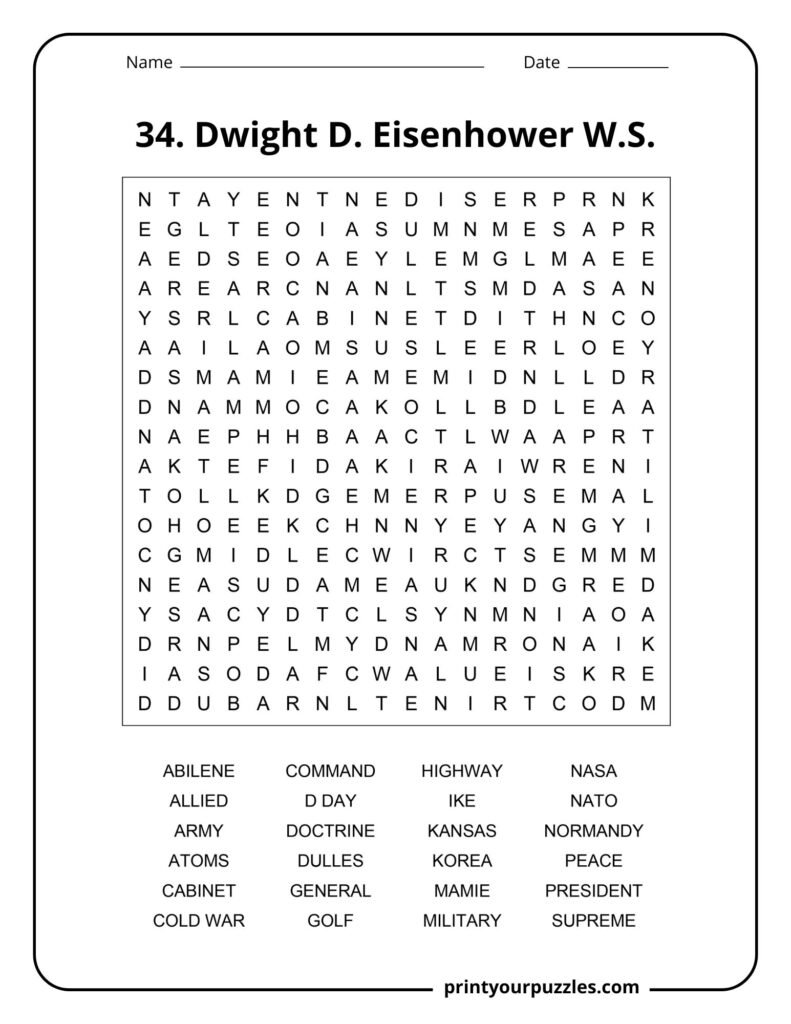
Medium Difficulty Word Search
Words to Find:
ABILENE, ALLIED, ARMY, ATOMS, CABINET, COLD WAR, COMMAND, D DAY, DOCTRINE, DULLES, GENERAL, GOLF, HIGHWAY, IKE, KANSAS, KOREA, MAMIE, MILITARY, NASA, NATO, NORMANDY, PEACE, PRESIDENT, SUPREME
All Words Defined
ABILENE – Eisenhower’s childhood hometown in Kansas where he grew up and later established his presidential library, museum, and final resting place alongside his wife Mamie.
ALLIED – The Allied forces of World War II that Eisenhower commanded, including American, British, Canadian, and other nations fighting against Nazi Germany and Axis powers.
ARMY – The United States Army where Eisenhower spent his entire military career, rising from second lieutenant in 1915 to five-star general by 1944.
ATOMS – Refers to his “Atoms for Peace” speech delivered to the United Nations in 1953, promoting peaceful nuclear energy development rather than weapons proliferation.
CABINET – Eisenhower’s presidential cabinet included influential figures like John Foster Dulles as Secretary of State and emphasized business-minded advisors for domestic policy management.
COLD WAR – The geopolitical tension between the United States and Soviet Union that dominated Eisenhower’s presidency, requiring careful diplomacy and military strategy to contain communism.
COMMAND – Eisenhower’s exceptional leadership ability in commanding large military operations, culminating in his role as Supreme Commander of Allied forces in Europe during WWII.
D-DAY – The June 6, 1944 Allied invasion of Normandy, France, which Eisenhower planned and commanded, marking the beginning of Nazi Germany’s defeat in Europe.
DOCTRINE – The Eisenhower Doctrine of 1957 pledged American military and economic assistance to Middle Eastern countries resisting communist aggression, particularly following the Suez
Crisis.
DULLES – John Foster Dulles served as Eisenhower’s Secretary of State from 1953-1959, shaping American foreign policy with his strong anti-communist stance and brinkmanship strategy.
GENERAL – Eisenhower’s military rank, achieving five-star General of the Army status, the highest rank possible, recognizing his exceptional leadership during World War II.
GOLF – Eisenhower’s favorite recreational activity; he played frequently during his presidency, often conducting informal diplomacy on golf courses and having a putting green installed.
HIGHWAY – The Interstate Highway System, officially named after Eisenhower, was created in 1956 to improve national defense, commerce, and transportation across the United States.
IKE – Eisenhower’s popular nickname since childhood, derived from his surname, which became his campaign slogan “I Like Ike” during both presidential elections in 1952.
KANSAS – Eisenhower’s home state where his family moved when he was young; he considered himself a Kansan despite being born in Texas originally.
KOREA – The Korean War was ongoing when Eisenhower became president; he fulfilled his campaign promise to visit Korea and negotiated an armistice in 1953.
MAMIE – Mamie Eisenhower, his beloved wife of over fifty years, served as First Lady from 1953-1961 and was known for her warmth and popular pink fashion.
MILITARY – Eisenhower’s lifelong military career from West Point graduation through WWII victory shaped his leadership style, strategic thinking, and presidential decision-making approach throughout both terms.
NASA – The National Aeronautics and Space Administration, established by Eisenhower in 1958 following the Soviet Sputnik launch, beginning America’s civilian space exploration program.
NATO – North Atlantic Treaty Organization; Eisenhower served as its first Supreme Commander before presidency, then strengthened this crucial Western alliance against Soviet expansion.
NORMANDY – The coastal region of France where Eisenhower directed the largest amphibious invasion in history on D-Day, establishing Allied foothold in Nazi-occupied Europe.
PEACE – Eisenhower prioritized peace through strength, ending the Korean War, avoiding direct military conflicts, and warning against the military-industrial complex in his farewell.
PRESIDENT – Eisenhower served as the 34th President of the United States from 1953-1961, winning two terms with his moderate Republican approach and immense popularity.
SUPREME – Eisenhower’s title as Supreme Commander of the Allied Expeditionary Force in Europe during WWII, demonstrating his unparalleled authority over multinational military operations.
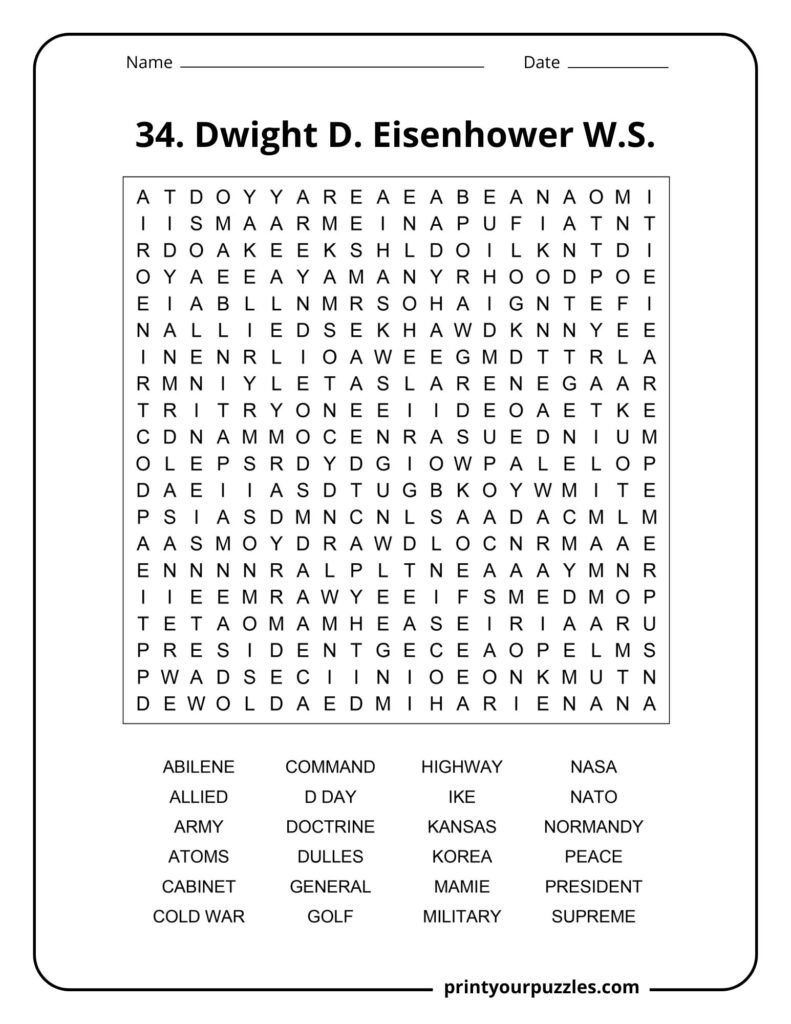
Hard Difficulty Word Search
Words to Find:
ABILENE, ALLIED, ARMY, ATOMS, CABINET, COLD WAR, COMMAND, D DAY, DOCTRINE, DULLES, GENERAL, GOLF, HIGHWAY, IKE, KANSAS, KOREA, MAMIE, MILITARY, NASA, NATO, NORMANDY, PEACE, PRESIDENT, SUPREME
7 Key FAQs About Dwight D. Eisenhower
5 Curious "Did You Know?" Facts About Dwight D. Eisenhower