Introduction to the Ronald Reagan Word Search
Ronald Reagan (1981–1989) understood the power of words, images, and confidence. Before becoming president, he had been a Hollywood actor, union leader, television speaker, and governor of California. By the time he reached the White House, he had developed a clear political message: smaller government, lower taxes, stronger defense, and renewed faith in America’s future. The Ronald Reagan word search gives students a way to explore a president who helped reshape modern conservative politics.
Reagan took office in 1981 at a time of economic worry and Cold War tension. Inflation had been high, unemployment was rising, and many Americans felt uncertain after the difficulties of the 1970s. Reagan responded with optimism and a promise of national renewal. His speaking style earned him the nickname “The Great Communicator,” because he could explain political ideas in simple, memorable language and connect emotionally with many voters.
Economic policy became one of the central parts of his presidency. Reagan supported large tax cuts, reduced regulation, and limits on some domestic spending, while also increasing military spending. His approach, often called Reaganomics, was based on the belief that lower taxes and fewer restrictions would encourage investment, growth, and job creation. Supporters argued that these policies helped restore confidence and strengthen the economy. Critics said they increased inequality, weakened some social programs, and contributed to large federal deficits.
The Cold War shaped Reagan’s foreign policy. He took a firm position against the Soviet Union, increased defense spending, and supported anti-communist movements in different parts of the world. Later, his relationship with Soviet leader Mikhail Gorbachev helped reduce tensions and led to important arms control agreements. This combination of pressure and negotiation became a major part of Reagan’s legacy.
His presidency also included controversy. The Iran-Contra affair damaged public trust when officials secretly sold arms to Iran and used money to support rebels in Nicaragua, despite congressional limits. Domestic debates over civil rights, the AIDS crisis, labor unions, environmental policy, and the role of government also remain important when studying the 1980s.
This Ronald Reagan word search examines optimism, tax policy, conservatism, Reaganomics, the Cold War, communication, military strength, and political controversy. Reagan’s presidency shows how one leader can change not only government policy, but also the tone and direction of national politics for decades.
Explore more modern presidents with our Jimmy Carter word search, George H. W. Bush word search, Bill Clinton word search, and the full US Presidents Word Searches collection.
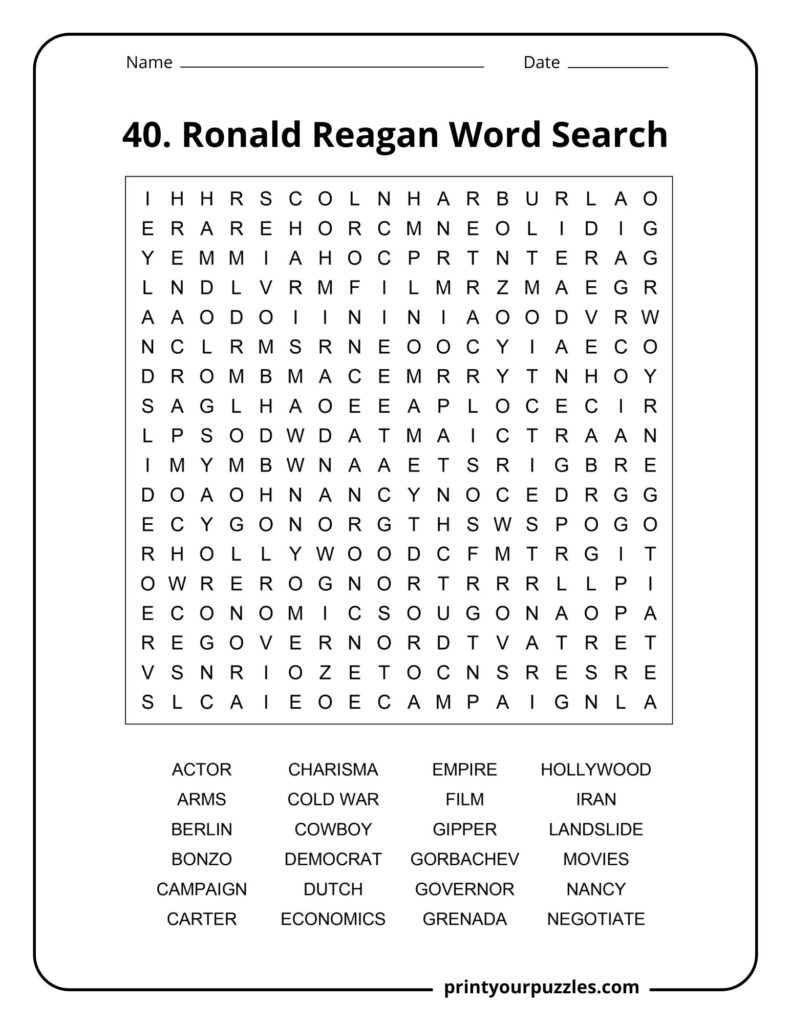
Medium Difficulty Word Search
Words to Find:
ACTOR, ARMS, BERLIN, BONZO, CAMPAIGN, CARTER, CHARISMA, COLD WAR, COWBOY, DEMOCRAT, DUTCH, ECONOMICS, EMPIRE, FILM, GIPPER, GORBACHEV, GOVERNOR, GRENADA, HOLLYWOOD, IRAN, LANDSLIDE, MOVIES, NANCY, NEGOTIATE
All Words Defined
ACTOR – Reagan’s first career in Hollywood, starring in over 50 films before transitioning to politics, which shaped his communication style and public presentation skills.
ARMS – Central to Reagan’s Cold War strategy, involving a massive military buildup and arms race with the Soviet Union, while later pursuing arms reduction agreements.
BERLIN – Site of Reagan’s famous 1987 speech at the Berlin Wall where he challenged Soviet leader Gorbachev to “tear down this wall,” symbolizing Cold War tensions.
BONZO – The chimpanzee co-star in Reagan’s 1951 film “Bedtime for Bonzo,” often referenced by critics but demonstrating his Hollywood background and comedic acting range.
CAMPAIGN – Reagan’s successful presidential campaigns in 1980 and 1984, marked by optimistic messaging, conservative values, and overwhelming electoral victories that reshaped American
politics.
CARTER – Jimmy Carter, the incumbent Democratic president Reagan defeated in 1980 during economic troubles, marking a significant shift toward conservative governance in America.
CHARISMA – Reagan’s exceptional personal charm and communication abilities earned him the nickname “Great Communicator,” connecting effectively with Americans through optimism and storytelling.
COLD WAR – The prolonged geopolitical tension between the United States and Soviet Union that dominated Reagan’s presidency, ultimately contributing to the Soviet Union’s eventual collapse.
COWBOY – Reagan’s Western image, reinforced by his California ranch, horseback riding, and cowboy persona that embodied American rugged individualism and frontier spirit.
DEMOCRAT – Reagan’s original party affiliation before switching to Republican in 1962, reflecting his political evolution from New Deal supporter to conservative icon.
DUTCH – Reagan’s childhood nickname given by his father, who said baby Ronald resembled a “fat little Dutchman,” used throughout his life.
ECONOMICS – “Reaganomics” featured supply-side economics, significant tax cuts, reduced government spending, and deregulation aimed at stimulating economic growth through free-market principles.
EMPIRE – Reagan’s famous “Evil Empire” speech in 1983 characterized the Soviet Union as morally corrupt, reflecting his strong anti-communist stance during the Cold War.
FILM – Reagan appeared in 53 films during his Hollywood career from 1937-1964, establishing his public presence before entering politics and governance.
GIPPER – Reagan’s most famous role as George Gipp in “Knute Rockne, All American” (1940), providing his enduring nickname and inspirational “win one for the Gipper” phrase.
GORBACHEV – Soviet leader Mikhail Gorbachev worked with Reagan on arms reduction treaties and reforms, helping end the Cold War through their diplomatic relationship.
GOVERNOR – Reagan served as California’s governor from 1967-1975, implementing conservative policies and building his political reputation before seeking the presidency.
GRENADA – The 1983 U.S. military invasion of Grenada ordered by Reagan to overthrow a Marxist regime, restore democracy, and protect American medical students.
HOLLYWOOD – The entertainment industry where Reagan worked as an actor and Screen Actors Guild president, developing skills that served his political career.
IRAN – The Iran-Contra affair, a major Reagan administration scandal involving secret arms sales to Iran and illegal funding of Nicaraguan Contra rebels.
LANDSLIDE – Reagan won overwhelming electoral victories in 1980 and especially 1984, when he captured 49 states, demonstrating his broad popular appeal.
MOVIES – Reagan’s extensive film career spanning nearly three decades provided name recognition, communication skills, and public familiarity essential for his political success.
NANCY – Nancy Reagan, Ronald’s devoted wife and former actress, served as influential First Lady and trusted advisor, fiercely protecting her husband’s image and health.
NEGOTIATE – Reagan’s approach shifted from confrontation to negotiation with Soviets, achieving historic arms reduction agreements while maintaining “peace through strength” philosophy.
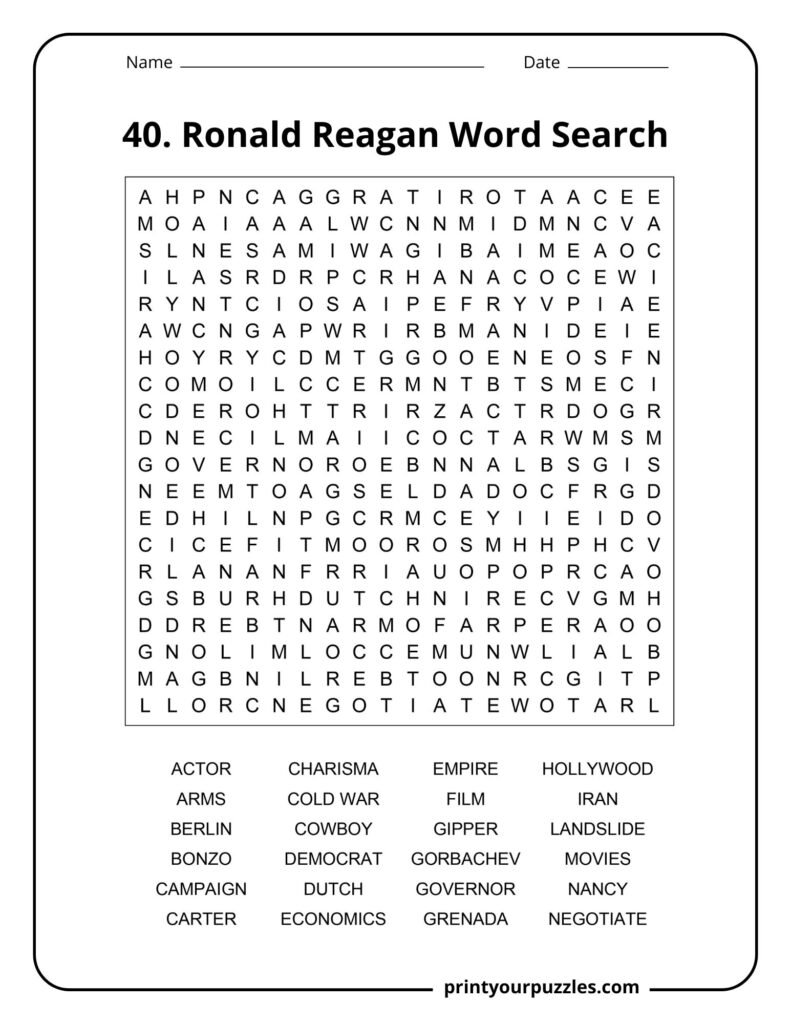
Hard Difficulty Word Search
Words to Find:
ACTOR, ARMS, BERLIN, BONZO, CAMPAIGN, CARTER, CHARISMA, COLD WAR, COWBOY, DEMOCRAT, DUTCH, ECONOMICS, EMPIRE, FILM, GIPPER, GORBACHEV, GOVERNOR, GRENADA, HOLLYWOOD, IRAN, LANDSLIDE, MOVIES, NANCY, NEGOTIATE
7 Key FAQs About Ronald Reagan
5 Curious "Did You Know?" Facts About Ronald Reagan