
The Civil Rights Act of 1964 was one of the most important laws in United States history. It was created to protect equal rights and to challenge legal discrimination that had affected millions of Americans for generations. The law became a major turning point in the struggle for justice, freedom, and equality.
Before the Civil Rights Act, many African Americans, especially in the South, faced segregation and unfair treatment in daily life. Schools, restaurants, hotels, theaters, buses, restrooms, and other public places were often separated by race. Discrimination also affected jobs, voting rights, housing, and education. Although the Constitution promised equal protection, many state and local laws allowed or encouraged inequality.
The Civil Rights Act was closely connected to the Civil Rights Movement of the 1950s and 1960s. Activists organized boycotts, marches, sit-ins, freedom rides, and peaceful protests to demand change. Leaders such as Dr. Martin Luther King Jr., Rosa Parks, John Lewis, and many others helped bring national attention to injustice. Ordinary citizens, students, church groups, and community organizers also played a vital role.
The law was first strongly supported by President John F. Kennedy, who called for civil rights legislation in 1963. After Kennedy’s assassination, President Lyndon B. Johnson worked to push the bill through Congress. The proposal faced strong opposition and a long debate, including a filibuster in the Senate. Finally, Johnson signed the Civil Rights Act into law on July 2, 1964.
The Civil Rights Act banned discrimination based on race, color, religion, sex, or national origin in many areas of public life. It prohibited segregation in public accommodations, strengthened school desegregation, and made employment discrimination illegal. It also gave the federal government more power to enforce civil rights protections.
The law did not end racism or inequality overnight, but it gave Americans a powerful legal tool to challenge discrimination. It changed schools, workplaces, public spaces, and the meaning of citizenship in the United States.
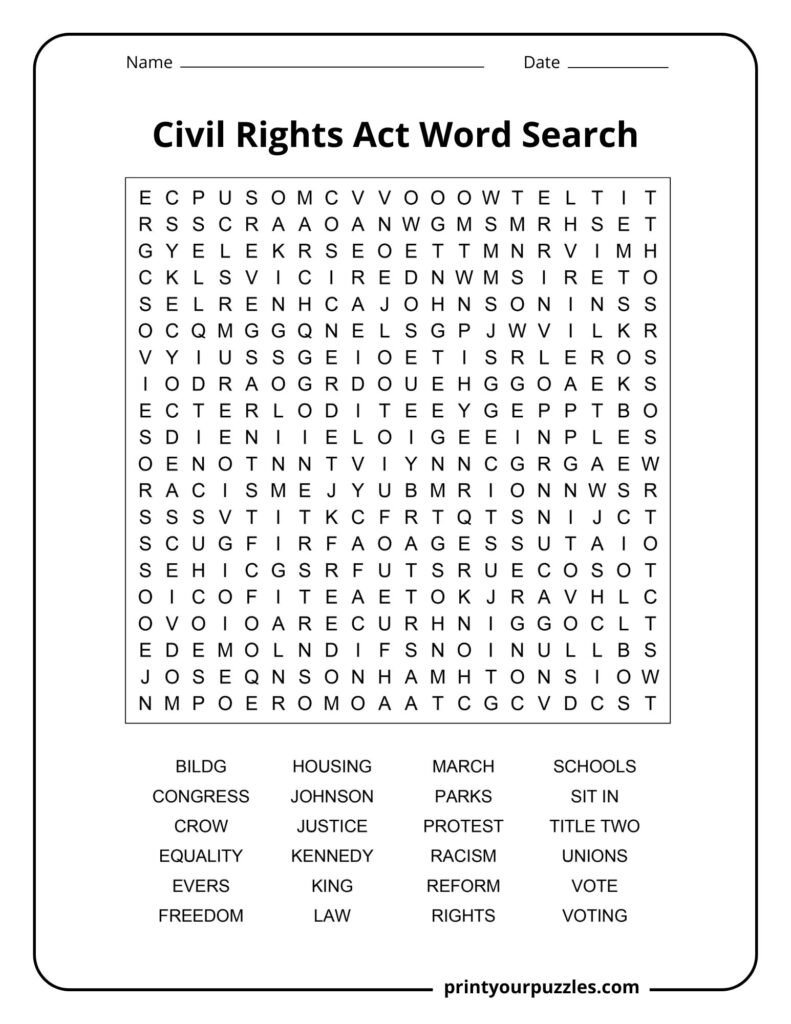
This Civil Rights Act word search helps students review vocabulary connected to equality, segregation, justice, protest, freedom, Congress, law, and rights. A Civil Rights Act word search can make this important chapter of American history easier to understand through key terms and historical connections.
Related Word Searches:
Civil Rights Movement | Martin Luther King Jr. | Rosa Parks | Lyndon B. Johnson | John F. Kennedy | Reconstruction Era
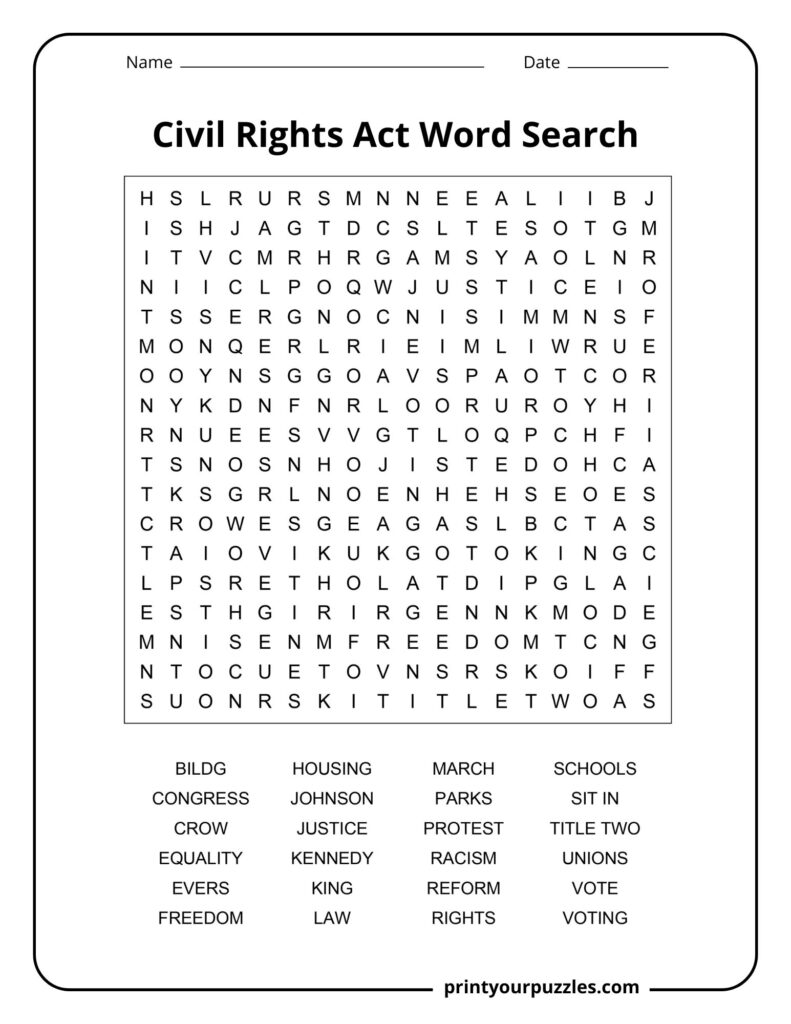
BILDG, CONGRESS, CROW, EQUALITY, EVERS, FREEDOM, HOUSING, JOHNSON, JUSTICE, KENNEDY, KING, LAW, MARCH, PARKS, PROTEST, RACISM, REFORM, RIGHTS, SCHOOLS, SIT IN, TITLE TWO, UNIONS, VOTE, VOTING
BILDG – Short for “building,” referring to physical structures and facilities that were desegregated under the Civil Rights Act, including public accommodations like restaurants and hotels.
CONGRESS – The United States legislative body that debated and passed the Civil Rights Act of 1964 after extensive discussion, overcoming a lengthy filibuster in the Senate.
CROW – Reference to Jim Crow laws, the state and local statutes that enforced racial segregation in the Southern United States, which the Civil Rights Act helped dismantle.
EQUALITY – The fundamental principle that all people deserve equal rights and opportunities regardless of race, color, religion, sex, or national origin, central to the Act’s purpose.
EVERS – Medgar Evers, a Mississippi civil rights activist and NAACP field secretary who was assassinated in 1963, becoming a martyr whose death galvanized support for civil rights.
FREEDOM – The basic human right to live without discrimination and oppression, which the civil rights movement sought to secure for African Americans through legal and social change.
HOUSING – Fair housing provisions addressed discrimination in selling, renting, and financing homes, though comprehensive housing protections came with the Fair Housing Act of 1968.
JOHNSON – President Lyndon B. Johnson, who championed and signed the Civil Rights Act into law on July 2, 1964, honoring President Kennedy’s legacy and his own commitment.
JUSTICE – The principle of fairness and equal treatment under law that the Civil Rights Act sought to establish, ending legally sanctioned discrimination in American society.
KENNEDY – President John F. Kennedy, who proposed comprehensive civil rights legislation in 1963 before his assassination, laying groundwork for the Act’s eventual passage under Johnson.
KING – Dr. Martin Luther King Jr., the prominent civil rights leader whose nonviolent protests, speeches, and advocacy were instrumental in building support for comprehensive civil rights
legislation.
LAW – Federal legislation that carries legal force, making discrimination illegal and providing enforcement mechanisms through courts and government agencies to protect civil rights.
MARCH – Organized protests and demonstrations, including the 1963 March on Washington, where activists peacefully gathered to demand civil rights legislation and economic justice for all.
PARKS – Rosa Parks, whose refusal to give up her bus seat in 1955 sparked the Montgomery Bus Boycott, catalyzing the modern civil rights movement.
PROTEST – Nonviolent demonstrations, sit-ins, boycotts, and marches used by civil rights activists to draw attention to racial injustice and demand legislative action from the federal government.
RACISM – Systemic discrimination and prejudice based on race that the Civil Rights Act sought to eliminate from employment, education, public accommodations, and government programs.
REFORM – The process of making fundamental changes to laws and social systems to eliminate discrimination and create a more just and equitable society for all Americans.
RIGHTS – Legal, social, and political entitlements guaranteed to all citizens, including voting, equal access to public facilities, employment, and education without discrimination based on race.
SCHOOLS – Educational institutions that were required to desegregate following Brown v. Board of Education and the Civil Rights Act, ending the “separate but equal” doctrine.
SIT IN – A form of nonviolent protest where activists occupied segregated lunch counters and other facilities, refusing to leave until served, forcing confrontation with discriminatory practices.
TITLE TWO – The section of the Civil Rights Act prohibiting discrimination in public accommodations such as hotels, restaurants, theaters, and other businesses serving the general public.
UNIONS – Labor organizations that were prohibited from discriminating based on race under the Act, ensuring equal employment opportunities and workplace protections for minority workers.
VOTE – The fundamental right of citizens to participate in elections, protected by the Civil Rights Act and later strengthened by the Voting Rights Act of 1965.
VOTING – The electoral process through which citizens choose their representatives, historically denied to many African Americans through literacy tests, poll taxes, and intimidation tactics.
BILDG, CONGRESS, CROW, EQUALITY, EVERS, FREEDOM, HOUSING, JOHNSON, JUSTICE, KENNEDY, KING, LAW, MARCH, PARKS, PROTEST, RACISM, REFORM, RIGHTS, SCHOOLS, SIT IN, TITLE TWO, UNIONS, VOTE, VOTING
The Civil Rights Act of 1964 is landmark federal legislation that prohibited discrimination based on race, color, religion, sex, or national origin in employment, education, and public accommodations.
President Lyndon B. Johnson signed the Civil Rights Act into law on July 2, 1964, following President Kennedy’s initial proposal and after overcoming a lengthy Senate filibuster.
The Act contains eleven titles addressing voting rights, public accommodations, public facilities, education desegregation, and employment discrimination. Title VII established the Equal Employment Opportunity Commission to enforce workplace protections.
The Act effectively ended legal segregation in schools, workplaces, and public facilities like restaurants, hotels, and theaters, dismantling Jim Crow laws that had enforced racial separation throughout the South.
It represented a monumental victory for the civil rights movement, establishing legal protections against discrimination and creating enforcement mechanisms that transformed American society toward greater equality and justice for all.
Southern senators spoke for over 60 working days, totaling more than 500 hours, making it one of the longest filibusters in U.S. Senate history before cloture finally ended it.
The Act underwent 83 days of debate, including 534 hours of discussion, 7,000 pages of Congressional Record, and over 100 proposed amendments before its historic passage in 1964.
A higher percentage of Republicans voted for the Act than Democrats. In the Senate, 82% of Republicans supported it compared to 69% of Democrats, overcoming Southern Democratic opposition.
President Lyndon B. Johnson used 75 ceremonial pens during the signing ceremony, distributing them as historic souvenirs to key legislators, civil rights leaders, and supporters who championed the legislation.
Representative Howard Smith added “sex” to Title VII, allegedly to kill the bill, but it backfired. The amendment passed, accidentally creating landmark protections against gender discrimination in employment.