Introduction to the Cuban Missile Crisis Word Search
The Cuban Missile Crisis was one of the most dangerous moments of the Cold War. It took place in October 1962, when the United States discovered that the Soviet Union was building missile sites in Cuba. Because these missiles could carry nuclear weapons and reach many American cities, the crisis created fear that the world might be moving toward nuclear war.
To understand why the crisis happened, it is important to look at the Cold War rivalry between the United States and the Soviet Union. Both countries had powerful nuclear weapons, and each side worried that the other might gain a military advantage. Cuba also became central to the conflict after the Cuban Revolution, when Fidel Castro’s government developed a close relationship with the Soviet Union.
The crisis began when American spy planes photographed Soviet missile installations under construction in Cuba. President John F. Kennedy and his advisers had to decide how to respond. A direct attack on the missile sites could have started a war, but doing nothing seemed too dangerous. Kennedy chose a naval “quarantine,” often described as a blockade, to stop more Soviet weapons from reaching Cuba.
For thirteen tense days, the world watched as the United States and the Soviet Union moved closer to confrontation. American forces went on high alert, Soviet ships approached the quarantine line, and leaders on both sides exchanged urgent messages. Many people feared that one mistake, one misunderstanding, or one aggressive decision could lead to a nuclear conflict.
Soviet leader Nikita Khrushchev and President Kennedy eventually reached an agreement. The Soviet Union would remove its missiles from Cuba, and the United States promised not to invade the island. Secretly, the United States also agreed to remove its missiles from Turkey. This compromise allowed both sides to step back from the edge of war.
The Cuban Missile Crisis had lasting consequences. It showed how dangerous nuclear weapons could be and how important careful diplomacy was during international conflicts. After the crisis, the United States and the Soviet Union created better communication systems, including a direct hotline between Washington and Moscow, to reduce the risk of future misunderstandings.
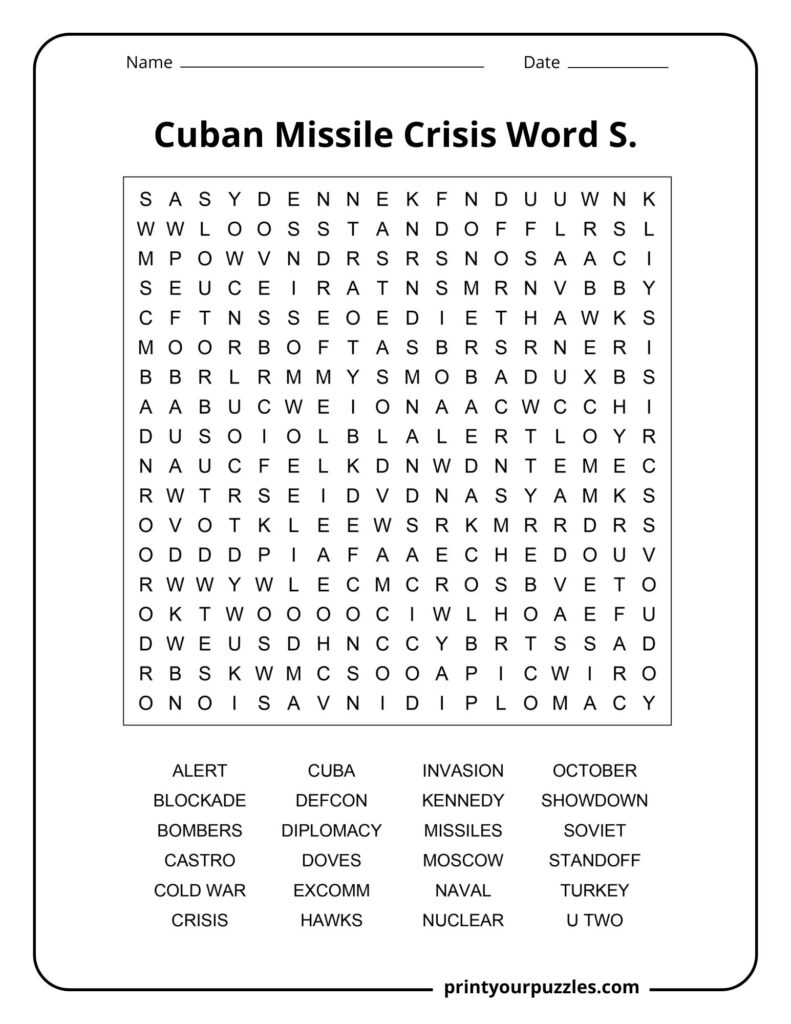
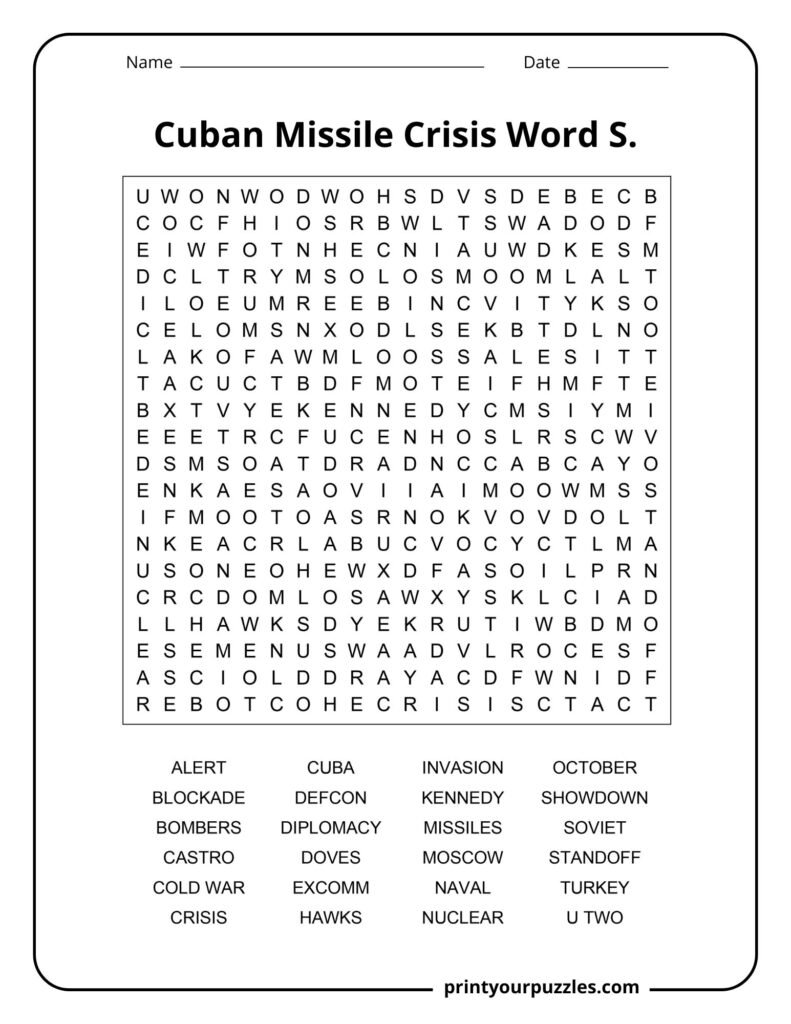
This Cuban Missile Crisis word search helps students review important vocabulary connected to missiles, Cuba, Kennedy, Khrushchev, blockade, quarantine, spy planes, nuclear weapons, diplomacy, and the Cold War. A Cuban Missile Crisis word search can make this dramatic event easier to understand by connecting key terms with the causes, decisions, dangers, and consequences of the crisis.
Related Word Searches:
Cold War | John F. Kennedy | Vietnam War | Berlin Wall | Bay of Pigs | Ronald Reagan
Medium Difficulty Word Search
Words to Find:
ALERT, BLOCKADE, BOMBERS, CASTRO, COLD WAR, CRISIS, CUBA, DEFCON, DIPLOMACY, DOVES, EXCOMM, HAWKS, INVASION, KENNEDY, MISSILES, MOSCOW, NAVAL, NUCLEAR, OCTOBER, SHOWDOWN, SOVIET, STANDOFF, TURKEY, U TWO
All Words Defined
ALERT – A state of heightened military readiness and vigilance during the crisis, with U.S. forces prepared to respond immediately to any Soviet aggressive action or nuclear threat.
BLOCKADE – Naval quarantine established by President Kennedy around Cuba to prevent Soviet ships from delivering additional missiles, forcing a confrontation without direct military invasion of the island.
BOMBERS – Strategic aircraft capable of delivering nuclear weapons, including American B-52s placed on continuous airborne alert and Soviet planes stationed in Cuba during the tense October standoff.
CASTRO – Fidel Castro, Cuba’s communist leader who allied with the Soviet Union and allowed nuclear missiles on Cuban soil, bringing the superpowers to the brink of war.
COLD WAR – The decades-long geopolitical tension between the United States and Soviet Union, characterized by ideological conflict, nuclear arms race, and proxy wars without direct military confrontation.
CRISIS – The thirteen-day October 1962 confrontation between superpowers over Soviet nuclear missiles in Cuba, representing the Cold War’s most dangerous moment when nuclear war seemed imminent.
CUBA – Caribbean island nation ninety miles from Florida that became the flashpoint for nuclear confrontation when it hosted Soviet missiles capable of striking American cities within minutes.
DEFCON – Defense Condition alert system measuring U.S. military readiness levels; raised to DEFCON 2 during the crisis, the highest level ever reached in peacetime history.
DIPLOMACY – Negotiation efforts by Kennedy, Khrushchev, and intermediaries to peacefully resolve the crisis through backchannel communications, preventing nuclear war while saving face for both nations.
DOVES – Kennedy administration advisors advocating for peaceful diplomatic solutions rather than military action, preferring negotiation and compromise over air strikes or invasion of Cuba during deliberations.
EXCOMM – Executive Committee of the National Security Council, the special advisory group Kennedy assembled to debate options and strategy throughout the thirteen-day crisis with intense secrecy.
HAWKS – Administration advisors and military leaders advocating aggressive military responses including air strikes and invasion, arguing diplomacy showed weakness and endangered American security and credibility.
INVASION – Potential U.S. military operation to overthrow Castro and remove missiles by force, seriously considered by Kennedy but ultimately avoided through diplomatic resolution and blockade.
KENNEDY – President John F. Kennedy, who navigated the dangerous crisis with a careful balance of firmness and restraint, ultimately negotiating peaceful missile removal and averting war.
MISSILES – Soviet nuclear-armed ballistic missiles secretly installed in Cuba, capable of striking major American cities within minutes, discovered through U-2 reconnaissance photography in October 1962.
MOSCOW – Capital of the Soviet Union where Premier Khrushchev made critical decisions about missile deployment and eventual withdrawal, communicating directly with Kennedy through diplomatic and backchannel methods.
NAVAL – Referring to the U.S. Navy’s critical role enforcing the quarantine blockade around Cuba, intercepting Soviet vessels and maintaining military pressure without triggering open warfare.
NUCLEAR – Relating to atomic weapons at the crisis’s center; both superpowers possessed devastating arsenals capable of mutual destruction, making any miscalculation potentially catastrophic for humanity.
OCTOBER – The month in 1962 when the crisis unfolded, specifically October 16-28, thirteen tense days when the world came closest to nuclear war in history.
SHOWDOWN – The dramatic confrontation between nuclear superpowers, forcing both Kennedy and Khrushchev to demonstrate resolve while seeking ways to step back from the precipice of war.
SOVIET – The Union of Soviet Socialist Republics, led by Nikita Khrushchev, which secretly deployed nuclear missiles to Cuba, triggering the crisis and dangerous superpower brinkmanship.
STANDOFF – The tense military and political deadlock between superpowers, with neither initially willing to back down, creating extreme danger until diplomatic compromise ended the confrontation.
TURKEY – NATO ally where U.S. Jupiter missiles were stationed; their secret removal was part of the compromise Kennedy offered Khrushchev in exchange for withdrawing Soviet missiles.
U TWO – American high-altitude reconnaissance aircraft that photographed Soviet missile installations in Cuba, providing crucial intelligence that revealed the threat and triggered Kennedy’s response to the crisis.
Hard Difficulty Word Search
Words to Find:
ALERT, BLOCKADE, BOMBERS, CASTRO, COLD WAR, CRISIS, CUBA, DEFCON, DIPLOMACY, DOVES, EXCOMM, HAWKS, INVASION, KENNEDY, MISSILES, MOSCOW, NAVAL, NUCLEAR, OCTOBER, SHOWDOWN, SOVIET, STANDOFF, TURKEY, U TWO
5 Key FAQs About the Cuban Missile Crisis
5 Curious "Did You Know?" Facts About the Cuban Missile Crisis