
The American Civil War remains one of the most significant events in United States history, and this Civil War Causes word search helps you explore the deep tensions that led to it. Between 1861 and 1865, Northern and Southern states fought over fundamental disagreements about slavery, states’ rights, and the future direction of the nation.
The causes were complex and developed over decades. Slavery stood at the heart of the conflict, as the Southern economy depended on enslaved labor for its profitable cotton plantations, while the North increasingly embraced industrialization and free labor. Political battles over slavery’s expansion into western territories, landmark events like the Dred Scott decision, and the rise of the abolitionist movement pushed the nation toward a breaking point.
The election of Abraham Lincoln in 1860 became the final catalyst. Southern states, fearing the end of slavery and the loss of their political power, began seceding from the Union. By early 1861, eleven states had formed the Confederate States of America, and the first shots were fired at Fort Sumter in April of that year.
Did you know that some Northern states openly defied federal law by passing legislation to protect escaped enslaved people? Fascinating details like this bring history to life beyond the textbook.
This Civil War Causes word search printable is designed to be both fun and educational. Along with the puzzle, you will find a FAQ section, five curious Did You Know? facts, and complete definitions for all 24 words. This word search printable offers an engaging way to learn about one of America’s most defining chapters.
This is the second in our series of 6 word searches about the Civil War. Also explore Civil War, Civil War Battles, Civil War Generals, Civil War Women, and Reconstruction Era!
Related Word Searches:
Civil War | Civil War Battles | Abraham Lincoln | Emancipation Proclamation | Harriet Tubman | Reconstruction Era
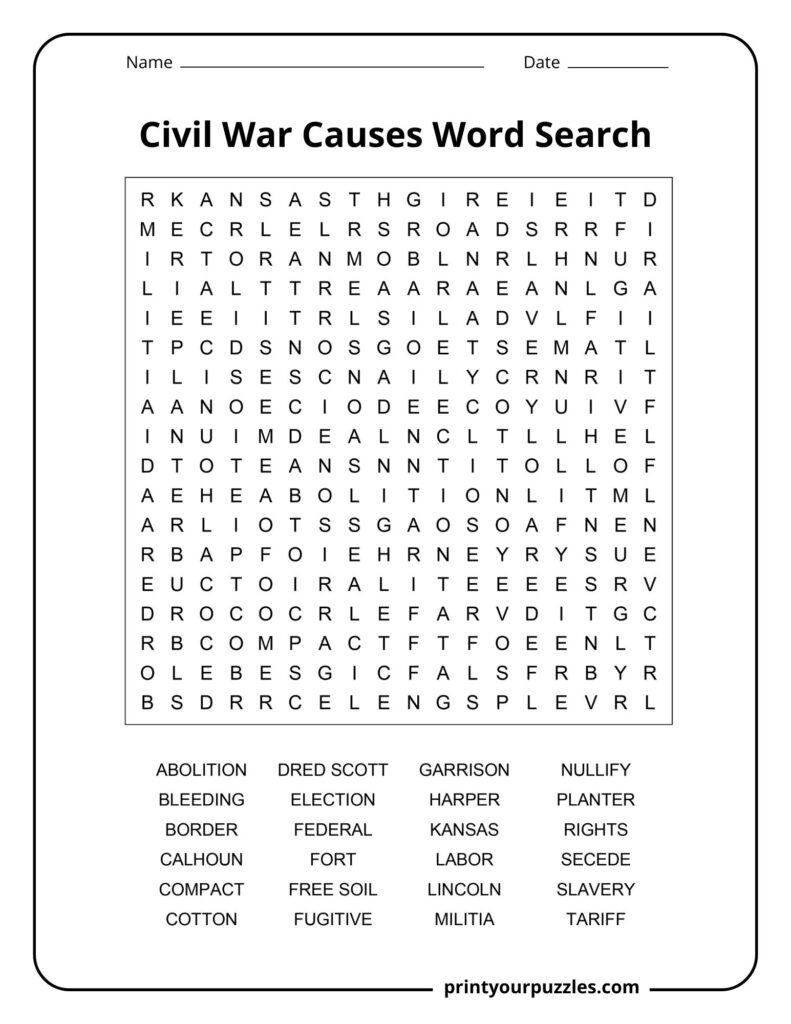
ABOLITION, BLEEDING, BORDER, CALHOUN, COMPACT, COTTON, DRED SCOTT, ELECTION, FEDERAL, FORT, FREE SOIL, FUGITIVE, GARRISON, HARPER, KANSAS, LABOR, LINCOLN, MILITIA, NULLIFY, PLANTER, RIGHTS, SECEDE, SLAVERY, TARIFF
ABOLITION – The movement to end slavery in the United States. Abolitionists campaigned through speeches, newspapers, and political action, increasing tensions between the slaveholding South and the free North.
BLEEDING – Refers to “Bleeding Kansas,” the violent conflicts in Kansas Territory during the 1850s between pro-slavery and anti-slavery settlers fighting over whether Kansas would enter the Union as a free or slave state.
BORDER – The border states were slave states that remained in the Union during the Civil War. Their loyalty was crucial and highlighted the complex geographic divisions over slavery.
CALHOUN – John C. Calhoun was a South Carolina senator and vice president who fiercely defended slavery and states’ rights. He championed nullification and Southern political interests before the war.
COMPACT – The idea that the Constitution was a compact among sovereign states. Southern leaders used this theory to argue that states could voluntarily leave the Union if their rights were violated.
COTTON – The South’s most valuable cash crop, deeply tied to slave labor. Cotton’s profitability made Southern planters resistant to abolition and strengthened their economic dependence on the institution of slavery.
DRED SCOTT – An enslaved man who sued for his freedom. The 1857 Supreme Court ruling denied his claim, declared Black people were not citizens, and inflamed national debate over slavery’s expansion.
ELECTION – The 1860 presidential election of Abraham Lincoln, who opposed slavery’s expansion, triggered Southern secession. Southern states feared his presidency would threaten the institution of slavery and their political power.
FEDERAL – Relates to federal power versus states’ rights. Disputes over whether the national government could regulate or restrict slavery in new territories were a central cause of the Civil War.
FORT – Refers to Fort Sumter in South Carolina, where the first shots of the Civil War were fired in April 1861. The attack followed months of secession and rising military tensions.
FREE SOIL – A political movement and party opposing the expansion of slavery into western territories. Free Soilers believed new lands should be reserved for free white labor, not slave-based agriculture.
FUGITIVE – Refers to the Fugitive Slave Act of 1850, which required Northern states to return escaped enslaved people. The law enraged abolitionists and deepened the divide between North and South.
GARRISON – William Lloyd Garrison was a leading abolitionist who published “The Liberator,” a newspaper demanding immediate emancipation. His radical views angered Southern slaveholders and fueled sectional hostility before the war.
HARPER – Refers to Harpers Ferry, Virginia, where abolitionist John Brown led a failed armed raid in 1859 to spark a slave rebellion. The event intensified fears and divisions nationwide.
KANSAS – Kansas Territory became a battleground over slavery in the 1850s. The Kansas-Nebraska Act allowed settlers to decide on slavery, leading to violent clashes known as “Bleeding Kansas.”
LABOR – The fundamental economic disagreement between North and South. The North relied on free wage labor and industrialization, while the South depended on enslaved labor for its plantation agricultural economy.
LINCOLN – Abraham Lincoln, the 16th president, opposed slavery’s expansion into new territories. His election in 1860 without Southern electoral support prompted several slave states to secede from the Union.
MILITIA – Armed citizen groups in both the North and South organized before the war. Southern militias seized federal property after secession, while Northern militias prepared to defend the Union government.
NULLIFY – The doctrine that a state could declare a federal law void within its borders. South Carolina attempted nullification in 1832 over tariffs, foreshadowing the secession crisis that led to war.
PLANTER – Wealthy Southern landowners who relied on enslaved labor to run large plantations. Planters held enormous political power and strongly resisted any efforts to abolish or limit slavery in America.
RIGHTS – Refers to states’ rights, the belief that individual states held authority over the federal government. Southern states invoked this principle to defend slavery and justify their secession from the Union.
SECEDE – To formally withdraw from the Union. Beginning with South Carolina in December 1860, eleven Southern states seceded and formed the Confederate States of America, directly causing the Civil War.
SLAVERY – The institution of owning human beings as property, primarily affecting African Americans. Slavery was the central moral, economic, and political issue that divided the nation and caused the Civil War.
TARIFF – Taxes on imported goods that benefited Northern industry but hurt the Southern agricultural economy. Tariff disputes fueled resentment in the South and strengthened arguments for states’ rights and secession.
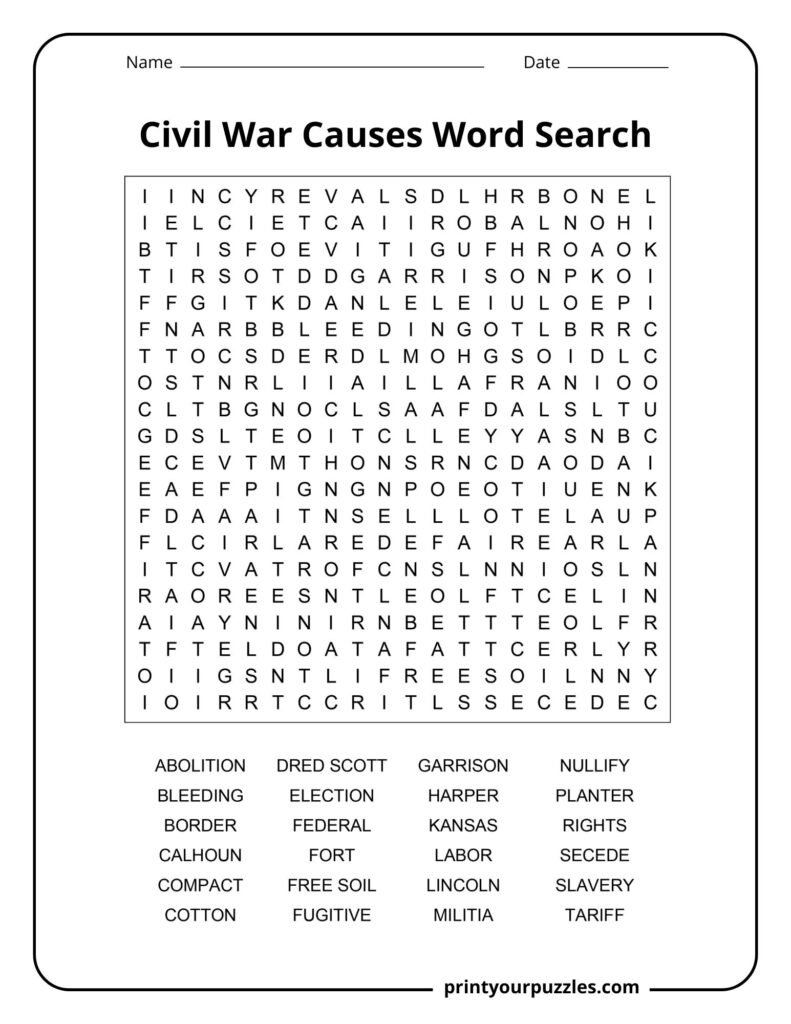
ABOLITION, BLEEDING, BORDER, CALHOUN, COMPACT, COTTON, DRED SCOTT, ELECTION, FEDERAL, FORT, FREE SOIL, FUGITIVE, GARRISON, HARPER, KANSAS, LABOR, LINCOLN, MILITIA, NULLIFY, PLANTER, RIGHTS, SECEDE, SLAVERY, TARIFF
Slavery was the central cause. Disputes over its expansion into new territories, its morality, and its economic role created an irreconcilable divide between the Northern and Southern states.
Southern states argued they had the right to govern themselves, especially regarding slavery. They believed the federal government overstepped its authority, justifying their decision to secede from the Union.
Lincoln opposed slavery’s expansion, alarming the South. Though he didn’t seek immediate abolition, Southern states viewed his 1860 election as a direct threat and began seceding before he took office.
The 1857 Supreme Court ruling denied citizenship to Black Americans and declared Congress could not ban slavery in territories. It outraged abolitionists and deepened the national crisis over slavery.
The North developed an industrial economy using free labor, while the South depended on enslaved labor for cotton production. These opposing systems created conflicting interests in trade policy and territorial expansion.
Battle Cry of Freedom by James McPherson. Worth mentioning again because the first third of the book is arguably the best single treatment of the causes of the war. McPherson traces the political, economic, and ideological tensions from the 1840s through secession with remarkable clarity and narrative momentum.
The Impending Crisis, 1848–1861 by David M. Potter. Often considered the definitive scholarly account of the antebellum political collapse. Potter traces the sequence of crises — the Compromise of 1850, Kansas-Nebraska, Dred Scott, John Brown — with careful analysis that never feels plodding. Won the Pulitzer posthumously.
Apostles of Disunion by Charles B. Dew. A short, powerful book that examines the secession commissioners sent by Southern states to persuade other states to leave the Union. Dew, a Southerner himself, lets the primary documents speak plainly, and they make the centrality of slavery unmistakable. It’s compact enough to read in an afternoon.
Harriet Beecher Stowe’s 1852 novel exposed slavery’s horrors to millions of readers. Abraham Lincoln reportedly told her, “So you’re the little woman who wrote the book that started this great war.”
During the “Bleeding Kansas” crisis, pro-slavery and anti-slavery settlers each established their own territorial governments, leading to violent clashes and political chaos throughout the 1850s.
In 1859, abolitionist John Brown attempted to start a massive slave rebellion by attacking the federal arsenal at Harpers Ferry with just 21 followers. The raid failed but shocked the entire nation.
Southern leaders believed European nations, especially Britain, depended so heavily on Southern cotton that they would intervene militarily to support the Confederacy. They called this strategy “King Cotton diplomacy.”
Several Northern states passed “Personal Liberty Laws” deliberately designed to obstruct the Fugitive Slave Act of 1850, making it nearly impossible to recapture enslaved people who had escaped to freedom.