
This Civil War Generals word search explores the military leaders who shaped one of the most defining conflicts in American history. From 1861 to 1865, the United States was torn apart as the Union and the Confederacy clashed over slavery, states’ rights, and the future of the nation. The generals on both sides played a crucial role in determining the outcome of this devastating war.
Among the most notable figures, Ulysses S. Grant and William Sherman led the Union to victory through relentless strategy and total war, while Robert E. Lee and Stonewall Jackson became legendary for their brilliance on the Confederate side. Battles raged across the country, from Gettysburg in Pennsylvania to Vicksburg in Mississippi, with these generals making decisions that cost hundreds of thousands of lives.
Many of these commanders shared a common background, having trained together at West Point and fought alongside each other in the Mexican-American War before choosing opposite sides. Did you know that Ambrose Burnside’s distinctive facial hair became so iconic that it gave us the modern word “sideburns”?
This Civil War Generals word search printable is designed to be both entertaining and educational. Alongside the puzzle, you will find a FAQ section answering key questions, a Did You Know? feature with surprising facts, and detailed definitions for all 24 words included in the word search.
Whether you are a history student, a teacher, or simply a curious mind, this word search printable offers an engaging way to learn about the generals who left an indelible mark on American history.
This is the fourth in our series of 6 word searches about the Civil War. Also explore Civil War, Civil War Causes, Civil War Battles, Civil War Women!, and Reconstruction Era!
Related Word Searches:
Civil War | Civil War Battles | Civil War Causes | Abraham Lincoln | Ulysses S. Grant | Reconstruction Era
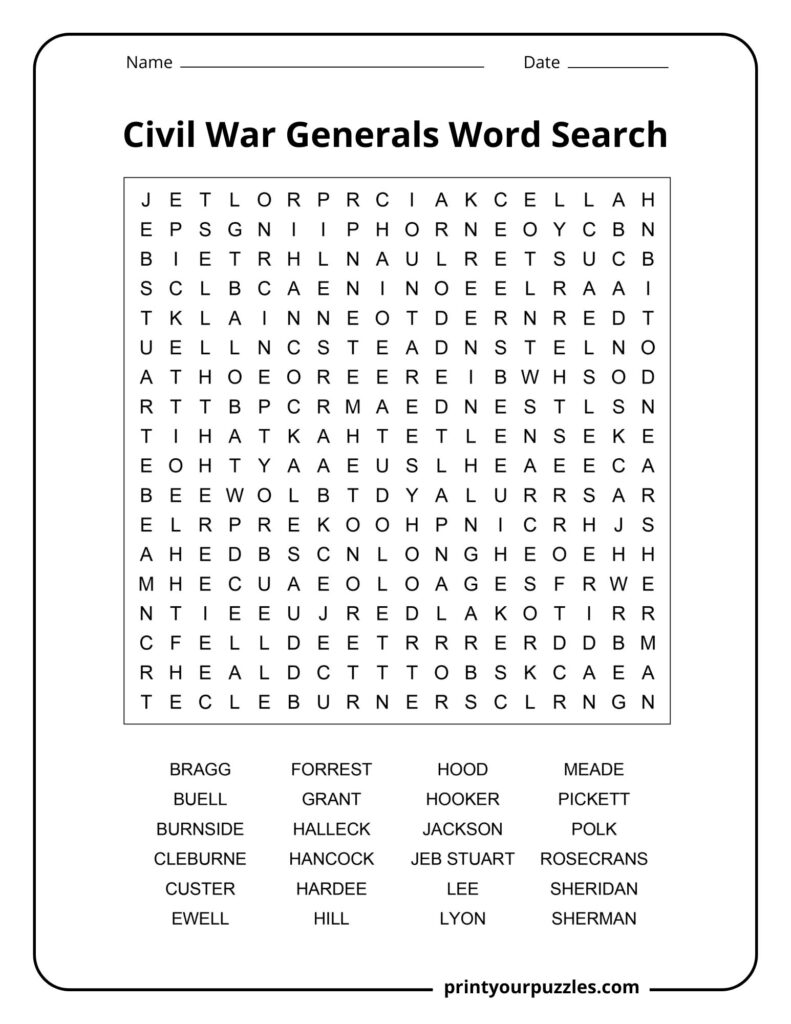
BRAGG, BUELL, BURNSIDE, CLEBURNE, CUSTER, EWELL, FORREST, GRANT, HALLECK, HANCOCK, HARDEE, HILL, HOOD, HOOKER, JACKSON, JEB STUART, LEE, LYON, MEADE, PICKETT, POLK, ROSECRANS, SHERIDAN, SHERMAN
BRAGG – Braxton Bragg was a Confederate general known for leading the Army of Tennessee. Despite some victories, he was criticized for poor leadership and lost key battles like Chattanooga.
BUELL – Don Carlos Buell was a Union general who commanded the Army of the Ohio. He helped win at Shiloh but was relieved of command for being too slow pursuing Confederate forces.
BURNSIDE – Ambrose Burnside was a Union general famous for his distinctive sideburns. He led the disastrous assault at Fredericksburg in 1862 and was later replaced by Joseph Hooker as commander.
CLEBURNE – Patrick Cleburne was an Irish-born Confederate general called the “Stonewall of the West.” He was a skilled division commander who controversially proposed arming enslaved people as soldiers before dying at Franklin.
CUSTER – George Armstrong Custer was a Union cavalry officer known for his boldness and flamboyance. He achieved fame during the Civil War before his infamous death at Little Bighorn in 1876.
EWELL – Richard Ewell was a Confederate general who replaced Stonewall Jackson as corps commander. His hesitation at Gettysburg, failing to take Cemetery Hill, is considered a critical missed opportunity for the South.
FORREST – Nathan Bedford Forrest was a Confederate cavalry commander considered a military genius by many. Self-taught in tactics, he excelled at raids and maneuver warfare but remains deeply controversial for postwar activities.
GRANT – Ulysses S. Grant was the Union’s top general who won decisive victories at Vicksburg and Appomattox. His relentless strategy ultimately defeated the Confederacy, and he later became the eighteenth President.
HALLECK – Henry Halleck served as Union general-in-chief and was nicknamed “Old Brains” for his military scholarship. He was an effective administrator but proved overly cautious and better suited to desk work than battlefield command.
HANCOCK – Winfield Scott Hancock was a Union general called “Hancock the Superb.” He played a crucial role at Gettysburg, helping repel Pickett’s Charge, and was later the Democratic presidential nominee in 1880.
HARDEE – William Hardee was a Confederate general who authored a widely used infantry tactics manual before the war. He served as a corps commander in major Western Theater campaigns including Atlanta and Savannah.
HILL – Ambrose Powell Hill was a Confederate general who led the famous Light Division with great aggressiveness. He served as a corps commander under Lee and was killed near Petersburg just days before the war ended.
HOOD – John Bell Hood was an aggressive Confederate general who commanded the Army of Tennessee. His reckless offensive tactics led to devastating defeats at Franklin and Nashville, effectively destroying his army in late 1864.
HOOKER – Joseph Hooker was a Union general who commanded the Army of the Potomac. Despite a strong reorganization of the army, he suffered a humiliating defeat by Lee at the Battle of Chancellorsville in 1863.
JACKSON – Thomas “Stonewall” Jackson was one of the Confederacy’s most brilliant generals, famous for his Shenandoah Valley Campaign. He was Lee’s most trusted subordinate until his accidental death by friendly fire at Chancellorsville.
JEB STUART – James Ewell Brown Stuart was the Confederacy’s premier cavalry commander, renowned for daring reconnaissance rides. His absence during the Gettysburg campaign left Lee without vital intelligence, contributing to the Confederate defeat there.
LEE – Robert E. Lee was the commanding general of the Confederate Army of Northern Virginia and the South’s greatest military leader. He surrendered to Grant at Appomattox Court House in April 1865.
LYON – Nathaniel Lyon was a Union general and the first Federal general killed in the Civil War. He died leading troops at the Battle of Wilson’s Creek in Missouri in August 1861.
MEADE – George Gordon Meade was the Union general who commanded the Army of the Potomac at Gettysburg, achieving a pivotal victory. He continued leading that army through the war’s end under Grant’s overall direction.
PICKETT – George Pickett was a Confederate general best remembered for Pickett’s Charge at Gettysburg, a doomed frontal assault against Union lines. The catastrophic failure became a symbol of the Confederacy’s turning point in the war.
POLK – Leonidas Polk was a Confederate general and Episcopal bishop, earning the nickname “Bishop General.” He served as a corps commander in the Western Theater and was killed by artillery fire during the Atlanta Campaign in 1864.
ROSECRANS – William Rosecrans was a Union general who skillfully maneuvered Confederates out of Tennessee but suffered a crushing defeat at Chickamauga. He was replaced by Grant and never received another major field command during the war.
SHERIDAN – Philip Sheridan was an aggressive Union cavalry commander who devastated the Shenandoah Valley. His leadership at Cedar Creek and Five Forks made him one of the war’s most effective and celebrated Union generals.
SHERMAN – William Tecumseh Sherman was a Union general famous for his March to the Sea through Georgia in 1864. His strategy of total war destroyed Confederate infrastructure and morale, helping hasten the end of the conflict.
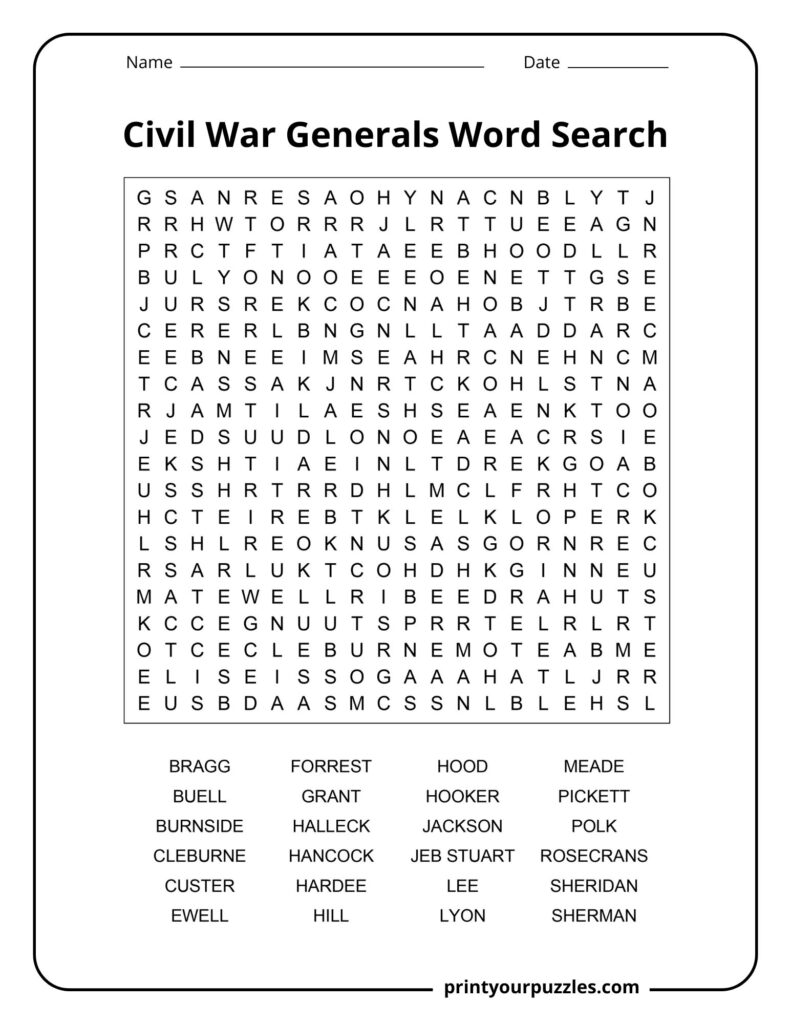
BRAGG, BUELL, BURNSIDE, CLEBURNE, CUSTER, EWELL, FORREST, GRANT, HALLECK, HANCOCK, HARDEE, HILL, HOOD, HOOKER, JACKSON, JEB STUART, LEE, LYON, MEADE, PICKETT, POLK, ROSECRANS, SHERIDAN, SHERMAN
The most prominent were Ulysses S. Grant and William Sherman for the Union, and Robert E. Lee and Stonewall Jackson for the Confederacy, shaping the war’s outcome decisively.
Lee was offered command of Union forces but declined out of loyalty to his home state of Virginia. He felt he could not fight against his own people and family.
Grant was relentless and willing to sustain heavy casualties to press the advantage. Unlike his predecessors, he refused to retreat, continuously pressuring Lee until the Confederacy surrendered at Appomattox.
Jackson was accidentally shot by his own Confederate soldiers at the Battle of Chancellorsville in May 1863. He died from complications of pneumonia after his left arm was amputated.
Yes, Ulysses S. Grant became the eighteenth President in 1869. Other veterans who became president include Rutherford Hayes, James Garfield, Benjamin Harrison, and William McKinley, all Union officers.
Grant by Ron Chernow. Already mentioned, but it really is the gold standard here. Chernow draws on extensive primary sources while writing with the pace of a novel. The military chapters are detailed without becoming dry.
Lee’s Lieutenants (3 volumes) by Douglas Southall Freeman. A classic study of the Confederate command structure under Lee. Freeman’s research was exhaustive (he also wrote a four-volume Lee biography), and his character portraits of figures like Jackson, Longstreet, and Stuart are vivid and memorable. The writing has an older style but remains highly engaging.
Sherman: Soldier, Realist, American by B.H. Liddell Hart. A shorter, incisive military biography by one of the 20th century’s most influential military theorists. Liddell Hart admired Sherman’s operational thinking, and the book reads as both biography and strategic analysis.
His distinctive facial hair style became so famous that it was originally called “burnsides.” Over time, the syllables were reversed, giving us the modern word “sideburns.”
He was born Hiram Ulysses Grant. The “S” in his name was a clerical error made during his West Point enrollment and stood for nothing, but he kept it permanently.
Several Union and Confederate generals had studied together at West Point and even fought side by side during the Mexican-American War before becoming enemies on the battlefield.
Jackson frequently sucked on lemons during battle, raised one arm skyward for “balance,” and was intensely secretive about his military plans, even keeping his own officers uninformed.
When suggested as a presidential candidate, Sherman famously declared he would not run if nominated and would not serve if elected, creating one of history’s most definitive political refusals.