
The periodic table is one of the most important tools in chemistry. It organizes all known chemical elements in a clear system, helping scientists, students, and teachers understand how different substances are related. Every element on the table has its own symbol, atomic number, and set of properties. By studying its position, we can learn how an element behaves, what it may react with, and whether it is a metal, nonmetal, or metalloid.
Elements are arranged according to their atomic number, which represents the number of protons in the nucleus of an atom. Hydrogen appears first because it has only one proton, while heavier elements have increasingly larger atomic numbers. The horizontal rows are called periods, and the vertical columns are known as groups or families. Elements within the same group often have similar chemical characteristics because they have related arrangements of electrons.
The table is divided into several main areas. Most elements are metals, which generally conduct heat and electricity well. Nonmetals, found mainly on the right side, include important elements such as oxygen, nitrogen, and carbon. Metalloids lie between metals and nonmetals and share some properties of both. Other recognizable families include the alkali metals, alkaline earth metals, halogens, noble gases, lanthanides, and actinides.
The periodic table also helps explain patterns known as periodic trends. These include changes in atomic size, electronegativity, ionization energy, and chemical reactivity. For example, noble gases are usually very unreactive because their outer electron shells are complete. Alkali metals, however, are highly reactive and readily combine with other elements.
Although many elements occur naturally, others have been created artificially in laboratories. Scientists continue to study these elements to understand their structure, stability, and possible uses. The table may appear complex at first, but its organized design makes it easier to identify repeating patterns and compare elements.
A periodic table word search puzzle can introduce learners to essential vocabulary such as element, proton, symbol, period, group, metal, atom, and nucleus. Becoming familiar with these terms provides a strong foundation for understanding chemistry, matter, chemical reactions, and the materials that make up the world around us.
Related Word Searches:
Chemical Elements | Atom | Chemistry | Molecule | Chemical Reaction | Matter
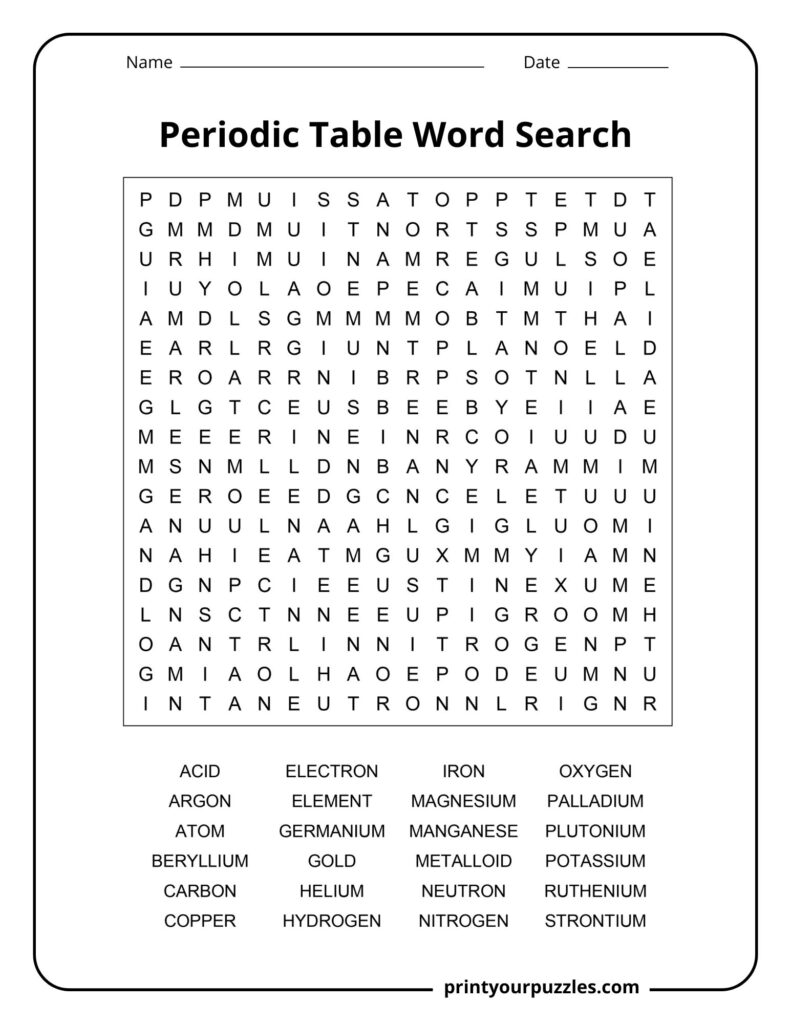
ACID, ARGON, ATOM, BERYLLIUM, CARBON, COPPER, ELECTRON, ELEMENT, GERMANIUM, GOLD, HELIUM, HYDROGEN, IRON, MAGNESIUM, MANGANESE, METALLOID, NEUTRON, NITROGEN, OXYGEN, PALLADIUM, PLUTONIUM, POTASSIUM, RUTHENIUM, STRONTIUM
ACID – A substance that donates protons or accepts electrons, typically has a pH less than 7, and can corrode metals or turn litmus paper red.
ARGON – A colorless, odorless noble gas that makes up about 1% of Earth’s atmosphere and is chemically inert, used in welding and light bulbs.
ATOM – The smallest unit of matter that retains chemical properties, consisting of a nucleus containing protons and neutrons, surrounded by orbiting electrons.
BERYLLIUM – A lightweight, strong, toxic alkaline earth metal with atomic number 4, used in aerospace applications, X-ray equipment, and nuclear reactor components.
CARBON – A nonmetallic element with atomic number 6, essential for all life, existing in forms like diamond and graphite, and forming organic compounds.
COPPER – A reddish-brown metallic element with atomic number 29, highly conductive to electricity and heat, widely used in wiring, plumbing, and coinage.
ELECTRON – A negatively charged subatomic particle orbiting the nucleus of an atom, responsible for chemical bonding, electricity, and determining an element’s chemical properties.
ELEMENT – A pure substance consisting of only one type of atom, cannot be broken down chemically, and is represented on the periodic table.
GERMANIUM – A grayish-white metalloid with atomic number 32, used in semiconductors, fiber optics, and infrared optics due to its electrical properties.
GOLD – A precious yellow metallic element with atomic number 79, highly valued for jewelry, resistant to corrosion, and used in electronics and dentistry.
HELIUM – The second lightest element, a colorless noble gas with atomic number 2, used in balloons, as a coolant, and in breathing mixtures.
HYDROGEN – The lightest and most abundant element in the universe, with atomic number 1, essential for water formation and a potential clean fuel.
IRON – A strong, magnetic metallic element with atomic number 26, essential for hemoglobin in blood, widely used in construction and manufacturing steel.
MAGNESIUM – A lightweight, silvery-white alkaline earth metal with atomic number 12, essential for plants and animals, used in alloys and pyrotechnics.
MANGANESE – A hard, brittle metallic element with atomic number 25, essential for steel production, batteries, and as a nutrient in biological systems.
METALLOID – An element with properties intermediate between metals and nonmetals, including silicon, germanium, and arsenic, useful in semiconductors and electronics.
NEUTRON – A subatomic particle with no electrical charge found in the nucleus of atoms, with mass similar to protons, determining isotopes of elements.
NITROGEN – A colorless, odorless gas comprising 78% of Earth’s atmosphere, with atomic number 7, essential for proteins and vital to all life.
OXYGEN – A reactive gaseous element with atomic number 8, essential for respiration and combustion, comprising 21% of Earth’s atmosphere and supporting life.
PALLADIUM – A rare, silvery-white precious metal with atomic number 46, used in catalytic converters, electronics, dentistry, and jewelry making.
PLUTONIUM – A radioactive, silvery metallic element with atomic number 94, created artificially, used in nuclear weapons and as fuel in nuclear reactors.
POTASSIUM – A soft, silvery alkali metal with atomic number 19, highly reactive, essential for nerve function, and used in fertilizers and chemical compounds.
RUTHENIUM – A rare, hard, silvery-white transition metal with atomic number 44, resistant to corrosion, used in electronics and as a catalyst.
STRONTIUM – A soft, silvery alkaline earth metal with atomic number 38, used in fireworks for red color, electronics, and in medical applications.
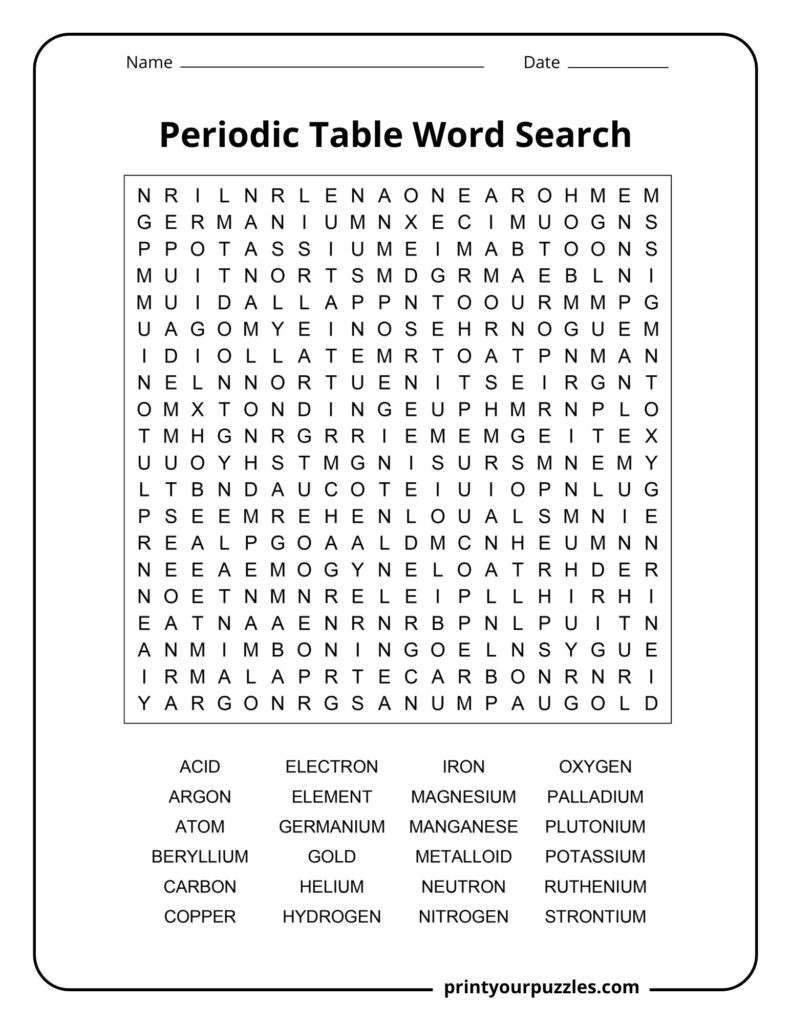
ACID, ARGON, ATOM, BERYLLIUM, CARBON, COPPER, ELECTRON, ELEMENT, GERMANIUM, GOLD, HELIUM, HYDROGEN, IRON, MAGNESIUM, MANGANESE, METALLOID, NEUTRON, NITROGEN, OXYGEN, PALLADIUM, PLUTONIUM, POTASSIUM, RUTHENIUM, STRONTIUM
The periodic table is an organized chart displaying all known chemical elements arranged by atomic number, electron configuration, and recurring chemical properties, showing relationships between elements.
Russian chemist Dmitri Mendeleev created the first widely recognized periodic table in 1869, arranging elements by atomic weight and predicting properties of undiscovered elements.
Currently, there are 118 confirmed elements on the periodic table, ranging from hydrogen (atomic number 1) to oganesson (atomic number 118), including natural and synthetic elements.
Rows, called periods, indicate the number of electron shells. Columns, called groups or families, contain elements with similar chemical properties and valence electron configurations.
Elements are radioactive when their atomic nuclei are unstable, causing them to decay and emit radiation. This typically occurs in heavier elements with high atomic numbers.
Gold is completely non-toxic and chemically inert, making it safe to eat. It’s used in luxury foods and drinks as edible gold leaf for decoration.
Mercury remains liquid between -38°F and 674°F, making it unique among metals. However, it’s highly toxic and requires careful handling in scientific applications.
Carbon’s ability to bond with itself and other elements creates millions of compounds, forming the basis of organic chemistry and all known life forms.
Liquid helium is a superfluid that can climb up and over container walls, flow without friction, and seemingly defy gravity at temperatures near absolute zero.
Despite its name, pencil lead contains no lead metal whatsoever. It’s made from graphite mixed with clay, making it safe for writing and drawing.