Introduction to Jonah and the Whale Word Search
Jonah and the Whale is one of the most memorable stories in the Bible. It appears in the Book of Jonah and tells how a prophet tried to escape from a mission given to him by God. The account explores obedience, repentance, mercy, forgiveness, and God’s concern for people from every nation.
God instructed Jonah to travel to Nineveh, the capital of the Assyrian Empire, and warn its people that their wrongdoing would bring judgment. Nineveh was known as a powerful enemy of Israel, so Jonah did not want its inhabitants to receive an opportunity to repent. Instead of traveling east toward the city, he boarded a ship sailing in the opposite direction.
During the voyage, God sent a violent storm that threatened to destroy the ship. The frightened sailors prayed to their gods and threw cargo into the sea to make the vessel lighter. Jonah admitted that the storm had occurred because he was running away from God. He told the sailors to throw him overboard, and when they finally did so, the sea immediately became calm.
Jonah was then swallowed by a great fish. Although the story is commonly called Jonah and the Whale, the biblical text does not identify the sea creature specifically as a whale. Jonah remained inside it for three days and three nights. From there, he prayed, thanked God for saving him, and promised to obey. The fish later released Jonah onto dry land.
God again told Jonah to go to Nineveh. This time, Jonah obeyed and announced that the city would soon be overthrown. The people believed his warning, fasted, and turned away from their wrongdoing. Even the king encouraged everyone to repent. When God saw their response, He showed mercy and did not destroy the city.
Jonah became angry because Nineveh had been spared. God used a fast-growing plant, a worm, and the heat of the sun to teach him a final lesson about compassion. Jonah cared deeply about the plant but struggled to understand God’s concern for thousands of people.
A Jonah and the Whale word search offers an engaging way to review important terms connected with Nineveh, the storm, the sailors, the great fish, repentance, obedience, forgiveness, and mercy. Understanding this biblical story helps explain the importance of listening to God, accepting responsibility, changing harmful behavior, and recognizing the value of compassion toward others.
Related Word Searches:
Old Testament | Books of the Bible | Noah’s Ark | Moses
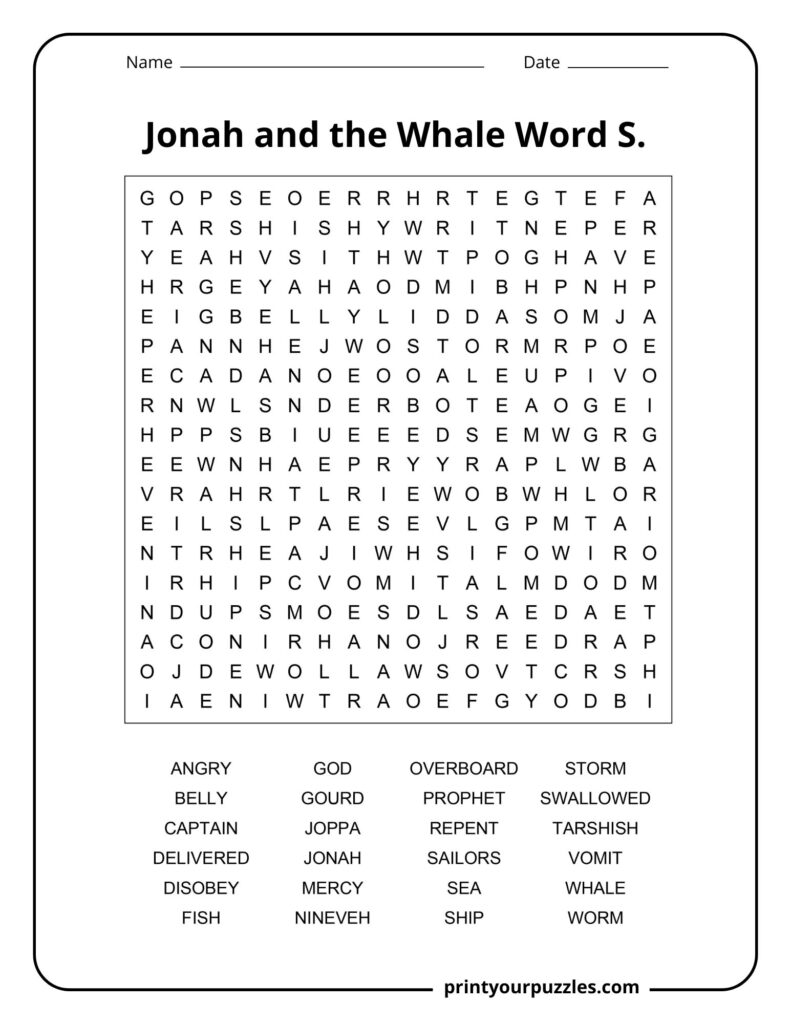
Medium Difficulty Word Search
Words to Find:
ANGRY, BELLY, CAPTAIN, DELIVERED, DISOBEY, FISH, GOD, GOURD, JOPPA, JONAH, MERCY, NINEVEH, OVERBOARD, PROPHET, REPENT, SAILORS, SEA, SHIP, STORM, SWALLOWED, TARSHISH, VOMIT, WHALE, WORM
All Words Defined
ANGRY – Jonah became angry with God for showing mercy to Nineveh after they repented, and also when the plant providing him shade died unexpectedly.
BELLY – The interior of the great fish where Jonah spent three days and three nights praying to God before being delivered back onto dry land safely.
CAPTAIN – The ship’s leader who woke Jonah during the storm and asked him to pray to his God, hoping to save the vessel and crew from destruction.
DELIVERED – God rescued Jonah from the belly of the fish and saved the people of Nineveh from destruction when they turned from their wicked ways.
DISOBEY – Jonah’s initial refusal to follow God’s command to go to Nineveh and preach against their wickedness, choosing instead to flee toward Tarshish by ship.
FISH – The great sea creature God appointed to swallow Jonah, keeping him alive inside its belly for three days and nights until God commanded its release.
GOD – The Lord who called Jonah to preach to Nineveh, sent the storm, appointed the fish, and showed mercy to the repentant city and its people.
GOURD – A plant God provided to grow quickly over Jonah’s shelter, giving shade and comfort, but which God later caused to wither through a worm.
JOPPA – The Mediterranean port city where Jonah boarded a ship bound for Tarshish while attempting to flee from God’s presence and assigned prophetic mission to Nineveh.
JONAH – The Hebrew prophet whom God called to warn Nineveh of impending judgment, who initially fled but eventually obeyed after his ordeal inside the fish.
MERCY – God’s compassion shown to both Jonah when he cried out from the fish’s belly and to Nineveh when its people fasted, repented, and turned away.
NINEVEH – The great Assyrian city known for wickedness where God sent Jonah to preach repentance, which ultimately turned from evil and avoided divine judgment through fasting.
OVERBOARD – The sailors threw Jonah into the raging sea at his own request, after discovering through casting lots that he was the cause of the storm.
PROPHET – Jonah’s role as God’s messenger, called to deliver divine warnings and messages to both Israel and the foreign city of Nineveh despite personal reluctance.
REPENT – The Ninevites turned from their evil ways, fasted, wore sackcloth, and cried out to God for mercy after hearing Jonah’s warning of impending destruction and judgment.
SAILORS – The ship’s crew who initially tried to save their vessel through rowing and prayer, then reluctantly threw Jonah overboard when the storm intensified dangerously.
SEA – The turbulent waters where God sent a violent storm to stop Jonah’s flight, which calmed immediately after the prophet was thrown into its depths.
SHIP – The vessel Jonah boarded at Joppa, bound for Tarshish, which encountered a violent storm that threatened to break it apart until Jonah was thrown overboard.
STORM – The violent tempest God sent upon the sea to stop Jonah’s disobedient flight, which threatened the ship until Jonah was cast into the water.
SWALLOWED – The great fish consumed Jonah whole when he was thrown overboard, keeping him alive in its belly for three days and nights of prayer and reflection.
TARSHISH – The distant destination where Jonah attempted to flee from God’s presence, sailing away from his assigned mission to preach judgment against Nineveh’s wickedness and corruption.
VOMIT – God commanded the fish to expel Jonah onto dry land after three days, releasing him unharmed to finally complete his mission to preach to Nineveh.
WHALE – Though Scripture says “great fish,” tradition often depicts this large sea creature as a whale that God specially appointed to swallow and preserve Jonah.
WORM – The creature God appointed to attack and destroy the gourd plant that had provided Jonah with shade, teaching him a lesson about compassion and mercy.
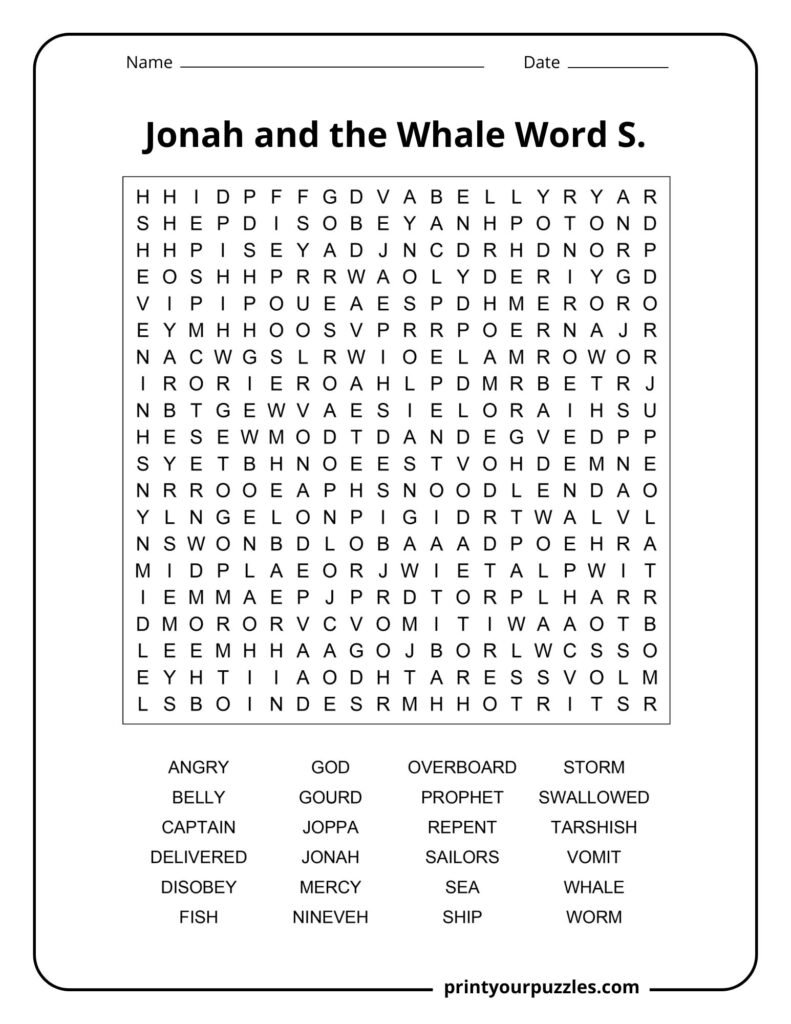
Hard Difficulty Word Search
Words to Find:
ANGRY, BELLY, CAPTAIN, DELIVERED, DISOBEY, FISH, GOD, GOURD, JOPPA, JONAH, MERCY, NINEVEH, OVERBOARD, PROPHET, REPENT, SAILORS, SEA, SHIP, STORM, SWALLOWED, TARSHISH, VOMIT, WHALE, WORM
6 Key FAQs About Jonah and the Whale
5 Curious "Did You Know?" Facts About Jonah and the Whale