
The Peloponnesian War was fought from 431 to 404 BCE between Athens and Sparta, the two strongest powers in Ancient Greece. Their allies were also drawn into the conflict, which spread across mainland Greece, the Aegean Sea, and parts of Sicily. The war lasted for nearly three decades and deeply weakened the Greek world.
Athens and Sparta represented very different kinds of power. Athens had a strong navy, a democratic government, great wealth, and a growing empire supported by the Delian League. Sparta led the Peloponnesian League and was famous for its disciplined army and military society. As Athenian influence expanded, Sparta and other city-states became increasingly fearful and resentful.
Several disputes helped push the two sides toward war. Tensions involving Corinth, Corcyra, and the Megarian Decree added to the wider struggle for control. The ancient historian Thucydides argued that the deeper cause was Sparta’s fear of rising Athenian power.
At the beginning of the war, the Athenian leader Pericles advised the population to remain behind the Long Walls and rely on the navy. Athens avoided large land battles with Sparta while attacking enemy coastlines and protecting access to its port. However, overcrowding inside the city contributed to a devastating plague that killed many people, including Pericles.
The war passed through several phases. There were battles at places such as Pylos and Amphipolis, followed by the uneasy Peace of Nicias. The most disastrous decision for Athens was the Sicilian Expedition from 415 to 413 BCE. The attempt to conquer Syracuse ended with the destruction of a large Athenian fleet and army.
Sparta eventually received financial support from Persia and built a navy strong enough to challenge Athens at sea. Under commanders such as Lysander, Spartan forces defeated the Athenian fleet and cut off vital supplies. Athens surrendered in 404 BCE, ending its empire and briefly losing its democratic government.
The Peloponnesian War changed Greek politics, warfare, and society. Trireme warships, hoplite formations, fortified walls, siege methods, and naval strategy all played important roles. Through this Peloponnesian War word search, students can explore vocabulary connected to Athens, Sparta, Pericles, plague, alliances, triremes, Sicily, Syracuse, Lysander, siege warfare, and the struggle for power in Ancient Greece.
Related Word Searches:
Ancient Greece | Ancient Rome | Ancient Egypt | Ancient Mesopotamia | Silk Road | Egyptian Gods
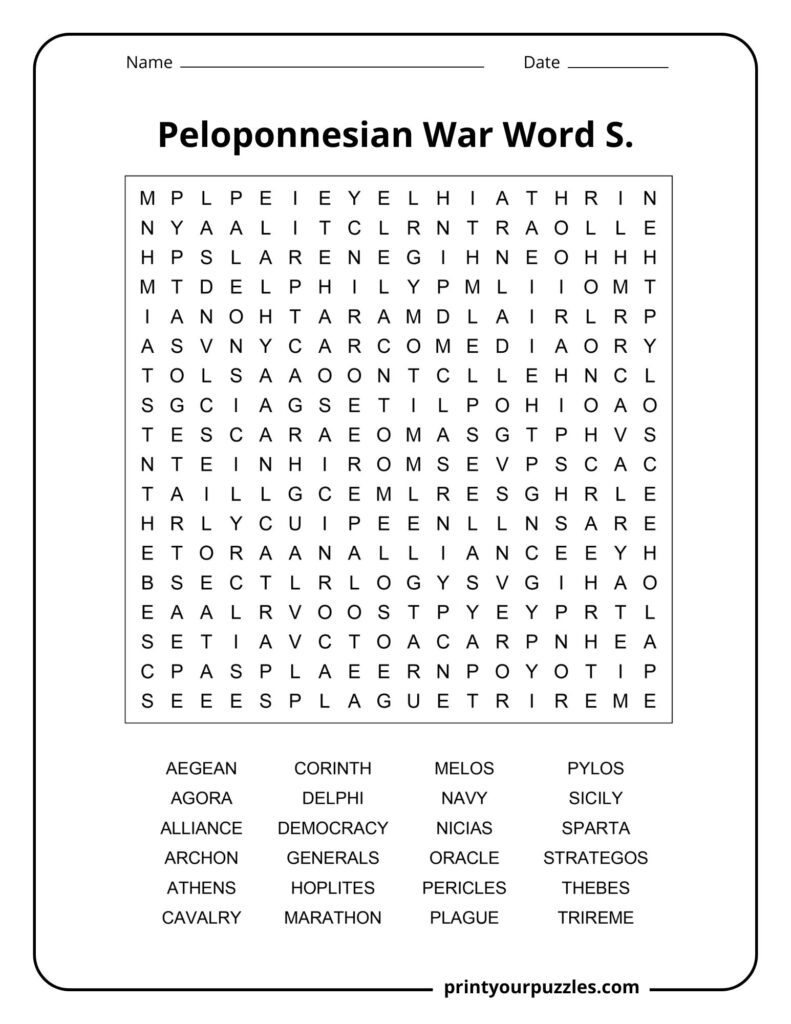
AEGEAN, AGORA, ALLIANCE, ARCHON, ATHENS, CAVALRY, CORINTH, DELPHI, DEMOCRACY, GENERALS, HOPLITES, MARATHON, MELOS, NAVY, NICIAS, ORACLE, PERICLES, PLAGUE, PYLOS, SICILY, SPARTA, STRATEGOS, THEBES, TRIREME
AEGEAN – Sea between Greece and Turkey where many naval battles of the Peloponnesian War took place, vital for Athenian trade routes and military dominance throughout the conflict.
AGORA – Central public space in Greek cities used for commerce, politics, and debate. In Athens, citizens gathered here to discuss war strategies and democratic decisions during the conflict.
ALLIANCE – Formal agreement between city-states to cooperate militarily. Athens led the Delian League while Sparta commanded the Peloponnesian League, making alliances the war’s structural backbone.
ARCHON – Senior Athenian magistrate holding executive and judicial authority. During the war, archons helped manage civic administration while generals handled military campaigns across Greece.
ATHENS – Powerful Greek city-state and naval empire that fought Sparta for supremacy. Its democratic government, cultural achievements, and Delian League made it the dominant Mediterranean power of its era.
CAVALRY – Horse-mounted soldiers used for scouting, flanking, and pursuit. Though Sparta excelled in infantry, Athenian and Thessalian cavalry played important supporting roles in several key engagements.
CORINTH – Wealthy and strategically located city-state that urged Sparta to declare war on Athens. Its rivalry with Athens over trade and colonial influence was a major trigger of the conflict.
DELPHI – Sacred sanctuary housing the Oracle of Apollo, consulted by both sides before major decisions. Delphi held enormous religious and political influence over all Greek city-states during the war.
DEMOCRACY – Athenian system of government where male citizens voted on laws and policies. The war tested and ultimately weakened Athenian democracy, culminating in brief oligarchic coups during the conflict.
GENERALS – Elected military commanders who led Athenian forces on land and sea. Figures like Pericles, Nicias, and Alcibiades shaped the war’s course through their strategic decisions and personal ambitions.
HOPLITES – Heavily armored Greek citizen-soldiers who fought in tight phalanx formations. They formed the backbone of most city-state armies, with Spartan hoplites considered the finest warriors in Greece.
MARATHON – Site of the famous Athenian victory over Persia in 490 BC, decades before the Peloponnesian War. This battle defined Athenian military pride and shaped their identity throughout the later conflict.
MELOS – Small island that tried to remain neutral in the war. Athens invaded in 416 BC, massacred its men, and enslaved its women and children, an act symbolizing ruthless Athenian imperial power.
NAVY – Athens built the most powerful fleet in Greece, funded by silver mines. Naval supremacy was central to Athenian strategy, allowing them to supply allies, raid coastlines, and project power widely.
NICIAS – Cautious and religious Athenian general who negotiated a temporary peace in 421 BC. He reluctantly led the catastrophic Sicilian Expedition, where he and his entire army were ultimately destroyed.
ORACLE – Prophetic voice of the god Apollo at Delphi, consulted before major military campaigns. Both Athens and Sparta sought divine guidance from the oracle, whose ambiguous answers influenced critical wartime decisions.
PERICLES – Dominant Athenian statesman and general who led Athens at the war’s outbreak. He devised a defensive strategy avoiding land battles, but died in the great plague that devastated Athens early on.
PLAGUE – Devastating epidemic that struck Athens around 430 BC, killing roughly a quarter of its population. It killed Pericles, demoralized the city, and significantly weakened Athenian military and political capacity.
PYLOS – Coastal stronghold in Sparta’s territory captured by Athens in 425 BC. The Athenian victory there trapped Spartan soldiers on nearby Sphacteria island, becoming one of Athens’ greatest early successes.
SICILY – Large Mediterranean island where Athens launched a massive and disastrous expedition in 415 BC. The total destruction of the Athenian fleet and army there marked the beginning of Athens’ irreversible decline.
SPARTA – Militaristic city-state that led the Peloponnesian League against Athens. Renowned for its disciplined infantry and austere culture, Sparta ultimately defeated Athens in 404 BC with Persian financial support.
STRATEGOS – Greek term for a general or military commander elected annually by Athenian citizens. The strategoi held both military and political influence, making them among the most powerful figures during wartime Athens.
THEBES – Powerful Boeotian city-state that allied with Sparta against Athens during the war. Though secondary at first, Thebes later rose to brief Greek dominance after defeating Sparta at Leuctra in 371 BC.
TRIREME – Fast and agile Greek warship powered by 170 oarsmen arranged in three rows. The trireme was Athens’ primary weapon, designed to ram enemy vessels and dominate the Aegean Sea during the war.
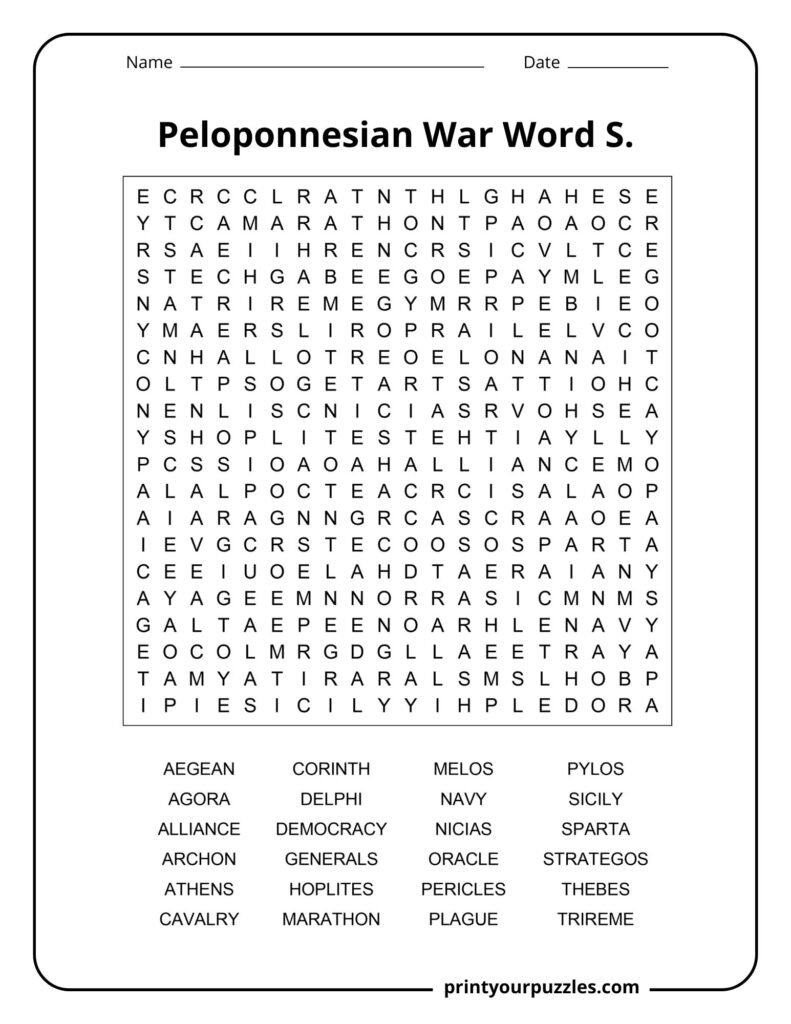
AEGEAN, AGORA, ALLIANCE, ARCHON, ATHENS, CAVALRY, CORINTH, DELPHI, DEMOCRACY, GENERALS, HOPLITES, MARATHON, MELOS, NAVY, NICIAS, ORACLE, PERICLES, PLAGUE, PYLOS, SICILY, SPARTA, STRATEGOS, THEBES, TRIREME
Growing Athenian imperial power and expansion of the Delian League alarmed Sparta and its allies, particularly Corinth, triggering a devastating conflict that engulfed nearly all of Greece.
The war lasted 27 years, from 431 to 404 BC, making it one of the longest and most destructive conflicts in ancient Greek history.
Sparta ultimately defeated Athens in 404 BC, largely thanks to Persian financial support that allowed Sparta to build a powerful fleet and cut off Athenian supply routes.
A devastating epidemic struck Athens around 430 BC, killing approximately one quarter of its population including Pericles, severely weakening Athenian morale, leadership, and military capacity throughout the war.
The war permanently weakened all major Greek city-states, leaving Greece fragmented and vulnerable, which eventually allowed Philip II of Macedon and later Alexander the Great to conquer and unify the region.
The Peloponnesian War by Donald Kagan. Yale’s Sterling Professor of Classics distils a lifetime of unrivalled Thucydidean scholarship into one gripping, clear-eyed volume — boldly correcting Thucydides himself while making Athens and Sparta’s epic clash utterly compelling.
Unlike modern armies, Athenian hoplites were ordinary male citizens who voted on the very wars they fought in, blending democratic participation directly with military service.
Sparta secretly negotiated Persian financial support to build its fleet, effectively allying with Greece’s former greatest enemy to defeat Athens, a deeply controversial and ironic wartime decision.
The historian Thucydides commanded Athenian forces before being exiled for a military failure, giving his famous account of the war a uniquely personal and eyewitness perspective.
After winning the Battle of Arginusae in 406 BC, Athens controversially executed six victorious generals for failing to rescue drowning sailors, revealing how volatile Athenian democracy could become under wartime pressure.
Aristophanes wrote Lysistrata in 411 BC, a comic play where Greek women refuse intimacy with their husbands until they end the war, boldly mocking Athenian and Spartan leadership through sharp humor.