
Ancient Mesopotamia was one of the earliest and most influential centers of civilization in world history. Its first cities began to develop around 3500 BCE, and Mesopotamian civilization continued through a succession of kingdoms and empires until the Persian conquest of Babylon in 539 BCE. Its name means “land between the rivers,” referring to the Tigris and Euphrates in a region that is now mainly Iraq. These rivers provided water and fertile soil, allowing communities to grow crops and support larger populations. However, flooding could be unpredictable, so people built canals, dikes, and irrigation systems that required planning and cooperation.
Over time, farming villages developed into some of the world’s first cities, including Ur, Uruk, Lagash, Babylon, and Nineveh. These cities became centers of government, religion, trade, craftsmanship, and learning. The Sumerians established independent city-states, each with its own ruler, army, laws, and protective deity. Large stepped temples called ziggurats stood at the center of many communities and reflected the importance of religion in public life.
Mesopotamian civilization changed as different peoples and empires gained power. Sargon of Akkad created one of history’s earliest territorial empires during the third millennium BCE. Later, Babylon became famous under Hammurabi in the eighteenth century BCE, while the Assyrians built a powerful military state. The Neo-Babylonian Empire reached its height under Nebuchadnezzar II during the sixth century BCE, shortly before Babylon fell to the Persian Empire.
One of Mesopotamia’s greatest achievements was cuneiform, an early writing system created by pressing wedge-shaped marks into clay tablets. Scribes used it to record taxes, trade, property, laws, prayers, stories, and government decisions. Hammurabi’s famous law code addressed family life, labor, commerce, crime, and punishment. Although its penalties varied according to social rank, the code remains an important example of written law and organized government.
Daily life included farmers, merchants, priests, soldiers, artisans, scribes, rulers, and enslaved people. Mesopotamians grew barley, wheat, dates, and other crops, while traders exchanged textiles, grain, pottery, metals, timber, and precious stones across long distances. Their cities depended on specialized labor, busy marketplaces, and carefully managed water systems.
Many Mesopotamian inventions and ideas still influence modern life. They developed or improved the wheel, plow, sailboat, irrigation, maps, accounting, measurement, and record keeping. Their base-60 number system still shapes the 60 minutes in an hour, 60 seconds in a minute, and 360 degrees in a circle. Mesopotamian scholars also made important advances in astronomy, calendars, mathematics, construction, and medicine. The legacy of Ancient Mesopotamia also survives in literature, especially the Epic of Gilgamesh, one of the oldest known written stories.
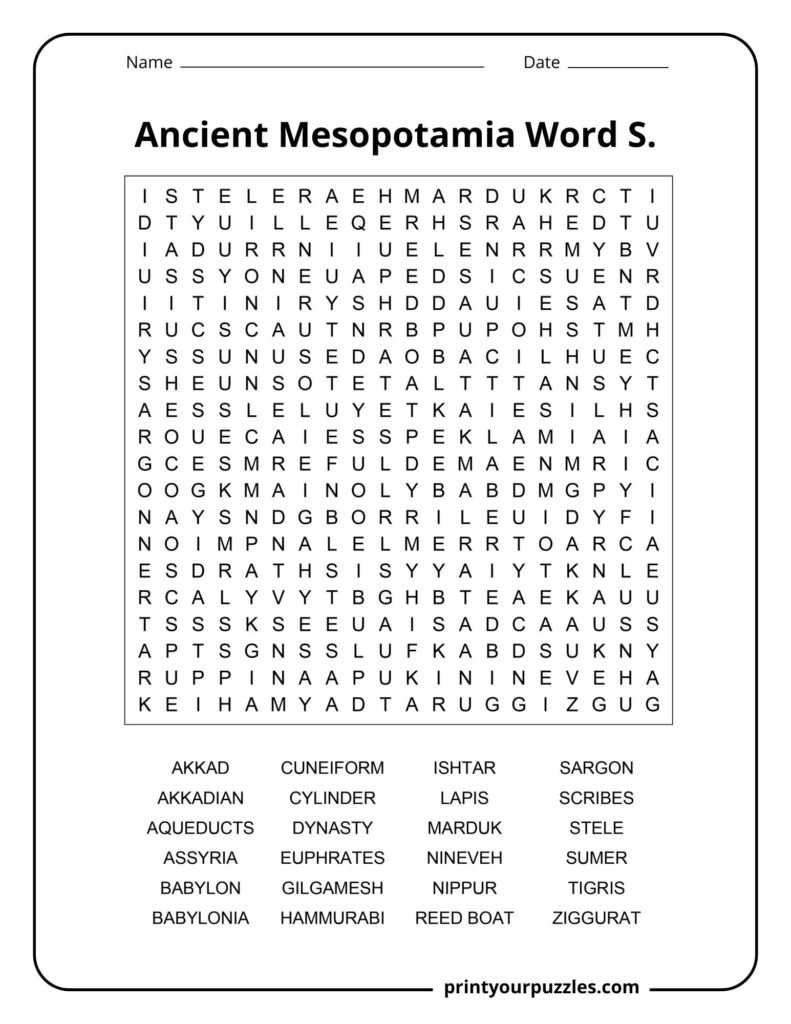
Through this Ancient Mesopotamia word wearch, students can explore vocabulary connected to rivers, city-states, rulers, writing, law, religion, inventions, trade, and daily life. These terms help show how Mesopotamia laid important foundations for cities, government, mathematics, literature, and organized society.
Related Word Searches:
Ancient Egypt | Ancient Greece | Ancient Rome | Ancient China | Silk Road | Stone Age
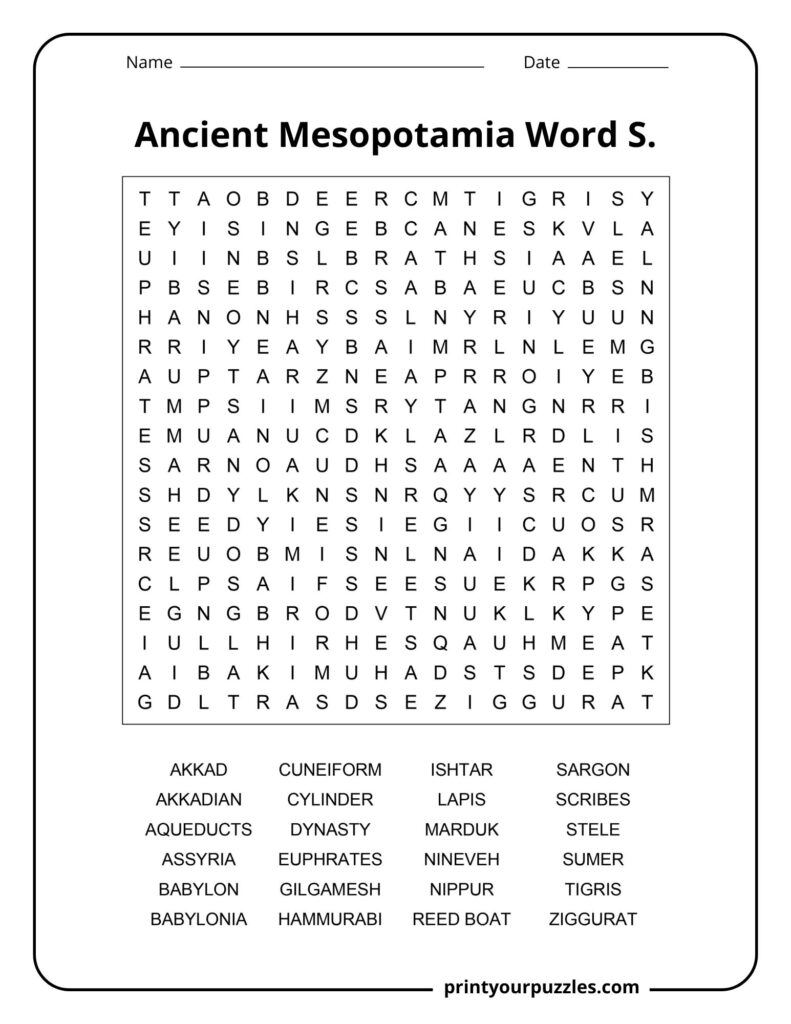
AKKAD, AKKADIAN, AQUEDUCTS, ASSYRIA, BABYLON, BABYLONIA, CUNEIFORM, CYLINDER, DYNASTY, EUPHRATES, GILGAMESH, HAMMURABI, ISHTAR, LAPIS, MARDUK, NINEVEH, NIPPUR, REED BOAT, SARGON, SCRIBES, STELE, SUMER, TIGRIS, ZIGGURAT
AKKAD – Ancient city and empire in central Mesopotamia, capital of the Akkadian Empire under Sargon, considered one of the world’s first empires around 2334 BCE.
AKKADIAN – Semitic language spoken in ancient Mesopotamia, used for diplomacy and literature across the Near East, written in cuneiform script on clay tablets.
AQUEDUCTS – Engineering structures built to transport water across distances, used in Mesopotamia to supply cities and irrigate agricultural fields in dry regions.
ASSYRIA – Powerful ancient empire in northern Mesopotamia, known for its fearsome military, grand palaces, extensive libraries, and dominance across the Near East.
BABYLON – Famous ancient city on the Euphrates River, capital of the Babylonian Empire, celebrated for its impressive walls, hanging gardens, and Hammurabi’s law code.
BABYLONIA – Ancient cultural region and empire in southern Mesopotamia, centered on Babylon, renowned for astronomy, mathematics, law, and rich religious traditions.
CUNEIFORM – One of the world’s earliest writing systems, developed by the Sumerians, made by pressing a reed stylus into soft clay tablets to create wedge-shaped marks.
CYLINDER – Small carved stone roller used in ancient Mesopotamia as a personal seal, rolled onto clay to leave an impression identifying ownership or authenticating documents.
DYNASTY – Succession of rulers from the same family or lineage, a fundamental political structure in Mesopotamian city-states and empires throughout their long history.
EUPHRATES – One of Mesopotamia’s two great rivers, flowing through modern Syria and Iraq, providing essential water for agriculture and serving as a cradle of civilization.
GILGAMESH – Legendary king of Uruk and hero of one of history’s oldest epic poems, whose story explores themes of friendship, power, and the human search for immortality.
HAMMURABI – Babylonian king who ruled around 1754 BCE, famous for establishing one of history’s earliest written legal codes, engraved on a tall black stone stele.
ISHTAR – Major Mesopotamian goddess of love, beauty, and war, associated with the planet Venus, worshipped widely across Assyria and Babylon with elaborate temples and rituals.
LAPIS – Deep blue semi-precious stone highly prized in ancient Mesopotamia, traded from Afghanistan, used in jewelry, art, and decorating sacred objects and royal tombs.
MARDUK – Chief deity of Babylon, patron god of the city, whose rise to supreme power among Mesopotamian gods is described in the creation myth known as Enuma Elish.
NINEVEH – Ancient capital of the Assyrian Empire on the Tigris River, home to King Ashurbanipal’s great library containing thousands of cuneiform tablets preserving Mesopotamian knowledge.
NIPPUR – Sacred Sumerian city and major religious center in Mesopotamia, home to the great temple of Enlil, serving as a spiritual capital respected by many successive civilizations.
REED BOAT – Watercraft crafted from bundled marsh reeds, used by ancient Mesopotamians to navigate rivers and marshes, representing one of humanity’s earliest forms of water transportation.
SARGON – Founder of the Akkadian Empire around 2334 BCE, considered history’s first empire builder, who unified Mesopotamian city-states under centralized rule through military conquest.
SCRIBES – Highly trained professional writers in ancient Mesopotamia who recorded laws, trade transactions, religious texts, and literature on clay tablets using cuneiform script.
STELE – Upright stone slab or pillar carved with inscriptions or reliefs, used in Mesopotamia to commemorate royal victories, record laws, and honor gods and rulers.
SUMER – Ancient civilization in southern Mesopotamia, considered one of humanity’s earliest, credited with inventing writing, the wheel, irrigation systems, and complex urban society.
TIGRIS – Eastern of Mesopotamia’s two great rivers, flowing through modern Turkey and Iraq, whose fertile banks supported ancient cities including Nineveh, Ashur, and Ctesiphon.
ZIGGURAT – Massive terraced temple tower built in ancient Mesopotamian cities, serving as a sacred mountain connecting earth to the heavens and housing the city’s patron deity.
AKKAD, AKKADIAN, AQUEDUCTS, ASSYRIA, BABYLON, BABYLONIA, CUNEIFORM, CYLINDER, DYNASTY, EUPHRATES, GILGAMESH, HAMMURABI, ISHTAR, LAPIS, MARDUK, NINEVEH, NIPPUR, REED BOAT, SARGON, SCRIBES, STELE, SUMER, TIGRIS, ZIGGURAT
The word comes from ancient Greek, meaning “land between the rivers,” referring to the fertile region between the Tigris and Euphrates rivers in modern-day Iraq.
Several major civilizations flourished there, including the Sumerians, Akkadians, Babylonians, and Assyrians, each contributing uniquely to law, science, literature, and urban development over thousands of years.
Because it produced many of humanity’s first achievements, including writing, codified laws, agriculture, cities, and organized religion, laying the essential foundations for all later human civilizations worldwide.
Most people were farmers, traders, or craftsmen living in mudbrick homes. Society was structured around temples, markets, and city-states, with scribes, priests, and kings holding significant power and influence.
A combination of factors contributed, including invasions by outside powers, prolonged droughts, soil salinization from over-irrigation, internal political instability, and the eventual conquests by Persian and later Greek forces.
Ancient Iraq by Georges Roux. French historian-archaeologist Roux, who lived for years in Iraq, distils three millennia of Sumerian, Babylonian, and Assyrian civilisation into one richly researched, engagingly written, and enduringly authoritative masterwork.
The Sumerians divided the day into 24 hours, each hour into 60 minutes, and each minute into 60 seconds, a system still used universally today.
Beer was a staple drink in Mesopotamia, consumed by all social classes, even paid as wages to workers, and protected by one of history’s earliest known brewing regulations.
Composed in Sumerian around 2000 BCE, this romantic poem was written in honor of King Shu-Sin and is considered the earliest recorded expression of romantic love in history.
Mesopotamian physicians combined herbal remedies with magical rituals, documented hundreds of medicinal plants on clay tablets, and even recognized that some diseases spread from person to person.
Written centuries before the Bible, the epic describes a great flood, a boat built to save living creatures, and a dove released to find dry land.