Disney has become one of the most influential names in entertainment, but its story began with a small animation business and a series of risky creative decisions. Walt Disney had already experimented with animation before moving to California, where he and his brother Roy founded the Disney Brothers Cartoon Studio in 1923. The company initially produced short films and worked with relatively limited resources, but Walt was determined to develop memorable characters and improve the possibilities of animation.
An important breakthrough came in the late 1920s with Mickey Mouse. After losing control of an earlier character, Oswald the Lucky Rabbit, Walt Disney needed something new. Mickey soon became the studio’s most recognizable creation, especially after appearing in Steamboat Willie in 1928, one of the early animated shorts to make synchronized sound a major attraction. The success of Mickey, followed by characters such as Minnie Mouse, Donald Duck, Goofy, and Pluto, gave the company a much stronger identity.
Disney then took another major gamble by producing Snow White and the Seven Dwarfs, released in 1937. Many people doubted that audiences would sit through a full-length animated feature, but the film became a major success. It helped establish feature animation as a serious form of entertainment and was followed by classics such as Pinocchio, Fantasia, Cinderella, Peter Pan, and many others.
The company continued to grow beyond animation. Television, live-action films, merchandising, and music all became important, while the opening of Disneyland in California in 1955 created a completely new kind of entertainment experience. Walt Disney World in Florida later expanded that idea on an even larger scale.
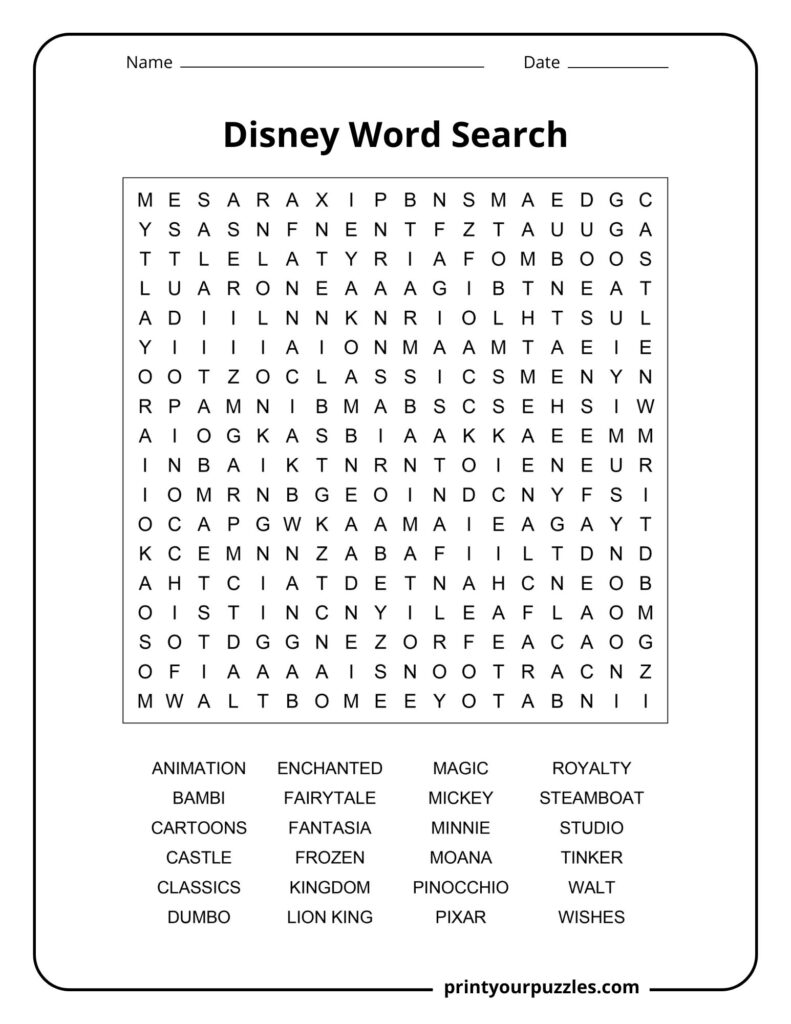
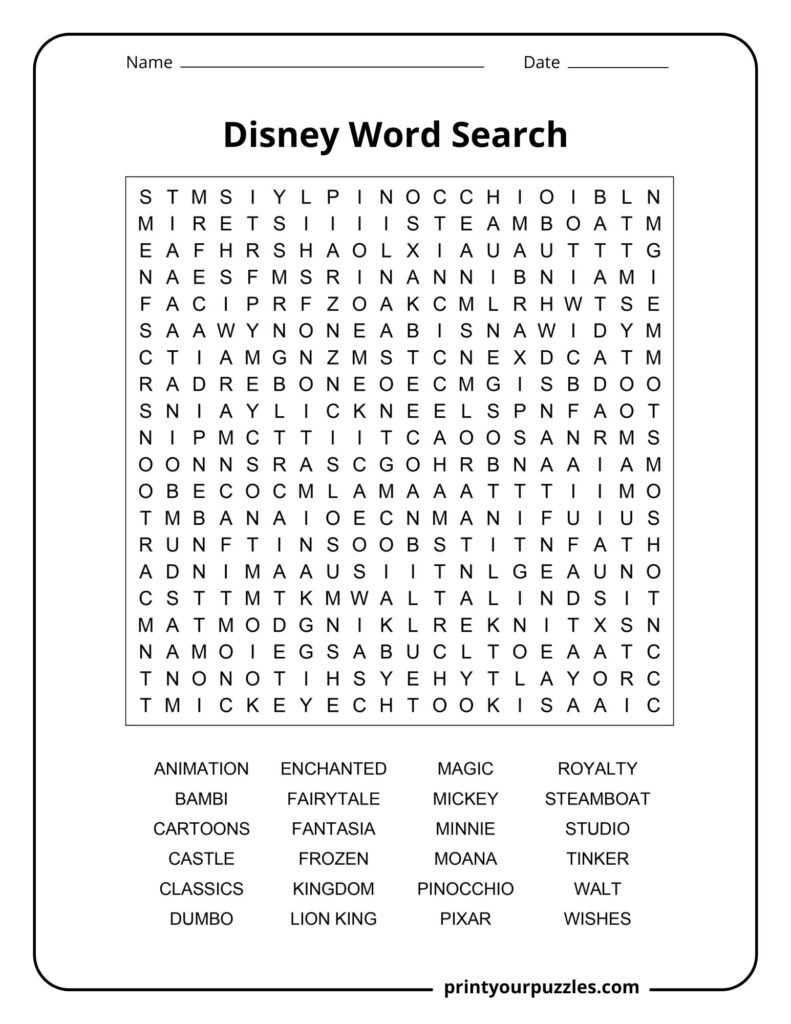
A Disney word search can bring together many parts of this history, including characters, films, animation, castles, parks, attractions, and storytelling traditions.
From a small cartoon studio to a global entertainment company, Disney grew by repeatedly turning creative ideas into new kinds of experiences. Its history shows how characters and stories can expand far beyond the screen and become part of popular culture across generations.
Related Word Searches:
Lego | Sony | Coca-Cola | McDonald’s
ANIMATION – The art of creating the illusion of movement by displaying a sequence of drawings or images, a technique Walt Disney revolutionized and turned into a global entertainment industry.
BAMBI – A beloved 1942 Disney animated film following a young deer’s journey through forest life, celebrated for its emotional storytelling, breathtaking hand-drawn nature scenes, and tearful moments.
CARTOONS – Short animated films that became Disney’s foundation, beginning with Mickey Mouse in 1928, entertaining generations of children and adults worldwide through humor, color, and memorable characters.
CASTLE – The iconic Sleeping Beauty or Cinderella castle standing at the heart of every Disney theme park, symbolizing magic, dreams, and the fairy-tale world Walt Disney imagined for families everywhere.
CLASSICS – The timeless collection of Disney animated masterpieces, from Snow White to The Lion King, that defined generations of childhood and continue inspiring audiences with their enduring stories and artistry.
DUMBO – A 1941 Disney animated film about a big-eared elephant who discovers his unusual ears give him the extraordinary ability to fly, delivering a powerful message about embracing what makes you different.
ENCHANTED – A 2007 Disney film blending animation and live action, following a fairy-tale princess transported to modern New York City, cleverly mixing classic Disney magic with humor and contemporary storytelling.
FAIRYTALE – The timeless narrative tradition that inspired countless Disney films, drawing from European folklore and classic stories to create magical worlds filled with heroes, villains, romance, and triumphant happy endings.
FANTASIA – A groundbreaking 1940 Disney film combining classical orchestral music with stunning animated visuals, pushing the boundaries of cinema and demonstrating that animation could be a serious and sophisticated artistic medium.
FROZEN – A massively successful 2013 Disney animated film inspired by Hans Christian Andersen’s story, featuring two royal sisters, breathtaking icy landscapes, and the iconic song Let It Go that became a global phenomenon.
KINGDOM – Referring to Walt Disney World’s Magic Kingdom park opened in Florida in 1971, a place where fantasy becomes reality and guests of all ages experience the wonder of Disney’s imaginative storytelling firsthand.
LION KING – An epic 1994 Disney animated film inspired by Shakespeare’s Hamlet, following young lion Simba’s journey from tragedy to triumph, featuring unforgettable music by Elton John and Hans Zimmer.
MAGIC – The essential spirit running through everything Disney creates, from enchanting films and beloved characters to spectacular theme parks, representing Walt’s belief that imagination and storytelling can make dreams genuinely come true.
MICKEY – Mickey Mouse, Disney’s most iconic character created by Walt Disney and Ub Iwerks in 1928, whose cheerful image and round ears have become the universally recognized symbol of the entire Disney brand.
MINNIE – Mickey Mouse’s sweetheart and one of Disney’s original characters, recognizable worldwide by her polka-dot bow and dress, representing charm, kindness, and the timeless appeal of Disney’s earliest animated creations.
MOANA – A 2016 Disney animated film celebrating Polynesian culture and heritage, following a courageous young girl who sets sail across the ocean to save her island, guided by her ancestors and the sea.
PINOCCHIO – A 1940 Disney animated masterpiece based on Carlo Collodi’s tale about a wooden puppet who dreams of becoming a real boy, exploring themes of honesty, temptation, and the transformative power of a conscience.
PIXAR – The groundbreaking animation studio acquired by Disney in 2006, responsible for revolutionary computer-animated films like Toy Story, Finding Nemo, and Up, consistently redefining what animated storytelling can emotionally and technically achieve.
ROYALTY – A central theme across Disney’s storytelling legacy, with princesses and kings populating beloved films, creating an enduring fantasy of noble characters, grand palaces, and romantic adventures that audiences around the world adore.
STEAMBOAT – A reference to Steamboat Willie, the 1928 short film that introduced Mickey Mouse to the world and became historically significant as one of the first synchronized sound cartoons ever successfully produced and released.
STUDIO – The Walt Disney Studios in Burbank, California, the creative heart of the Disney empire since 1940, where legendary animated films, live-action movies, and countless entertainment projects have been conceived, developed, and produced.
TINKER – Tinker Bell, the feisty and beloved fairy from Peter Pan who became one of Disney’s most recognizable symbols, famously opening Disney television broadcasts and sprinkling magical pixie dust over the castle logo.
WALT – Walter Elias Disney, the visionary founder born in 1901 who transformed a small animation studio into a global entertainment empire, leaving an extraordinary legacy of creativity, innovation, and magical storytelling that endures today.
WISHES – Representing the core emotional promise at the heart of every Disney experience, inspired by Pinocchio’s famous song, embodying the belief that if you dream with enough heart and courage, wishes really can come true.