Introduction to the Passover Word Search
Passover is one of the most important festivals in Judaism, remembering the Israelites’ freedom from slavery in ancient Egypt. Known in Hebrew as “Pesach”, it begins on the fifteenth day of the Hebrew month of Nisan, usually falling in March or April. The celebration lasts seven days in Israel and traditionally eight days in many Jewish communities outside Israel.
The story of Passover is told in the Book of Exodus. According to the biblical account, the Israelites were enslaved under the Egyptian pharaoh until Moses demanded their release. After Pharaoh repeatedly refused, Egypt experienced a series of plagues. During the final plague, the Israelites marked their doorposts so that death would “pass over” their homes. Pharaoh eventually allowed them to leave, beginning their journey from slavery toward freedom.
The most important home tradition is the Seder, a ceremonial meal usually held on the first night or first two nights of Passover. Families and guests follow a special book called the “Haggadah”, which guides them through prayers, songs, questions, stories, and symbolic foods. Children often participate by asking the Four Questions, beginning with why this night is different from all other nights.
The Seder plate contains foods with special meanings. Bitter herbs represent the suffering of slavery, while salt water recalls tears. “Charoset”, a sweet mixture often made with fruit, nuts, and wine, resembles the mortar used by enslaved workers. A roasted bone symbolizes the ancient Passover sacrifice, and an egg can represent mourning and renewal.
Matzah, an unleavened bread, is one of the festival’s best-known foods. It recalls the Israelites leaving Egypt so quickly that their dough had no time to rise. During Passover, observant Jews avoid “chametz”, foods made from certain grains that have been allowed to ferment or rise. Families may clean their homes carefully and prepare special meals using matzah, vegetables, eggs, meat, fish, and traditional recipes.
Passover combines faith, family memory, gratitude, and the universal hope for freedom. Its customs encourage each generation to retell the story and consider the meaning of justice and liberation.
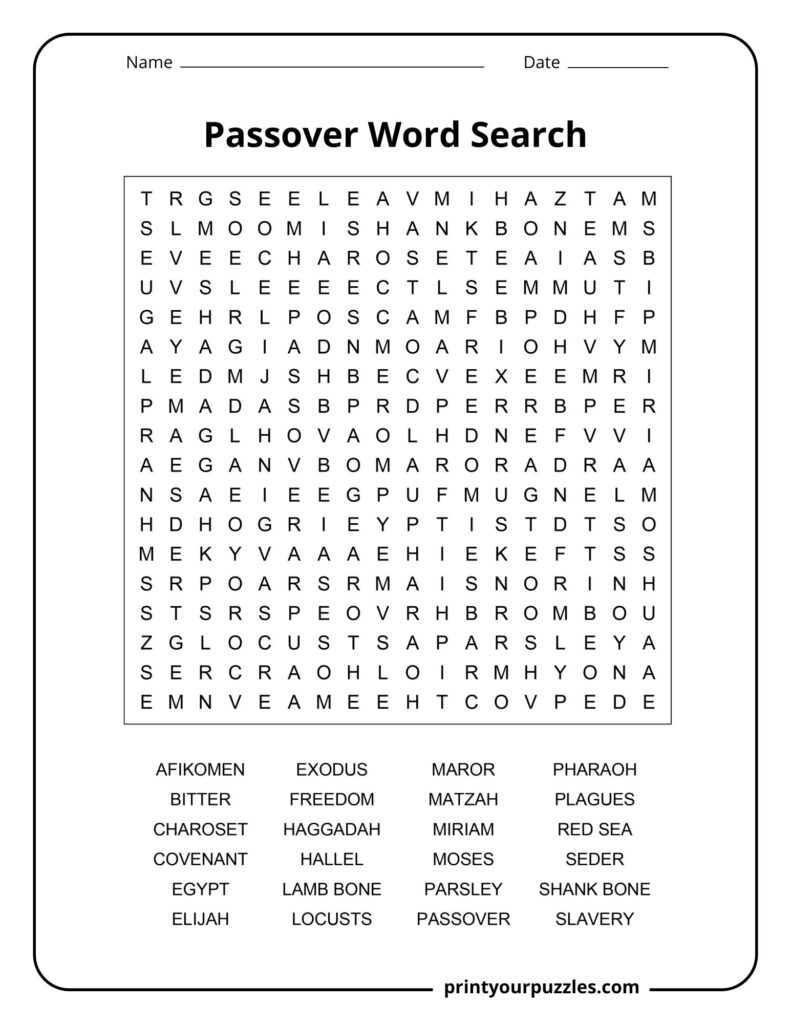
Explore the symbols, foods, people, and traditions of this meaningful festival with this Passover word search, featuring 24 carefully selected words inspired by Moses, Egypt, matzah, the Seder, freedom, family, remembrance, and the journey from slavery.
Related Word Searches:
Easter | Good Friday | April | Spring | March
Medium Difficulty Word Search
Words to Find
AFIKOMEN, BITTER, CHAROSET, COVENANT, EGYPT, ELIJAH, EXODUS, FREEDOM, HAGGADAH, HALLEL, LAMB BONE, LOCUSTS, MAROR, MATZAH, MIRIAM, MOSES, PARSLEY, PASSOVER, PHARAOH, PLAGUES, RED SEA, SEDER, SHANK BONE, SLAVERY
All Words Defined
AFIKOMEN – A broken piece of matzah hidden during the Passover seder and searched for by children at the end of the meal, traditionally exchanged for a small gift or reward before dessert.
BITTER – Refers to the bitter herbs eaten during the seder to symbolize the harsh suffering and misery endured by the Jewish people during their years of slavery in ancient Egypt.
CHAROSET – A sweet paste made from fruits, nuts, wine, and spices eaten at the seder table, symbolizing the mortar that enslaved Jewish people used when building structures for the Egyptian pharaoh.
COVENANT – The sacred and binding agreement between God and the Jewish people, in which God promised to protect and guide them as His chosen nation throughout all generations.
EGYPT – The ancient North African civilization where the Jewish people were enslaved for hundreds of years under successive pharaohs before Moses led them toward liberation and freedom.
ELIJAH – A revered biblical prophet for whom a cup of wine is poured and the door is opened during the Passover seder, welcoming his symbolic spirit into the home.
EXODUS – The dramatic and miraculous departure of the Jewish people from slavery in Egypt, led by Moses, marking one of the most foundational events in Jewish history and identity.
FREEDOM – The central theme of Passover, celebrating the liberation of the Jewish people from Egyptian bondage and the universal human longing to live with dignity, rights, and independence.
HAGGADAH – The traditional text read aloud during the Passover seder that tells the story of the Exodus, includes prayers, songs, and instructions guiding participants through the entire ritual meal.
HALLEL – A joyful collection of psalms of praise recited or sung during the Passover seder to thank and glorify God for performing the miracles that freed the Jewish people from Egypt.
LAMB BONE – A roasted shankbone placed on the seder plate as a symbolic reminder of the Paschal lamb sacrificed in ancient times and the blood marked on Jewish doorposts in Egypt.
LOCUSTS – One of the ten plagues God sent upon Egypt, a massive swarm of insects that devoured all crops and vegetation, leaving the land completely bare and the people devastated.
MAROR – A bitter herb, typically horseradish or romaine lettuce, eaten at the Passover seder to symbolize the bitterness and suffering endured by the Jewish people during their slavery in Egypt.
MATZAH – Unleavened flatbread eaten throughout Passover, representing the haste with which the Jewish people fled Egypt, leaving no time for their bread dough to rise before their departure.
MIRIAM – Moses’s courageous older sister who watched over him as an infant, and later led the Jewish women in joyful song and dance after the miraculous crossing of the Red Sea.
MOSES – The great Jewish leader chosen by God to confront Pharaoh, deliver the ten plagues, and guide the Jewish people out of slavery in Egypt toward the Promised Land.
PARSLEY – A fresh green herb dipped in saltwater during the seder to symbolize springtime renewal and hope, while the saltwater itself represents the tears shed during years of Egyptian slavery.
PASSOVER – The major Jewish festival celebrating the liberation from Egyptian slavery, named for God’s act of passing over the homes of the Israelites during the final devastating plague against Egypt.
PHARAOH – The powerful ruler of ancient Egypt who refused to free the Jewish slaves despite Moses’s repeated demands and God’s increasingly severe plagues, ultimately losing his army at the Red Sea.
PLAGUES – The ten divine punishments God sent upon Egypt to compel Pharaoh to release the Jewish people, including frogs, locusts, darkness, and finally the death of every Egyptian firstborn son.
RED SEA – The body of water miraculously parted by God to allow the Jewish people to cross safely, then released to engulf the pursuing Egyptian army, sealing their miraculous escape from slavery.
SEDER – The ceremonial Passover meal held on the first nights of the holiday, during which families retell the Exodus story, eat symbolic foods, drink four cups of wine, and sing traditional songs.
SHANK BONE – The roasted lamb bone placed on the Passover seder plate as a symbol of the ancient temple sacrifice and God’s outstretched arm that delivered the Jewish people from Egyptian oppression.
SLAVERY – The brutal condition of forced labor endured by the Jewish people in Egypt for generations, building cities and monuments under cruel taskmasters, until God heard their cries and sent Moses.
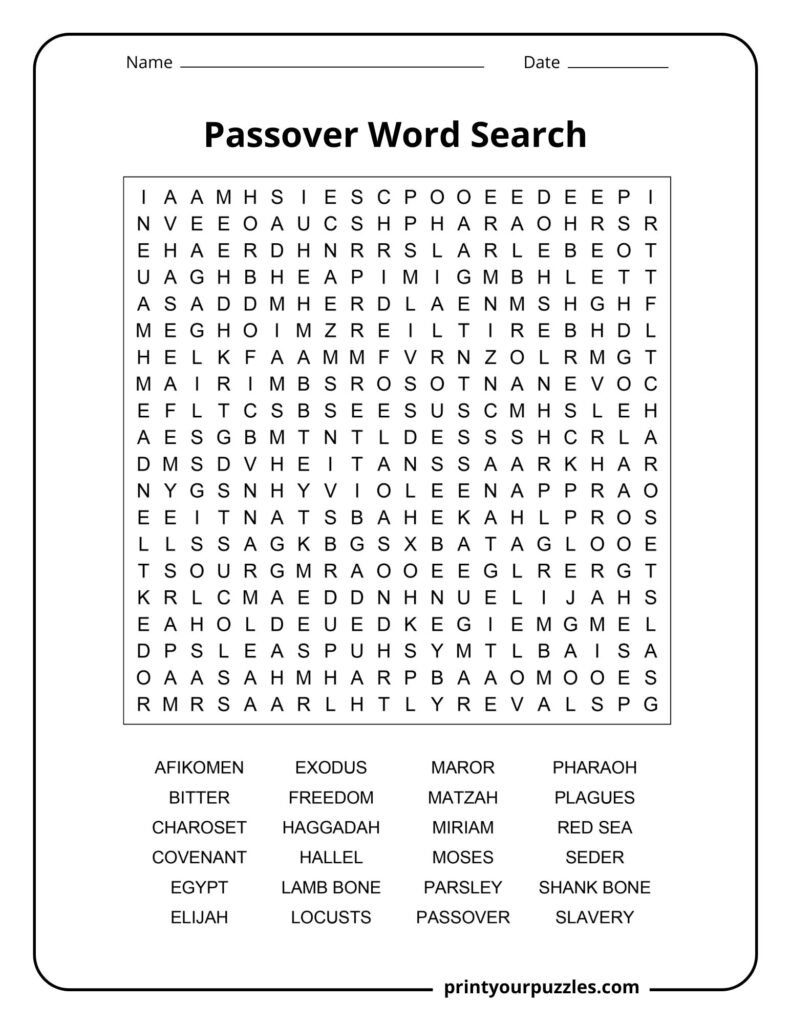
Hard Difficulty Word Search
Words to Find
AFIKOMEN, BITTER, CHAROSET, COVENANT, EGYPT, ELIJAH, EXODUS, FREEDOM, HAGGADAH, HALLEL, LAMB BONE, LOCUSTS, MAROR, MATZAH, MIRIAM, MOSES, PARSLEY, PASSOVER, PHARAOH, PLAGUES, RED SEA, SEDER, SHANK BONE, SLAVERY
5 Key FAQs About Passover
5 Curious "Did You Know?" Facts About Passover