Introduction to the Berlin Wall Word Search
The construction of the Berlin Wall in August 1961 became one of the most recognizable events of the Cold War. Built by East Germany, officially known as the German Democratic Republic, the barrier divided East Berlin from West Berlin and separated families, neighborhoods, workplaces, and communities almost overnight. For nearly three decades, the Wall stood as a powerful symbol of the political and ideological division between the communist East and the democratic West.
After World War II, Germany was divided into occupation zones controlled by the United States, the United Kingdom, France, and the Soviet Union. Berlin, although located inside the Soviet-controlled part of Germany, was also divided among the four Allied powers. Eventually, West Germany and East Germany became separate countries, while Berlin remained divided between East and West.
During the 1950s, millions of people left East Germany, many traveling through Berlin to reach the West. East German leaders saw this movement as a serious problem because many of those leaving were young workers, professionals, and skilled citizens. To stop the growing number of departures, the East German government closed the border in Berlin.
Early on August 13, 1961, soldiers and police began placing barbed wire, fences, and roadblocks along the border between East and West Berlin. Streets were closed, transportation routes were interrupted, and buildings near the border were controlled or sealed. The temporary barriers were gradually replaced with concrete walls, guard towers, patrol roads, and other security measures.
The Berlin Wall was not simply one continuous concrete wall. Over time, it developed into an extensive border system designed to prevent people from escaping from East Berlin and East Germany. Attempts to cross could be extremely dangerous, although many people still tried using tunnels, hidden compartments, homemade devices, and other creative methods.
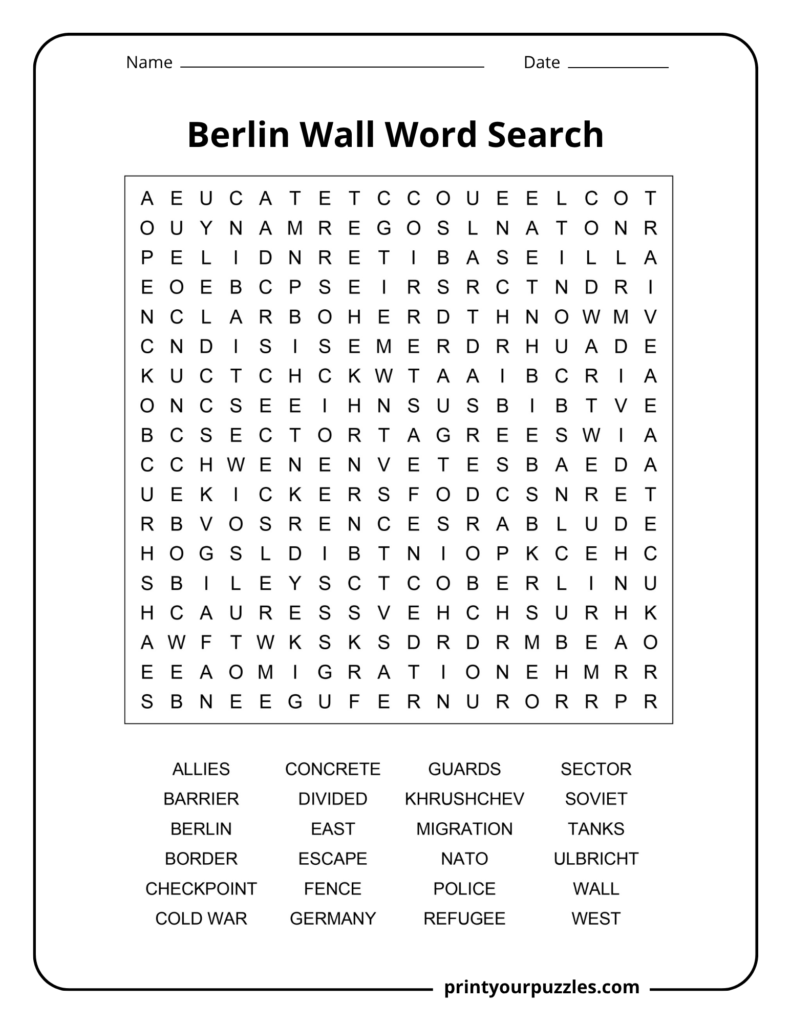
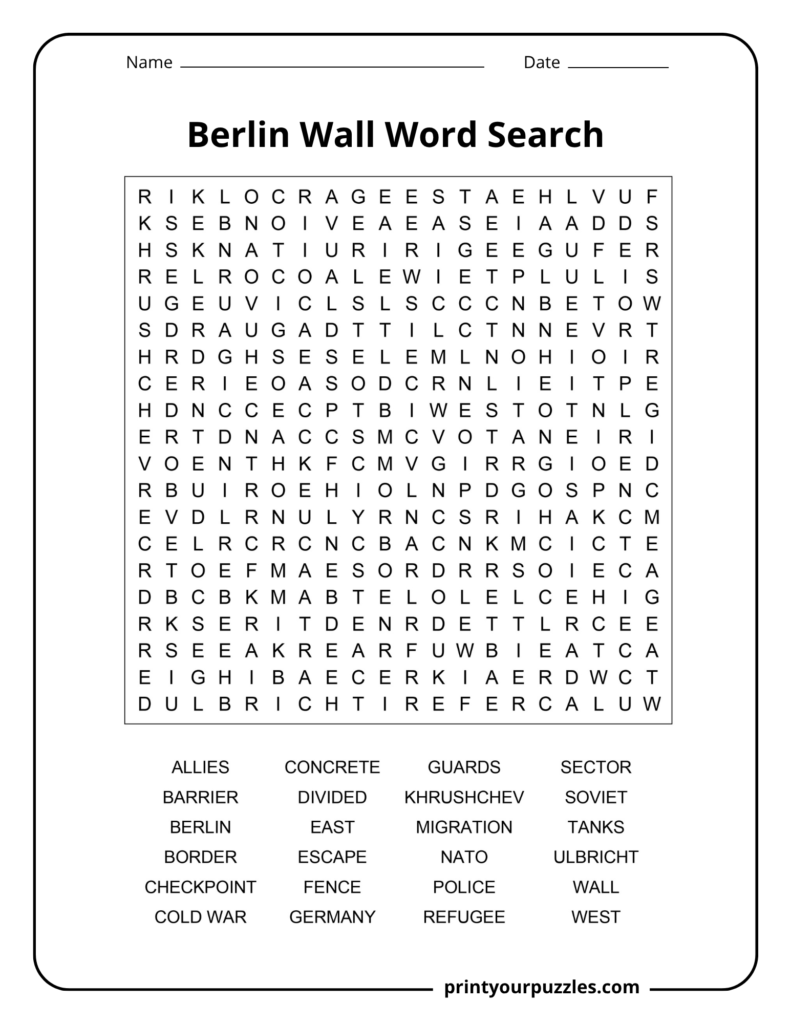
This Berlin Wall word search introduces important people, places, events, and terms connected with the Wall’s construction and its historical background. Understanding why the Berlin Wall was built helps explain the tensions of the Cold War and how political decisions could dramatically affect everyday life. The Wall remained in place until 1989, when dramatic political changes finally opened the border and began a new chapter in German history.
Related Word Searches:
Cold War | John F. Kennedy | Ronald Reagan | Truman Doctrine | Marshall Plan | Cuban Missile Crisis
Medium Difficulty Word Search
Words to Find
ALLIES, BARRIER, BERLIN, BORDER, CHECKPOINT, COLD WAR, CONCRETE, DIVIDED, EAST, ESCAPE, FENCE, GERMANY, GUARDS, KHRUSHCHEV, MIGRATION, NATO, POLICE, REFUGEE, SECTOR, SOVIET, TANKS, ULBRICHT, WALL, WEST
All Words Defined
ALLIES – The victorious World War II powers that occupied Germany after 1945. The United States, Britain, France, and Soviet Union divided Germany and Berlin into separate zones.
BARRIER – A physical obstacle designed to prevent movement across a boundary. The Berlin Wall developed from temporary barriers into a heavily guarded system separating East and West Berlin.
BERLIN – Germany’s capital city and the main location of Cold War division. After World War II, Berlin was split into Soviet, American, British, and French sectors.
BORDER – The dividing line separating East and West Berlin. In August 1961, East German authorities closed much of this border to prevent citizens from escaping westward.
CHECKPOINT – A controlled crossing point where authorized travelers could pass between East and West Berlin. Checkpoints were guarded and became visible symbols of Cold War tension.
COLD WAR – The long political, military, and ideological rivalry between the United States and Soviet Union. The Berlin Wall became one of its most famous symbols.
CONCRETE – Strong building material used to replace the first barbed-wire barriers. Concrete sections eventually formed the most recognizable parts of the Berlin Wall border system.
DIVIDED – Separated into different political areas or groups. Berlin became divided after World War II, and the Wall made that separation far more physical and permanent.
EAST – The communist-controlled side of divided Berlin. East Berlin became the capital of East Germany and was separated from West Berlin by the Berlin Wall.
ESCAPE – An attempt to leave East Germany without official permission. After the Wall was constructed, many people tried dangerous methods to reach West Berlin and freedom.
FENCE – A barrier made from wire or other materials. Fences and barbed wire were among the first structures installed when East Germany closed Berlin’s border.
GERMANY – The European country divided after World War II into East Germany and West Germany. Berlin’s division reflected the wider political separation of the German nation.
GUARDS – Armed personnel stationed along the Berlin Wall and border areas. Their job was to prevent unauthorized crossings and watch for people attempting to escape westward.
KHRUSHCHEV – Nikita Khrushchev was the Soviet leader during the Berlin Wall’s construction. He supported East Germany and played an important role in Cold War Berlin tensions.
MIGRATION – The movement of people from one place to another. Before 1961, large numbers of East Germans migrated through Berlin to reach West Germany.
NATO – The North Atlantic Treaty Organization, a Western military alliance formed in 1949. West Germany later joined NATO, increasing Cold War tensions with the Soviet bloc.
POLICE – East German police helped secure streets, transportation routes, and border areas during construction. They worked alongside soldiers to enforce the sudden closure of Berlin’s border.
REFUGEE – A person who leaves home seeking safety or freedom elsewhere. Many East Germans who fled through Berlin before 1961 were described as refugees.
SECTOR – One of the occupation areas created in Berlin after World War II. The city contained American, British, French, and Soviet sectors controlled by different Allied powers.
SOVIET – Relating to the Soviet Union, the communist superpower controlling East Germany’s occupation zone. Soviet influence strongly shaped East Germany and the division of Berlin.
TANKS – Armored military vehicles used during moments of serious Cold War tension in Berlin. American and Soviet tanks famously faced each other near Checkpoint Charlie.
ULBRICHT – Walter Ulbricht was East Germany’s leader when the Berlin Wall was constructed. His government pushed for stronger border controls to stop people leaving the country.
WALL – The physical barrier constructed by East Germany beginning in August 1961. It separated East and West Berlin and became an enduring Cold War symbol.
WEST – The democratic side of divided Berlin, controlled by the United States, Britain, and France. West Berlin remained politically connected to West Germany during the Cold War.
Hard Difficulty Word Search
Words to Find
ALLIES, BARRIER, BERLIN, BORDER, CHECKPOINT, COLD WAR, CONCRETE, DIVIDED, EAST, ESCAPE, FENCE, GERMANY, GUARDS, KHRUSHCHEV, MIGRATION, NATO, POLICE, REFUGEE, SECTOR, SOVIET, TANKS, ULBRICHT, WALL, WEST
5 Key FAQs About the Berlin Wall
5 Curious "Did You Know?" Facts About the Berlin Wall