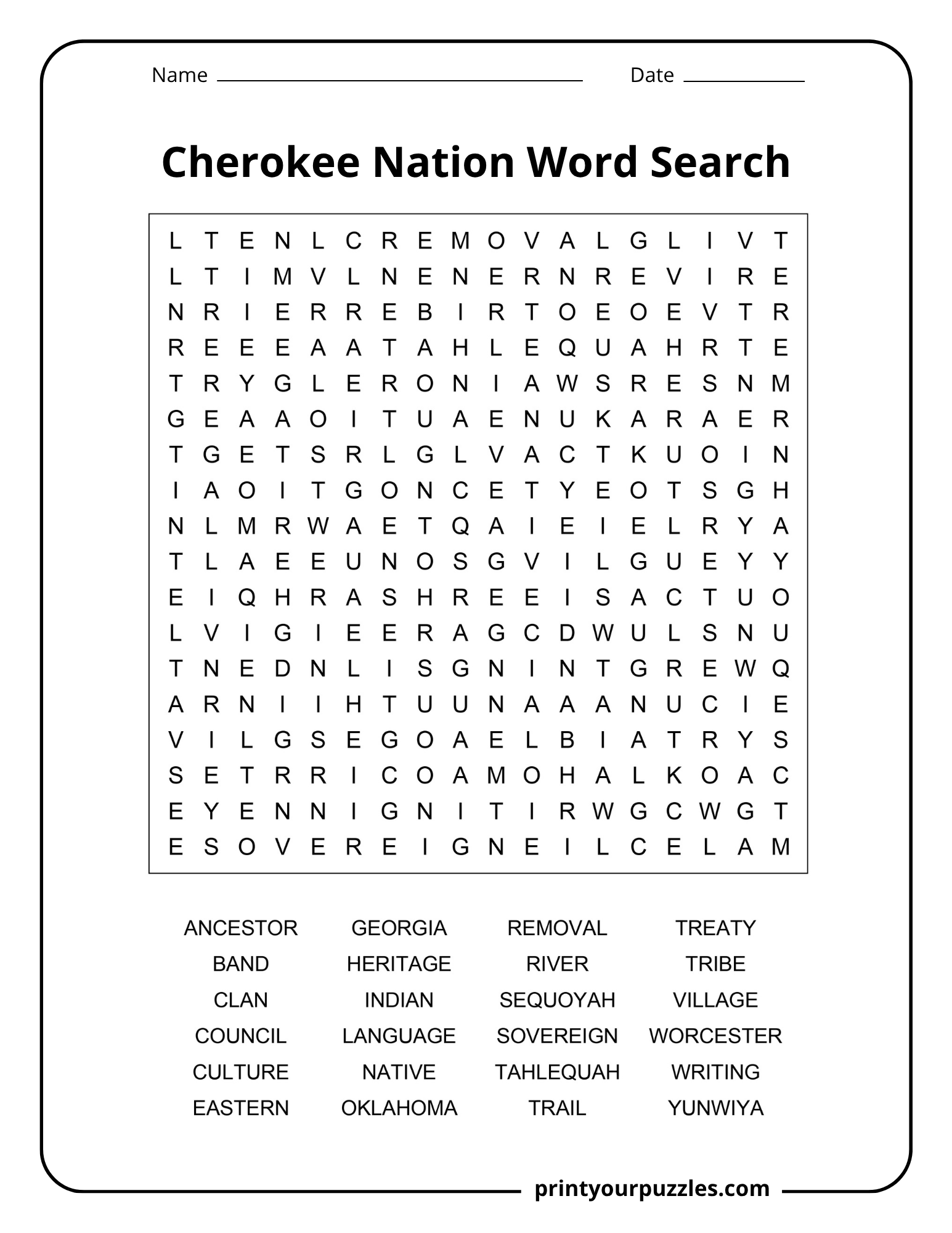

The Cherokee Nation is one of the largest Native American nations in the United States, with a long history shaped by cultural traditions, political organization, forced removal, survival, and renewal. The Cherokee people originally lived across a broad area of the southeastern United States, including parts of present-day Georgia, Tennessee, North Carolina, Alabama, and South Carolina. Their communities developed farming systems, towns, trade networks, and forms of government long before European settlers arrived.
During the early nineteenth century, the Cherokee Nation adopted a written constitution and established a centralized government. One of the most important cultural developments of this period came from Sequoyah, who created the Cherokee syllabary. His writing system made it possible for Cherokee speakers to read and write their own language, contributing to high literacy rates and the publication of the Cherokee Phoenix newspaper beginning in 1828.
Relations with the United States became increasingly difficult as settlers demanded Native lands. Although Cherokee leaders used negotiations and legal challenges to defend their territory, the federal government supported policies designed to relocate Native peoples westward. The Indian Removal Act of 1830 helped pave the way for the forced removal of thousands of Cherokee people.
Between 1838 and 1839, many Cherokee were driven from their southeastern homeland to Indian Territory, in what is now Oklahoma. This journey became known as the Trail of Tears. Thousands suffered from disease, hunger, exposure, and exhaustion, and many died during the removal. The event remains one of the most painful chapters in Cherokee and United States history.
Despite these hardships, the Cherokee people rebuilt their communities and government. Today, the Cherokee Nation is headquartered in Tahlequah, Oklahoma, and operates its own government, schools, health programs, cultural initiatives, and economic enterprises. Efforts to preserve and teach the Cherokee language remain an important part of maintaining cultural identity.
This Cherokee Nation word search introduces important people, places, events, and ideas connected with Cherokee history. As you complete the puzzle, you can explore how the Cherokee Nation developed, how its people responded to removal and other challenges, and how Cherokee culture and government continue to thrive today.
Related US History Word Searches:
Trail of Tears | Indian Removal Act | Native Americans | Andrew Jackson | Westward Expansion | Manifest Destiny
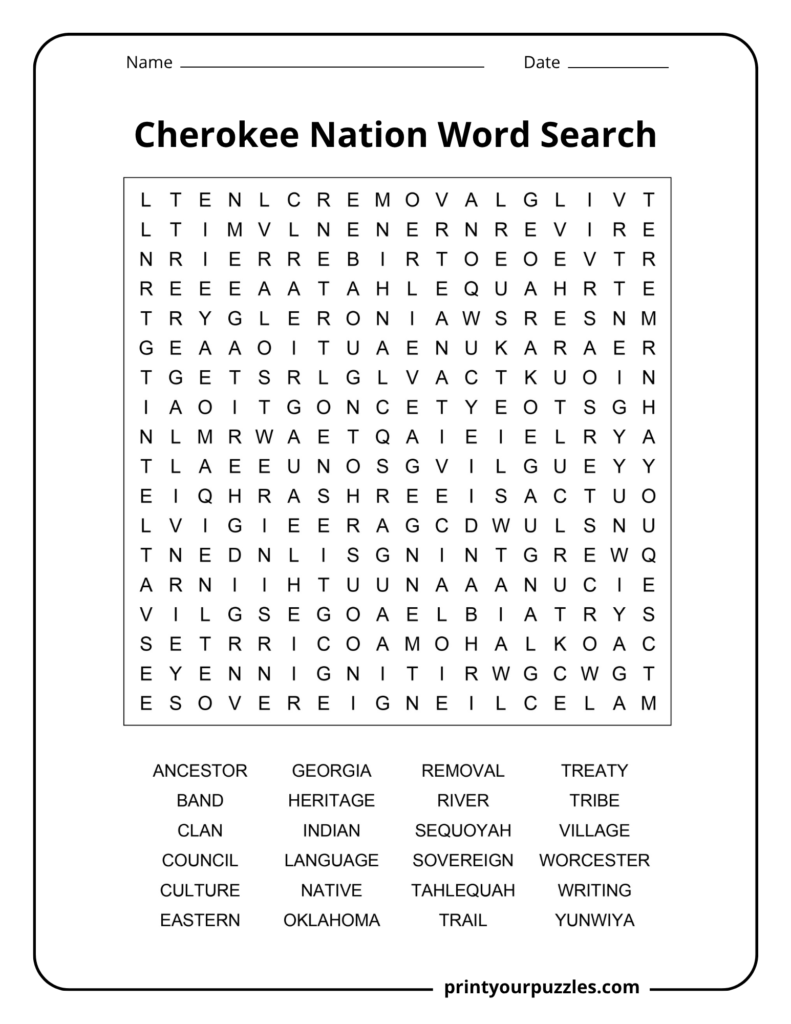
ANCESTOR, BAND, CLAN, COUNCIL, CULTURE, EASTERN, GEORGIA, HERITAGE, INDIAN, LANGUAGE, NATIVE, OKLAHOMA, REMOVAL, RIVER, SEQUOYAH, SOVEREIGN, TAHLEQUAH, TRAIL, TREATY, TRIBE, VILLAGE, WORCESTER, WRITING, YUNWIYA
ANCESTOR – A person from whom someone is descended. Cherokee families honor ancestors through stories, traditions, ceremonies, and cultural knowledge passed carefully from generation to generation.
BAND – A smaller community or group within a larger Native population. Cherokee history includes different communities that maintained local identities while sharing language, traditions, and ancestry.
CLAN – A traditional Cherokee kinship group connecting families through shared ancestry. The seven Cherokee clans historically influenced marriage rules, responsibilities, identity, community relationships, and social organization.
COUNCIL – A governing or advisory body where leaders discuss important issues. Cherokee councils have played major roles in political decisions, laws, diplomacy, and community leadership.
CULTURE – The shared traditions, beliefs, language, arts, customs, and practices of a people. Cherokee culture remains strong through storytelling, ceremonies, crafts, music, and education.
EASTERN – Referring to Cherokee communities connected with the southeastern United States, especially North Carolina, where the Eastern Band of Cherokee Indians maintains its homeland and government.
GEORGIA – Southeastern U.S. state containing part of the Cherokee homeland. During the nineteenth century, Georgia pressured Cherokee communities and sought control over their lands and resources.
HERITAGE – The traditions, history, language, beliefs, and cultural practices inherited from earlier generations. Cherokee heritage is preserved through education, ceremonies, storytelling, museums, and community programs.
INDIAN – Historical term widely used in U.S. laws and official names referring to Native Americans. Today, many people prefer specific tribal names, including Cherokee.
LANGUAGE – A system of communication using spoken or written words. The Cherokee language is an important cultural treasure, supported today through classes, schools, technology, and preservation efforts.
NATIVE – Referring to Indigenous peoples whose communities existed in North America before European colonization. The Cherokee are one of many distinct Native nations with unique traditions.
OKLAHOMA – U.S. state where the Cherokee Nation is headquartered today. Many Cherokee ancestors were forcibly removed there during the nineteenth-century journey known as the Trail of Tears.
REMOVAL – The forced relocation of Native peoples from their homelands. Cherokee removal during the 1830s displaced thousands from the Southeast to Indian Territory, causing suffering and death.
RIVER – A natural flowing waterway important for transportation, farming, fishing, and settlement. Rivers were central to many Cherokee communities throughout their traditional southeastern homeland.
SEQUOYAH – Cherokee scholar who created the Cherokee syllabary in the early nineteenth century, allowing Cherokee speakers to read and write their language using a unique writing system.
SOVEREIGN – Describing the authority of a nation to govern itself. Cherokee sovereignty includes maintaining its own government, laws, courts, elections, services, and relationships with other governments.
TAHLEQUAH – Oklahoma city serving as the capital and governmental center of the Cherokee Nation. It is also an important location for Cherokee education, history, culture, and community life.
TRAIL – A path or route used for travel. In Cherokee history, the word strongly recalls the Trail of Tears and the forced westward removal journey.
TREATY – A formal agreement between governments or nations. Cherokee treaties with the United States addressed land, boundaries, rights, and political relations, although agreements were sometimes violated.
TRIBE – A commonly used term for a Native American political and cultural community. The Cherokee Nation is a federally recognized sovereign tribal government based in Oklahoma.
VILLAGE – A small settlement where people live together. Traditional Cherokee villages often included homes, agricultural areas, gathering places, and communal buildings used for political and ceremonial activities.
WORCESTER – Name associated with *Worcester v. Georgia*, the 1832 Supreme Court case recognizing important limits on Georgia’s authority over Cherokee lands and internal governmental affairs.
WRITING – The representation of language through visible symbols. Cherokee writing became widespread after Sequoyah developed his syllabary, supporting literacy, newspapers, communication, education, and cultural preservation.
YUNWIYA – A Cherokee term connected with the people’s traditional self-identification, often appearing within *Ani-Yunwiya*, generally translated as “Principal People” or “Real People” in English.
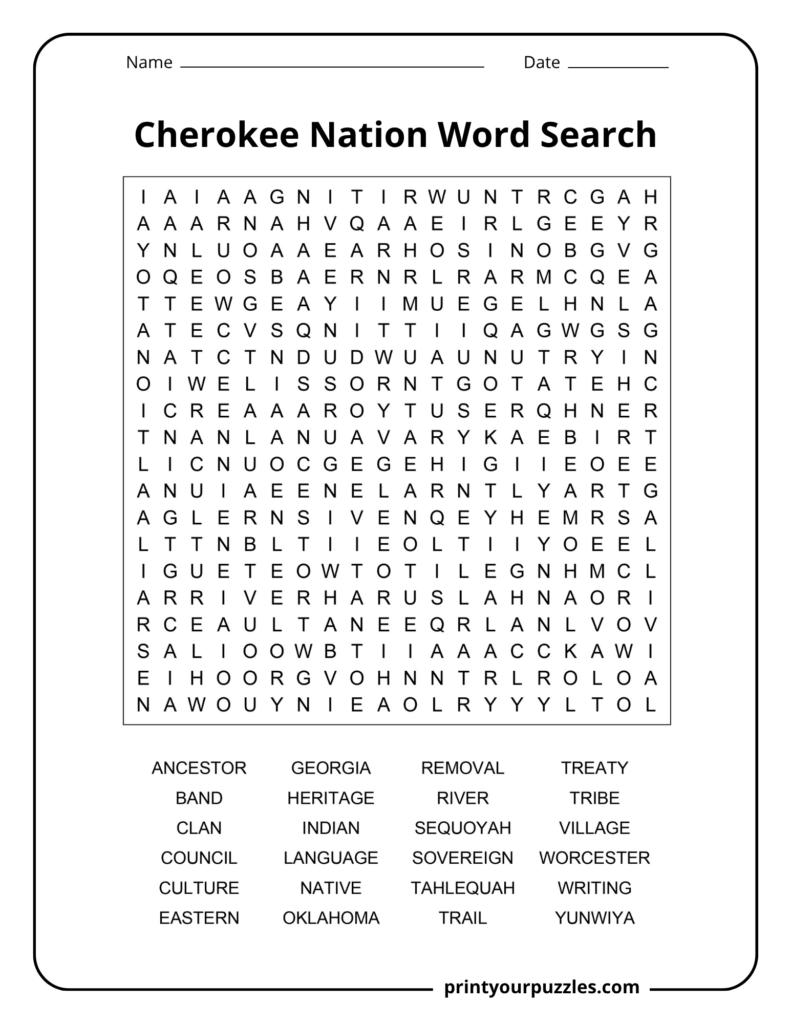
ANCESTOR, BAND, CLAN, COUNCIL, CULTURE, EASTERN, GEORGIA, HERITAGE, INDIAN, LANGUAGE, NATIVE, OKLAHOMA, REMOVAL, RIVER, SEQUOYAH, SOVEREIGN, TAHLEQUAH, TRAIL, TREATY, TRIBE, VILLAGE, WORCESTER, WRITING, YUNWIYA
The Cherokee Nation is a federally recognized Native American tribe headquartered in Tahlequah, Oklahoma, with its own government, services, programs, and cultural institutions.
The Cherokee traditionally lived across parts of present-day Georgia, Tennessee, North Carolina, Alabama, and South Carolina before many were forcibly removed westward.
The Trail of Tears was the forced removal of thousands of Cherokee people to Indian Territory during 1838–1839, causing widespread suffering, disease, and death.
Sequoyah was a Cherokee scholar who created the Cherokee syllabary, a writing system that allowed Cherokee speakers to read and write their own language.
Today, the Cherokee Nation is based in northeastern Oklahoma, with its capital in Tahlequah, where it operates government, education, health, and cultural programs.
Sequoyah created the Cherokee syllabary in the early 1800s, allowing Cherokee speakers to read and write their language using specially designed written characters.
The Cherokee Phoenix began publication in 1828, printing articles in both English and Cherokee and becoming the first Native American newspaper in the United States.
The Cherokee Nation operates a sovereign government with elected leaders, courts, laws, public services, and programs serving Cherokee citizens and communities today.
During the Trail of Tears in 1838–1839, thousands of Cherokee people were removed westward, and many died from disease, hunger, and harsh conditions.
Tahlequah, Oklahoma, serves as the Cherokee Nation’s capital and is an important center for tribal government, education, cultural preservation, and community activities.