Introduction to the D-Day Word Search
D-Day was one of the most important military operations of World War II and a major turning point in the fight against Nazi Germany. On June 6, 1944, Allied forces launched a massive invasion of Nazi-occupied France by landing on the beaches of Normandy. The operation, officially known as Operation Overlord, involved soldiers, sailors, pilots, ships, aircraft, tanks, and equipment from several Allied nations. The United States, the United Kingdom, and Canada played leading roles, while troops and support also came from other Allied countries.
The invasion began before sunrise with airborne troops landing behind German defensive lines. Later that morning, thousands of soldiers crossed the English Channel and approached five designated landing beaches: Utah, Omaha, Gold, Juno, and Sword. American forces landed at Utah and Omaha, British troops attacked Gold and Sword, and Canadian soldiers landed at Juno. Each beach presented different challenges, including fortified bunkers, mines, obstacles, rough seas, and intense German resistance.
Omaha Beach became especially well known because American troops faced extremely heavy defensive fire and suffered serious casualties. Despite these difficulties, Allied soldiers gradually secured positions along the Normandy coast. By the end of June 6, the Allies had established an important foothold in France, allowing more troops, vehicles, weapons, and supplies to arrive during the following days.
D-Day did not immediately end the war. Instead, it opened the way for the larger Battle of Normandy. Allied forces fought through difficult countryside and strong German defenses before eventually breaking out of Normandy and advancing across France. Paris was liberated in August 1944, and Allied armies continued moving toward Germany. Nazi Germany finally surrendered in May 1945.
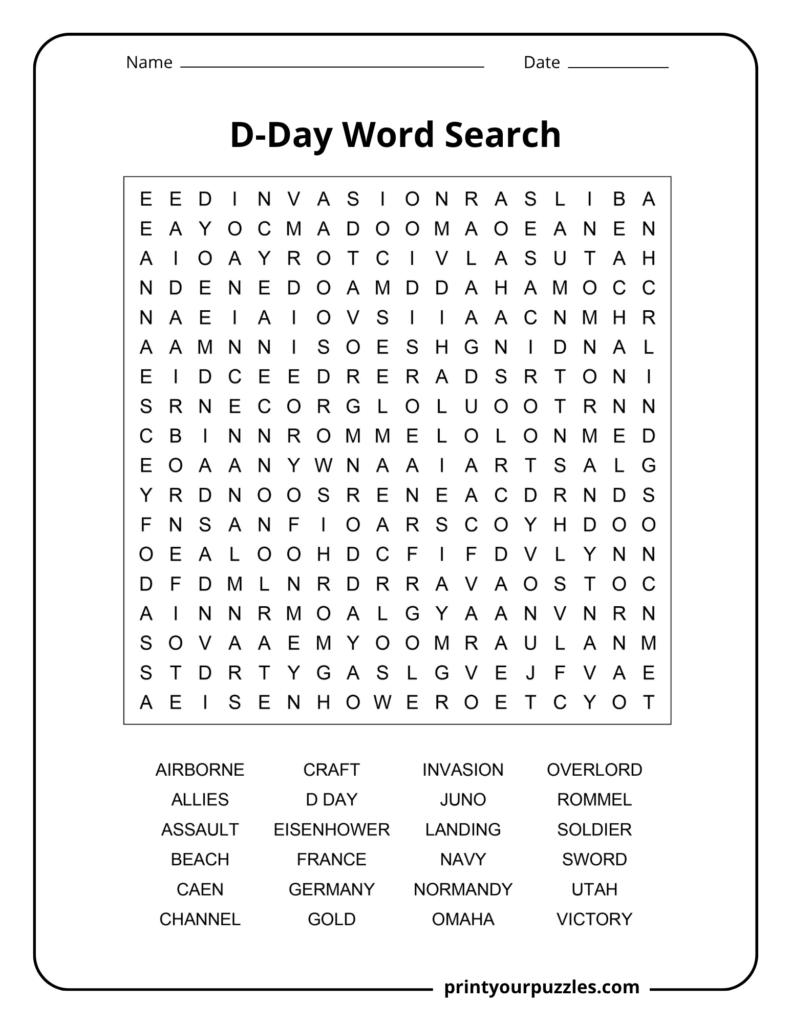
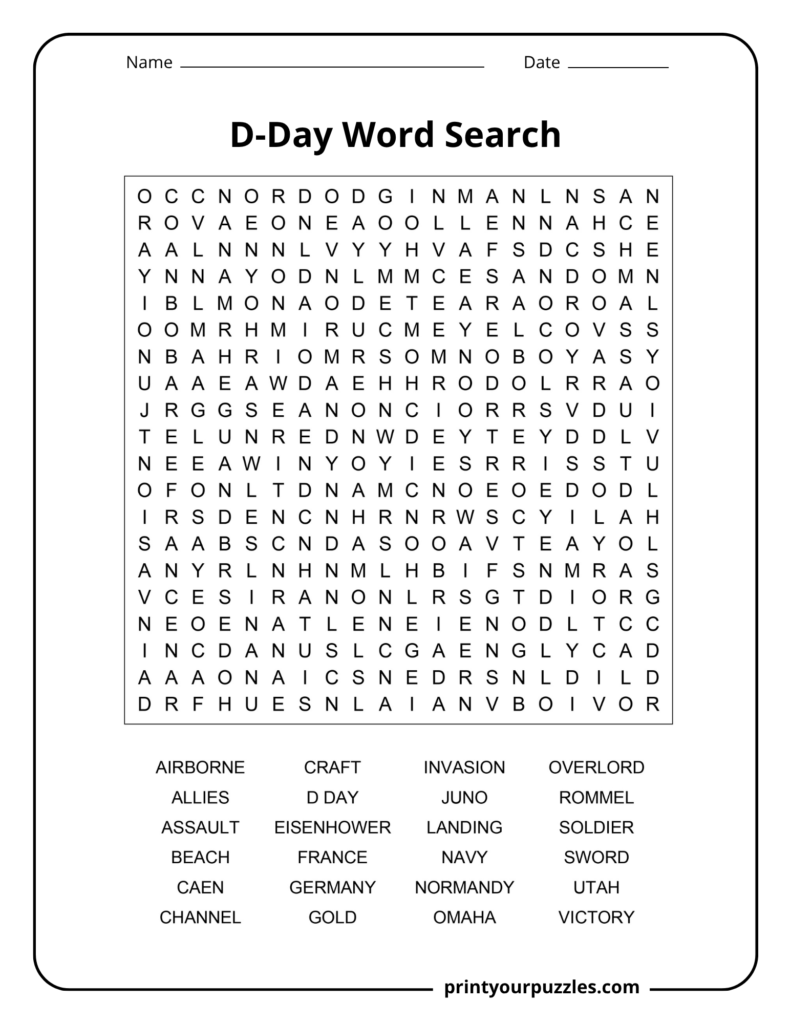
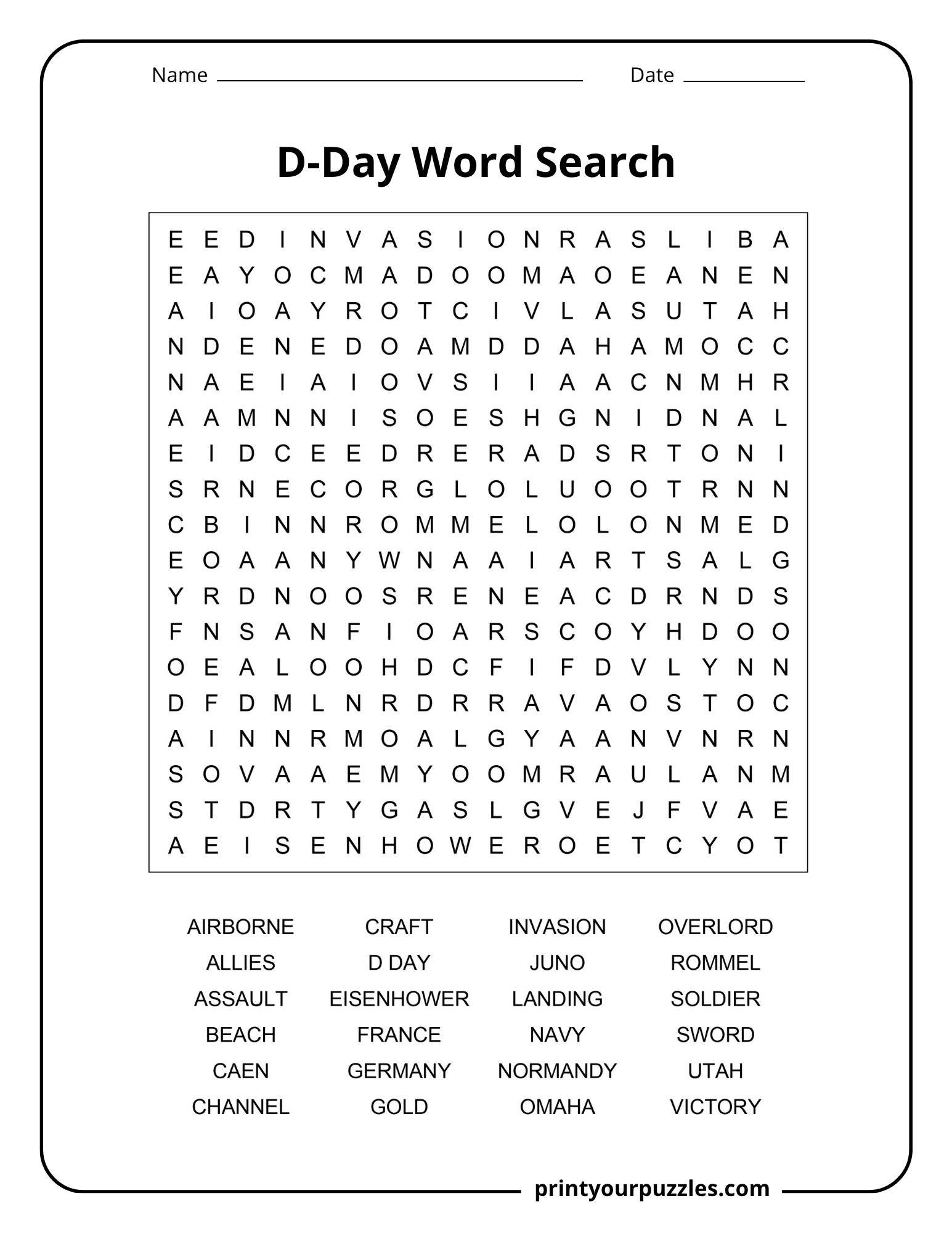
This D-Day word search offers an engaging way to explore key terms connected with the invasion, including military operations, locations, commanders, beaches, and wartime strategy. Learning about these words can help readers better understand the enormous planning and cooperation required for the Normandy landings.
D-Day remains an important historical event because of its scale, its military significance, and the sacrifices made by those who participated. Studying the invasion helps explain how the Allies gained a crucial position in Western Europe and began the long campaign that contributed to the defeat of Nazi Germany.
Related US History Word Searches:
Pearl Harbor | Dwight D. Eisenhower | Franklin D. Roosevelt | Harry S. Truman | Cold War | Marshall Plan
Medium Difficulty Word Search
Words to Find
AIRBORNE, ALLIES, ASSAULT, BEACH, CAEN, CHANNEL, CRAFT, D DAY, EISENHOWER, FRANCE, GERMANY, GOLD, INVASION, JUNO, LANDING, NAVY, NORMANDY, OMAHA, OVERLORD, ROMMEL, SOLDIER, SWORD, UTAH, VICTORY
All Words Defined
AIRBORNE – Military forces trained to enter combat by parachute or aircraft. Airborne troops landed behind German defenses before the main D-Day beach landings began in Normandy.
ALLIES – Nations united against the Axis powers during World War II. The United States, Britain, Canada, and other Allied countries participated in planning and carrying out D-Day.
ASSAULT – A coordinated military attack against an enemy position. The D-Day assault combined naval bombardment, airborne operations, aircraft support, and landings by thousands of Allied soldiers.
BEACH – Coastal area where troops came ashore during the Normandy invasion. Five main landing beaches were assigned code names: Utah, Omaha, Gold, Juno, and Sword.
CAEN – French city in Normandy that became an important Allied objective after D-Day. Heavy fighting around Caen continued for weeks as British and Canadian forces advanced.
CHANNEL – The English Channel separates southern England from northern France. Allied ships crossed these waters during D-Day while transporting soldiers, vehicles, weapons, and supplies toward Normandy.
CRAFT – Specialized landing vessels used to transport troops and equipment from larger ships toward Normandy beaches. Landing craft played an essential role during the D-Day invasion.
D-DAY – Name commonly used for June 6, 1944, when Allied forces invaded Normandy. D-Day marked the beginning of the major campaign to liberate Western Europe.
EISENHOWER – Dwight D. Eisenhower was the Supreme Allied Commander responsible for overseeing Operation Overlord. He approved the final decision to launch the Normandy invasion on June 6.
FRANCE – Western European country occupied by Nazi Germany during much of World War II. D-Day began the large-scale Allied campaign to liberate France from German occupation.
GERMANY – European nation ruled by Adolf Hitler and the Nazi regime during World War II. German forces defended Normandy against the Allied invasion launched on D-Day.
GOLD – One of the five D-Day landing beaches in Normandy. British forces landed at Gold Beach and fought to secure positions while advancing inland against German defenses.
INVASION – Large military operation in which armed forces enter enemy-controlled territory. The Normandy invasion brought Allied troops into occupied France and opened a Western European front.
JUNO – D-Day landing beach assigned mainly to Canadian forces. Soldiers faced German defenses, obstacles, and rough conditions before advancing inland and establishing important positions in Normandy.
LANDING – The arrival of military forces on enemy-held territory by sea or air. D-Day involved enormous amphibious landings supported by airborne troops and naval forces.
NAVY – Branch of the armed forces responsible for operations at sea. Allied navies transported troops, protected convoys, bombarded German defenses, and supported the D-Day landings.
NORMANDY – Region of northern France chosen for the Allied invasion of June 1944. Its coastline contained the five principal beaches used during the historic D-Day landings.
OMAHA – American D-Day landing beach where troops encountered especially strong German resistance. Heavy defensive fire caused severe casualties before United States forces gradually secured the area.
OVERLORD – Code name for the Allied campaign to invade Normandy and establish forces in France. Operation Overlord included extensive planning, deception, airborne attacks, and amphibious landings.
ROMMEL – German Field Marshal Erwin Rommel commanded forces responsible for defending parts of Western Europe. He strengthened coastal fortifications intended to stop an expected Allied invasion.
SOLDIER – Member of an army trained for military service and combat. Thousands of Allied soldiers landed in Normandy on D-Day, facing dangerous obstacles, gunfire, and fortified defenses.
SWORD – Easternmost of the five principal D-Day landing beaches. British troops landed at Sword Beach with objectives including advancing toward Caen and linking with airborne forces.
UTAH – Westernmost D-Day landing beach, assigned to American forces. United States troops landed slightly away from their planned position but successfully established a strong foothold.
VICTORY – Successful outcome in a conflict or military operation. D-Day helped the Allies establish a foothold in France, contributing eventually to victory over Nazi Germany.
Hard Difficulty Word Search
Words to Find
AIRBORNE, ALLIES, ASSAULT, BEACH, CAEN, CHANNEL, CRAFT, D DAY, EISENHOWER, FRANCE, GERMANY, GOLD, INVASION, JUNO, LANDING, NAVY, NORMANDY, OMAHA, OVERLORD, ROMMEL, SOLDIER, SWORD, UTAH, VICTORY
5 Key FAQs About the D-Day
5 Curious "Did You Know?" Facts About the D-Day