
The Napoleonic Wars were a series of major conflicts that reshaped Europe during the early nineteenth century. Fought mainly between 1803 and 1815, they involved France, led by Napoleon Bonaparte, and several changing coalitions of European powers, including Britain, Austria, Prussia, Russia, Spain, and Portugal. The wars grew out of the political upheaval caused by the French Revolution and Napoleon’s rise to power, eventually spreading across much of Europe and beyond.
Napoleon became famous for his military skill, rapid campaigns, and ability to defeat larger enemy forces. His armies won important victories at battles such as Austerlitz, Jena, and Wagram, allowing France to dominate large parts of continental Europe. Napoleon also reorganized territories, placed relatives and allies on foreign thrones, and introduced legal and administrative reforms influenced by the Napoleonic Code.
However, French control created strong resistance. In Spain and Portugal, local fighters used guerrilla warfare against French troops during the Peninsular War. Britain remained Napoleon’s most persistent enemy and used its powerful navy to protect trade routes and challenge French expansion. The British victory at the Battle of Trafalgar in 1805 prevented Napoleon from gaining control of the seas.
One of the most important turning points came in 1812, when Napoleon invaded Russia. The campaign ended disastrously as the French army suffered from supply shortages, combat losses, disease, and extreme winter conditions. European powers then joined together more effectively against France. Napoleon was defeated, forced to abdicate in 1814, and sent into exile on the island of Elba.
He returned briefly in 1815 during the period known as the Hundred Days, but his final defeat came at the Battle of Waterloo. Napoleon was then exiled to Saint Helena, where he spent the rest of his life.
After Napoleon’s defeat, European leaders met at the Congress of Vienna to redraw borders and restore political stability. Their decisions influenced international relations for decades, while the wars also encouraged nationalism, military reform, and new political ideas across Europe.
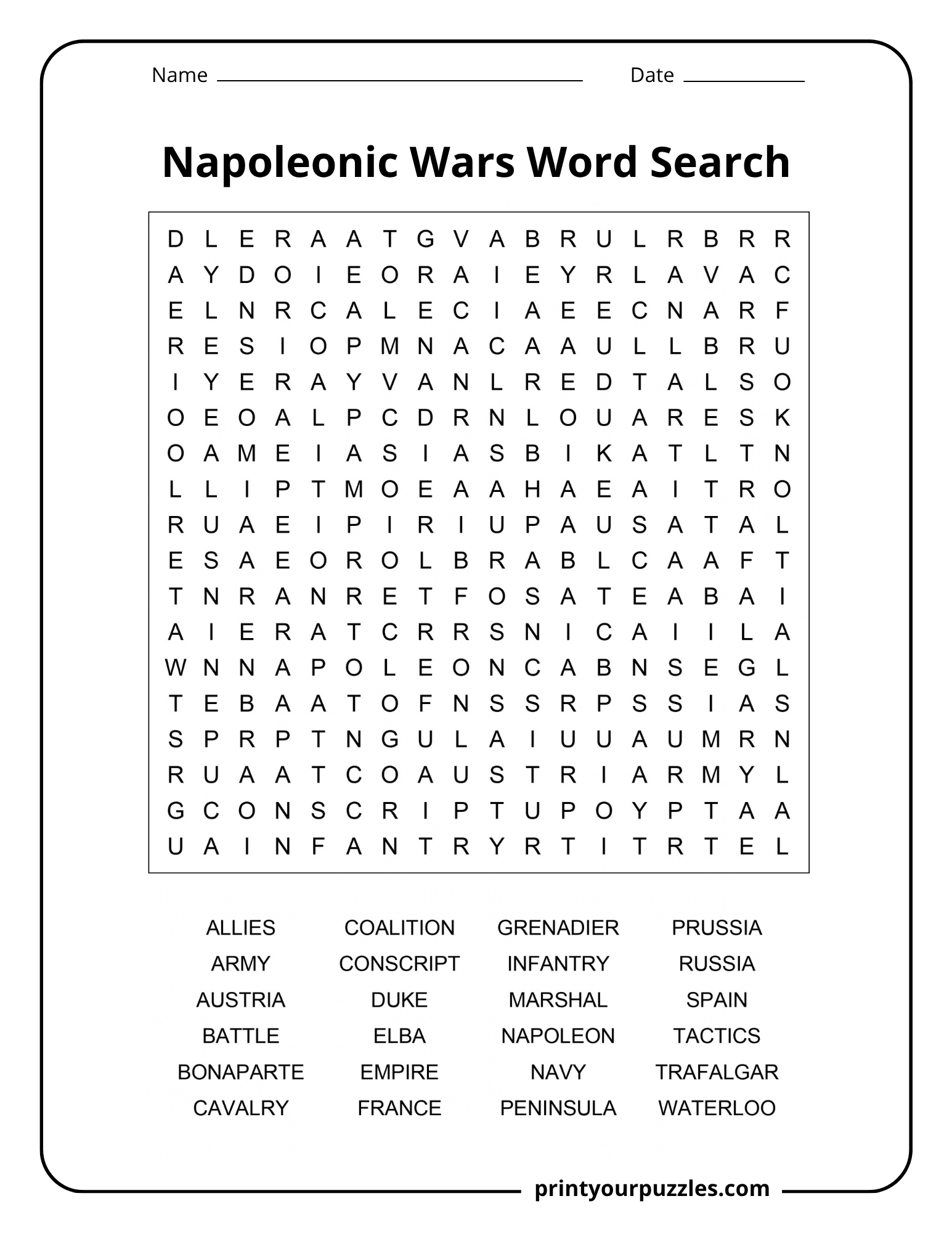
This Napoleonic Wars word search introduces key people, battles, places, armies, and ideas connected with this dramatic period. It offers an engaging way to review how Napoleon rose, how his empire expanded, and why it eventually collapsed, while exploring events that changed European politics for generations.
Related Word Searches:
French Revolution | American Revolution | Industrial Revolution | Enlightenment | Spanish Civil War | Russian Revolution
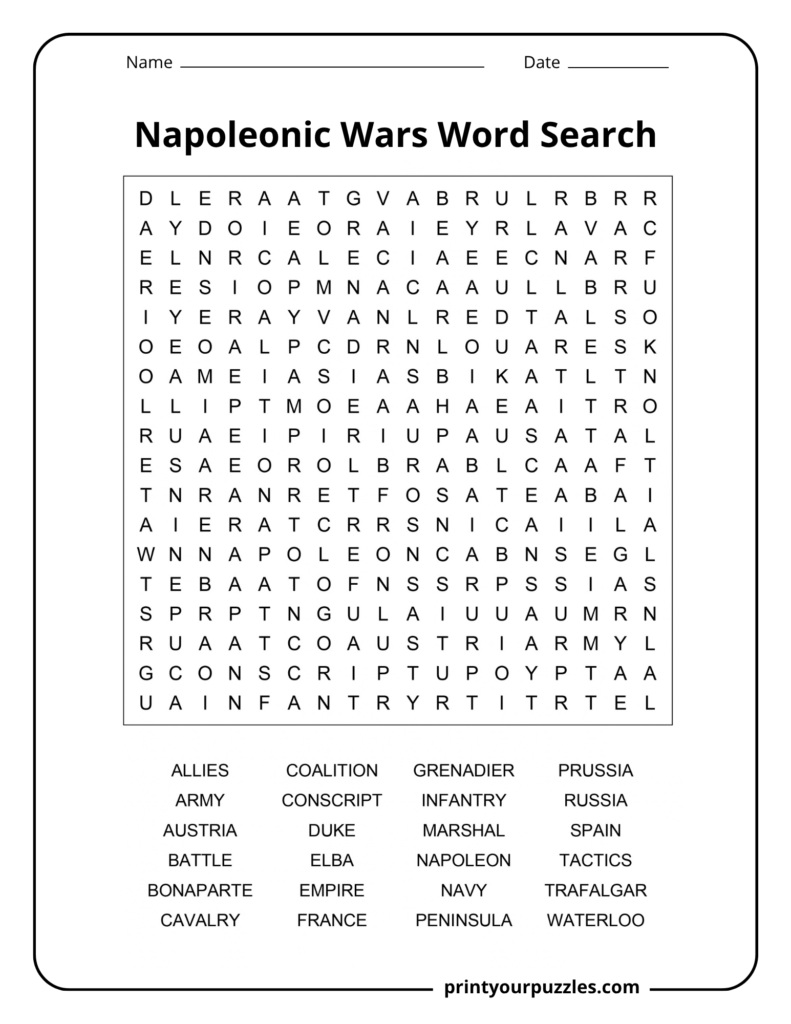
ALLIES, ARMY, AUSTRIA, BATTLE, BONAPARTE, CAVALRY, COALITION, CONSCRIPT, DUKE, ELBA, EMPIRE, FRANCE, GRENADIER, INFANTRY, MARSHAL, NAPOLEON, NAVY, PENINSULA, PRUSSIA, RUSSIA, SPAIN, TACTICS, TRAFALGAR, WATERLOO
ALLIES – Nations or military forces that cooperated against Napoleon and France, especially Britain, Austria, Prussia, and Russia, often joining together in changing European coalitions.
ARMY – Organized military force used by Napoleon and his enemies in campaigns across Europe, including infantry, cavalry, artillery, officers, and large numbers of conscripted soldiers.
AUSTRIA – Major European power that repeatedly fought Napoleon in several coalitions, suffering important defeats but later helping bring about the collapse of his empire.
BATTLE – Armed confrontation between opposing forces, often deciding control of territory, weakening armies, or changing the direction of major campaigns during the Napoleonic Wars.
BONAPARTE – Family name of Napoleon, the French military leader and emperor whose campaigns, reforms, and ambitions transformed European politics during the early nineteenth century.
CAVALRY – Soldiers who fought on horseback and were used for scouting, rapid attacks, pursuing retreating enemies, protecting flanks, and breaking weakened formations on battlefields.
COALITION – Alliance of several countries formed to oppose Napoleon and France, with different coalitions appearing throughout the wars as European powers coordinated military campaigns.
CONSCRIPT – Person required by law to serve in the military, helping Napoleon build enormous armies by drawing large numbers of young men into French service.
DUKE – Noble title held by several important figures of the period, including the Duke of Wellington, who commanded British-led forces against Napoleon at Waterloo.
ELBA – Mediterranean island where Napoleon was exiled in 1814 after his first abdication, before escaping and returning to France for the Hundred Days.
EMPIRE – Territory ruled by an emperor; Napoleon’s French Empire expanded across much of Europe through conquest, alliances, political control, and the creation of dependent states.
FRANCE – Country ruled by Napoleon during most of the wars and the center of his military, political, and administrative efforts to dominate much of Europe.
GRENADIER – Elite infantry soldier traditionally associated with throwing grenades, though during the Napoleonic era grenadiers were mainly experienced troops chosen for strength and courage.
INFANTRY – Foot soldiers who formed the largest part of Napoleonic armies, fighting with muskets and bayonets in lines, columns, squares, and other battlefield formations.
MARSHAL – High-ranking military commander in Napoleon’s army, often entrusted with leading major forces, campaigns, or battlefield sections under the emperor’s overall strategic direction.
NAPOLEON – French general, emperor, and central figure of the Napoleonic Wars, known for military victories, political reforms, territorial expansion, and eventual defeat and exile.
NAVY – Sea-based military force used especially by Britain to protect trade, transport troops, blockade French ports, and prevent Napoleon from dominating European waters.
PENINSULA – Reference to the Iberian Peninsula, where France fought Britain, Portugal, and Spanish resistance forces in the long and costly Peninsular War.
PRUSSIA – German kingdom that fought Napoleon, suffered severe defeat in 1806, reorganized its military, and later played an important role in his final defeat.
RUSSIA – Powerful empire invaded by Napoleon in 1812; its resistance, vast distances, supply problems, and harsh conditions contributed heavily to the destruction of his army.
SPAIN – Country occupied by Napoleon’s forces, where regular armies and guerrilla fighters resisted French rule during the difficult and prolonged Peninsular War.
TACTICS – Methods used to position and move troops during battle, including formations, artillery placement, cavalry charges, flanking attacks, and rapid concentration of military forces.
TRAFALGAR – Major naval battle fought in 1805 where Britain, led by Admiral Nelson, defeated French and Spanish fleets and secured British naval superiority.
WATERLOO – Battle fought in Belgium in 1815 where Napoleon was decisively defeated by forces led by Wellington and Blücher, ending his return to power.
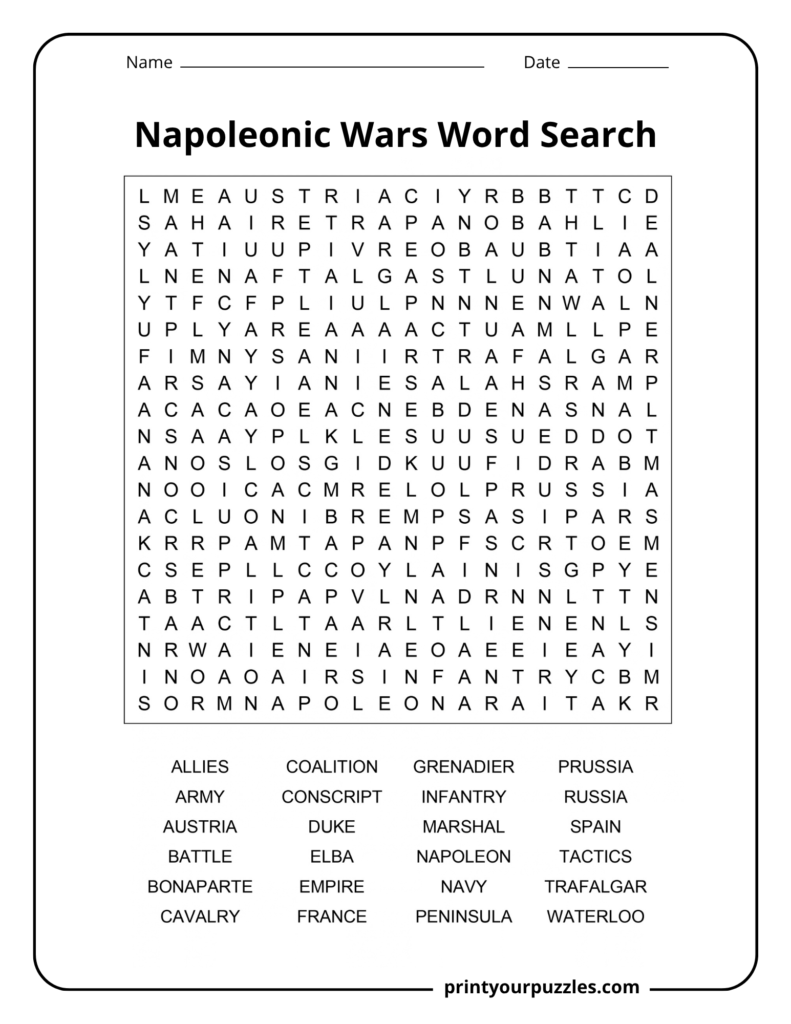
ALLIES, ARMY, AUSTRIA, BATTLE, BONAPARTE, CAVALRY, COALITION, CONSCRIPT, DUKE, ELBA, EMPIRE, FRANCE, GRENADIER, INFANTRY, MARSHAL, NAPOLEON, NAVY, PENINSULA, PRUSSIA, RUSSIA, SPAIN, TACTICS, TRAFALGAR, WATERLOO
The Napoleonic Wars were conflicts fought from 1803 to 1815 between Napoleon’s France and changing coalitions of European powers seeking to limit French expansion.
They grew from tensions created by the French Revolution, Napoleon’s rise to power, French territorial expansion, and efforts by European monarchies to contain France.
Britain, Austria, Prussia, Russia, Spain, Portugal, and several other states joined different coalitions against France at various stages of the wars.
Napoleon’s 1812 invasion of Russia became disastrous because of combat losses, supply shortages, disease, exhaustion, retreat, and severe winter conditions.
The wars ended after Napoleon’s defeat at Waterloo in 1815, followed by his second abdication and permanent exile to the island of Saint Helena.
Napoleon escaped from Elba in 1815, returned to France, regained power, and ruled during the Hundred Days before his final defeat at Waterloo.
Britain repeatedly fought against Napoleon, financed European coalitions, used its powerful navy effectively, and played a major role in his eventual military defeat.
Fighting in Spain and Portugal forced France to commit large numbers of troops while local guerrillas and British forces continually challenged French control.
Napoleon became emperor in 1804 during a ceremony in Paris, strengthening his personal authority and beginning a new phase of French imperial expansion.
The Battle of Waterloo took place in present-day Belgium in 1815, where Napoleon was defeated by allied forces commanded by Wellington and Blücher.