
Saint Patrick’s Day is celebrated every year on March 17 in honor of Saint Patrick, the patron saint of Ireland. What began as a religious feast day has grown into an international celebration of Irish history, culture, music, food, and identity. It is observed most strongly in Ireland, but parades and community events also take place in the United States, Canada, Australia, and many other countries.
Saint Patrick lived during the fifth century and is traditionally credited with helping spread Christianity in Ireland. Although many details of his life are uncertain, stories about him became an important part of Irish tradition. One famous legend says that he used a three-leaf clover, or shamrock, to explain the Christian idea of the Holy Trinity. Another popular story claims that he drove all the snakes out of Ireland, although the island probably had no native snakes during his lifetime.
The shamrock remains one of the best-known symbols of the occasion. Green is also strongly associated with Saint Patrick’s Day because of Ireland’s landscapes, national identity, and nickname as the Emerald Isle. People may wear green clothing, hats, beads, or accessories, while streets, buildings, rivers, and landmarks are sometimes illuminated or decorated in green.
Parades are a major part of modern celebrations. They often include marching bands, dancers, floats, flags, and groups representing Irish organizations. Traditional Irish music, step dancing, storytelling, and cultural performances help create a lively atmosphere. In some communities, churches hold services that remember the religious origins of the day.
Food traditions vary widely. Families and restaurants may serve Irish dishes such as soda bread, potatoes, stews, or colcannon. Corned beef and cabbage is especially associated with Irish American celebrations, although it is less traditional in Ireland itself. Festivals may also feature crafts, historical displays, and activities for children.
Saint Patrick’s Day can be both festive and educational. It offers an opportunity to learn about Ireland’s history, folklore, language, migration, and cultural influence around the world.
Celebrate the symbols, stories, music, colors, and traditions of March 17 with this Saint Patrick’s Day word search puzzle, featuring 24 carefully selected words inspired by shamrocks, parades, Ireland, legends, dancing, green decorations, and Irish heritage.
Related Word Searches:
March | Spring | Mardi Gras | Easter | April Fools’ Day
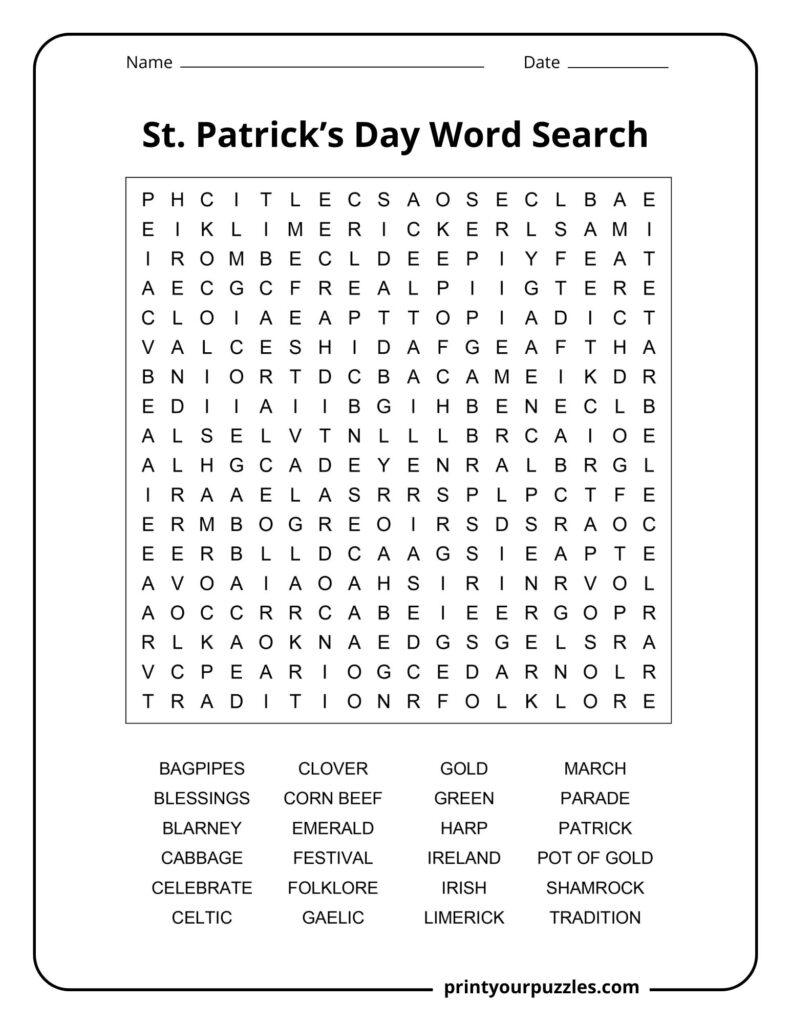
BAGPIPES, BLESSINGS, BLARNEY, CABBAGE, CELEBRATE, CELTIC, CLOVER, CORN BEEF, EMERALD, FESTIVAL, FOLKLORE, GAELIC, GOLD, GREEN, HARP, IRELAND, IRISH, LIMERICK, MARCH, PARADE, PATRICK, POT OF GOLD, SHAMROCK, TRADITION
BAGPIPES – Traditional Scottish and Irish musical instrument consisting of reed pipes and a bag that produces distinctive droning sounds, commonly played at Celtic celebrations and parades.
BLESSINGS – Prayers, good wishes, or divine favor invoked for protection and prosperity, often associated with Irish traditions and the religious aspects of St. Patrick’s Day celebrations.
BLARNEY – Skillful flattery or smooth, clever talk originating from Ireland’s Blarney Castle, where kissing the famous stone supposedly grants the gift of eloquent speech.
CABBAGE – Leafy green vegetable traditionally served with corned beef on St. Patrick’s Day, representing Irish-American culinary traditions, though not authentically Irish in this pairing.
CELEBRATE – To honor and observe St. Patrick’s Day through festivities, parades, wearing green, and participating in Irish cultural traditions worldwide on March seventeenth annually.
CELTIC – Relating to the ancient Celts and their descendants, including Irish, Scottish, and Welsh people, encompassing their languages, art, music, and rich cultural heritage.
CLOVER – Small plant with characteristic three-leafed formation, symbolizing the Holy Trinity in Irish tradition; the rare four-leaf variety represents extraordinary good luck.
CORN BEEF – Salt-cured beef brisket, often served with cabbage on St. Patrick’s Day in America, representing Irish-American immigrant cuisine rather than traditional Irish fare.
EMERALD – Precious green gemstone that gives Ireland its nickname “The Emerald Isle” due to the country’s lush, verdant landscape and rolling green countryside.
FESTIVAL – Large-scale celebration featuring parades, music, dancing, food, and cultural activities held annually to commemorate St. Patrick and honor Irish heritage and traditions.
FOLKLORE – Traditional Irish stories, legends, myths, and superstitions passed down through generations, featuring leprechauns, fairies, and tales of ancient Celtic heroes and magical lands.
GAELIC – Ancient Celtic language spoken in Ireland and Scotland, representing Irish cultural identity and heritage, still taught and used in certain regions today.
GOLD – Precious metal associated with leprechaun legends and the mythical treasure found at rainbow’s end, symbolizing luck and wealth in Irish folklore traditions.
GREEN – The symbolic color of Ireland and St. Patrick’s Day, representing the island’s lush landscapes, Irish pride, and worn worldwide to celebrate Irish heritage.
HARP – Ireland’s national symbol and traditional musical instrument, featured on Irish coins and official emblems, producing beautiful melodic sounds in Celtic music performances.
IRELAND – Island nation in the North Atlantic, known for its rich culture, history, stunning landscapes, and as the birthplace of St. Patrick’s Day celebrations worldwide.
IRISH – Relating to Ireland, its people, language, and culture, celebrated globally on St. Patrick’s Day through traditions, music, dance, and displays of national pride.
LIMERICK – Five-line humorous poem with distinctive AABBA rhyme scheme, originating from Ireland’s Limerick city, known for its witty, often nonsensical or playful verses.
MARCH – The third month of the year when St. Patrick’s Day is celebrated on the seventeenth, marking spring’s arrival with Irish festivities worldwide.
PARADE – Public procession featuring marching bands, dancers, floats, and costumed participants celebrating St. Patrick’s Day, with major events held in Dublin, New York, and globally.
PATRICK – Patron saint of Ireland who lived in the fifth century, credited with bringing Christianity to Ireland and celebrated annually on March seventeenth.
POT OF GOLD – Legendary treasure hidden at rainbow’s end, guarded by leprechauns in Irish folklore, symbolizing elusive riches, dreams, and the magic of Irish mythology.
SHAMROCK – Three-leafed clover plant, Ireland’s national symbol, reportedly used by St. Patrick to explain the Holy Trinity, worn proudly on St. Patrick’s Day celebrations.
TRADITION – Customs, beliefs, and practices passed down through Irish generations, including storytelling, music, dance, and festive celebrations maintaining cultural identity and heritage.
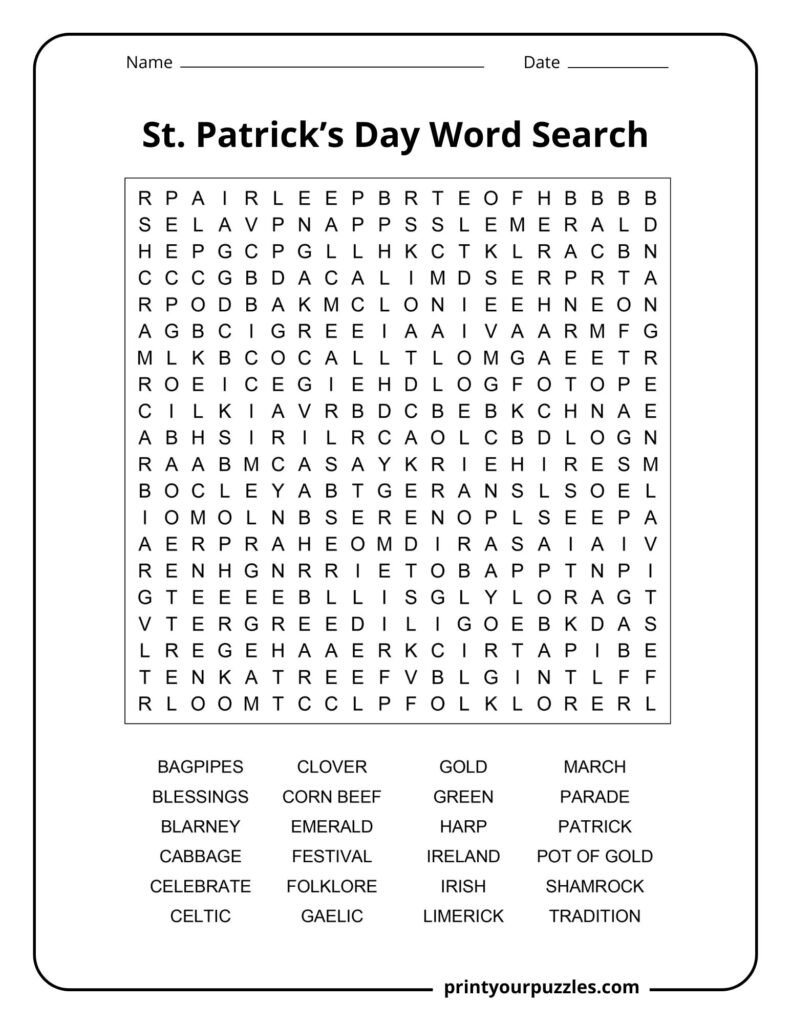
BAGPIPES, BLESSINGS, BLARNEY, CABBAGE, CELEBRATE, CELTIC, CLOVER, CORN BEEF, EMERALD, FESTIVAL, FOLKLORE, GAELIC, GOLD, GREEN, HARP, IRELAND, IRISH, LIMERICK, MARCH, PARADE, PATRICK, POT OF GOLD, SHAMROCK, TRADITION
St. Patrick’s Day is celebrated annually on March 17th, marking the traditional death date of Saint Patrick, Ireland’s patron saint who died circa 461 AD.
Saint Patrick was a fifth-century Christian missionary who brought Christianity to Ireland. He’s credited with using the shamrock to explain the Holy Trinity to Irish pagans.
Green represents Ireland’s lush landscapes and national identity. Wearing green shows Irish pride and solidarity. Legend says it also makes you invisible to mischievous leprechauns pinching people.
The shamrock, a three-leafed clover, is Ireland’s national symbol. Saint Patrick reportedly used it as a visual metaphor to teach the concept of the Holy Trinity to Irish people.
No, St. Patrick’s Day is celebrated worldwide, especially in countries with Irish diaspora populations. Major parades and festivities occur in the United States, Canada, Australia, and numerous other nations.
Saint Patrick was born in Roman Britain, possibly Scotland or Wales. He was kidnapped by Irish raiders at age sixteen and enslaved in Ireland before escaping and later returning as a missionary.
St. Patrick’s traditional color was “St. Patrick’s Blue,” seen in ancient Irish flags and illustrations. Green became prominent later through Ireland’s nickname and nationalist movements during the eighteenth century.
This popular St. Patrick’s Day meal is actually Irish-American. In Ireland, people traditionally ate bacon and cabbage. Irish immigrants in America substituted cheaper corned beef from Jewish delis.
Since 1962, Chicago has used eco-friendly vegetable dye to turn the Chicago River emerald green each March. The tradition started accidentally when plumbers used dye to trace pollution sources.
Ireland never had snakes due to its island geography and Ice Age climate. The “snakes” St. Patrick supposedly banished likely symbolize pagan beliefs he converted to Christianity throughout Ireland.