
A volcano is an opening in Earth’s surface through which melted rock, gases, ash, and other materials can escape from deep underground. Volcanoes are usually found in places where sections of Earth’s crust, called tectonic plates, meet or move apart. They can also form above unusually hot areas inside the planet known as hotspots.
Beneath Earth’s surface, temperatures are high enough to melt some rock and create magma. Because magma is lighter than the solid rock around it, it may rise through cracks in the crust. When pressure builds, the magma can reach the surface and cause a volcanic eruption. Once magma comes out of a volcano, it is called lava. Lava may flow slowly down the sides of the volcano or burst into the air during a more explosive eruption.
Volcanoes come in several shapes and sizes. Shield volcanoes are wide with gentle slopes and usually produce flowing lava. Composite volcanoes, also called stratovolcanoes, are tall, steep, and built from layers of lava and ash. They can produce powerful eruptions. Cinder cone volcanoes are generally smaller and form when pieces of lava and rock fall around a volcanic opening.
Volcanoes may be described as active, dormant, or extinct. An active volcano is erupting or may erupt again. A dormant volcano has not erupted for a long time but could become active in the future. An extinct volcano is not expected to erupt again. However, predicting volcanic activity can be difficult, so scientists carefully monitor changes in earthquakes, gases, temperature, and the shape of the ground.
Volcanic eruptions can be dangerous because they may produce lava flows, clouds of hot ash, falling rocks, toxic gases, and fast-moving mixtures of gas and debris called pyroclastic flows. At the same time, volcanoes also provide benefits. Volcanic material can create fertile soil, form new land, produce useful minerals, and supply geothermal energy.
Completing our volcano word search puzzle can help learners recognize important terms such as magma, lava, crater, ash, eruption, vent, and tectonic plates. Understanding this vocabulary makes it easier to explore how volcanoes form, why they erupt, and how they continue to shape Earth’s surface.
Related Word Searches:
Plate Tectonics | Earth Layers | Rock Cycle | Erosion | States of Matter | Energy
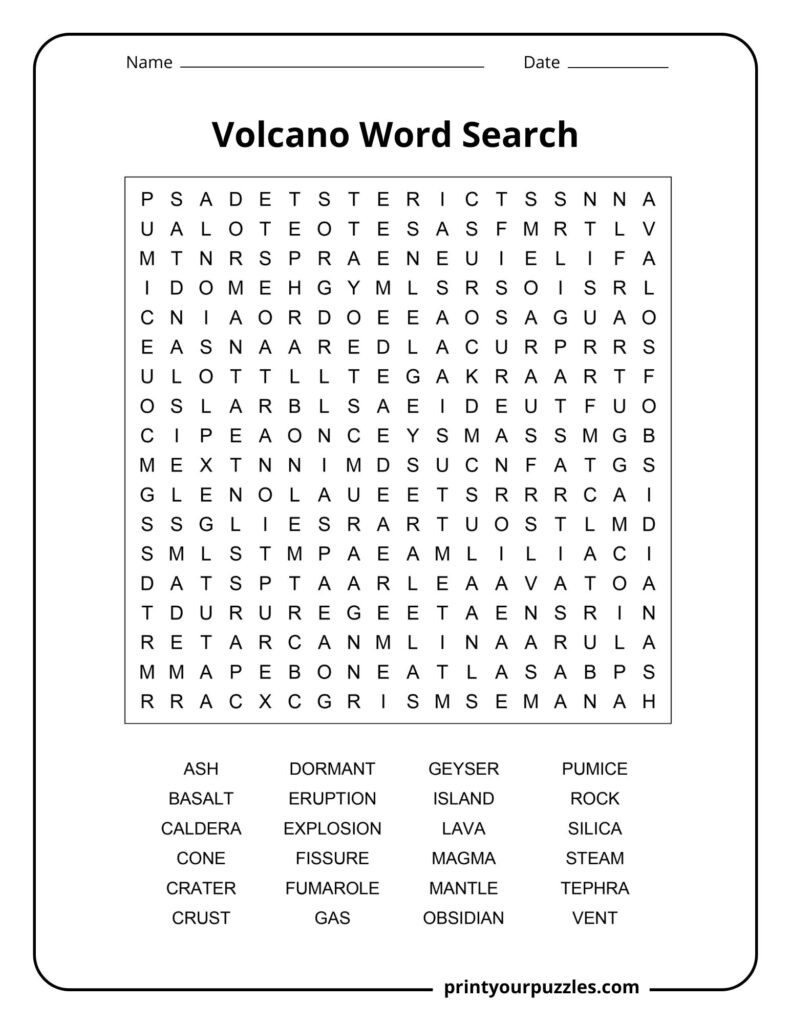
ASH, BASALT, CALDERA, CONE, CRATER, CRUST, DORMANT, ERUPTION, EXPLOSION, FISSURE, FUMAROLE, GAS, GEYSER, ISLAND, LAVA, MAGMA, MANTLE, OBSIDIAN, PUMICE, ROCK, SILICA, STEAM, TEPHRA, VENT
ASH – Fine particles of pulverized rock, minerals, and volcanic glass expelled during an eruption, often forming clouds that can travel great distances and blanket surrounding areas.
BASALT – A dark, fine-grained volcanic rock formed from rapidly cooled lava, commonly found in oceanic crust and one of the most abundant rock types on Earth’s surface.
CALDERA – A large, bowl-shaped depression formed when a volcano’s summit collapses into the emptied magma chamber below, often creating massive craters several miles wide after catastrophic eruptions.
CONE – The characteristic mountain-like shape of a volcano built up over time by successive layers of lava, ash, and other volcanic materials ejected during multiple eruptions.
CRATER – A bowl-shaped depression at the summit of a volcano, formed around the vent where volcanic materials are expelled, often containing pools of lava during active periods.
CRUST – Earth’s outermost solid layer, composed of rocky material that floats on the mantle below, broken into tectonic plates where most volcanic activity occurs at boundaries.
DORMANT – A volcano that hasn’t erupted recently but could erupt again in the future, showing no current activity but maintaining the potential for renewed volcanic behavior.
ERUPTION – A volcanic event where molten rock, gases, and debris are forcefully ejected from Earth’s interior, ranging from gentle lava flows to explosive blasts destroying entire landscapes.
EXPLOSION – A violent, rapid release of energy during volcanic activity, caused by expanding gases that shatter rock and propel material high into the atmosphere at extreme velocities.
FISSURE – A long, narrow crack or opening in Earth’s crust through which lava can flow, often creating curtains of fire rather than erupting from a single point.
FUMAROLE – An opening in volcanic areas that emits steam and volcanic gases like sulfur dioxide, indicating geothermal activity and pathways connecting to hot magma or rock below.
GAS – Volcanic gases including water vapor, carbon dioxide, and sulfur dioxide released during eruptions, often creating toxic clouds and contributing to explosive eruptions when pressure
builds.
GEYSER – A hot spring that periodically erupts jets of boiling water and steam into the air, powered by underground volcanic heat in geothermally active regions.
ISLAND – Land formed by volcanic activity, created when underwater volcanoes build up layers of lava and debris until they rise above sea level, like Hawaii.
LAVA – Molten rock that reaches Earth’s surface during eruptions, flowing downhill and cooling into solid rock, with temperatures typically ranging from 1,300 to 2,200 degrees Fahrenheit.
MAGMA – Molten rock located beneath Earth’s surface, stored in
chambers deep underground until pressure forces it upward through vents, becoming lava when it erupts.
MANTLE – The thick layer of hot, semi-solid rock between Earth’s crust and core where magma forms, driving volcanic activity through convection currents and tectonic movement.
OBSIDIAN – A naturally occurring volcanic glass formed when lava cools extremely rapidly without crystallizing, typically black or dark-colored with sharp edges when broken into fragments.
PUMICE – An extremely light, porous volcanic rock filled with gas bubbles, formed when frothy lava cools quickly, often light enough to float on water despite being stone.
ROCK – Solid mineral material ejected during eruptions or formed from cooled lava, building up volcanic mountains and creating new land through successive deposits over time.
SILICA – A chemical compound silicon dioxide found in magma, with high silica content creating thick, explosive lava while low silica produces thin, flowing lava like basalt.
STEAM – Water vapor created when groundwater contacts hot volcanic rock or magma, often driving explosive eruptions when pressure builds and contributing to volcanic plumes and clouds.
TEPHRA – Fragmented volcanic material ejected during eruptions, including ash, cinders, and larger rocks called volcanic bombs, ranging in size from tiny particles to massive boulders.
VENT – The opening through which volcanic materials escape to the surface, acting as a conduit connecting magma chambers below to the outside world during eruptions.
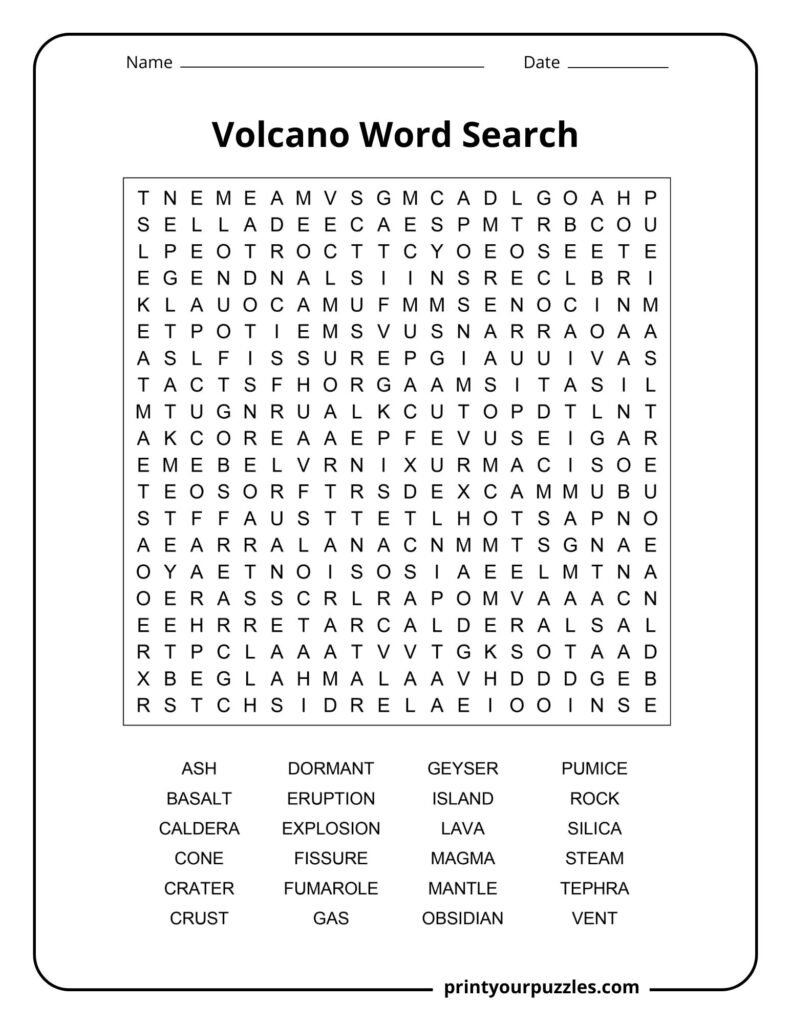
ASH, BASALT, CALDERA, CONE, CRATER, CRUST, DORMANT, ERUPTION, EXPLOSION, FISSURE, FUMAROLE, GAS, GEYSER, ISLAND, LAVA, MAGMA, MANTLE, OBSIDIAN, PUMICE, ROCK, SILICA, STEAM, TEPHRA, VENT
Volcanoes erupt when molten rock called magma rises from Earth’s mantle, building pressure in underground chambers until it forcefully breaks through the surface, releasing lava, gas, and ash.
The three main types are shield volcanoes with gentle slopes, stratovolcanoes that are steep and cone-shaped, and cinder cone volcanoes that are small with bowl-shaped craters.
Most volcanoes are found along the Pacific Ring of Fire, a zone encircling the Pacific Ocean where tectonic plates meet, creating intense geological activity and frequent eruptions.
Magma is molten rock beneath Earth’s surface stored in underground chambers, while lava is the same molten rock after it reaches the surface during a volcanic eruption.
Yes, volcanoes create fertile soil rich in minerals for agriculture, provide geothermal energy, form new land masses, attract tourism, and supply valuable minerals and building materials.
Volcanic lightning occurs when ash particles collide during eruptions, generating static electricity that produces spectacular lightning bolts within the ash cloud, creating an amazing natural light show.
Indonesia contains approximately 130 active volcanoes, more than any nation on Earth, due to its location on the Pacific Ring of Fire where multiple tectonic plates converge.
Mars hosts Olympus Mons, a massive shield volcano standing 13.6 miles high and 370 miles wide, making it nearly three times taller than Mount Everest.
Most volcanic eruptions happen beneath the ocean along mid-ocean ridges, creating new seafloor and forming underwater mountain ranges largely invisible to us on the surface.
Volcanic “ash” consists of tiny fragments of pulverized rock and glass created by explosive eruptions, not combustion residue, with particles sharp enough to damage aircraft engines.