
This James Monroe word search invites you to explore the life of America’s fifth president, a Founding Father whose leadership shaped the young nation’s identity and foreign policy. James Monroe was a Revolutionary War veteran, accomplished diplomat, and statesman who guided the United States through a transformative period of growth and unity.
Monroe served as president from 1817 to 1825, presiding over what became known as the “Era of Good Feelings”—a time marked by reduced political partisanship and national optimism. His most enduring contribution was the Monroe Doctrine of 1823, which declared that European powers should no longer colonize or interfere in the Americas. This bold policy statement established a cornerstone of American foreign relations that influenced international politics for generations.
Born in Virginia in 1758, Monroe maintained deep connections to his home state throughout his career, serving as governor and senator while operating his Highland plantation near Thomas Jefferson‘s Monticello. His presidency witnessed the acquisition of Florida from Spain and the Missouri Compromise, which temporarily eased sectional tensions over slavery’s expansion.
This James Monroe word search printable goes beyond a simple puzzle by incorporating educational resources that enrich your learning experience. The puzzle includes 24 terms with complete definitions, a helpful FAQ section answering common questions, and a fascinating “Did You Know?” section revealing surprising facts—like Monroe being wounded at the Battle of Trenton or dying on July 4th, Independence Day.
Whether for classroom use or personal enjoyment, this word search printable transforms puzzle-solving into an engaging history lesson about one of America’s most influential early presidents.
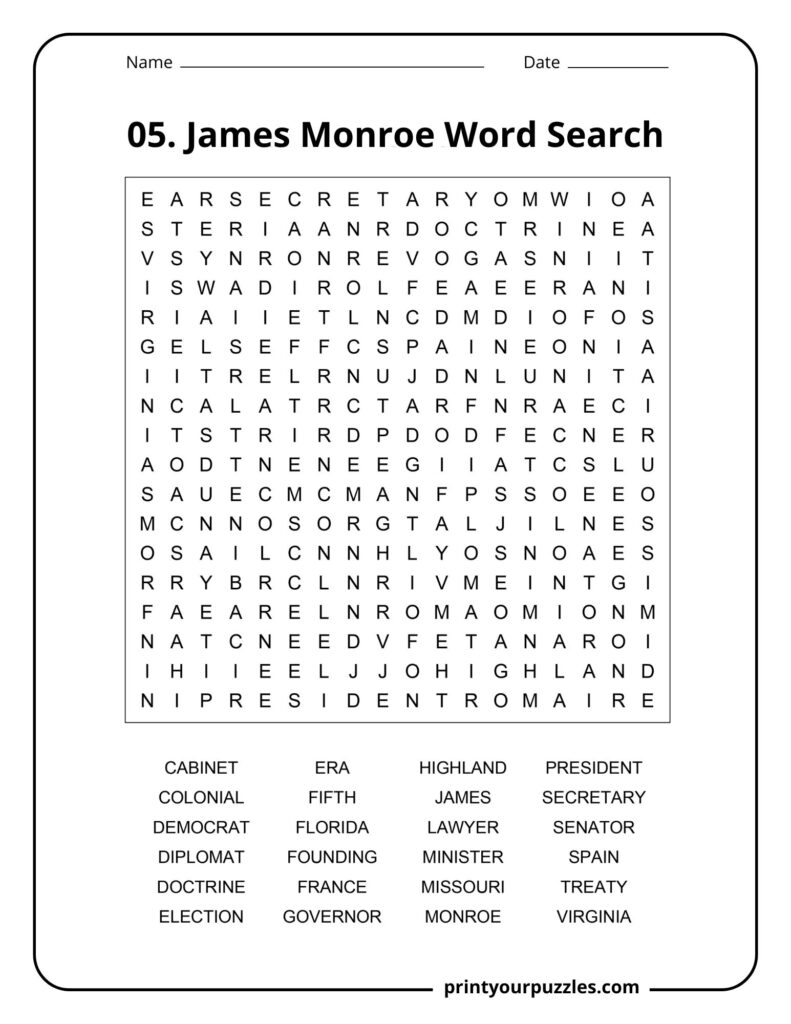
CABINET, COLONIAL, DEMOCRAT, DIPLOMAT, DOCTRINE, ELECTION, ERA, FIFTH, FLORIDA, FOUNDING, FRANCE, GOVERNOR, HIGHLAND, JAMES, LAWYER, MINISTER, MISSOURI, MONROE, PRESIDENT, SECRETARY, SENATOR, SPAIN, TREATY, VIRGINIA
CABINET – Monroe’s presidential cabinet included John Quincy Adams as Secretary of State and John C. Calhoun as Secretary of War, forming a strong executive team during his administration.
COLONIAL – Monroe was born during the colonial period in 1758 in Virginia, experiencing firsthand the transition from British colonial rule to American independence and self-governance.
DEMOCRAT – Monroe belonged to the Democratic-Republican Party, which favored states’ rights and limited federal government, opposing the Federalist Party during the early republic’s political development.
DIPLOMAT – Monroe served as a skilled diplomat, representing American interests in France, Spain, and Britain, negotiating critical treaties and strengthening international relations during formative years.
DOCTRINE – The Monroe Doctrine of 1823 declared that European powers should not interfere in the Americas, establishing a foundational principle of American foreign policy for generations.
ELECTION – Monroe won the 1816 presidential election decisively and was re-elected in 1820 with nearly unanimous Electoral College support, reflecting widespread national approval and unity.
ERA – The “Era of Good Feelings” characterized Monroe’s presidency, marked by reduced partisan conflict, national unity, territorial expansion, and relative political harmony across America.
FIFTH – James Monroe served as the fifth President of the United States from 1817 to 1825, following James Madison and preceding John Quincy Adams in office.
FLORIDA – Monroe oversaw the acquisition of Florida from Spain through the Adams-Onís Treaty in 1819, significantly expanding American territory and resolving long-standing border disputes.
FOUNDING – As a Founding Father, Monroe fought in the Revolutionary War, participated in the Constitutional Convention debates, and helped establish the new American republic’s foundations.
FRANCE – Monroe served as Minister to France during the 1790s and helped negotiate the Louisiana Purchase while collaborating with Robert Livingston under President Jefferson’s administration.
GOVERNOR – Monroe served three terms as Governor of Virginia between 1799 and 1802, demonstrating strong executive leadership before ascending to national positions in federal government.
HIGHLAND – Highland was Monroe’s plantation estate in Albemarle County, Virginia, where he lived near Monticello and managed agricultural operations while engaging in political life.
JAMES – James was Monroe’s given first name, shared with other prominent early presidents including Madison and subsequent leaders, representing traditional American naming conventions.
LAWYER – Monroe studied law under Thomas Jefferson in Virginia, establishing a legal practice that provided foundation for his diplomatic and political career in state and national government.
MINISTER – Monroe served as Minister to France, Britain, and Spain at various times, representing American diplomatic interests abroad and negotiating important agreements during critical periods.
MISSOURI – The Missouri Compromise of 1820 during Monroe’s presidency temporarily resolved sectional tensions by admitting Missouri as a slave state while maintaining the free-state balance.
MONROE – Monroe was his family surname, of Scottish descent, which became synonymous with the important foreign policy doctrine that bears his name in American history.
PRESIDENT – Monroe served two terms as President from 1817-1825, overseeing territorial expansion, economic growth, and establishing lasting foreign policy principles during the early republic.
SECRETARY – Monroe served as Secretary of State under Madison and simultaneously as Secretary of War, demonstrating versatility and dedication during the challenging War of 1812 period.
SENATOR – Monroe served as United States Senator from Virginia in the 1790s, representing his state’s interests in the early federal government before pursuing executive positions.
SPAIN – Monroe’s administration successfully negotiated with Spain for Florida’s acquisition and settled disputed boundaries through the Adams-Onís Treaty, expanding American influence and territory southward.
TREATY – Monroe participated in negotiating numerous treaties including the Adams-Onís Treaty with Spain and commercial agreements during his diplomatic service, securing vital American interests abroad.
VIRGINIA – Virginia was Monroe’s home state where he was born, educated, and maintained his plantation, representing the Commonwealth in various governmental capacities throughout his career.
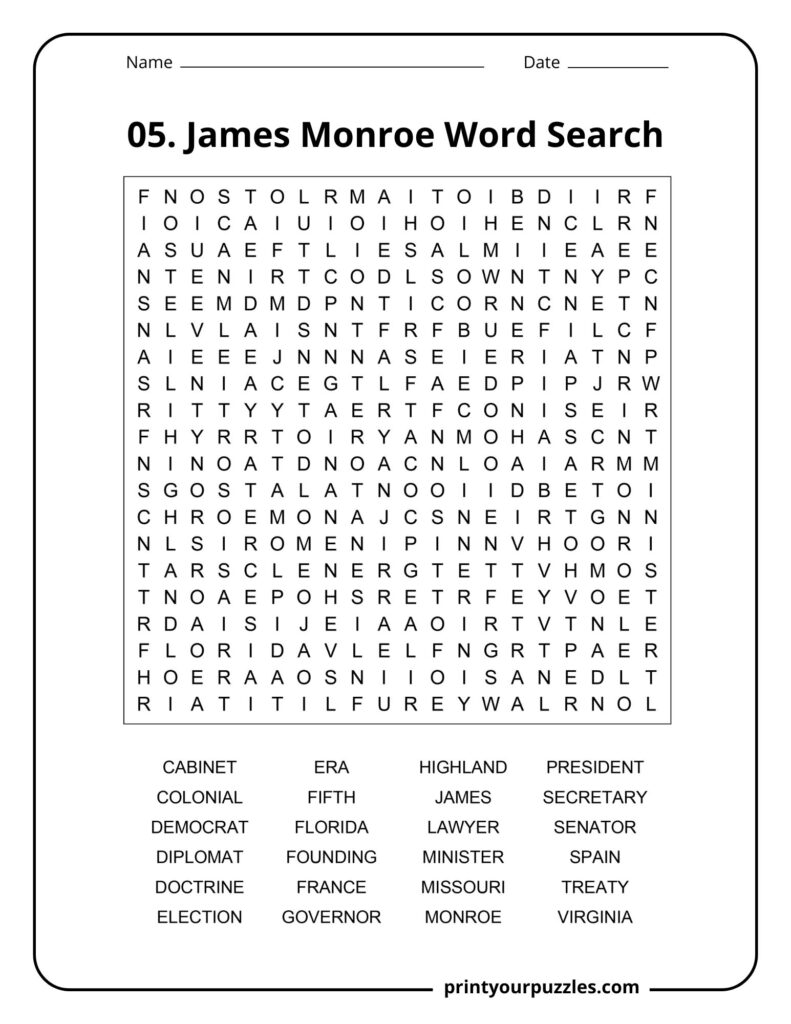
CABINET, COLONIAL, DEMOCRAT, DIPLOMAT, DOCTRINE, ELECTION, ERA, FIFTH, FLORIDA, FOUNDING, FRANCE, GOVERNOR, HIGHLAND, JAMES, LAWYER, MINISTER, MISSOURI, MONROE, PRESIDENT, SECRETARY, SENATOR, SPAIN, TREATY, VIRGINIA
The Monroe Doctrine, announced in 1823, declared that European nations should not colonize or interfere in the Americas. This policy established Western Hemisphere independence and shaped American foreign relations.
James Monroe served as the fifth President of the United States from March 4, 1817, to March 4, 1825, completing two full terms in office with widespread support.
The Era of Good Feelings was a period during Monroe’s presidency characterized by national unity, decreased political partisanship, economic growth, and territorial expansion following the War of 1812.
Monroe’s administration acquired Florida from Spain through the Adams-Onís Treaty in 1819, significantly expanding U.S. territory and resolving border disputes along the southeastern frontier region.
Before his presidency, Monroe served as Virginia Governor, U.S. Senator, Minister to France and Britain, Secretary of State, and Secretary of War under President James Madison.
For official administration records and historical biography, visit the James Monroe page in the White House Archives. If you are planning a trip or looking for personal papers, check out the official James Monroe Museum.
The Last Founding Father: James Monroe and a Nation’s Call to Greatness by Harlow Giles Unger. A well-written chronicle of an underappreciated Founding Father whose Monroe Doctrine shaped American foreign policy for two centuries.
Monroe was shot in the shoulder at the Battle of Trenton in 1776, nearly dying from the wound. A doctor’s quick action saved his life and future presidency.
Monroe’s 1820 re-election was nearly unanimous, with only one dissenting electoral vote. This overwhelming support reflected the national unity characterizing the Era of Good Feelings during his administration.
Monroe died on July 4, 1831, becoming the third president to die on Independence Day, following John Adams and Thomas Jefferson, who both died in 1826.
The capital city of Liberia was named Monrovia in honor of James Monroe, who supported the American Colonization Society’s efforts to establish settlements for freed American slaves.
Monroe was the last U.S. president to dress in the old colonial fashion, wearing knee breeches, silk stockings, and buckled shoes, connecting him visually to America’s founding generation.