
The Whig Party was a major political party in the United States during the 1830s, 1840s, and early 1850s. It became one of the two main parties of the Second Party System, competing against the Democratic Party. The Whigs formed at a time when Americans were debating the power of the president, the role of Congress, the economy, and the future direction of the country.
The party grew mainly in opposition to President Andrew Jackson and his Democratic supporters. Many Whigs believed Jackson used too much presidential power, especially during conflicts over the national bank and federal authority. They chose the name “Whig” from an older British political term connected to opposition to royal power, suggesting that they were resisting what they saw as Jackson’s overly strong executive leadership.
Whigs generally supported a stronger role for Congress and a more active federal government in building the nation’s economy. They favored protective tariffs, a national bank, roads, canals, railroads, and other internal improvements. Many of these ideas were connected to Henry Clay’s “American System,” which aimed to encourage industry, trade, transportation, and national unity.
Important Whig leaders included Henry Clay, Daniel Webster, and William Henry Harrison. The party also elected several presidents: William Henry Harrison, Zachary Taylor, and Millard Fillmore. John Tyler became president after Harrison died in office, but he often disagreed with Whig leaders and was eventually rejected by much of the party.
The Whigs were also known for using lively campaign methods. In the 1840 election, Harrison’s supporters used the slogan “Tippecanoe and Tyler Too,” along with songs, parades, rallies, and log cabin imagery. These campaign tools helped make politics feel more public, emotional, and popular among voters.
However, the Whig Party struggled with the growing conflict over slavery. Because the party included members from both the North and the South, it was difficult for Whigs to agree on whether slavery should expand into new territories. Debates over the Compromise of 1850 and the Kansas-Nebraska Act weakened the party until it collapsed in the 1850s. Many former Whigs later joined the Republican Party, while others moved into different political groups.
Students can use this Whig Party word search to review vocabulary connected to Jackson, Clay, Webster, Harrison, Tyler, tariffs, bank, Congress, slavery, campaigns, and politics. These words help connect the leaders, ideas, debates, and conflicts that made the Whig Party an important part of United States history before the Civil War.
Related Word Searches:
Andrew Jackson | Martin Van Buren | William Henry Harrison | John Tyler | Zachary Taylor | Mexican-American War
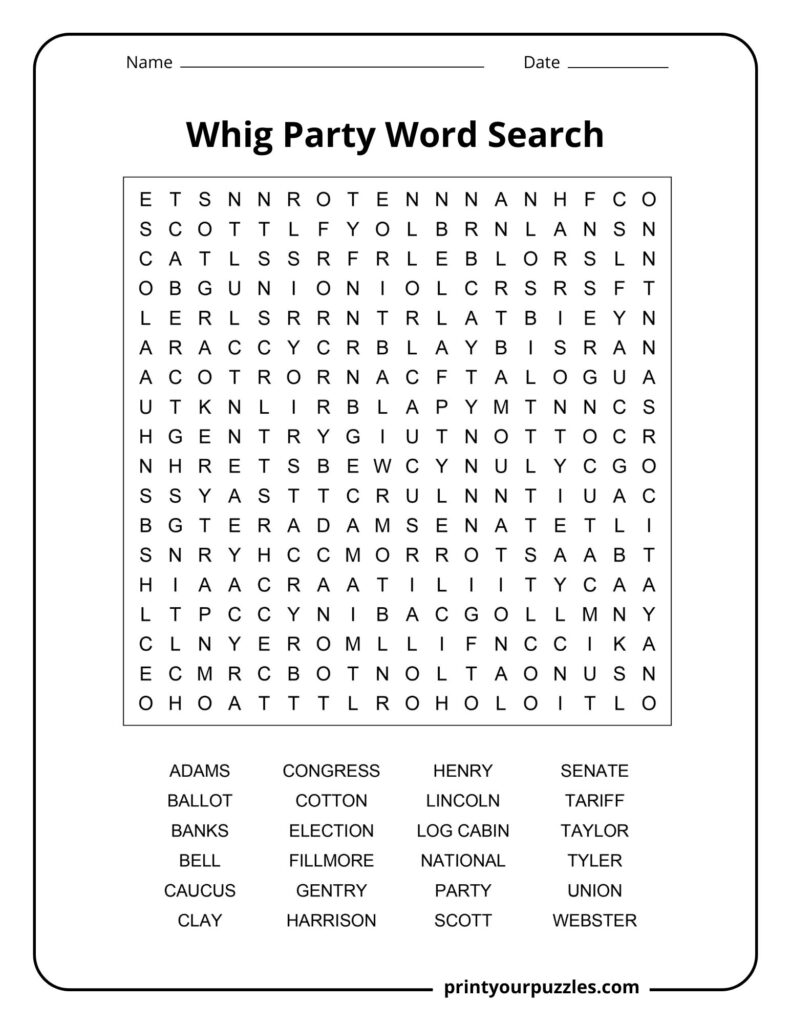
ADAMS, BALLOT, BANKS, BELL, CAUCUS, CLAY, CONGRESS, COTTON, ELECTION, FILLMORE, GENTRY, HARRISON, HENRY, LINCOLN, LOG CABIN, NATIONAL, PARTY, SCOTT, SENATE, TARIFF, TAYLOR, TYLER, UNION, WEBSTER
ADAMS – John Quincy Adams, sixth president and later congressman, was a key forerunner of Whig ideology, opposing Andrew Jackson’s executive overreach and defending civil liberties throughout his career.
BALLOT – The formal method by which Whig candidates were chosen at national conventions and elected to office, representing the party’s commitment to democratic participation and representative government.
BANKS – A central Whig issue, the party strongly supported a national bank to stabilize currency, promote commerce, and fund infrastructure, directly opposing Democratic hostility toward centralized financial institutions.
BELL – John Bell of Tennessee, the Constitutional Union nominee in 1860, was a longtime Whig senator who championed moderate compromise positions on slavery and sectional tensions.
CAUCUS – Whig leaders frequently organized caucuses in Congress to coordinate legislative strategy, unify opposition against Jacksonian Democrats, and select candidates for presidential and congressional races.
CLAY – Henry Clay of Kentucky, the Great Compromiser, was the Whig Party’s spiritual founder and chief architect, championing his American System of tariffs, banking, and internal improvements.
CONGRESS – The Whigs believed in congressional supremacy over the executive branch, arguing that the legislature should drive national policy rather than an overly powerful imperial presidency.
COTTON – The Southern cotton economy deeply influenced Whig politics, as many plantation-owning Whigs supported tariffs and commerce policies that protected their agricultural export interests and wealth.
ELECTION – Whig electoral campaigns, especially the famous 1840 Log Cabin campaign, pioneered modern American political tactics including rallies, slogans, songs, and widespread popular voter mobilization efforts.
FILLMORE – Millard Fillmore, the last Whig president, assumed office after Zachary Taylor’s death in 1850 and signed the controversial Compromise of 1850, deepening divisions within the party.
GENTRY – Many Whig supporters came from the educated gentry class, including merchants, professionals, and planters who favored economic modernization, moral reform, and orderly national progress over populist democracy.
HARRISON – William Henry Harrison won the presidency in 1840 with the famous Log Cabin and Hard Cider campaign, but tragically died just one month after his inauguration.
HENRY – Henry Clay’s first name became almost synonymous with Whig politics itself, as he ran for president three times and shaped the party’s entire platform and identity.
LINCOLN – Abraham Lincoln began his political career as a devoted Whig in Illinois, serving in Congress and embracing internal improvements and tariff policies before joining the Republicans.
LOG CABIN – The log cabin became the iconic Whig campaign symbol in 1840, portraying William Henry Harrison as a humble frontier everyman despite his actual aristocratic Virginia origins.
NATIONAL – The Whigs promoted a national vision for economic development, favoring federal investment in roads, canals, and railroads to bind the expanding American republic together commercially.
PARTY – The Whig Party existed from roughly 1833 to 1854, uniting diverse opponents of Andrew Jackson under a shared name inspired by British anti-monarchical parliamentary tradition.
SCOTT – Winfield Scott, celebrated Mexican War general, was the Whig presidential nominee in 1852 but suffered a devastating defeat that effectively signaled the party’s terminal electoral decline.
SENATE – The United States Senate served as the primary Whig power base, where leaders like Clay, Webster, and John Calhoun debated the era’s most consequential national issues.
TARIFF – Protective tariffs were a cornerstone Whig policy, intended to shield American manufacturing from foreign competition, generate federal revenue, and fund the party’s ambitious internal improvement agenda.
TAYLOR – Zachary Taylor, a Mexican War hero with no prior political experience, won the presidency for the Whigs in 1848 but died in office just sixteen months later.
TYLER – John Tyler, elected vice president in 1840, became president after Harrison’s death but was expelled from the Whig Party for repeatedly vetoing the national bank legislation.
UNION – Preserving the American Union was a paramount Whig concern, as the party constantly sought compromise between North and South to prevent the growing sectional crisis from escalating.
WEBSTER – Daniel Webster of Massachusetts, one of America’s greatest orators, was a towering Whig leader who championed the Union, the Constitution, and national economic development tirelessly.
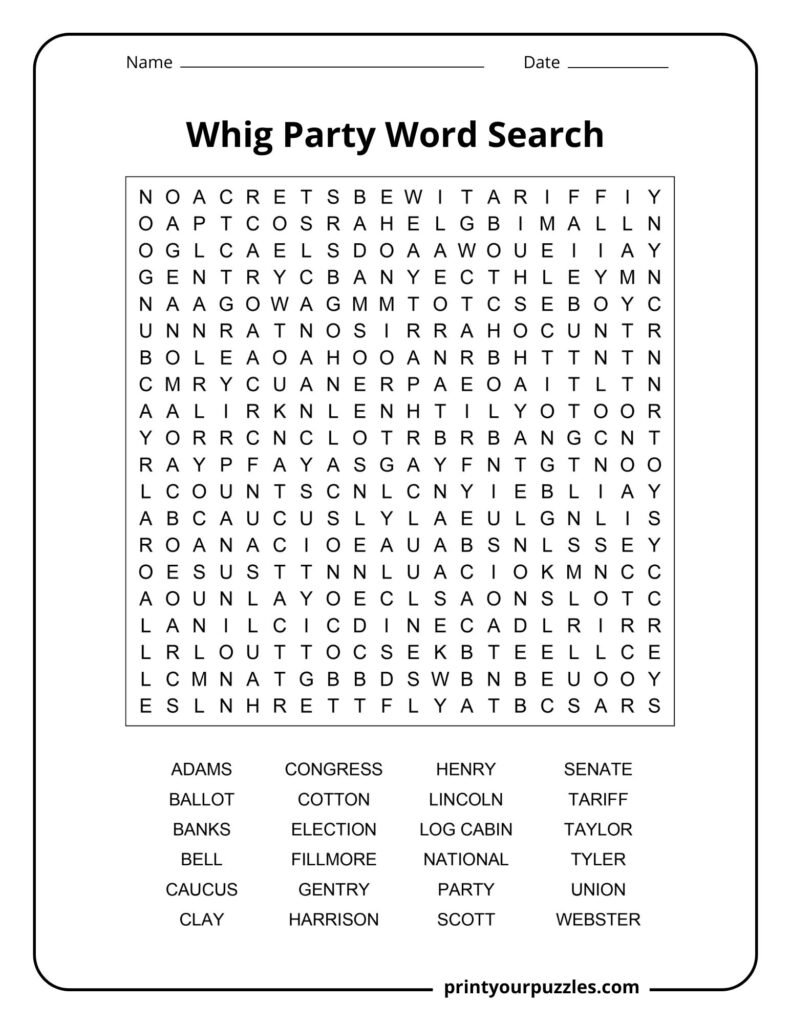
ADAMS, BALLOT, BANKS, BELL, CAUCUS, CLAY, CONGRESS, COTTON, ELECTION, FILLMORE, GENTRY, HARRISON, HENRY, LINCOLN, LOG CABIN, NATIONAL, PARTY, SCOTT, SENATE, TARIFF, TAYLOR, TYLER, UNION, WEBSTER
The name came from the British Whig tradition opposing royal tyranny. American Whigs adopted it to portray Andrew Jackson as a tyrannical monarch abusing executive power.
Henry Clay and Daniel Webster were the principal founders, uniting National Republicans, Anti-Masons, and disaffected Democrats in 1833 to create a broad coalition opposing Jacksonian Democracy.
The Whigs championed protective tariffs, a national bank, federal funding for roads and canals, congressional authority over the presidency, and moral reform including temperance and public education.
Two Whigs won the presidency: William Henry Harrison in 1840 and Zachary Taylor in 1848. Both tragically died in office, undermining the party’s ability to govern effectively.
The Kansas-Nebraska Act of 1854 fatally divided Northern and Southern Whigs over slavery’s expansion. Most Northern Whigs joined the new Republican Party while Southern Whigs scattered into other factions.
The 1840 Log Cabin campaign introduced rallies, catchy slogans, campaign songs, and merchandise to American politics, transforming elections into massive popular entertainment spectacles for the first time.
William Henry Harrison died of pneumonia just 31 days after inauguration in 1841, and Zachary Taylor died suddenly of acute gastroenteritis in July 1850, cursing the party’s fortunes.
Before becoming the first Republican president, Lincoln spent his early political career as a loyal Illinois Whig, serving one congressional term and campaigning enthusiastically for Henry Clay.
John Tyler was formally disowned by the Whig Party in 1841 after repeatedly vetoing national bank bills, making him a president without any party affiliation or congressional support.
“Tippecanoe and Tyler Too” from the 1840 election is considered one of the most famous and effective political slogans in all of American electoral history.