
The Tower of Babel is a well-known biblical story about human ambition, pride, language, and the spread of people across the earth. It appears in the Book of Genesis, shortly after the account of Noah and the great flood. Although the story is brief, it explains why humanity no longer speaks one common language according to the biblical account.
At the beginning of the story, everyone on earth shared the same language and used the same words. As people traveled eastward, they settled in a plain in the land of Shinar. There, they decided to build a permanent city rather than continue spreading into different regions.
The builders developed bricks made from baked clay and used bitumen as mortar. These materials allowed them to construct stronger buildings in an area where stone may not have been readily available. Their greatest project was a tower intended to reach toward the heavens.
The people wanted the city and tower to make them famous and prevent them from being scattered across the earth. Their plan demonstrated impressive cooperation and skill, but it also revealed pride and a desire for security based entirely on human achievement. Instead of following God’s instruction to fill the earth, they attempted to remain together and establish their own greatness.
According to Genesis, God came down to observe the city and tower. He recognized that people working together with one language could accomplish many things. God then confused their speech so that they could no longer understand one another. Without clear communication, the builders were unable to continue the project.
The people were scattered from that location into different parts of the world, and the city became known as Babel. The name is connected in the story with confusion because God confused the language of its inhabitants there. Babel is also associated with Babylon, an important ancient city that later appears throughout the Bible.
The account emphasizes that cooperation can achieve remarkable results, but shared ability should not become a reason for arrogance. It also teaches that human plans may fail when they oppose God’s purposes. This printable Tower of Babel word search puzzle helps readers revisit key details from the story, including Shinar, bricks, mortar, language, confusion, pride, construction, scattering, and the unfinished city and tower.
Related Word Searches:
Genesis | Old Testament | Noah’s Ark | Adam and Eve
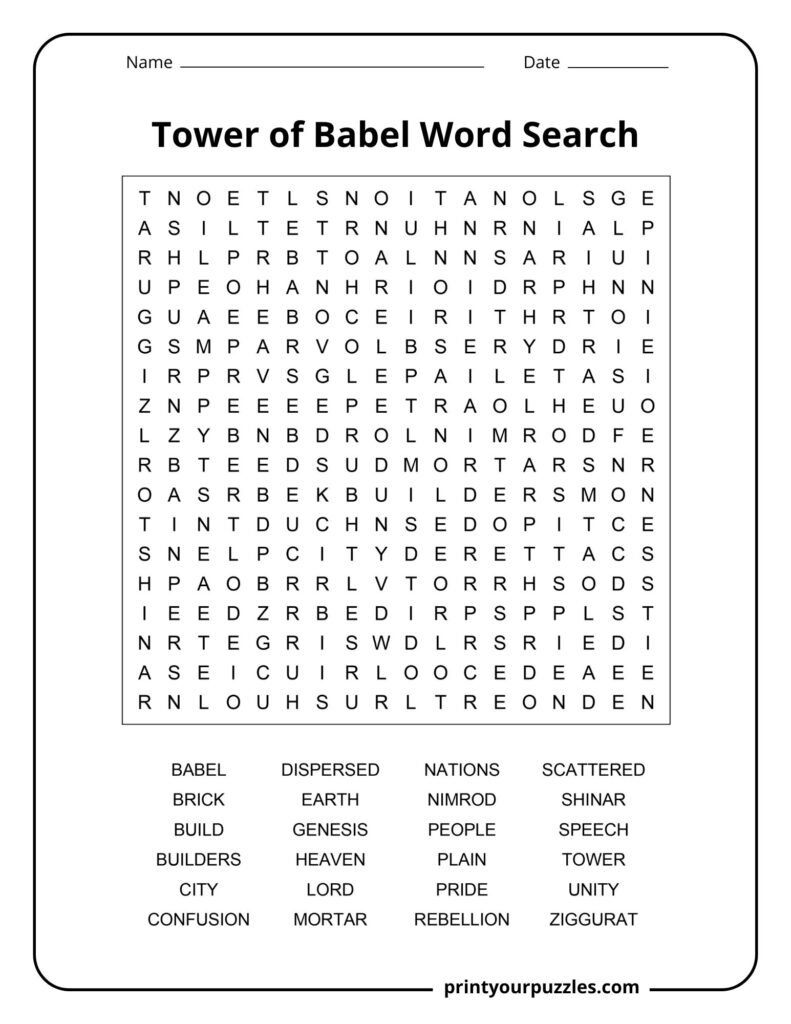
BABEL, BRICK, BUILD, BUILDERS, CITY, CONFUSION, DISPERSED, EARTH, GENESIS, HEAVEN, LORD, MORTAR, NATION, NIMROD, PEOPLE, PLAIN, PRIDE, REBELLION SCATTERED, SHINAR, SPEECH, TOWER, UNITY, ZIGGURAT
BABEL – The name of the tower and city built in Ancient Mesopotamia where God confused human language, derived from Hebrew meaning “confusion” or “to confuse through mixing.”
BRICK – A building block made from clay and baked, used instead of stone in constructing the Tower of Babel on the Mesopotamian plain where stone was scarce.
BUILD – To construct or erect a structure; the people’s action in creating the Tower of Babel, attempting to reach heaven and make a name for themselves before God intervened.
BUILDERS – The people who constructed the Tower of Babel, working together with one language and purpose until God confused their speech and scattered them across the earth’s surface.
CITY – An urban settlement that the people built alongside the tower at Babel, intending to establish a permanent dwelling place to prevent their dispersion across the earth.¡
CONFUSION – The act or state of disorder and misunderstanding that resulted when God mixed the languages at Babel, preventing communication and halting the tower’s construction permanently.
DISPERSED – Scattered or spread out across different locations; describes how God distributed the people across the earth after confusing their language, fulfilling His command to populate the world.
EARTH – The world or ground; mentioned in Genesis as the area God commanded humanity to fill, which the people resisted by building Babel to stay together.
GENESIS – The first book of the Bible containing the Tower of Babel narrative in chapter eleven, describing early human history and God’s relationship with humanity after creation.
HEAVEN – The sky or divine dwelling place; the destination the builders aspired to reach with their tower, displaying human pride and desire to achieve divine status independently.
LORD – The divine name for God used in Genesis; refers to Yahweh who observed the tower construction, confused the languages, and scattered humanity across earth’s surface.
MORTAR – Binding material made from tar or bitumen used between bricks at Babel; specifically mentioned in Genesis as the substance holding the tower’s construction materials together.
NATIONS – Distinct people groups formed after Babel when God confused languages, creating separate ethnic and linguistic communities that spread across different regions of the ancient world.
NIMROD – A mighty hunter and king mentioned before the Babel account in Genesis, traditionally associated with the tower’s construction and establishing cities in the land of Shinar.
PEOPLE – The human inhabitants who united with one language at Babel, working together to build the tower before God intervened, creating linguistic and geographic divisions among them.
PLAIN – A flat, open area of land in Shinar where the people settled and built Babel; the geographical location lacked stone, necessitating brick construction for their tower.
PRIDE – Human arrogance and self-exaltation demonstrated at Babel when people attempted to build a tower reaching heaven, seeking fame and autonomy from God rather than obeying His command.
REBELLION – Defiant resistance against God’s authority; demonstrated when people at Babel united to build their tower, directly disobeying the divine command to spread across the earth and populate it.
SCATTERED – Dispersed or spread apart forcibly; describes God’s action of distributing the people across the earth after confusing their languages, preventing further unified rebellion against His divine plan.
SHINAR – The ancient geographical region in Mesopotamia, likely modern-day Iraq, where the Tower of Babel was constructed and where early civilizations like Babylon later developed and flourished.
SPEECH – The ability to communicate through spoken language; at Babel, God confounded human speech by introducing multiple languages, making unified communication impossible and halting the tower’s construction immediately.
TOWER – A tall vertical structure built at Babel intended to reach heaven, symbolizing human pride and rebellion; God halted its construction by confusing the builders’ unified common language.
UNITY – The state of being joined together in purpose and understanding; characterized the people at Babel before God confused their language, ending their coordinated effort permanently.
ZIGGURAT – A massive stepped temple tower built in ancient Mesopotamia with terraced levels ascending toward heaven; the architectural style likely inspiring the Tower of Babel narrative and construction design.
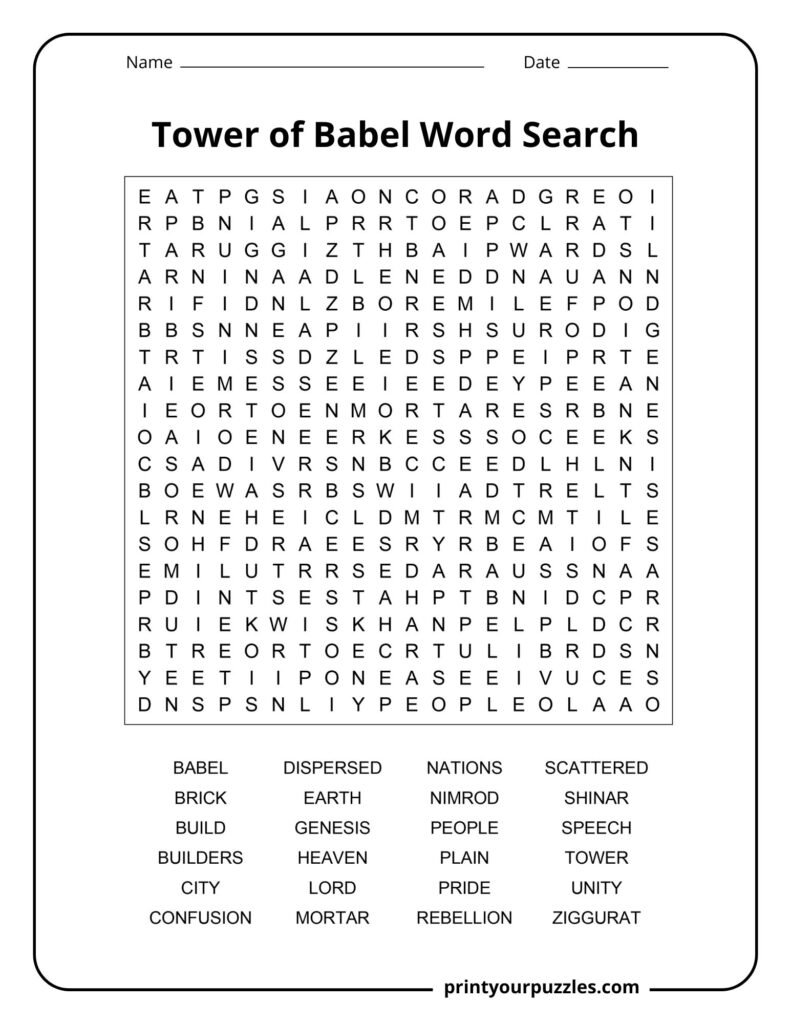
BABEL, BRICK, BUILD, BUILDERS, CITY, CONFUSION, DISPERSED, EARTH, GENESIS, HEAVEN, LORD, MORTAR, NATION, NIMROD, PEOPLE, PLAIN, PRIDE, REBELLION SCATTERED, SHINAR, SPEECH, TOWER, UNITY, ZIGGURAT
The Tower of Babel was built in the land of Shinar, an ancient region in Mesopotamia corresponding to modern-day Iraq, near where the civilization of Babylon later flourished.
People built the tower to reach heaven, make a name for themselves, and avoid being scattered across the earth, directly disobeying God’s command to fill the world.
God confused the single human language into many different languages, making communication impossible. This forced the people to stop building and scattered them across the earth’s surface.
Babel comes from the Hebrew word meaning “confusion” or “to confuse by mixing.” It’s associated with Babylon and represents the place where God confused human language and unity.
The story explains the origin of different languages and nations, demonstrates consequences of human pride, and shows God’s sovereignty over human ambition and rebellious attempts at independence.
Read Genesis 11:1-9.
Genesis specifically mentions that builders used baked bricks and tar for mortar because the Mesopotamian plain lacked natural stone, making brick construction the practical choice for building.
Mesopotamian ziggurats were massive stepped temple towers reaching skyward. The famous Etemenanki ziggurat in Babylon, meaning “temple of the foundation of heaven and earth,” likely influenced the biblical narrative.
Both names derive from the same Hebrew word “Bavel.” This connects the tower’s story to the later powerful city of Babylon, representing human pride and opposition throughout Scripture.
Linguists estimate thousands of distinct languages worldwide, reflecting the profound linguistic diversity that the Tower of Babel story symbolically explains as originating from God’s intervention at Babel’s construction.
Despite its cultural impact and significance, the entire Tower of Babel narrative is concisely told in just Genesis 11:1-9, making it one of Scripture’s shortest yet most influential stories.