
The Eucharist is one of the most important acts of Christian worship. It remembers the Last Supper, when Jesus shared bread and wine with His disciples before His arrest and crucifixion. Christians celebrate the Eucharist as a sacred meal that expresses faith, thanksgiving, unity, and a close relationship with Jesus Christ.
The word “Eucharist” comes from a Greek term meaning “thanksgiving.” During the celebration, prayers of gratitude are offered to God, and bread and wine are blessed and shared. Different Christian traditions may call this ceremony Holy Communion, the Lord’s Supper, the Breaking of Bread, or the Mass.
The biblical foundation of the Eucharist appears in the Gospels of Matthew, Mark, and Luke, as well as in Paul’s First Letter to the Corinthians. At the Last Supper, Jesus took bread, gave thanks, broke it, and gave it to His disciples, identifying it with His body. He then shared a cup of wine and connected it with His blood and the new covenant.
Christians understand these words in different ways. Catholics and Orthodox Christians believe that the bread and wine truly become the body and blood of Christ, while still appearing as bread and wine. Other denominations describe Christ as spiritually present, and some view the elements mainly as powerful symbols that help believers remember His sacrifice.
The Eucharist usually includes Bible readings, prayers, hymns, a sermon or homily, and the sharing of bread and wine. In some churches, only ordained ministers lead the celebration. Participants may approach an altar, kneel at a rail, or receive Communion while standing, depending on local custom.
The ceremony also emphasizes Christian unity. By sharing one bread and one cup, believers express that they belong to one community. The Eucharist encourages gratitude, forgiveness, service, and concern for others. It also connects worshippers with the death and resurrection of Jesus and with the hope of eternal life.
Preparation for Communion varies among churches. Some require Baptism, instruction, Confession, fasting, or membership, while others invite all baptized Christians to participate. A Eucharist word search can help readers review important terms connected with bread, wine, disciples, covenant, thanksgiving, sacrifice, worship, and Communion while learning more about this central Christian celebration.
We’ve dedicated a post to each of the Seven Sacraments: Anointing of the Sick, Baptism, Confirmation, Eucharist, Holy Orders, Marriage, and Reconciliation.
We have also curated seven books on the Seven Sacraments, each offering a unique perspective on this sacred theme. All seven books cover the complete set of sacraments, not just one individual sacrament. Every post in our Seven Sacraments series features a different book recommendation. Don’t miss them — a great read awaits you!
Related Word Searches:
Last Supper | Jesus Christ | Confirmation | Reconciliation
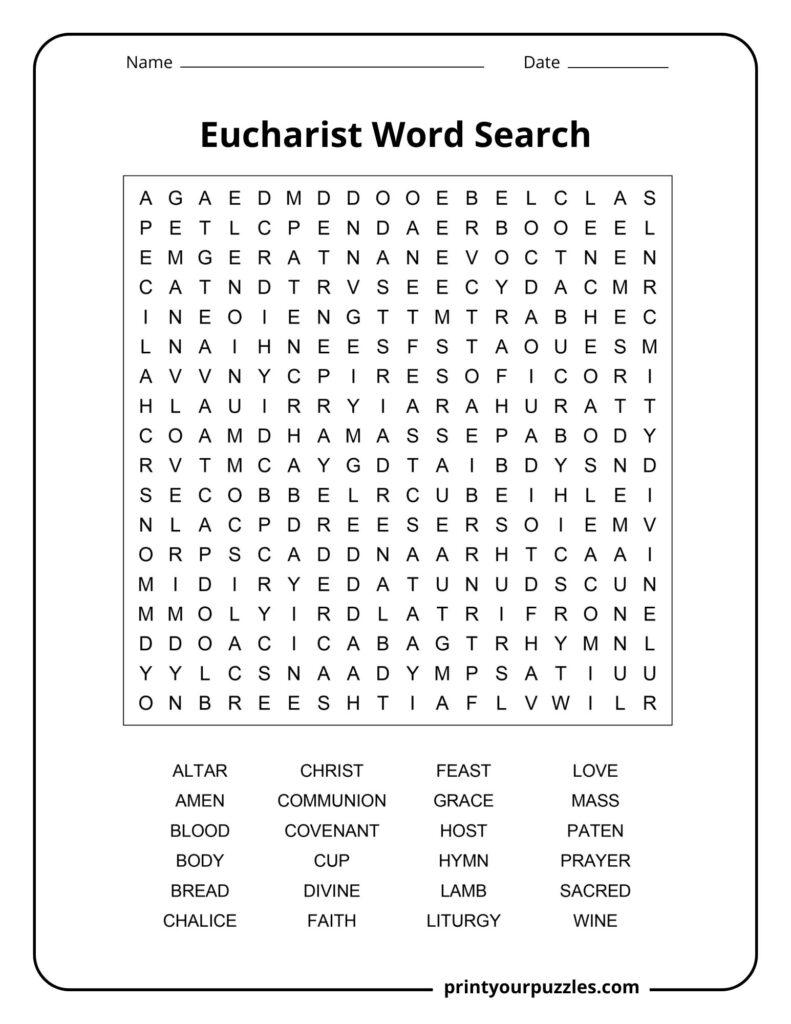
ALTAR, AMEN, BLOOD, BODY, BREAD, CHALICE, CHRIST, COMMUNION, COVENANT, CUP, DIVINE, FAITH, FEAST, GRACE, HOST, HYMN, LAMB, LITURGY, LOVE, MASS, PATEN, PRAYER, SACRED, WINE
ALTAR – The sacred table or structure in a church where the Eucharistic celebration takes place. It represents the place of sacrifice and the table of the Lord’s Supper shared with the faithful.
AMEN – A Hebrew word meaning “so be it” or “truly.” It is spoken by the faithful to affirm their belief and acceptance, especially after receiving the Body and Blood of Christ.
BLOOD – Refers to the precious Blood of Christ, which is made present under the appearance of wine during the consecration. It represents the new covenant and the redemption of humanity.
BODY – Refers to the Body of Christ, made truly present under the appearance of bread through consecration. Receiving the Body of Christ unites the faithful with Jesus and with one another.
BREAD – The essential Eucharistic element, usually unleavened wheat bread, which through consecration becomes the Body of Christ. It symbolizes nourishment, unity, and God’s provision for His people.
CHALICE – The sacred cup used during Mass to hold the wine that becomes the Blood of Christ. It is typically made of precious metal and treated with great reverence during the liturgy.
CHRIST – Jesus Christ, the Son of God, whose sacrifice on the cross is made present in every Eucharistic celebration. He is both the priest and the offering in this holy sacrament.
COMMUNION – The act of receiving the consecrated bread and wine, the Body and Blood of Christ. It signifies intimate union with Jesus and fellowship among all believers gathered in faith.
COVENANT – The sacred bond between God and His people, renewed through the Eucharist. Jesus established the new and eternal covenant at the Last Supper through His Body and Blood.
CUP – Refers to the cup Jesus shared with His disciples at the Last Supper, saying it was His Blood of the new covenant, poured out for the forgiveness of sins.
DIVINE – Relating to God or the sacred nature of the Eucharist. The Eucharistic celebration is a divine mystery where heaven and earth meet and believers encounter God’s real presence.
FAITH – The theological virtue by which believers trust in God’s word and accept the real presence of Christ in the Eucharist, even though the appearances of bread and wine remain unchanged.
FEAST – The Eucharist is understood as a sacred banquet or heavenly feast where the faithful are nourished by Christ Himself. It anticipates the eternal feast of the Kingdom of God.
GRACE – The free and unmerited gift of God’s love and favor bestowed upon the faithful. The Eucharist is a primary source of grace, strengthening believers in their spiritual journey and daily life.
HOST – The round, thin piece of unleavened bread used in the Eucharistic celebration. After consecration, it becomes the Body of Christ and is distributed to the faithful during Holy Communion.
HYMN – A sacred song of praise and worship sung during the Eucharistic celebration. Hymns help the assembly pray together, express devotion, and reflect on the mystery of Christ’s presence.
LAMB – A title for Jesus, the Lamb of God, who takes away the sins of the world. It recalls the paschal lamb of the Old Testament and Christ’s perfect sacrifice on the cross.
LITURGY – The official public worship of the Church, especially the celebration of the Eucharist or Mass. It follows a structured order of prayers, readings, and rituals established by sacred tradition.
LOVE – The Eucharist is the supreme expression of God’s love for humanity. Jesus gave His Body and Blood out of love, and receiving Communion calls the faithful to love God and neighbor.
MASS – The principal act of Catholic worship in which the Eucharist is celebrated. It includes the Liturgy of the Word and the Liturgy of the Eucharist, culminating in Holy Communion.
PATEN – A small, flat plate, usually made of precious metal, used to hold the bread or host during the Eucharistic celebration. It is one of the sacred vessels essential to the liturgy.
PRAYER – Communication with God that permeates the entire Eucharistic celebration. Through prayers of thanksgiving, petition, and praise, the faithful unite their hearts with Christ’s offering to the Father.
SACRED – Set apart for God and worthy of reverence. The Eucharist is considered the most sacred act of Christian worship because Christ Himself becomes truly present among His people.
WINE – The fruit of the vine used in the Eucharistic celebration, which through consecration becomes the Blood of Christ. Typically grape wine is required for the valid celebration of the sacrament.
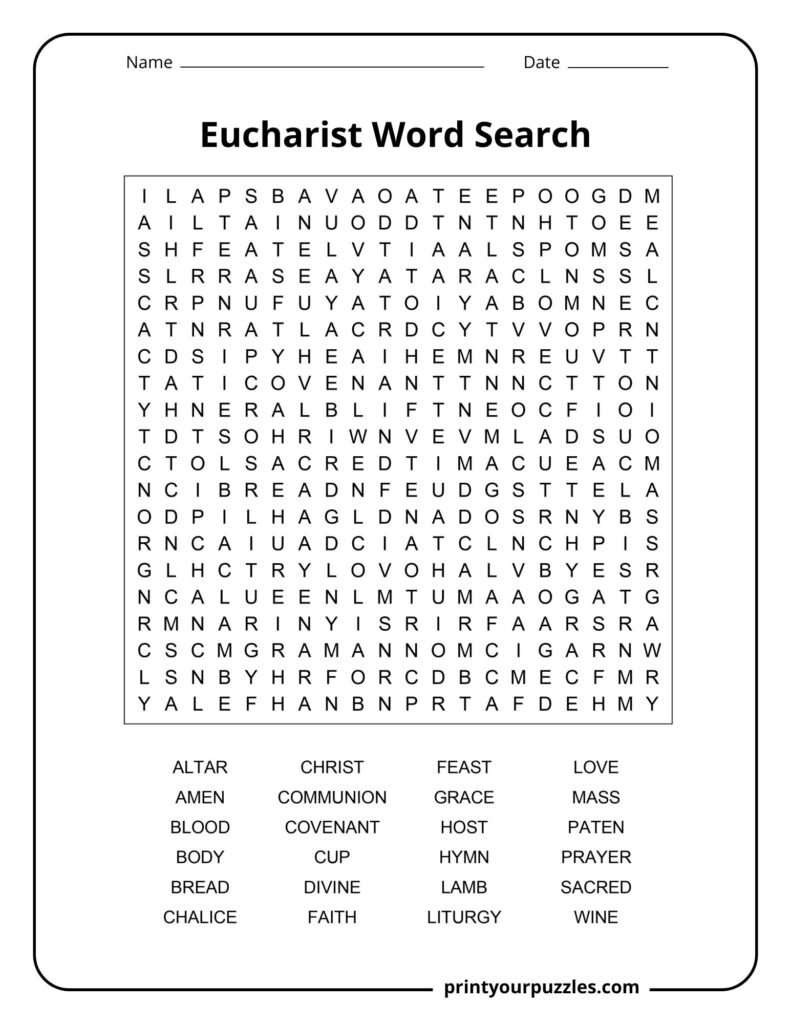
ALTAR, AMEN, BLOOD, BODY, BREAD, CHALICE, CHRIST, COMMUNION, COVENANT, CUP, DIVINE, FAITH, FEAST, GRACE, HOST, HYMN, LAMB, LITURGY, LOVE, MASS, PATEN, PRAYER, SACRED, WINE
The Eucharist is the sacrament in which bread and wine become the Body and Blood of Jesus Christ. It is the central act of Catholic worship and the source of spiritual nourishment.
The Eucharist is considered the source and summit of Christian life. Through it, believers receive Christ Himself, strengthen their union with God, and are united as one body in faith and love.
Baptized Catholics in a state of grace may receive the Eucharist. Those conscious of serious sin should first receive the Sacrament of Reconciliation. Proper fasting before Communion is also required by the Church.
Jesus instituted the Eucharist at the Last Supper on the night before His crucifixion. He took bread and wine, blessed them, and gave them to His apostles, saying “This is my Body” and “This is my Blood.”
The Church encourages Catholics to receive Communion every time they attend Mass, provided they are in a state of grace. At minimum, Catholics are obliged to receive Communion at least once a year during Easter.
The Sacraments: An Interdisciplinary and Interactive Study by Joseph Martos. Approaching the sacraments from multiple perspectives — historical, theological, and experiential — this book invites readers to actively engage with sacramental meaning, making it ideal for group study and personal reflection.
This name reflects the essence of the celebration, as it is the supreme act of giving thanks to God for His gifts, especially the sacrifice of Jesus Christ for humanity.
One of the most famous occurred in Lanciano, Italy, around the 8th century, where the consecrated bread and wine visibly transformed into human flesh and blood, which are still preserved today.
Saints like Marthe Robin and Alexandrina Maria da Costa reportedly survived for decades without any food other than the consecrated Host, a phenomenon studied by doctors and theologians alike.
Every single day, millions of Masses are celebrated across all continents and time zones, making the Eucharist the most widely and continuously celebrated act of worship in human history.
According to Church teaching, Christ is wholly and entirely present in every particle of the consecrated bread and every drop of the consecrated wine, no matter how small.