
Summer is the warmest season of the year and a time commonly associated with sunshine, vacations, outdoor adventures, and long days. It arrives between spring and autumn, although its timing depends on the hemisphere. In the Northern Hemisphere, summer generally lasts from June through August, while in the Southern Hemisphere it usually occurs from December through February.
Astronomical summer begins with the summer solstice. Around June 20 or 21 in the Northern Hemisphere, and December 21 or 22 in the Southern Hemisphere, the Sun reaches its highest seasonal position in the sky. This creates the longest day and shortest night of the year. After the solstice, daylight gradually decreases, although temperatures may continue rising for several weeks.
Warm weather changes both nature and everyday routines. Gardens and farms produce fruits and vegetables such as tomatoes, corn, peaches, berries, melons, and cucumbers. Trees provide welcome shade, flowers attract bees and butterflies, and many animals remain active throughout the longer days. In some regions, however, summer can also bring drought, thunderstorms, hurricanes, wildfires, or periods of extreme heat.
Many families plan vacations during summer because schools are closed or follow reduced schedules. Popular activities include swimming, camping, hiking, cycling, fishing, boating, and visiting beaches, lakes, national parks, or amusement parks. Children may attend camps, play outdoor games, explore nature, or enjoy more time with friends and relatives.
Seasonal food is an important part of the summer atmosphere. Barbecues, picnics, salads, cold drinks, ice cream, grilled vegetables, and fresh fruit are common choices. Outdoor concerts, fairs, festivals, sporting events, and evening gatherings also take advantage of the warm temperatures and extended daylight.
Summer is often energetic and relaxing at the same time. It can offer freedom from regular routines, opportunities for travel, and memorable family experiences. However, people should also use sunscreen, drink enough water, seek shade, and avoid excessive activity during the hottest part of the day.
Celebrate the warmth, colors, foods, and outdoor pleasures of the season with this printable Summer word search puzzle, featuring 24 carefully selected words inspired by sunshine, beaches, vacations, swimming, picnics, nature, cool treats, and the freedom of long summer days.
Related Word Searches:
June | July | August | 4th of July | National Ice Cream Day
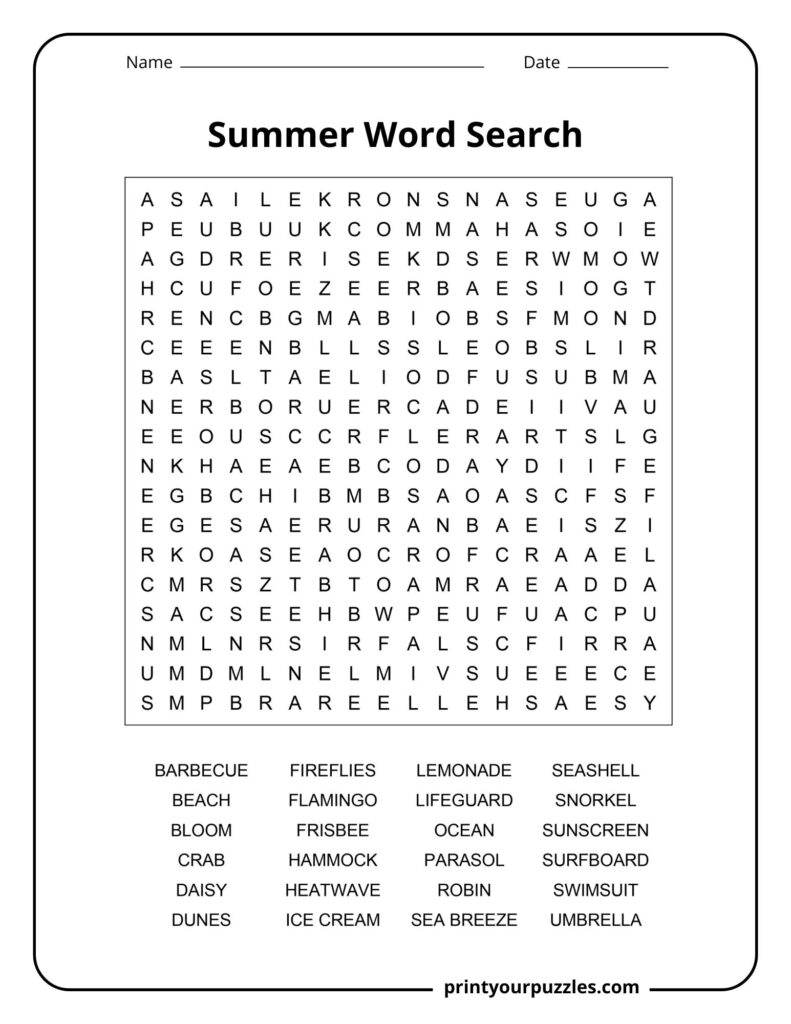
BARBECUE, BEACH, BLOOM, CRAB, DAISY, DUNES, FIREFLIES, FLAMINGO, FRISBEE, HAMMOCK, HEATWAVE, ICE CREAM, LEMONADE, LIFEGUARD, OCEAN, PARASOL, ROBIN, SEA BREEZE, SEASHELL, SNORKEL, SUNSCREEN, SURFBOARD, SWIMSUIT, UMBRELLA
BARBECUE – An outdoor cooking method using a grill over fire or hot coals, typically used to prepare meats, vegetables, and other foods during warm-weather gatherings with friends and family.
BEACH – A strip of sand or pebbles along the edge of a sea, lake, or river where people gather to swim, relax, sunbathe, and enjoy warm weather during the summer season.
BLOOM – The process by which a flower opens and displays its petals, typically occurring in spring when warmer temperatures and longer daylight hours encourage plants to blossom and grow.
CRAB – A small sea creature with a hard shell, ten legs, and claws, commonly found on sandy beaches and in shallow coastal waters, often caught and eaten as a popular seafood dish.
DAISY – A common spring wildflower with white petals surrounding a bright yellow centre, often found growing in meadows, gardens, and grassy fields as one of the first signs of the season.
DUNES – Mounds or ridges of sand shaped by the wind, commonly found along coastlines and deserts, forming a natural barrier between the beach and inland areas where grasses often take root.
FIREFLIES – Small flying insects that produce a soft, blinking light from their abdomens on warm summer evenings, creating a magical glowing display in gardens, meadows, and forests after dark.
FLAMINGO – A tall wading bird with bright pink feathers, long thin legs, and a curved beak, known for standing on one leg in shallow tropical waters and coastal lagoons around the world.
FRISBEE – A lightweight plastic disc thrown between players as an outdoor recreational activity, widely enjoyed at parks, beaches, and open fields during sunny days as a fun and social game.
HAMMOCK – A suspended fabric or rope bed hung between two trees or posts, designed for relaxing and napping outdoors in the shade, popular in gardens and tropical destinations during warm months.
HEATWAVE – A prolonged period of unusually hot weather that lasts several days or weeks, often causing discomfort and health risks, especially in cities where temperatures can rise significantly above normal.
ICE CREAM – A sweet frozen dessert made from cream, sugar, and various flavourings, served in cones, cups, or bars, widely loved as a refreshing treat during hot summer days worldwide.
LEMONADE – A cold refreshing drink made from lemon juice, water, and sugar, commonly enjoyed on hot summer days as a sweet and tangy beverage that helps cool down and quench thirst.
LIFEGUARD – A trained professional stationed at beaches or swimming pools to monitor swimmers, prevent accidents, and respond quickly to emergencies by performing rescues and first aid when needed.
OCEAN – A vast body of salt water that covers most of the Earth’s surface, home to an enormous variety of marine life, and a popular destination for swimming, surfing, and exploration.
PARASOL – A lightweight handheld or standing umbrella designed to provide shade from the sun, commonly used at beaches, outdoor cafés, and gardens to protect people from direct sunlight and heat.
ROBIN – A small songbird with a distinctive red or orange breast, widely regarded as a cheerful symbol of spring, often seen hopping across lawns searching for worms after rainfall.
SEA BREEZE – A gentle wind that blows from the sea toward the land, typically occurring during warm afternoons when the land heats up faster than the water, providing welcome relief on hot days.
SEASHELL – The hard, protective outer casing of a marine creature such as a snail or clam, often found washed up on sandy beaches and collected by visitors as a natural coastal souvenir.
SNORKEL – A curved breathing tube worn with a mask that allows swimmers to float face-down on the water’s surface and observe underwater marine life without needing to resurface for air constantly.
SUNSCREEN – A protective lotion or spray applied to the skin to block harmful ultraviolet rays from the sun, helping to prevent sunburn and reduce the long-term risk of skin damage and cancer.
SURFBOARD – A long, buoyant board used by surfers to ride ocean waves, typically made from foam and fibre glass, and available in various shapes and sizes to suit different skill levels and wave conditions.
SWIMSUIT – A tight-fitting garment worn for swimming or sunbathing at the beach or pool, designed to allow freedom of movement in the water while drying quickly after getting wet.
UMBRELLA – A folding canopy stretched over a frame and held by a handle, used to provide shelter from rain or intense sun, commonly seen at beaches, outdoor events, and in everyday use.
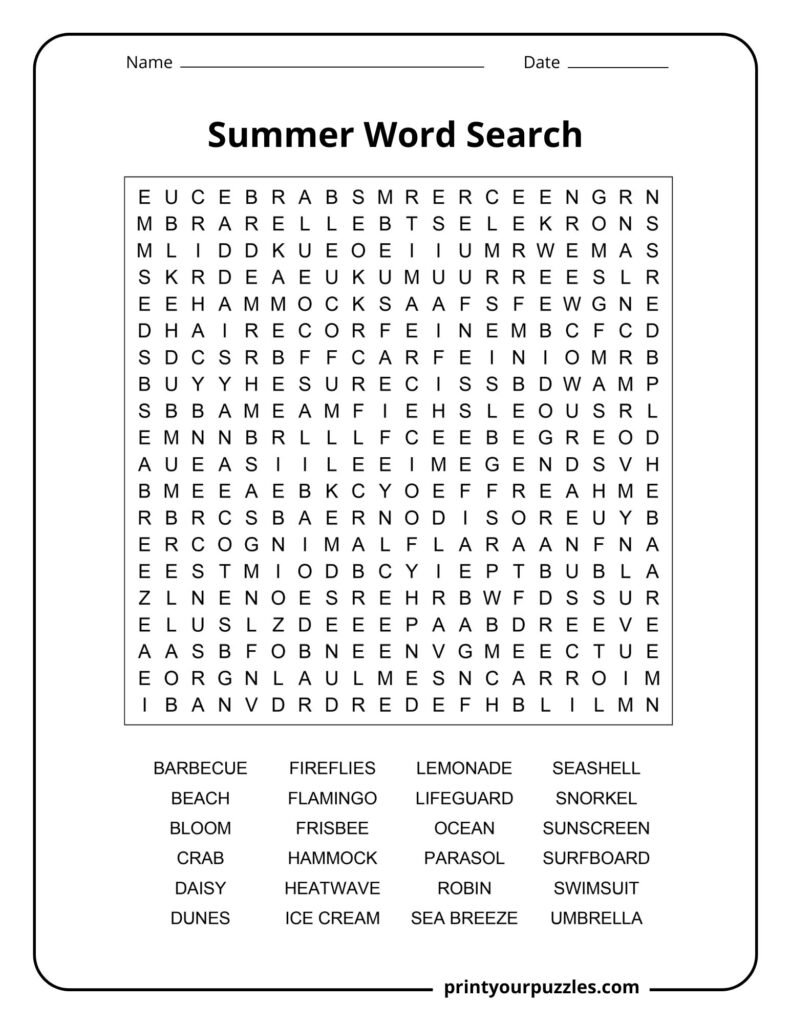
BARBECUE, BEACH, BLOOM, CRAB, DAISY, DUNES, FIREFLIES, FLAMINGO, FRISBEE, HAMMOCK, HEATWAVE, ICE CREAM, LEMONADE, LIFEGUARD, OCEAN, PARASOL, ROBIN, SEA BREEZE, SEASHELL, SNORKEL, SUNSCREEN, SURFBOARD, SWIMSUIT, UMBRELLA
Astronomically, summer runs from the June solstice to the September equinox. In the Northern Hemisphere this falls roughly between June 21 and September 22 each year.
Earth’s axial tilt causes the hemisphere facing the sun to receive more direct sunlight for longer periods, resulting in extended daylight hours and shorter nights throughout the summer season.
Apply sunscreen with at least SPF 30, wear protective clothing and a hat, seek shade during peak hours between 10 am and 4 pm, and stay well hydrated throughout the day.
Drink plenty of water, use fans or air conditioning, take cool showers, wear light breathable fabrics, and avoid strenuous outdoor activity during the hottest part of the afternoon.
Cities experience the urban heat island effect, where concrete, asphalt, and buildings absorb and retain heat, raising temperatures several degrees higher than surrounding rural or vegetated areas nearby.
Summer is the year with its guard down — long days, warm nights, and a feeling of boundless freedom. These five books capture that heat and expansiveness, each one made to be read slowly, with nowhere else to be.
Dandelion Wine – Ray Bradbury. A boy tries to bottle summer itself — fireflies, bare feet, golden evenings. A pure, joyful celebration of everything summer means and everything it will one day become memory.
On the Road – Jack Kerouac. America at full speed, windows down, the highway endless. Restless, free, and blazing with summer energy — the ultimate book for the longest days of the year.
The Talented Mr. Ripley – Patricia Highsmith. Sun, sea, and murder on the glittering Italian coast. Glamorous and deeply unsettling — summer with a dark, irresistible undertow pulling beneath the beautiful surface.
To the Lighthouse – Virginia Woolf. A family suspended in one long summer day on a Scottish island. Woolf captures summer’s timeless, golden, fleeting quality like no other writer ever has.
Under the Tuscan Sun – Frances Mayes. A woman restores a crumbling Italian farmhouse in the height of summer. Warm, sensory, and utterly intoxicating — summer on every single page.
In places like northern Norway, the sun never fully sets during summer, a phenomenon known as the midnight sun.
Temperature is driven by the angle of sunlight, not by distance, which peaks around early July.
Heat drives people to seek cold treats, making July and August the highest-selling period for frozen desserts worldwide.
Heat causes its iron structure to expand by up to 15 centimeters, a natural effect of thermal expansion on large metal constructions.
Hot air rises rapidly, creating the unstable atmospheric conditions that generate the towering storm clouds responsible for thunder and lightning.