Introduction to the Atom Word Search
An atom is the basic building block of matter. Everything around us—including air, water, rocks, plants, animals, buildings, and our own bodies—is made of atoms. Although atoms are extremely small and cannot be seen with an ordinary microscope, they combine in countless ways to create every physical substance in the universe.
Each atom has a central region called the nucleus. The nucleus contains protons, which have a positive electrical charge, and neutrons, which have no charge. Moving around the nucleus are much smaller particles called electrons, which carry a negative charge. Most atoms contain equal numbers of protons and electrons, making them electrically neutral. However, an atom can gain or lose electrons and become a charged particle known as an ion.
The number of protons in an atom determines which chemical element it belongs to. For example, every hydrogen atom has one proton, while every carbon atom has six. Oxygen atoms always have eight protons, and gold atoms have seventy-nine. Scientists organize all known elements in the periodic table, where elements are arranged according to their atomic number and chemical properties.
Atoms can join together through chemical bonds to form molecules. A molecule of water, for instance, consists of two hydrogen atoms bonded to one oxygen atom. Some substances contain only one type of atom, while compounds contain atoms from two or more different elements. The way atoms connect and interact determines a material’s appearance, behavior, and properties.
Atoms are mostly empty space, even though solid objects feel firm. The particles inside an atom are held together by powerful forces. Protons and neutrons remain in the nucleus because of the strong nuclear force, while electrical attraction helps keep negatively charged electrons near the positively charged nucleus.
Learning about atoms helps explain chemical reactions, electricity, radiation, materials, and many processes that occur in nature. Scientists also study smaller particles inside protons and neutrons, showing that atomic science continues to develop. An atom word search can introduce important vocabulary such as nucleus, proton, neutron, electron, element, molecule, and ion while making this fascinating scientific topic more engaging and easier to remember.
Related Word Searches:
Chemical Elements | Chemistry | Molecule | Matter | Electricity | Energy
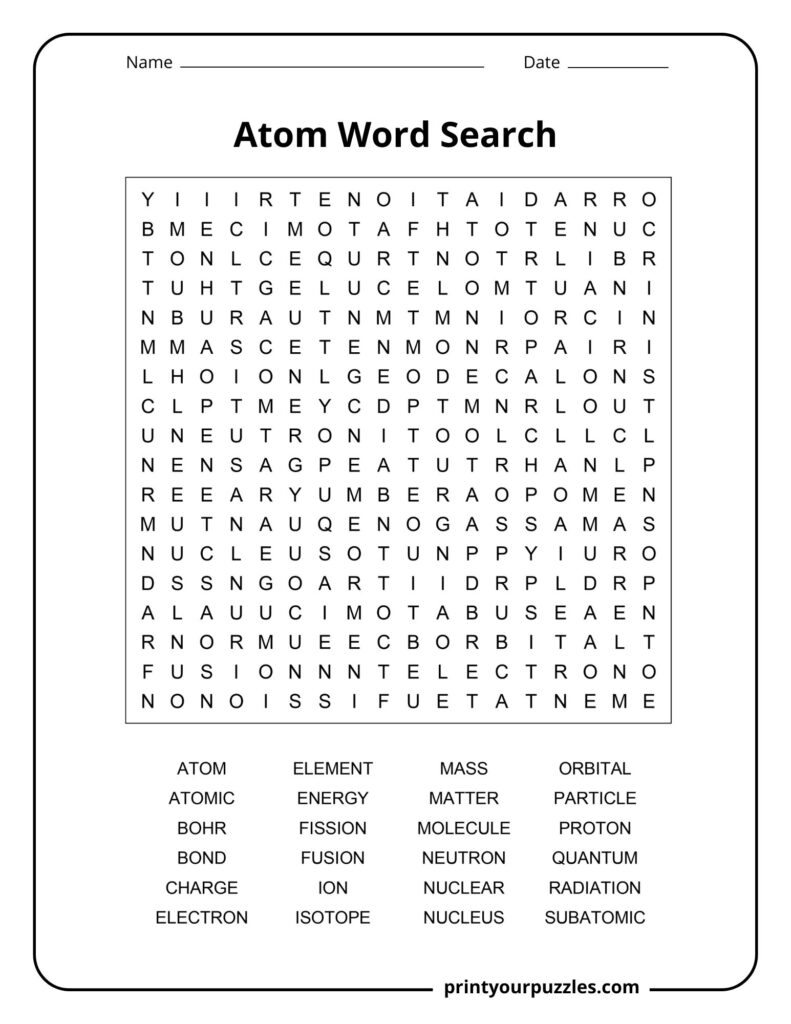
Medium Difficulty Word Search
Words to Find
ATOM, ATOMIC, BOHR, BOND, CHARGE, ELECTRON, ELEMENT, ENERGY, FISSION, FUSION, ION, ISOTOPE, MASS, MATTER, MOLECULE, NEUTRON, NUCLEAR, NUCLEUS, ORBITAL, PARTICLE, PROTON, QUANTUM, RADIATION, SUBATOMIC
All Words Defined
ATOM – The smallest unit of matter that retains the properties of an element, consisting of a nucleus surrounded by electrons in orbital shells.
ATOMIC – Relating to atoms or the energy released from splitting or combining atomic nuclei; pertaining to the fundamental building blocks of matter.
BOHR – Niels Bohr, Danish physicist who developed the Bohr model of the atom, showing electrons orbit the nucleus in specific energy levels or shells.
BOND – A chemical connection between atoms formed by sharing or transferring electrons, creating molecules and compounds through attractive forces holding atoms together.
CHARGE – An electrical property of matter that can be positive or negative, caused by an excess or deficiency of electrons in an atom or particle.
ELECTRON – A negatively charged subatomic particle that orbits the nucleus of an atom, responsible for chemical bonding and electrical conductivity in materials.
ELEMENT – A pure substance consisting of only one type of atom, characterized by its unique number of protons, and cannot be broken down chemically.
ENERGY – The capacity to do work or cause change, existing in various forms including kinetic, potential, thermal, and released during atomic reactions.
FISSION – Nuclear reaction where a heavy atomic nucleus splits into smaller fragments, releasing massive amounts of energy used in nuclear power and weapons.
FUSION – Nuclear process where light atomic nuclei combine to form heavier nuclei, releasing tremendous energy, powering stars and experimental reactors on Earth.
ION – An atom or molecule with a net electrical charge due to the loss or gain of one or more electrons during chemical reactions.
ISOTOPE – Variant forms of the same element having identical proton numbers but different neutron counts, resulting in different atomic masses and stability.
MASS – The amount of matter in an object, measured in units like grams or kilograms, representing the object’s resistance to acceleration or movement.
MATTER – Anything that has mass and occupies space, composed of atoms and molecules, existing in solid, liquid, gas, and plasma states.
MOLECULE – A group of two or more atoms bonded together chemically, representing the smallest unit of a chemical compound maintaining its properties.
NEUTRON – An electrically neutral subatomic particle found in the atomic nucleus, with mass similar to protons, determining isotopes and contributing to atomic stability.
NUCLEAR – Relating to the nucleus of an atom or the energy produced from splitting or fusing atomic nuclei in reactions and power generation.
NUCLEUS – The dense central core of an atom containing protons and neutrons, holding most of the atom’s mass and maintaining a positive charge.
ORBITAL – A region of space around an atom’s nucleus where electrons are most likely to be found, having specific shapes and energy levels.
PARTICLE – A tiny piece of matter, including subatomic particles like protons, neutrons, and electrons, or any small discrete unit of physical substance.
PROTON – A positively charged subatomic particle located in the atomic nucleus, determining the element’s identity through its atomic number and chemical properties.
QUANTUM – The smallest discrete unit of energy or matter, fundamental to quantum mechanics describing atomic and subatomic behavior at microscopic scales.
RADIATION – Energy transmitted as electromagnetic waves or moving subatomic particles, emitted from radioactive materials or nuclear reactions, potentially harmful in large doses.
SUBATOMIC – Referring to particles smaller than an atom, including protons, neutrons, electrons, and other fundamental particles comprising atomic structure and behavior.
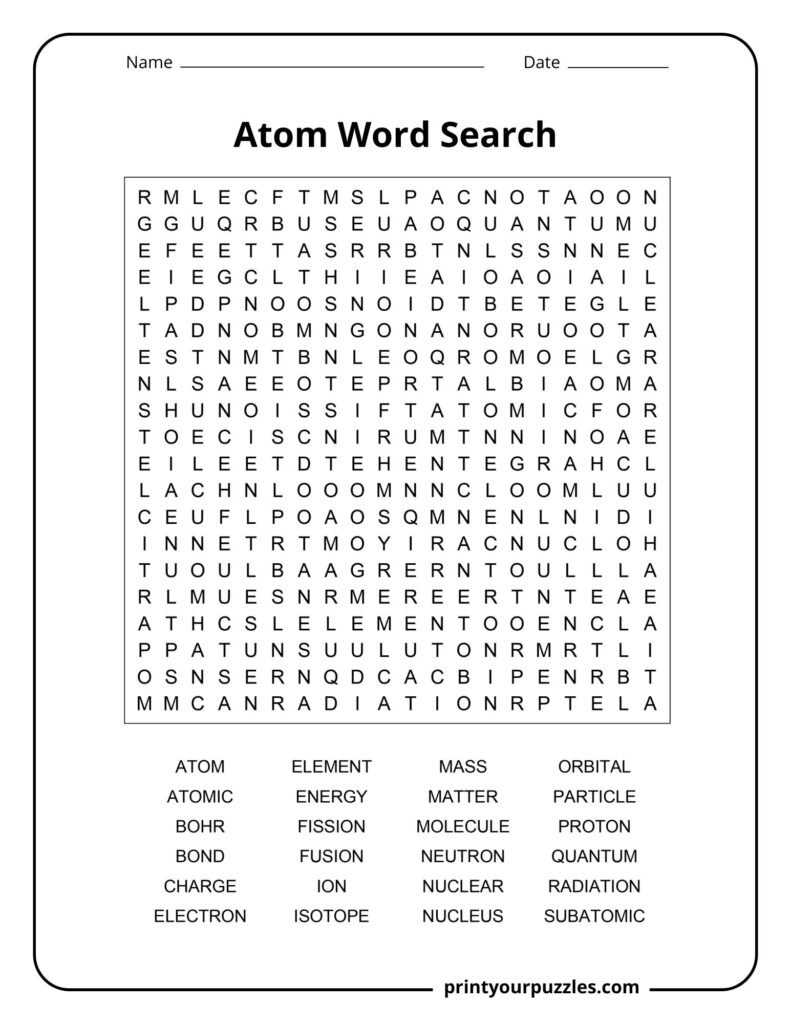
Hard Difficulty Word Search
Words to Find
ATOM, ATOMIC, BOHR, BOND, CHARGE, ELECTRON, ELEMENT, ENERGY, FISSION, FUSION, ION, ISOTOPE, MASS, MATTER, MOLECULE, NEUTRON, NUCLEAR, NUCLEUS, ORBITAL, PARTICLE, PROTON, QUANTUM, RADIATION, SUBATOMIC
5 Key FAQs About Atoms
5 Curious "Did You Know?" Facts About Atoms