
The Indian Removal Act was a major United States law that changed the lives of thousands of Native Americans during the nineteenth century. Signed by President Andrew Jackson on May 28, 1830, the law authorized the federal government to negotiate agreements with Native nations living east of the Mississippi River. These agreements were intended to exchange their ancestral lands for territory farther west, mainly in what later became Oklahoma.
Supporters of removal argued that moving Native peoples westward would reduce conflicts between settlers and Native nations while opening more southeastern land to white settlement and agriculture. The expansion of cotton farming also increased pressure on valuable Native lands in states such as Georgia, Alabama, Mississippi, and Tennessee. However, many Native communities strongly opposed removal and did not willingly want to leave their homes.
The policy especially affected the Cherokee, Creek, Choctaw, Chickasaw, and Seminole nations, sometimes referred to historically as the Five Civilized Tribes. Some groups attempted to resist removal through negotiations, political action, or the courts. The Cherokee Nation, for example, challenged Georgia’s actions in cases that reached the United States Supreme Court.
Despite this resistance, the federal government continued its removal policies. Thousands of Native Americans were eventually forced to travel west under extremely difficult conditions. The most famous example was the forced removal of the Cherokee in 1838–1839, remembered as the Trail of Tears. Thousands suffered from hunger, disease, exposure, and exhaustion during the journey, and many died.
The Indian Removal Act remains an important and controversial part of American history because it demonstrates how westward expansion often came at an enormous cost to Native peoples. It also raises important questions about federal power, treaties, land ownership, Native sovereignty, and the treatment of Indigenous communities.
This Indian Removal Act word search offers a way to explore important people, places, events, and ideas connected with the law and its consequences. Learning these terms can help explain why removal occurred, how Native nations responded, and how the policy shaped both United States expansion and Native American history for generations.
Related Word Searches:
Trail of Tears | Cherokee Nation | Andrew Jackson | Native Americans | Westward Expansion | Manifest Destiny
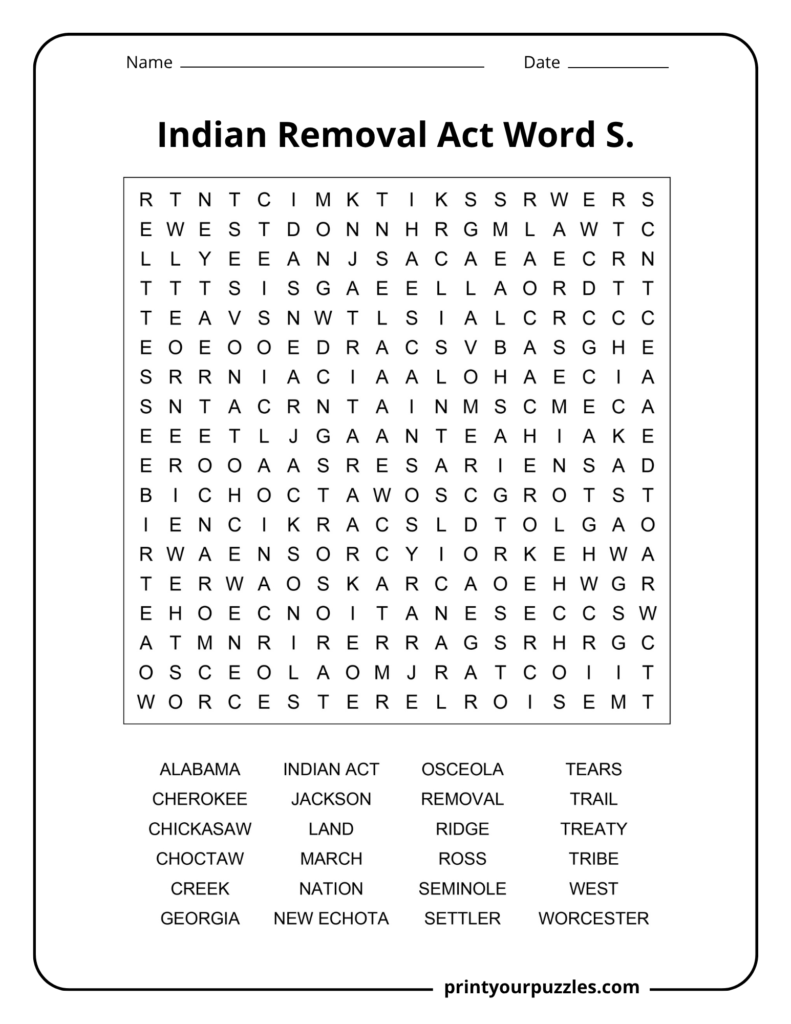
ALABAMA, CHEROKEE, CHICKASAW, CHOCTAW, CREEK, GEORGIA, INDIAN ACT, JACKSON, LAND, MARCH, NATION, NEW ECHOTA, OSCEOLA, REMOVAL, RIDGE, ROSS, SEMINOLE, SETTLER, TEARS, TRAIL, TREATY, TRIBE, WEST, WORCESTER
ALABAMA – Southern state where Creek people lost large areas of ancestral land during the removal era, allowing white settlers to expand cotton farming across the region.
CHEROKEE – Native nation deeply affected by removal policies. Thousands of Cherokee people were forced west from their southeastern homelands during the devastating Trail of Tears.
CHICKASAW – Native nation originally living across parts of Mississippi, Alabama, Tennessee, and Kentucky whose members were relocated west after signing removal agreements with the federal government.
CHOCTAW – Native nation among the first groups removed under Andrew Jackson’s policies, with thousands traveling west from Mississippi to Indian Territory under extremely difficult conditions.
CREEK – Native people also known as the Muscogee, many of whom were forced from Alabama and Georgia to Indian Territory following conflict, treaties, and federal pressure.
GEORGIA – Southern state that aggressively sought control over Cherokee lands, creating major legal and political conflicts involving Native sovereignty, state authority, and the federal government.
INDIAN ACT – Shortened reference to the Indian Removal Act of 1830, the federal law authorizing negotiations intended to relocate Native nations west of the Mississippi River.
JACKSON – Andrew Jackson, seventh president of the United States, signed the Indian Removal Act in 1830 and strongly supported relocating Native peoples from southeastern lands.
LAND – Central issue behind removal because white settlers, farmers, and state governments wanted access to fertile Native territories for settlement, agriculture, expansion, and economic development.
MARCH – Long forced journeys made by Native communities traveling west, often involving difficult weather, hunger, disease, exhaustion, inadequate supplies, and deaths along the routes.
NATION – Term describing a politically organized Native people with its own government, territory, traditions, and leadership, including the Cherokee, Choctaw, Creek, Chickasaw, and Seminole.
NEW ECHOTA – Georgia location where a controversial 1835 treaty was signed by a small Cherokee faction, providing the federal government justification for removing the Cherokee westward.
OSCEOLA – Influential Seminole leader who resisted United States efforts to remove Seminole people from Florida and became an important figure during the Second Seminole War.
REMOVAL – Federal policy of relocating Native peoples from ancestral eastern homelands to western territories, sometimes through agreements but frequently involving pressure, coercion, violence, and forced migration.
RIDGE – Cherokee political family name associated with Major Ridge and John Ridge, who supported the Treaty of New Echota despite strong opposition from most Cherokee people.
ROSS – John Ross, principal chief of the Cherokee Nation, strongly opposed removal and worked through petitions, diplomacy, and legal efforts to defend Cherokee lands and sovereignty.
SEMINOLE – Native people of Florida who strongly resisted removal, leading to prolonged conflicts with the United States, especially during the costly Second Seminole War.
SETTLER – Person who moved into developing American territories, often occupying lands previously controlled by Native nations as United States settlement expanded farther south and west.
TEARS – Word associated with the Trail of Tears, reflecting the suffering, deaths, displacement, and hardship experienced by Cherokee people during their forced journey westward.
TRAIL – Route or journey associated with Native removal, especially the Trail of Tears, along which displaced Cherokee communities traveled from southeastern homelands to Indian Territory.
TREATY – Formal agreement between governments or nations. During removal, treaties were used to transfer Native lands and arrange relocation, sometimes despite widespread opposition within Native communities.
TRIBE – Common historical term for a Native American community sharing political, cultural, or ancestral connections, although many such groups also identify themselves as sovereign nations.
WEST – Direction in which Native nations were relocated, particularly toward Indian Territory beyond the Mississippi River, far from their traditional southeastern homelands and established communities.
WORCESTER – Samuel Worcester, missionary involved in Worcester v. Georgia, the Supreme Court case that supported Cherokee sovereignty against Georgia’s attempts to control activities within Cherokee territory.
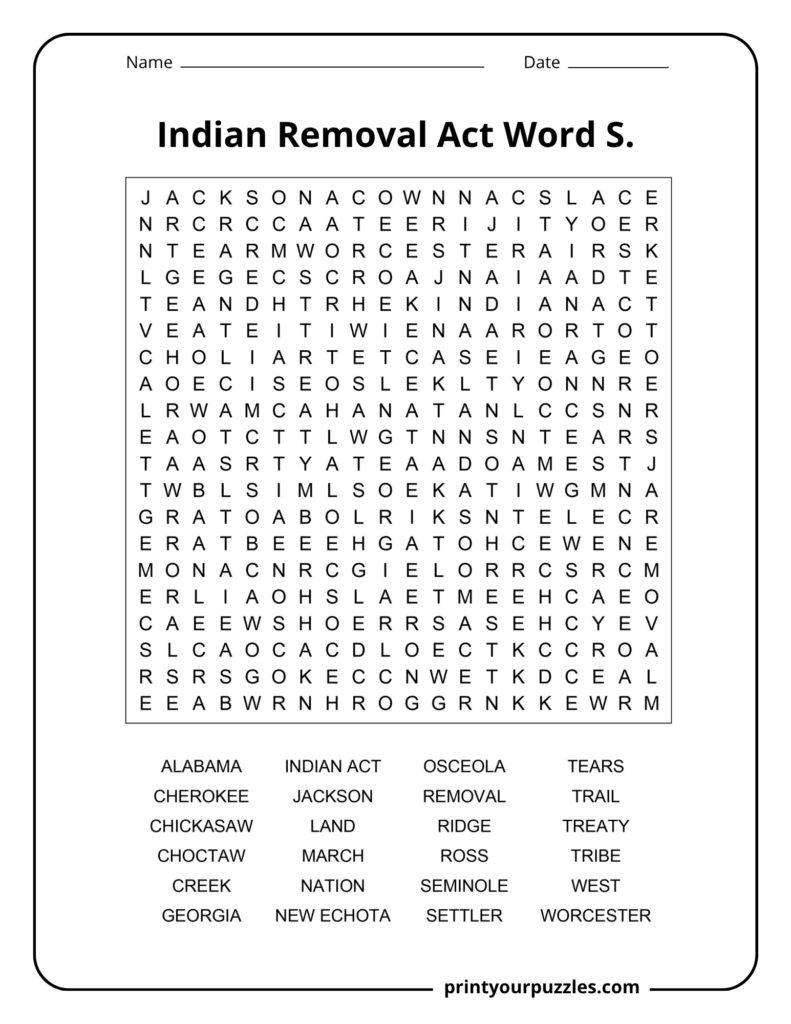
ALABAMA, CHEROKEE, CHICKASAW, CHOCTAW, CREEK, GEORGIA, INDIAN ACT, JACKSON, LAND, MARCH, NATION, NEW ECHOTA, OSCEOLA, REMOVAL, RIDGE, ROSS, SEMINOLE, SETTLER, TEARS, TRAIL, TREATY, TRIBE, WEST, WORCESTER
The Indian Removal Act was an 1830 federal law authorizing the government to negotiate the relocation of Native nations to lands west of the Mississippi River.
President Andrew Jackson signed the Indian Removal Act on May 28, 1830, making Native removal a central policy of his presidential administration.
The Cherokee, Choctaw, Chickasaw, Creek, and Seminole nations were among those most affected by removal from their ancestral homelands in the southeastern United States.
The Trail of Tears was the forced westward removal of the Cherokee in 1838–1839, during which thousands suffered from disease, hunger, exposure, and exhaustion.
The law dramatically expanded white settlement while causing widespread Native displacement, suffering, and land loss, making it a major turning point in United States history.
Yes. The Indian Removal Act passed the House of Representatives by only a small margin before President Andrew Jackson signed it into law in 1830.
Yes. Cherokee leaders used the American legal system to defend their sovereignty, resulting in important Supreme Court cases including Worcester v. Georgia.
Yes. The Indian Removal Act became law in 1830, while the forced Cherokee removal known as the Trail of Tears occurred mainly in 1838–1839.
Yes. Many Seminole people fought United States forces in Florida, especially during the Second Seminole War, resisting efforts to relocate them westward.
Yes. Nations such as the Cherokee maintained political institutions, written laws, schools, farms, and communities before federal removal policies displaced many of their people.