
The Byzantine Empire was one of the most important and long-lasting civilizations of the medieval world. It developed from the eastern half of the Roman Empire and survived for more than a thousand years after the western Roman government collapsed. Its capital, Constantinople, stood between Europe and Asia, giving the empire a powerful position for trade, diplomacy, and military defense. Today, Constantinople is known as Istanbul, one of the largest cities in Turkey.
The empire is usually considered to have begun in 330, when Roman emperor Constantine the Great made Constantinople his new imperial capital. Although modern historians call it the Byzantine Empire, its people generally considered themselves Romans. They preserved many Roman laws, traditions, and political institutions while gradually developing a culture strongly influenced by Greek language and Orthodox Christianity.
One of the empire’s most famous rulers was Emperor Justinian I, who reigned from 527 to 565. Justinian attempted to recover former Roman territories in the Mediterranean and ordered an important collection of Roman laws known as the Justinian Code. During his reign, the magnificent Hagia Sophia was constructed in Constantinople. For centuries, it stood as one of the greatest achievements of Byzantine architecture.
Religion played a major role in Byzantine society. The empire became a center of Eastern Orthodox Christianity, producing distinctive religious art, mosaics, icons, churches, and theological traditions. In 1054, disagreements between eastern and western Christians contributed to the Great Schism, which separated the Eastern Orthodox Church from the Roman Catholic Church.
The Byzantine Empire also faced repeated wars and invasions. Its armies fought Persians, Arabs, Bulgars, Crusaders, and Ottoman Turks at different times. The empire gradually lost territory, and Constantinople was even captured by Crusaders in 1204 before Byzantine rule was restored in 1261.
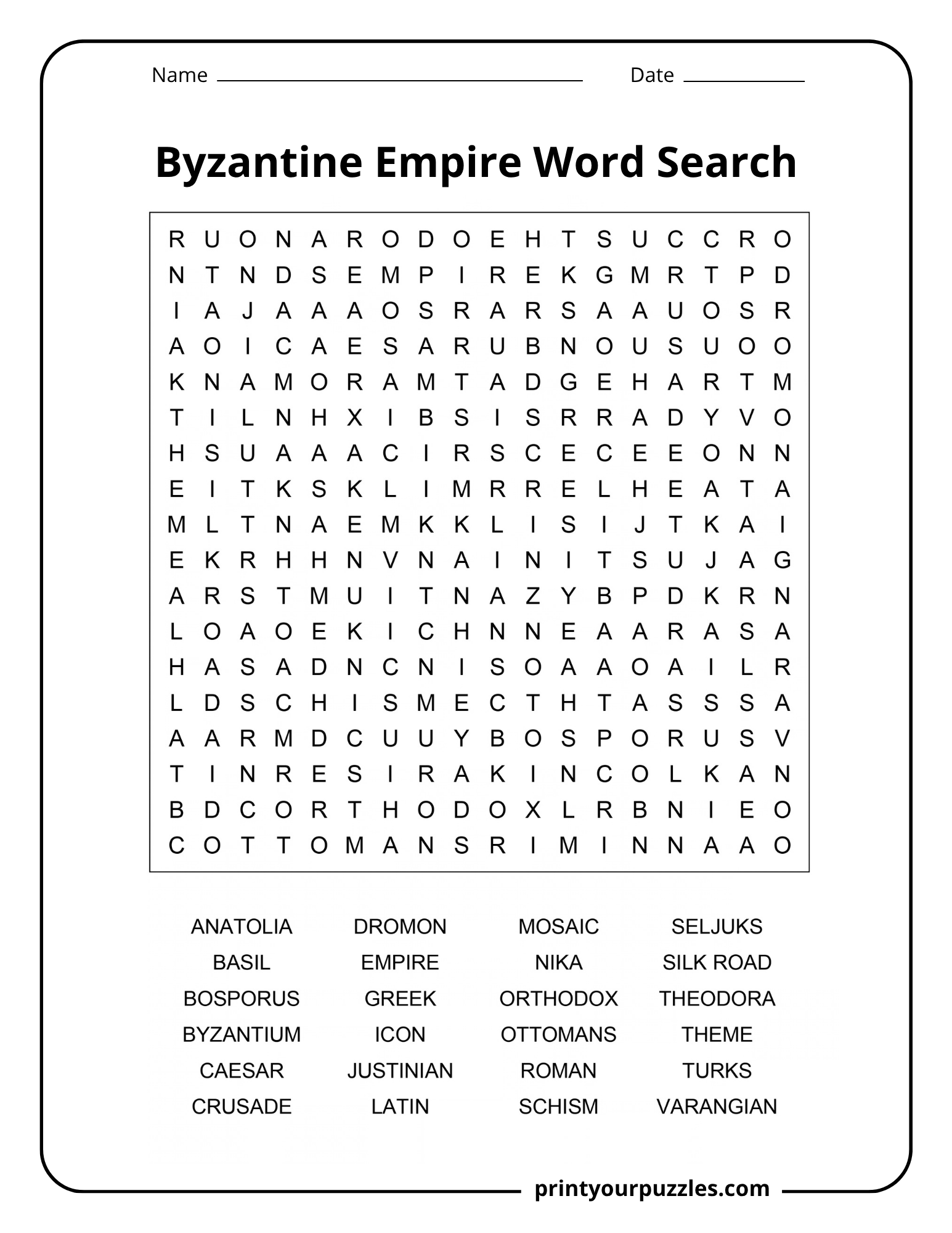
The empire finally ended in 1453 when Ottoman forces led by Sultan Mehmed II captured Constantinople. However, Byzantine influence continued long afterward through law, religion, art, architecture, scholarship, and the preservation of ancient Greek and Roman writings. This Byzantine Empire word search offers an engaging way to explore the rulers, places, beliefs, conflicts, and cultural achievements connected with this remarkable civilization.
Related Word Searches:
Ancient Rome | Ancient Greece | Feudalism | Carolingian Empire | Silk Road | Renaissance
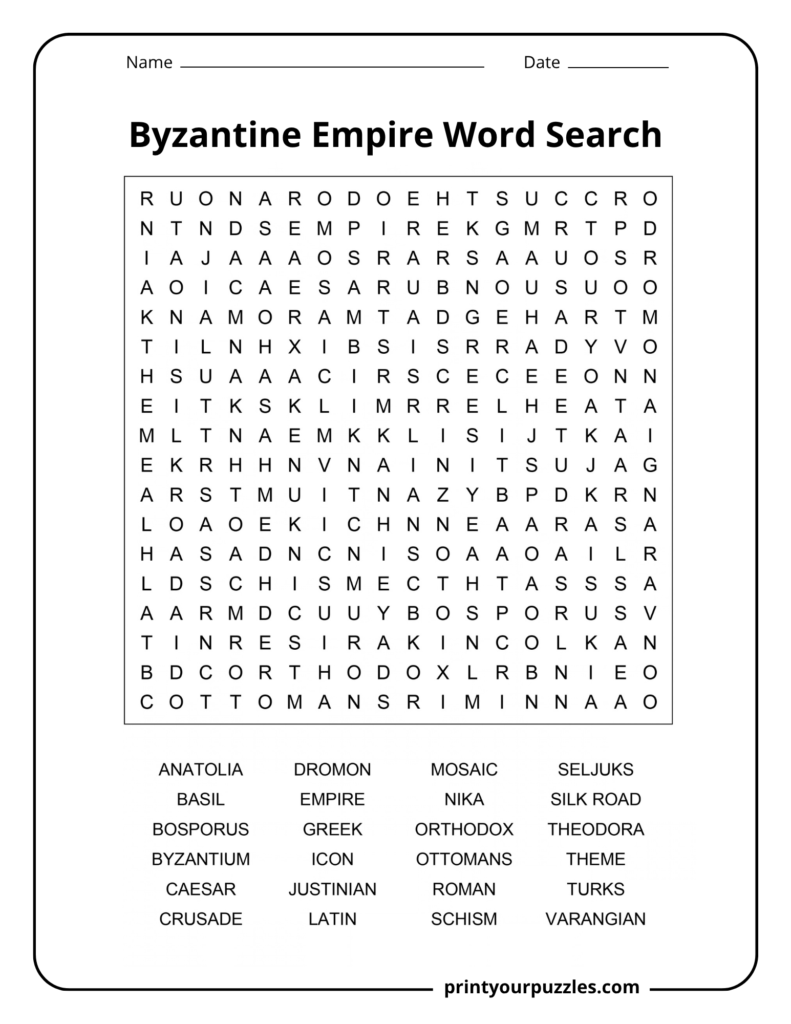
ANATOLIA, BASIL, BOSPORUS, BYZANTIUM, CAESAR, CRUSADE, DROMON, EMPIRE, GREEK, ICON, JUSTINIAN, LATIN, MOSAIC, NIKA, ORTHODOX, OTTOMANS, ROMAN, SCHISM, SELJUKS, SILK ROAD, THEODORA, THEME, TURKS, VARANGIAN
ANATOLIA – Large peninsula forming most of modern Turkey, where the Byzantine Empire controlled important cities, roads, farms, and military territories for many centuries.
BASIL – Name used by several Byzantine emperors, including Basil II, a powerful ruler who expanded imperial territory and strengthened Byzantine authority during the eleventh century.
BOSPORUS – Narrow waterway separating Europe and Asia at Constantinople, giving the Byzantine capital a strategic position for trade, naval defense, and control of regional movement.
BYZANTIUM – Ancient Greek settlement that later became Constantinople under Emperor Constantine. Its name eventually inspired the modern historical term used for the Eastern Roman Empire.
CAESAR – Prestigious Roman title adopted in Byzantine imperial government, often granted to important members of the ruling family or senior figures close to the emperor.
CRUSADE – Military expedition organized by Western Christians, several of which passed through Byzantine lands and affected relations between Constantinople and the kingdoms of Western Europe.
DROMON – Fast Byzantine warship powered by oars and sails, commonly used by the imperial navy and sometimes equipped to attack enemies with Greek fire.
EMPIRE – Large state ruled by an emperor. The Byzantine Empire governed territories across southeastern Europe, Asia Minor, and parts of the Mediterranean at different times.
GREEK – Language that gradually became dominant in Byzantine government, culture, education, and religion, replacing Latin in many official and everyday uses across the empire.
ICON – Sacred image of Jesus, Mary, saints, or biblical scenes used in Orthodox Christian worship and devotion, becoming an important feature of Byzantine religious culture.
JUSTINIAN – Byzantine emperor who ruled from 527 to 565, reconquered former Roman territories, reorganized Roman law, and ordered the construction of Constantinople’s Hagia Sophia.
LATIN – Language inherited from the Roman Empire and initially used in Byzantine government before Greek became increasingly dominant in administration, literature, and everyday imperial life.
MOSAIC – Decorative artwork created from small pieces of colored glass, stone, or tile, widely used in Byzantine churches to represent religious figures and sacred scenes.
NIKA – Name associated with the Nika Revolt of 532, a major uprising in Constantinople that threatened Justinian’s rule before imperial forces violently suppressed it.
ORTHODOX – Branch of Christianity closely associated with Byzantine religious life, traditions, worship, and leadership, especially after growing divisions between eastern and western Christian churches.
OTTOMANS – Turkish dynasty and empire that gradually conquered Byzantine territories, finally capturing Constantinople in 1453 under Sultan Mehmed II and ending Byzantine political rule.
ROMAN – Identity claimed by Byzantine citizens, who considered their empire the continuation of ancient Rome despite their increasing use of Greek language and eastern traditions.
SCHISM – Religious division, especially the Great Schism of 1054, which deepened the separation between the Eastern Orthodox Church and the Roman Catholic Church.
SELJUKS – Turkish Muslim dynasty that defeated Byzantine forces at Manzikert in 1071, contributing to the empire’s loss of important territories across much of Anatolia.
SILK ROAD – Network of trade routes linking Asia, the Middle East, and Europe. Byzantine merchants benefited from commerce involving silk, spices, precious goods, and other products.
THEODORA – Influential Byzantine empress and wife of Justinian I, remembered for her political involvement, strong personality, and role in supporting the emperor during the Nika Revolt.
THEME – Administrative and military district of the Byzantine Empire, organized to improve regional defense by connecting local government, soldiers, landholding, and military responsibilities.
TURKS – General term for several Turkic peoples who entered Anatolia and challenged Byzantine power, including the Seljuks and later the Ottomans who captured Constantinople.
VARANGIAN – Member of the Varangian Guard, an elite unit of mainly Scandinavian and later Anglo-Saxon warriors who served as loyal personal bodyguards to Byzantine emperors.
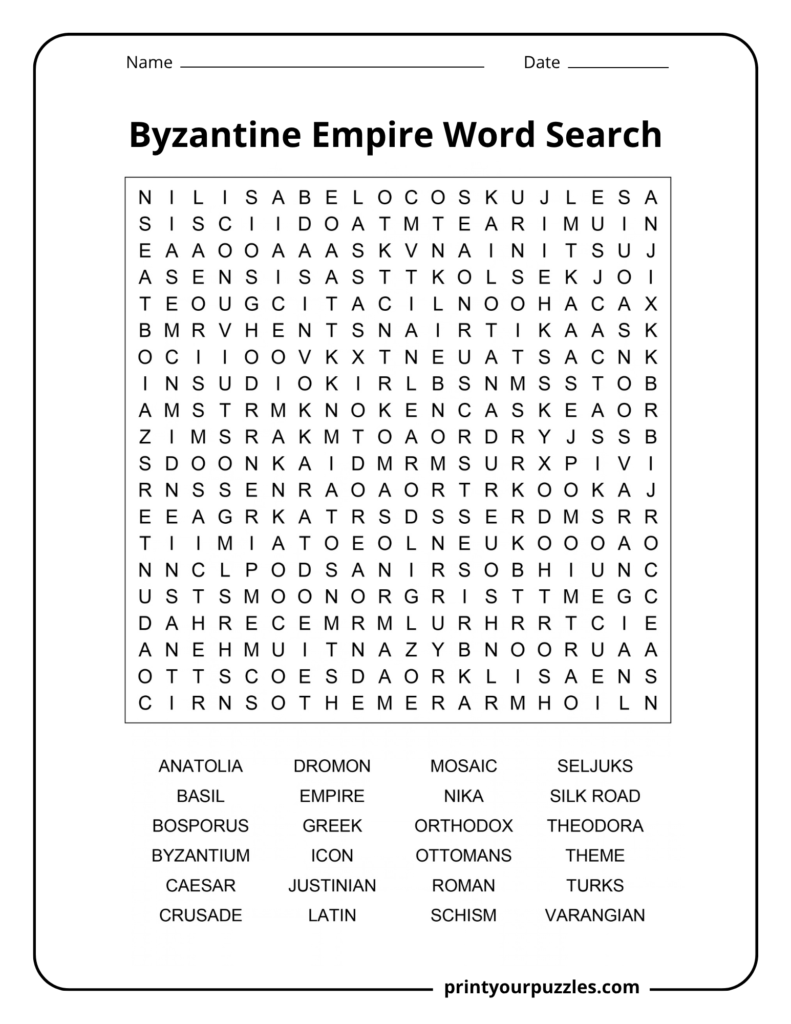
ANATOLIA, BASIL, BOSPORUS, BYZANTIUM, CAESAR, CRUSADE, DROMON, EMPIRE, GREEK, ICON, JUSTINIAN, LATIN, MOSAIC, NIKA, ORTHODOX, OTTOMANS, ROMAN, SCHISM, SELJUKS, SILK ROAD, THEODORA, THEME, TURKS, VARANGIAN
The Byzantine Empire was the eastern continuation of the Roman Empire, centered on Constantinople and lasting for more than a thousand years until 1453.
Constantinople controlled major trade routes between Europe and Asia and had strong defensive walls, making it a wealthy, strategic, and highly protected imperial capital.
Justinian I was a major Byzantine emperor who expanded imperial territory, reorganized Roman law, and ordered the construction of the famous Hagia Sophia.
Eastern Orthodox Christianity shaped Byzantine worship, art, politics, and culture, becoming especially important after divisions developed between eastern and western Christian churches.
The Byzantine Empire ended in 1453 when Ottoman forces led by Sultan Mehmed II captured Constantinople after a major siege and defeated the remaining defenders.
The people of the Byzantine Empire generally called themselves Romans because they believed their state was the direct continuation of the ancient Roman Empire.
Greek fire was a powerful incendiary weapon used by Byzantine forces, especially at sea, and its exact chemical formula remains unknown to historians today.
Emperor Justinian I ordered the construction of Hagia Sophia in Constantinople, and the enormous church was completed in only about five years.
During the Fourth Crusade in 1204, Western Crusaders captured and looted Constantinople, establishing Latin rule until Byzantine forces recovered the city in 1261.
Byzantine scholars copied and preserved many important Greek and Roman texts, helping ancient philosophy, science, literature, and history survive for future generations.