
The Middle Ages were a long and fascinating period of European history that lasted roughly from the fall of the Western Roman Empire in the fifth century to the beginning of the Renaissance in the fifteenth century. Also called the medieval period, these centuries brought enormous political, social, religious, and cultural changes. Kingdoms rose and fell, castles appeared across the landscape, powerful churches influenced everyday life, and communities developed new ways of governing, farming, trading, and defending themselves.
Life during the Middle Ages was very different depending on a person’s position in society. Kings and queens ruled territories, while nobles controlled large estates and often provided military support to their rulers. Knights became important figures in warfare and medieval culture, while most people worked as farmers or laborers in villages. This social system is often associated with feudalism, in which land, protection, military service, and loyalty connected rulers, nobles, knights, and peasants.
Religion played a central role in medieval European life. The Christian Church influenced education, art, politics, law, and daily customs. Monasteries preserved books and ancient knowledge, while great cathedrals demonstrated the skill of medieval architects and craftsmen. The period also witnessed the Crusades, a series of religious and military expeditions involving European Christians and Muslim powers in the eastern Mediterranean.
The Middle Ages were not only a time of castles and battles. Towns expanded, trade increased, universities were founded, and new forms of literature and art appeared. Merchants traveled along growing trade routes, guilds organized skilled workers, and large fairs connected people from different regions. Important inventions and agricultural improvements also helped transform medieval society.
However, medieval people also faced serious challenges. Wars, famines, disease, and political conflicts could cause enormous suffering. The Black Death, which spread across Europe during the fourteenth century, killed millions and dramatically affected the economy and social structure.
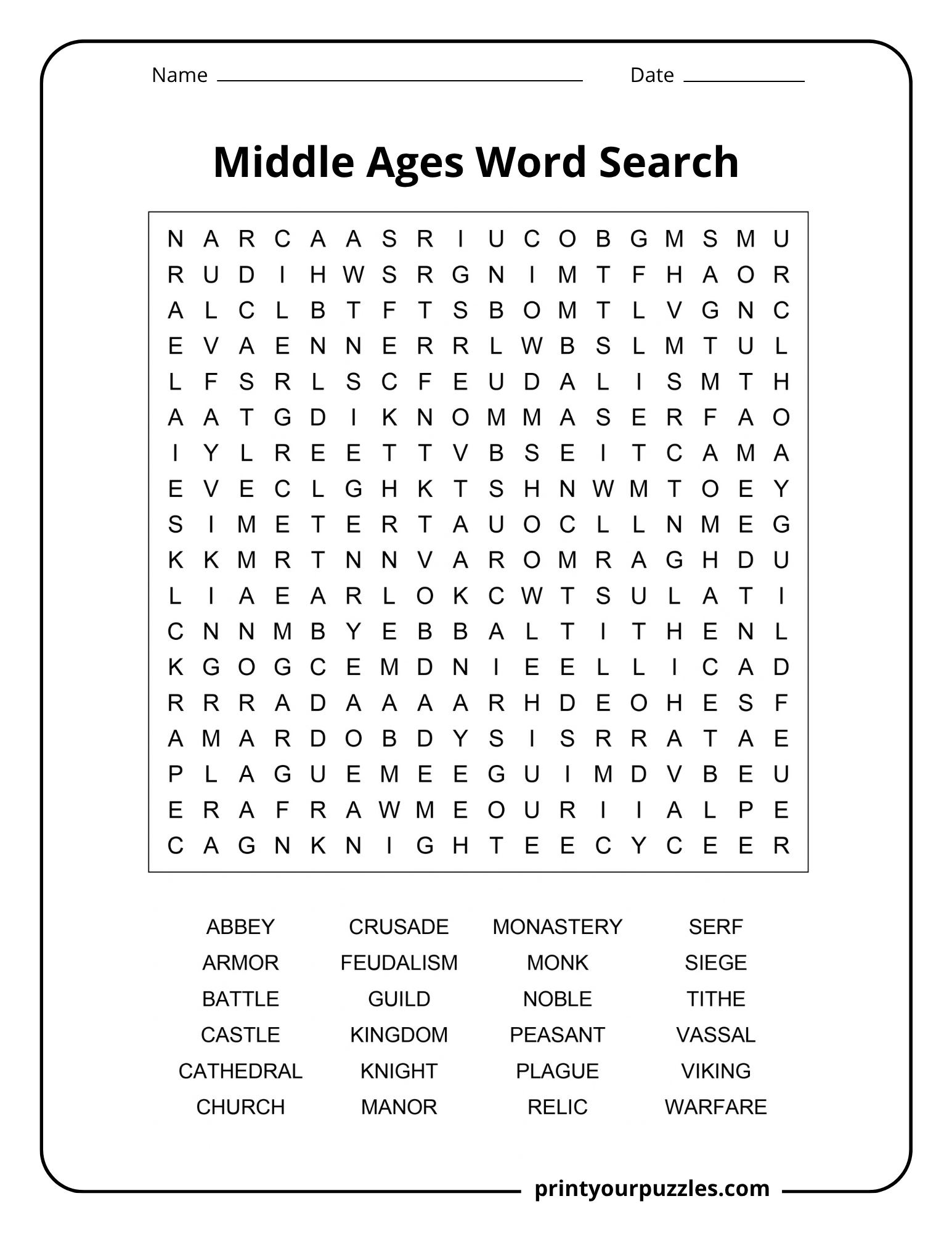
A Middle Ages word search offers an engaging way to explore the people, places, ideas, and events connected with this remarkable era. From knights and castles to monasteries, trade, feudalism, and the plague, the vocabulary of medieval history helps reveal how Europeans lived and how the Middle Ages helped shape the modern world.
Related Word Searches:
Feudalism | Carolingian Empire | Byzantine Empire | Viking Age | Renaissance | Ancient Rome
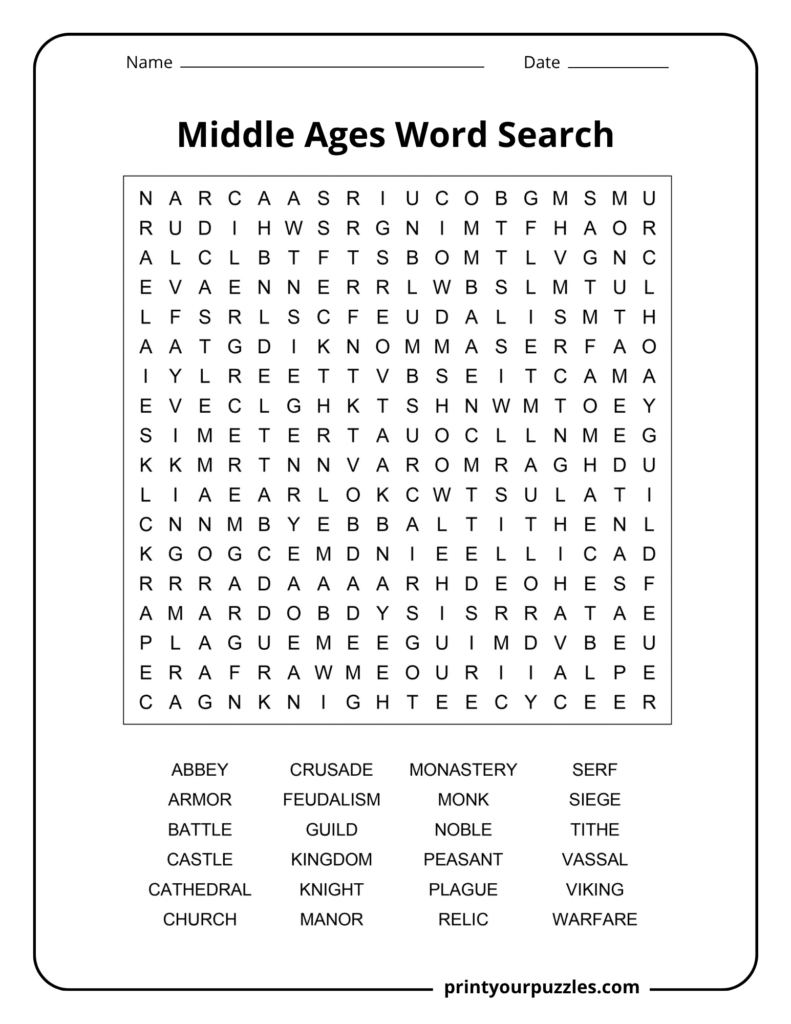
ABBEY, ARMOR, BATTLE, CASTLE, CATHEDRAL, CHURCH, CRUSADE, FEUDALISM, GUILD, KINGDOM, KNIGHT, MANOR, MONASTERY, MONK, NOBLE, PEASANT, PLAGUE, RELIC, SERF, SIEGE, TITHE, VASSAL, VIKING, WARFARE
ABBEY – A religious building or community where monks or nuns lived, prayed, worked, studied, and often preserved books and knowledge during the Middle Ages for future generations.
ARMOR – Protective clothing made from metal, leather, or other materials, worn by knights and soldiers to reduce injuries from swords, arrows, and other weapons during medieval warfare.
BATTLE – An armed fight between opposing forces, often involving knights, soldiers, archers, and cavalry during wars between medieval kingdoms, nobles, or rival rulers competing for power.
CASTLE – A fortified residence built for kings, nobles, or lords, designed for defense and often containing towers, walls, gates, courtyards, and living quarters for residents and soldiers.
CATHEDRAL – A large and important Christian church that served as the main church of a bishop and often displayed impressive medieval architecture, sculpture, and stained glass windows.
CHURCH – A Christian place of worship that played a central role in medieval communities, influencing religion, education, charity, celebrations, laws, and everyday social life for local populations.
CRUSADE – One of several religious military expeditions launched mainly by European Christians, especially to gain or defend control of sacred places in the eastern Mediterranean region.
FEUDALISM – A medieval social and political system based on land, loyalty, and service, connecting kings, nobles, knights, and peasants through agreements, obligations, protection, and military duties.
GUILD – An organized association of medieval merchants or skilled workers that regulated trades, controlled training, protected members, maintained standards, and influenced economic life in growing towns and cities.
KINGDOM – A territory ruled by a king or queen, often including towns, villages, castles, farmland, and nobles who governed local areas in the ruler’s name and authority.
KNIGHT – A trained mounted warrior who usually served a king or noble, fought in battles, protected lands, and followed traditions associated with loyalty, honor, service, and chivalry.
MANOR – A large medieval estate controlled by a lord, usually including farmland, villages, a manor house, and peasants who worked the surrounding land and supported its economy.
MONASTERY – A religious community where monks lived together under established rules, dedicating themselves to prayer, study, work, teaching, farming, and preserving important written texts and manuscripts.
MONK – A man who joined a religious community and devoted his life to prayer, worship, study, labor, and service, usually living inside a monastery with other monks.
NOBLE – A person belonging to the upper social class, often owning land, controlling estates, advising rulers, collecting taxes, and providing soldiers or military support when required.
PEASANT – A member of the large rural population who worked the land, grew crops, raised animals, paid dues, and supported medieval society through agricultural labor and food production.
PLAGUE – A deadly infectious disease that caused devastating outbreaks, especially the Black Death, which killed millions of people across Europe during the fourteenth century and transformed society.
RELIC – A physical object connected with a saint or holy person, often preserved in churches or monasteries and respected by medieval Christians as spiritually important and worthy of veneration.
SERF – A peasant legally tied to a lord’s land, required to provide labor or payments while receiving protection and the right to farm certain fields for survival.
SIEGE – A military operation in which an attacking army surrounded a castle, town, or fortress, attempting to force surrender by blockade, bombardment, starvation, or direct assault.
TITHE – A religious payment, usually equal to one tenth of a person’s produce or income, given to support the medieval Church, clergy, charitable work, and religious activities.
VASSAL – A person who promised loyalty and service to a more powerful lord, often receiving land or protection in return under the medieval feudal system and its obligations.
VIKING – A Scandinavian seafarer who explored, traded, settled, and sometimes raided parts of Europe between the eighth and eleventh centuries, influencing early medieval history, culture, and trade.
WARFARE – The organized use of military force between kingdoms, nobles, or rival groups, involving weapons, castles, sieges, knights, armies, and changing medieval battle tactics and defensive strategies.
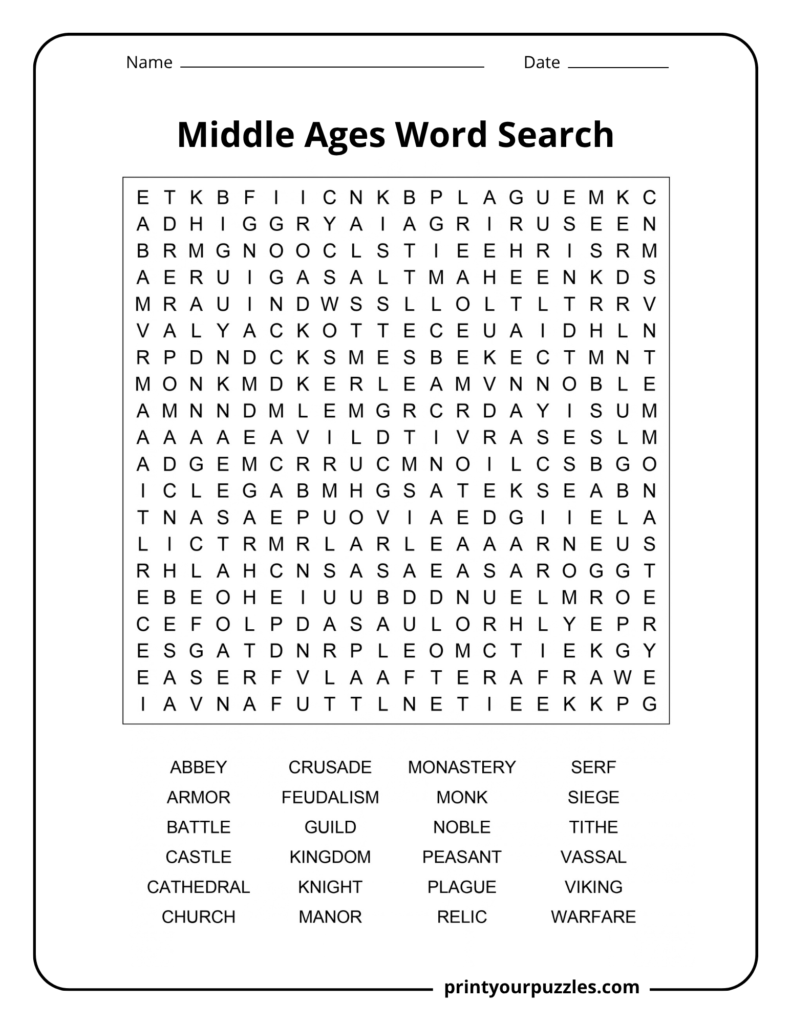
ABBEY, ARMOR, BATTLE, CASTLE, CATHEDRAL, CHURCH, CRUSADE, FEUDALISM, GUILD, KINGDOM, KNIGHT, MANOR, MONASTERY, MONK, NOBLE, PEASANT, PLAGUE, RELIC, SERF, SIEGE, TITHE, VASSAL, VIKING, WARFARE
The Middle Ages generally lasted from the fifth century, after the fall of the Western Roman Empire, until the Renaissance began around the fifteenth century.
Feudalism was a system based on land, loyalty, and service, connecting kings, nobles, knights, and peasants through political, military, and economic obligations.
Castles served as fortified homes for rulers and nobles, military strongholds, administrative centers, and symbols of political authority and control over surrounding lands.
The Church influenced religion, education, politics, art, charity, law, and daily customs, while monasteries preserved books and helped maintain important knowledge.
The Black Death killed millions during the fourteenth century, reducing populations, disrupting trade and farming, creating labor shortages, and causing major social and economic changes.
Early castles often used timber defenses, but many were later rebuilt in stone because it offered stronger protection against attacks, fire, and sieges.
Monks copied manuscripts by hand, preserving religious works, classical writings, historical records, and scientific knowledge that might otherwise have disappeared over time.
Future knights often started as pages before becoming squires, learning riding, weapons, manners, and military skills before eventually earning the title of knight.
Guilds brought together merchants or skilled workers, regulated trades, trained apprentices, protected members, maintained standards, and played an important role in town economies.
The enormous loss of life created labor shortages, giving some surviving workers greater bargaining power and contributing to significant economic and social changes across Europe.