The Solar System is our cosmic neighborhood, a vast region of space centered around the Sun. It includes eight planets, their moons, dwarf planets, asteroids, comets, and countless smaller objects. Although these bodies differ greatly in size, temperature, and composition, they are connected by the Sun’s gravity and travel along predictable paths called orbits.
The Sun is a star and contains almost all the mass in the Solar System. It produces the heat and light that make life possible on Earth. Closest to the Sun are the four inner planets: Mercury, Venus, Earth, and Mars. These are known as rocky or terrestrial planets because they have solid surfaces. Mercury is the smallest and nearest planet, while Venus is extremely hot because of its thick atmosphere. Earth is the only planet known to support life, and Mars is famous for its red surface and evidence of ancient water.
Beyond Mars lies the asteroid belt, a region filled with rocky objects of many different sizes. Farther away are the four outer planets: Jupiter, Saturn, Uranus, and Neptune. Jupiter and Saturn are gas giants made mainly of hydrogen and helium. Jupiter is the largest planet, while Saturn is easily recognized by its spectacular ring system. Uranus and Neptune are called ice giants because they contain large amounts of icy materials such as water, methane, and ammonia.
Many planets have natural satellites, commonly called moons. Earth has one moon, while some outer planets have dozens. The Solar System also contains dwarf planets, including Pluto and Ceres. Comets travel around the Sun in long, stretched orbits and may develop glowing tails when they approach it.
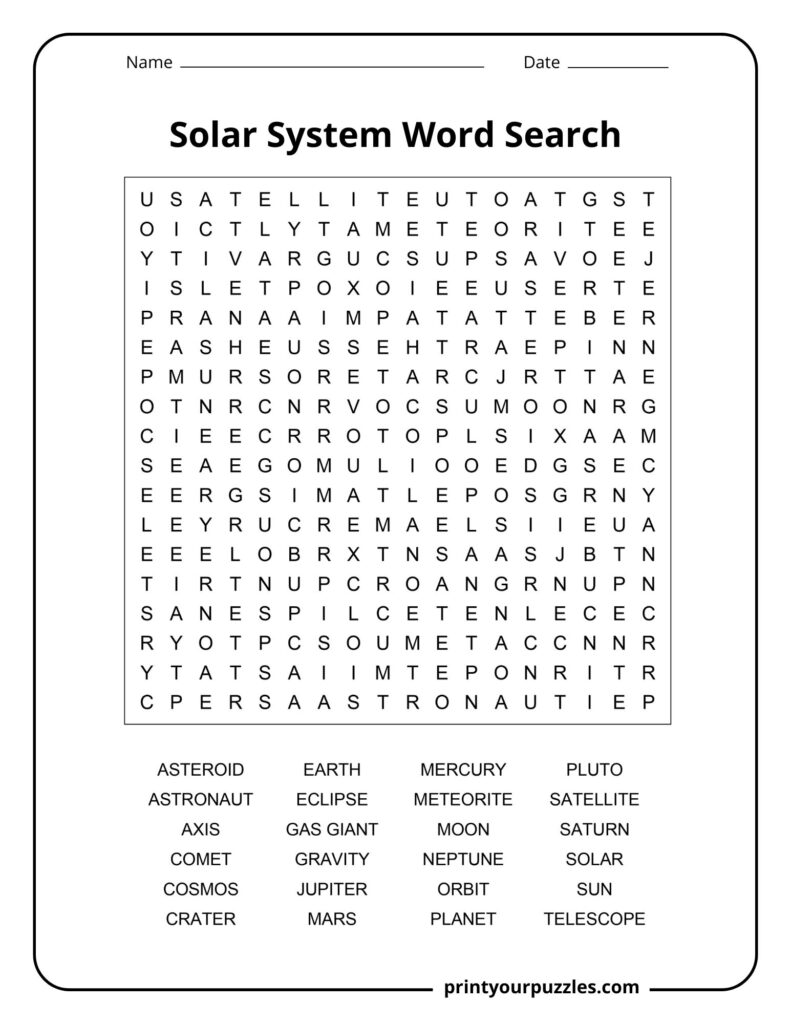
Scientists study the Solar System using telescopes, satellites, robotic spacecraft, and space probes. These tools help researchers understand how planets formed, why their environments are different, and whether life could exist beyond Earth. A Solar system word search printable can introduce important vocabulary such as planet, orbit, asteroid, comet, galaxy, gravity, and satellite. Learning these terms makes it easier to explore the objects, movements, and discoveries that shape our understanding of space.
Related Word Searches:
Astronomy | Gravity | Moon Phases | Visible Stars | Eclipse | Physics
ASTEROID – A small rocky or metallic object orbiting the Sun, typically found in the asteroid belt between Mars and Jupiter, ranging from meters to hundreds of kilometers wide.
ASTRONAUT – A person trained and equipped to travel in spacecraft beyond Earth’s atmosphere, conducting scientific research, performing maintenance tasks, and exploring space for human knowledge and advancement.
AXIS – An imaginary straight line passing through the center of a planet or celestial body around which it rotates, determining its day-night cycle and seasonal patterns.
COMET – An icy celestial body that develops a glowing tail of gas and dust when its orbit brings it close to the Sun, causing its frozen materials to vaporize.
COSMOS – The universe regarded as an orderly, harmonious system encompassing all matter, energy, space, and time, including galaxies, stars, planets, and all forms of existence throughout infinity.
CRATER – A bowl-shaped depression on a planet or moon’s surface formed by the high-speed impact of meteorites, asteroids, or comets, or created by volcanic activity explosions.
EARTH – The third planet from the Sun and our home world, featuring liquid water, diverse life forms, protective atmosphere, and unique conditions supporting complex ecosystems throughout continents.
ECLIPSE – A celestial event occurring when one astronomical body moves into the shadow of another, temporarily blocking light, such as when the Moon obscures the Sun or Earth.
GAS GIANT – A massive planet composed primarily of hydrogen and helium gases rather than solid rock, like Jupiter or Saturn, featuring thick atmospheres and often numerous moons orbiting.
GRAVITY – The natural attractive force between objects with mass, pulling them toward each other, keeping planets in orbit around stars and moons around planets throughout the universe.
JUPITER – The largest planet in our Solar System, a massive gas giant with distinctive bands of clouds, the famous Great Red Spot storm, and over seventy known moons.
MARS – The fourth planet from the Sun, known as the Red Planet due to iron oxide on its surface, featuring polar ice caps, volcanoes, and potential for past water.
MERCURY – The smallest planet and closest to the Sun, featuring extreme temperature variations, no atmosphere, a heavily cratered surface, and the fastest orbital speed in our system.
METEORITE – A solid piece of debris from space that survives its fiery passage through Earth’s atmosphere and lands on the surface, providing valuable samples of extraterrestrial material for study.
MOON – Earth’s natural satellite orbiting our planet, influencing ocean tides, stabilizing Earth’s axial tilt, and providing reflected sunlight that illuminates our nights with its changing phases.
NEPTUNE – The eighth and most distant planet from the Sun in our Solar System, an ice giant with powerful winds, a deep blue color, and several moons including Triton.
ORBIT – The curved path followed by a celestial object moving around another due to gravitational attraction, such as planets circling the Sun or satellites revolving around Earth continuously.
PLANET – A large celestial body orbiting a star, having sufficient mass for gravity to form it into a spherical shape, and having cleared its orbital path of other debris.
PLUTO – A dwarf planet in the outer Solar System beyond Neptune’s orbit, once considered the ninth planet, featuring a heart-shaped region and five known moons including Charon.
SATELLITE – Any object orbiting a planet or star, either natural like moons formed from cosmic debris, or artificial spacecraft launched by humans for communication, observation, or scientific purposes.
SATURN – The sixth planet from the Sun, famous for its spectacular system of icy rings, numerous moons including Titan, and its distinctive golden appearance from hydrogen clouds.
SOLAR – Relating to or originating from the Sun, our central star that provides light, heat, and energy to Earth and all planets within our system through nuclear fusion.
SUN – The star at the center of our Solar System, a massive sphere of hot plasma producing energy through nuclear fusion, providing essential light and warmth for life on Earth.
TELESCOPE – An optical instrument using lenses or mirrors to magnify distant objects, allowing astronomers to observe planets, stars, galaxies, and other celestial phenomena across vast cosmic distances.