Introduction to the DNA Word Search
DNA, short for deoxyribonucleic acid, is the molecule that carries the genetic instructions needed for living organisms to grow, develop, function, and reproduce. It is found in almost every cell of the human body and in the cells of animals, plants, fungi, and many microorganisms. DNA helps explain why children resemble their parents, why organisms have particular characteristics, and how traits can be passed from one generation to the next.
The structure of DNA is often described as a double helix because it looks like a twisted ladder. The sides of this ladder are made from sugar and phosphate molecules, while the steps consist of four chemical bases: adenine, thymine, cytosine, and guanine. These bases are usually represented by the letters A, T, C, and G. Adenine pairs with thymine, while cytosine pairs with guanine. The order of these bases forms a biological code containing the instructions that cells need.
Sections of DNA called genes provide directions for producing proteins. Proteins perform many essential jobs, including building tissues, transporting substances, supporting chemical reactions, and helping the immune system defend the body. Although humans share most of their DNA, small differences in the genetic code contribute to individual features such as eye color, hair texture, and certain inherited traits.
Before a cell divides, its DNA must be copied so that each new cell receives a complete set of genetic instructions. This process is called DNA replication. Occasionally, small changes known as mutations occur during copying. Some mutations have no noticeable effect, while others may influence an organism’s characteristics, cause genetic disorders, or contribute to evolution over many generations.
DNA research has transformed science and medicine. Scientists use genetic information to study inherited diseases, identify organisms, investigate human ancestry, develop treatments, and analyze evidence in criminal investigations. DNA technology is also important in agriculture, conservation, and biotechnology.
Learning about DNA introduces students to important ideas involving genes, chromosomes, inheritance, mutations, and the organization of living cells. A DNA word search can make these scientific terms easier to recognize and remember while encouraging learners to explore the fascinating molecule that contains the instructions for life.
Related Word Searches:
Genetics | Cell | Cell Division | Biology | Bacteria | Body Systems
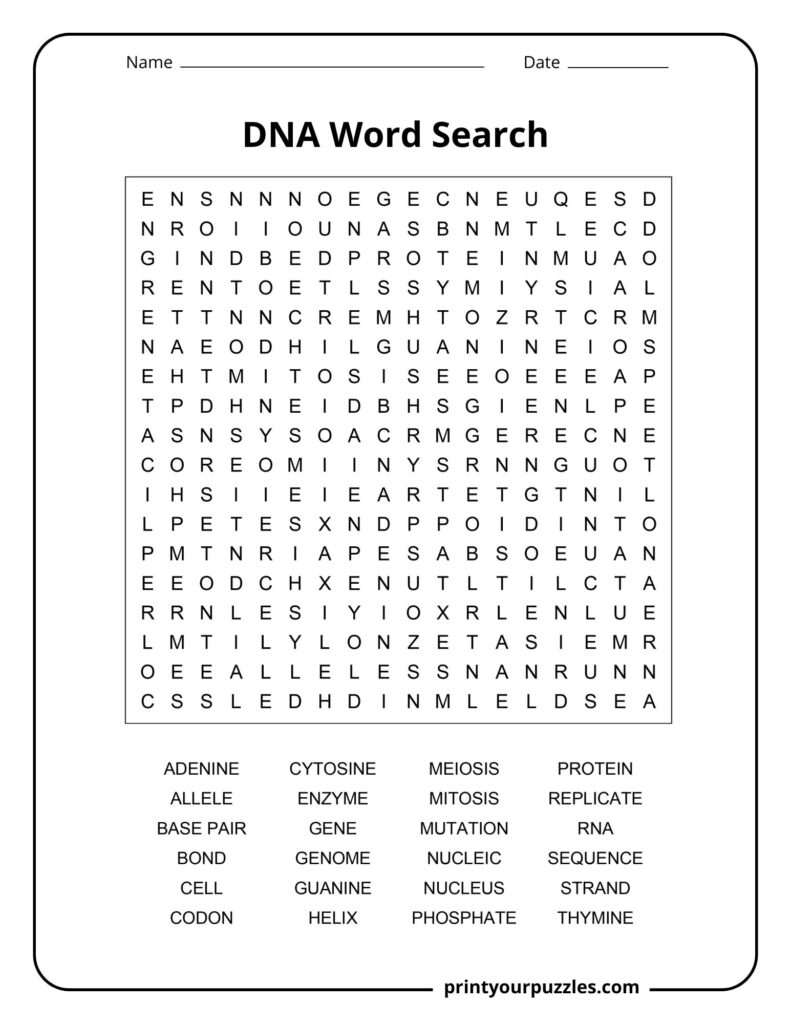
Medium Difficulty Word Search
Words to Find:
ADENINE, ALLELE, BASE PAIR, BOND, CELL, CODON, CYTOSINE, ENZYME, GENE, GENOME, GUANINE, HELIX, MEIOSIS, MITOSIS, MUTATION, NUCLEIC, NUCLEUS, PHOSPHATE, PROTEIN, REPLICATE, RNA, SEQUENCE, STRAND, THYMINE
All Words Defined
ADENINE – A purine nitrogenous base found in DNA and RNA that pairs with thymine in DNA or uracil in RNA, essential for genetic coding.
ALLELE – An alternative form of a gene located at a specific position on a chromosome, determining variations in inherited traits among organisms.
BASE PAIR – Two complementary nitrogenous bases connected by hydrogen bonds in DNA’s double helix structure, with adenine pairing to thymine and guanine to cytosine.
BOND – A chemical connection between atoms or molecules in DNA, including hydrogen bonds between base pairs and covalent bonds in the sugar-phosphate backbone.
CELL – The smallest structural and functional unit of life, containing genetic material and organelles necessary for growth, reproduction, and maintaining living processes.
CODON – A three-nucleotide sequence on messenger RNA that codes for a specific amino acid or signals the start or stop of protein synthesis.
CYTOSINE – A pyrimidine nitrogenous base found in DNA and RNA that pairs with guanine through three hydrogen bonds, crucial for genetic information storage.
ENZYME – A biological catalyst protein that speeds up chemical reactions in cells, including DNA replication, transcription, and repair processes without being consumed.
GENE – A segment of DNA that contains instructions for making specific proteins or RNA molecules, serving as the basic unit of heredity in organisms.
GENOME – The complete set of genetic information contained in an organism’s DNA, including all genes and non-coding sequences necessary for development and function.
GUANINE – A purine nitrogenous base in DNA and RNA that pairs with cytosine through three hydrogen bonds, playing a vital role in genetic coding.
HELIX – The spiral, twisted ladder structure of DNA formed by two complementary strands wound around each other, discovered by Watson and Crick in 1953.
MEIOSIS – A specialized cell division process producing four genetically unique daughter cells with half the chromosome number, essential for sexual reproduction in organisms.
MITOSIS – A cell division process creating two identical daughter cells with the same chromosome number as the parent, important for growth and repair.
MUTATION – A permanent change in DNA sequence that can occur spontaneously or through environmental factors, potentially affecting traits and causing genetic variation.
NUCLEIC – Relating to nucleic acids like DNA and RNA, which are complex molecules responsible for storing and transmitting genetic information in all living things.
NUCLEUS – A membrane-bound organelle in eukaryotic cells containing chromosomes and genetic material, controlling cellular activities and storing hereditary information through DNA.
PHOSPHATE – A chemical group containing phosphorus and oxygen in DNA’s backbone, linking sugar molecules together to form the structural framework of genetic material.
PROTEIN – Large molecules made of amino acid chains that perform numerous cellular functions, including structure, catalysis, signaling, and regulation, encoded by genes.
REPLICATE – The process of copying DNA to produce two identical molecules before cell division, ensuring genetic information is accurately passed to daughter cells.
RNA – Ribonucleic acid, a nucleic acid that reads DNA instructions and helps synthesize proteins, exists in several forms including messenger, transfer, and ribosomal.
SEQUENCE – The specific order of nucleotide bases along a DNA or RNA strand, which determines genetic instructions for building and maintaining an organism.
STRAND – One of the two chains of nucleotides forming DNA’s double helix structure, running antiparallel to each other with complementary base pairing.
THYMINE – A pyrimidine nitrogenous base found only in DNA that pairs with adenine through two hydrogen bonds, replaced by uracil in RNA molecules.
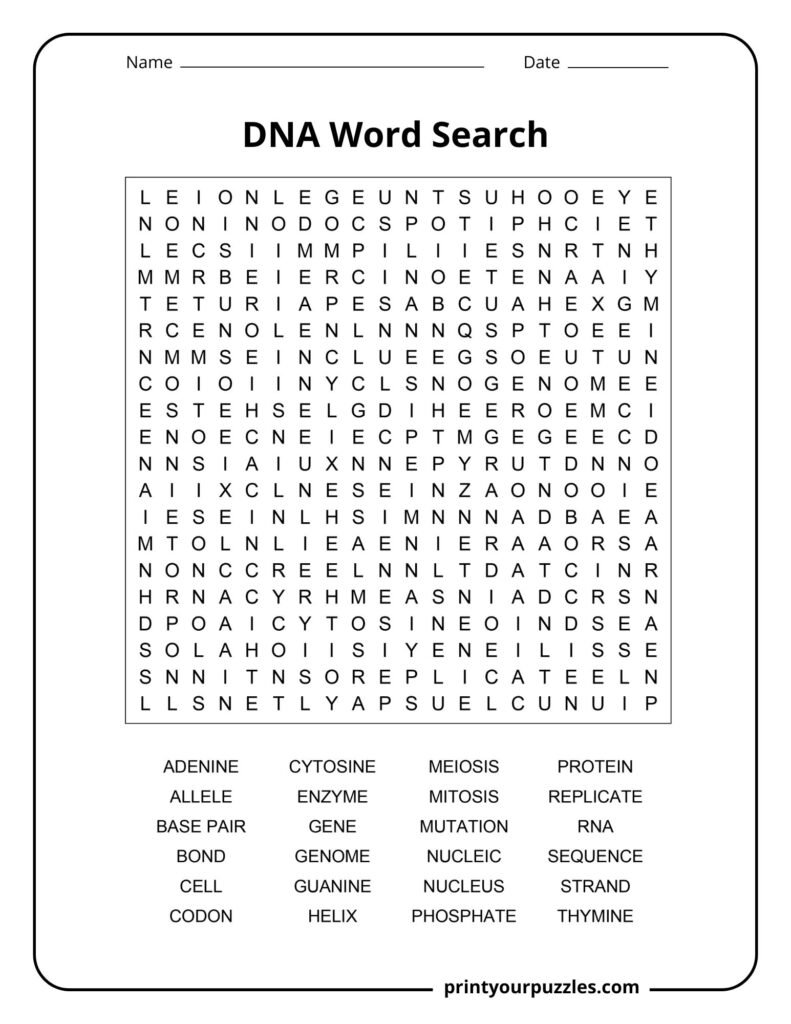
Hard Difficulty Word Search
Words to Find:
ADENINE, ALLELE, BASE PAIR, BOND, CELL, CODON, CYTOSINE, ENZYME, GENE, GENOME, GUANINE, HELIX, MEIOSIS, MITOSIS, MUTATION, NUCLEIC, NUCLEUS, PHOSPHATE, PROTEIN, REPLICATE, RNA, SEQUENCE, STRAND, THYMINE
5 Key FAQs About DNA
5 Curious "Did You Know?" Facts About DNA