Introduction to the Harry S. Truman Word Search
Harry S. Truman (1945–1953) did not expect to inherit some of the most difficult decisions of the twentieth century. When Franklin D. Roosevelt died in April 1945, Truman had been vice president for only a short time. Suddenly, he had to lead the United States through the final months of World War II, make decisions about the atomic bomb, and help shape the uncertain world that followed the war. The Harry S. Truman word search gives students a clear entry point into a presidency defined by pressure, responsibility, and rapid change.
Truman came from Missouri and had a plainspoken style that made him very different from Roosevelt. Before entering national politics, he worked as a farmer, served in World War I, ran a small business, and became active in local Democratic politics. Later, as a U.S. senator, he gained respect for investigating waste and inefficiency in wartime spending. That reputation helped prepare him for national leadership, even though few Americans expected him to become president so suddenly.
The end of World War II dominated Truman’s first months in office. In August 1945, he approved the use of atomic bombs against Hiroshima and Nagasaki, one of the most debated decisions in world history. Japan surrendered soon afterward, but the beginning of the nuclear age raised moral, military, and diplomatic questions that continue to be studied today.
After the war, Truman faced a new challenge: the Cold War. Relations between the United States and the Soviet Union worsened quickly. His administration announced the Truman Doctrine, supported the Marshall Plan to rebuild Europe, and helped create NATO. These policies aimed to contain the spread of communism and became central to American foreign policy for decades.
Domestic issues also mattered. Truman supported civil rights, desegregated the armed forces, and proposed the Fair Deal, a program that called for health care, housing, education, and economic reforms. Congress accepted some ideas and rejected others, showing the limits of presidential power.
Then came the Korean War, which tested Truman’s leadership again. The conflict led to major debates over communism, military strategy, and presidential authority, especially after Truman dismissed General Douglas MacArthur. This Harry S. Truman word search examines World War II, the atomic bomb, the Cold War, civil rights, Korea, and the difficult choices that shaped America’s role in the modern world.
Explore more World War II and Early Cold War presidents with our Franklin D. Roosevelt word search, Dwight D. Eisenhower word search, Herbert Hoover word search, and the full US Presidents Word Searches collection.
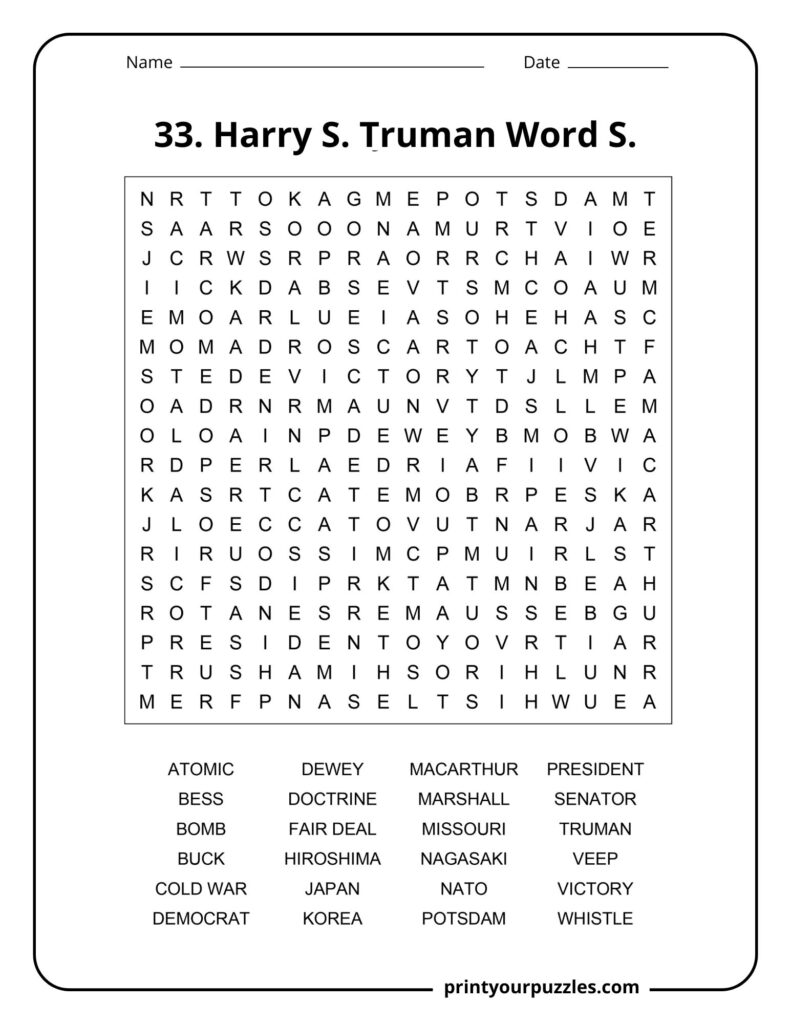
Medium Difficulty Word Search
Words to Find:
ATOMIC, BESS, BOMB, BUCK, COLD WAR, DEMOCRAT, DEWEY, DOCTRINE, FAIR DEAL, HIROSHIMA, JAPAN, KOREA, MACARTHUR, MARSHALL, MISSOURI, NAGASAKI, NATO, POTSDAM, PRESIDENT, SENATOR, TRUMAN, VEEP, VICTORY, WHISTLE
All Words Defined
ATOMIC – Relating to nuclear weapons development during Truman’s presidency, including the Manhattan Project and the decision to use atomic bombs against Japan in 1945.
BESS – Bess Wallace Truman, Harry’s wife and First Lady from 1945-1953. They married in 1919 and remained devoted partners throughout his political career.
BOMB – The atomic bombs dropped on Hiroshima and Nagasaki in August 1945, ending World War II. Truman made the controversial decision to authorize their use.
BUCK – From Truman’s famous desk sign “The Buck Stops Here,” symbolizing presidential responsibility and his willingness to accept accountability for difficult decisions made in office.
COLD WAR – The geopolitical tension between the United States and Soviet Union that began during Truman’s presidency, shaping his foreign policy and global strategy significantly.
DEMOCRAT – Truman’s political party affiliation. He served as a Democratic senator, vice president, and president, championing progressive policies and civil rights initiatives throughout.
DEWEY – Thomas Dewey, Republican opponent in the 1948 presidential election. Truman’s upset victory defied polls and produced the famous “Dewey Defeats Truman” headline error.
DOCTRINE – The Truman Doctrine of 1947 pledged American support for nations threatened by communism, establishing containment policy and marking a Cold War turning point.
FAIR DEAL – Truman’s domestic policy agenda proposing national health insurance, civil rights legislation, and expanded social programs. Congress blocked many proposals but some succeeded.
HIROSHIMA – Japanese city where the first atomic bomb was dropped on August 6, 1945. The attack killed approximately 140,000 people and led to Japan’s surrender.
JAPAN – Enemy nation during World War II. Truman’s decision to use atomic weapons forced Japan’s unconditional surrender in August 1945, ending the Pacific War.
KOREA – Site of the Korean War (1950-1953), a major Cold War conflict. Truman committed American troops to defend South Korea against communist North Korea’s invasion.
MACARTHUR – General Douglas MacArthur, Korean War commander whom Truman controversially fired in 1951 for insubordination and publicly challenging presidential authority over military policy.
MARSHALL – George Marshall, Truman’s Secretary of State who created the Marshall Plan, providing billions in economic aid to rebuild war-torn Europe and contain communism.
MISSOURI – Truman’s home state, where he was born, raised, and began his political career. He remained proudly identified with Missouri’s values throughout his life.
NAGASAKI – Second Japanese city destroyed by atomic bomb on August 9, 1945. Approximately 70,000 died. Japan surrendered six days later, ending World War II.
NATO – North Atlantic Treaty Organization, formed in 1949 during Truman’s presidency as a military alliance between Western nations to counter Soviet expansion and aggression.
POTSDAM – German city where Truman attended his first summit conference in July 1945, meeting with Churchill and Stalin to discuss post-war Europe arrangements.
PRESIDENT – Truman became the 33rd president upon Franklin Roosevelt‘s death in April 1945, serving until 1953. He won election in his own right in 1948.
SENATOR – Truman served as U.S. Senator from Missouri from 1935-1945, gaining national recognition for investigating military spending waste during World War II effectively.
TRUMAN – The 33rd U.S. President (1945-1953), known for ending World War II, containing communism, desegregating the military, and his straightforward leadership style.
VEEP – Informal term for vice president. Truman served as Franklin Roosevelt’s vice president for only 82 days before becoming president upon Roosevelt’s death.
VICTORY – Truman presided over Allied victory in World War II in 1945 and won an unexpected presidential election victory against Thomas Dewey in 1948.
WHISTLE – Refers to Truman’s famous 1948 Whistle Stop Campaign, where he traveled 31,000 miles by train, delivering speeches from the rear platform to connect directly with American voters.
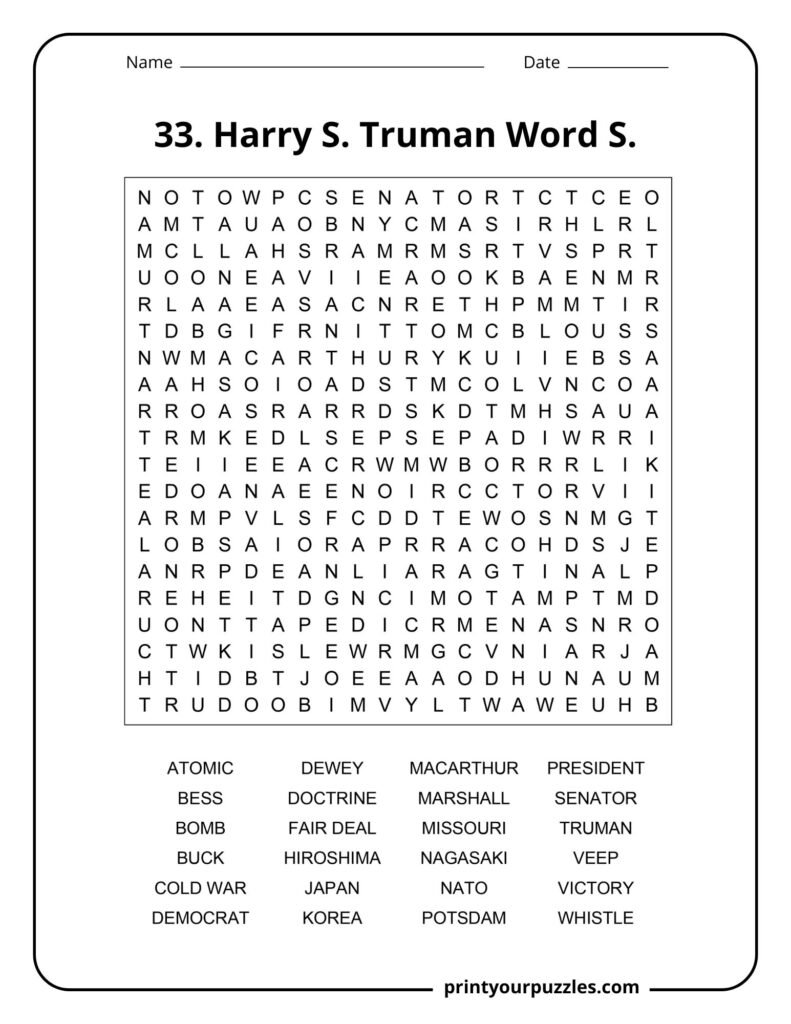
Hard Difficulty Word Search
Words to Find:
ATOMIC, BESS, BOMB, BUCK, COLD WAR, DEMOCRAT, DEWEY, DOCTRINE, FAIR DEAL, HIROSHIMA, JAPAN, KOREA, MACARTHUR, MARSHALL, MISSOURI, NAGASAKI, NATO, POTSDAM, PRESIDENT, SENATOR, TRUMAN, VEEP, VICTORY, WHISTLE
7 Key FAQs About Harry S. Truman
5 Curious "Did You Know?" Facts About Harry S. Truman