Introduction to the Pearl Harbor Word Search
Pearl Harbor is a U.S. naval base in Hawaii, but the name is most often remembered because of the Japanese attack that happened there during World War II. On December 7, 1941, Japanese aircraft launched a surprise attack on the base, causing major destruction and bringing the United States directly into the war.
Before the attack, World War II was already being fought in Europe and Asia. The United States had not yet entered the war as a direct combatant, but tensions with Japan had been growing. Japan was expanding its empire across Asia and the Pacific, while the United States opposed Japanese aggression and placed economic pressure on Japan, including restrictions on oil and other important resources.
Japanese leaders wanted to weaken the U.S. Pacific Fleet so Japan could continue expanding in the Pacific without immediate American interference. Pearl Harbor was an important target because many American battleships, aircraft, and military facilities were located there. The attack was planned to be sudden and powerful, giving the United States little time to respond.
On Sunday morning, December 7, Japanese planes attacked in waves. They bombed ships, airfields, and naval facilities. Battleships were badly damaged or sunk, aircraft were destroyed on the ground, and thousands of American service members and civilians were killed or wounded. The USS Arizona became one of the most famous symbols of the attack after it exploded and sank with many sailors aboard.
The attack shocked the United States. President Franklin D. Roosevelt called December 7, 1941, “a date which will live in infamy,” and asked Congress to declare war on Japan. On December 8, 1941, the United States officially entered World War II. Soon after, Germany and Italy declared war on the United States, bringing America fully into both the Pacific and European theaters of the war.
Pearl Harbor became a turning point in U.S. and world history. It changed American public opinion, united the country behind the war effort, and marked the beginning of a long and difficult fight across the Pacific. It is also remembered as a place of sacrifice, loss, courage, and national remembrance.
This Pearl Harbor word search helps students review vocabulary connected to Hawaii, Japan, Roosevelt, battleships, aircraft, navy, attack, Pacific, war, and remembrance. A Pearl Harbor word search can make this important World War II event easier to understand by connecting key terms with its causes, events, consequences, and lasting meaning.
Related Word Searches:
Franklin D. Roosevelt | D-Day | Harry S. Truman | Great Depression | Cold War | Truman Doctrine
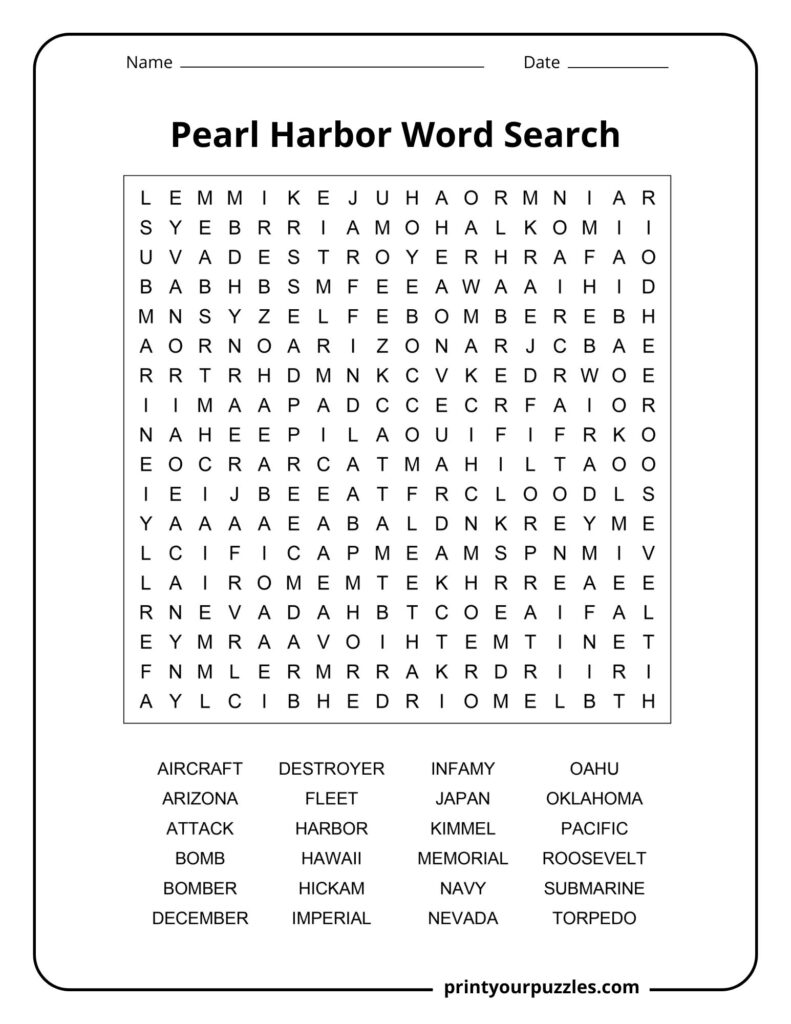
Medium Difficulty Word Search
Words to Find:
AIRCRAFT, ARIZONA, ATTACK, BOMB, BOMBER, DECEMBER, DESTROYER, FLEET, HARBOR, HAWAII, HICKAM, IMPERIAL, INFAMY, JAPAN, KIMMEL, MEMORIAL, NAVY, NEVADA, OAHU, OKLAHOMA, PACIFIC, ROOSEVELT, SUBMARINE, TORPEDO
All Words Defined
AIRCRAFT – Military planes used in combat operations. During the Pearl Harbor attack, Japanese aircraft carriers launched hundreds of bombers and fighters to strike the American naval base.
ARIZONA – USS Arizona battleship sunk during the Pearl Harbor attack, resulting in 1,177 crew deaths. The sunken ship remains a memorial and final resting place for many sailors.
ATTACK – The surprise military assault by Japan on Pearl Harbor, December 7, 1941. The devastating strike killed over 2,400 Americans and brought the United States into World War II.
BOMB – Explosive weapons dropped from Japanese aircraft onto ships and facilities at Pearl Harbor. Bombs caused massive destruction to battleships, airfields, and military installations throughout the naval base.
BOMBER – Aircraft designed to drop bombs on targets. Japanese bombers, including dive bombers and torpedo bombers, were instrumental in the devastating attack on Pearl Harbor’s ships and installations.
DECEMBER – The month when Pearl Harbor was attacked on December 7, 1941. This date marked America’s entry into World War II and is remembered as a day of infamy.
DESTROYER – Fast, maneuverable warship designed to escort larger vessels and defend against submarines and aircraft. Several destroyers were damaged or sunk during the Pearl Harbor attack on December seventh.
FLEET – The collection of U.S. Navy warships stationed at Pearl Harbor. The Pacific Fleet suffered significant losses during the Japanese attack, including eight battleships damaged or destroyed completely.
HARBOR – A sheltered body of water where ships can anchor safely. Pearl Harbor served as a crucial U.S. naval base in Hawaii, providing strategic Pacific Ocean access for the fleet.
HAWAII – U.S. Pacific territory where Pearl Harbor is located on Oahu island. Hawaii became America’s fiftieth state in 1959, nearly two decades after the infamous December attack occurred.
HICKAM – Hickam Field, the U.S. Army Air Forces base adjacent to Pearl Harbor. Japanese aircraft attacked this airfield simultaneously with the naval base, destroying many American planes.
IMPERIAL – Relating to the Empire of Japan, whose imperial military forces launched the surprise attack. The Imperial Japanese Navy planned and executed the devastating assault on Pearl Harbor.
INFAMY – President Franklin Roosevelt’s famous description of December 7, 1941, calling it “a date which will live in infamy” in his declaration of war speech to Congress.
JAPAN – Island nation in East Asia whose military forces launched the surprise attack on Pearl Harbor. This aggressive action prompted the United States to declare war and enter WWII.
KIMMEL – Admiral Husband Kimmel, commander of the U.S. Pacific Fleet during the Pearl Harbor attack. He was relieved of command afterward and faced criticism for unpreparedness despite intelligence warnings.
MEMORIAL – The USS Arizona Memorial honors the 1,177 sailors killed when their battleship sank. This white structure spans the sunken ship, allowing visitors to pay respects and remember.
NAVY – The United States Naval forces stationed at Pearl Harbor. The Navy suffered devastating losses with eighteen ships damaged or sunk and over two thousand personnel killed during attack.
NEVADA – USS Nevada battleship that attempted to escape during the attack. Though heavily damaged by bombs and torpedoes, Nevada was the only battleship to get underway during the assault.
OAHU – Hawaiian island where Pearl Harbor naval base is located. Oahu’s strategic position in the Pacific made it an important military installation and target for Japanese forces then.
OKLAHOMA – USS Oklahoma battleship that capsized during the attack after being struck by multiple torpedoes. The capsized ship trapped hundreds of sailors, with 429 crew members ultimately perishing aboard.
PACIFIC – The Pacific Ocean theater where Pearl Harbor is located. The attack aimed to neutralize American naval power in the Pacific, allowing Japan to expand its empire unopposed.
ROOSEVELT – President Franklin Delano Roosevelt, who led America during Pearl Harbor and World War II. His “Day of Infamy” speech rallied the nation to declare war against Japan.
SUBMARINE – Underwater naval vessels used in warfare. While submarines weren’t primary targets at Pearl Harbor, Japanese midget submarines participated in the attack, and American submarines later retaliated significantly.
TORPEDO – Underwater explosive weapon launched from aircraft or submarines. Japanese torpedo bombers inflicted severe damage on battleships at Pearl Harbor, particularly devastating the USS Oklahoma and USS Arizona.
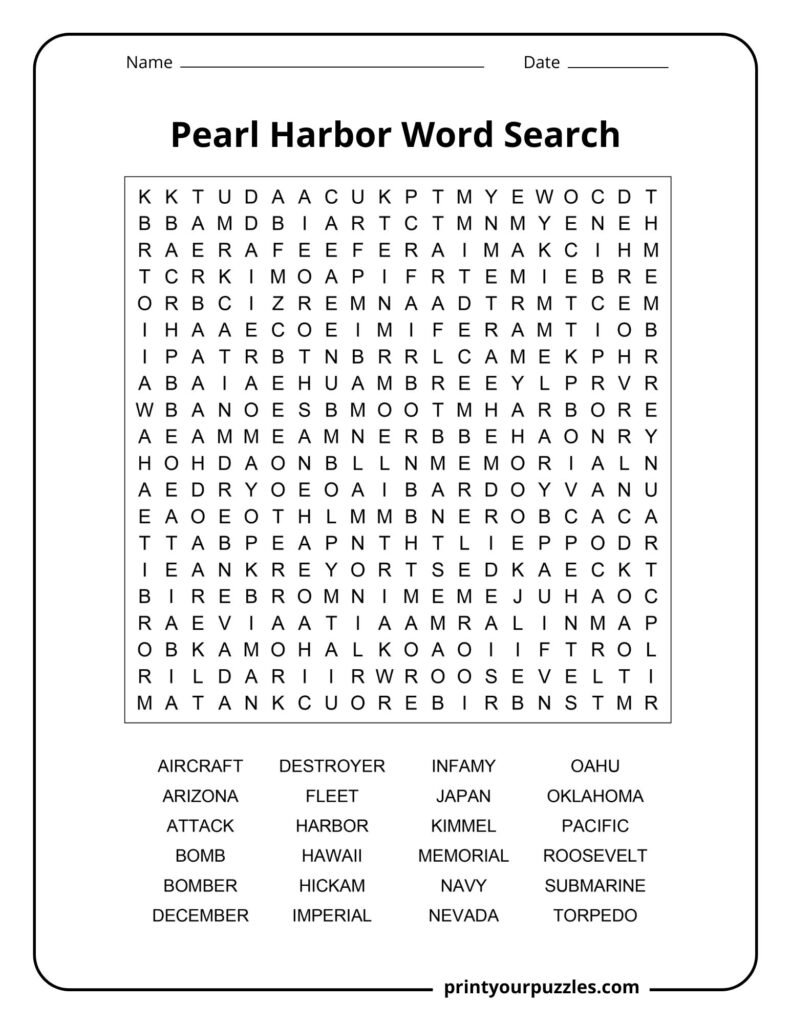
Hard Difficulty Word Search
Words to Find:
AIRCRAFT, ARIZONA, ATTACK, BOMB, BOMBER, DECEMBER, DESTROYER, FLEET, HARBOR, HAWAII, HICKAM, IMPERIAL, INFAMY, JAPAN, KIMMEL, MEMORIAL, NAVY, NEVADA, OAHU, OKLAHOMA, PACIFIC, ROOSEVELT, SUBMARINE, TORPEDO
5 Key FAQs About Pearl Harbor
5 Curious "Did You Know?" Facts About Pearl Harbor