
Ancient Rome began as a small settlement in central Italy and grew into one of the most powerful civilizations in history. According to Roman tradition, the city was founded in 753 BCE. Over the centuries, Rome developed from a monarchy into a republic and later into a vast empire that controlled much of Europe, North Africa, and the Middle East. The Western Roman Empire ended in 476 CE, although the Eastern Roman Empire continued for many centuries.
The Roman Republic began after the monarchy was overthrown. Its government included elected consuls, public assemblies, and a powerful Senate. Roman citizens could participate in politics, but rights and influence depended greatly on wealth, gender, and social class. Patricians belonged to wealthy families, while plebeians formed the majority of the population. Roman society also included soldiers, farmers, merchants, artisans, women, foreigners, and enslaved people.
Rome expanded through diplomacy, alliances, and military conquest. Its legions became known for discipline, organization, training, and engineering skill. Roman soldiers built roads, forts, bridges, and defensive walls as they moved into new territories. After conquering the Italian Peninsula, Rome defeated Carthage in the Punic Wars and gradually established control across the Mediterranean world.
Political rivalry and civil war eventually weakened the republic. Julius Caesar became one of Rome’s most powerful leaders before his assassination in 44 BCE. Further conflict followed until Octavian defeated his rivals and became Augustus, Rome’s first emperor, in 27 BCE. His reign began the Pax Romana, a long period of relative peace and stability during which trade, cities, government, and infrastructure expanded.
Religion, law, and public life were central to Roman civilization. Romans worshipped many gods and goddesses, often adapting traditions from Ancient Greece. Christianity later spread through the empire despite periods of persecution and eventually gained official support. Roman law developed principles involving contracts, property, citizenship, evidence, and legal procedure that influenced many later legal systems.
Roman engineers and builders created achievements that still shape modern life. They improved concrete, arches, domes, aqueducts, sewers, roads, bridges, public baths, and large-scale urban planning. Some buildings used underfloor heating, while the Julian calendar helped organize the year. Although the Romans borrowed and adapted ideas from earlier cultures, they applied them across an enormous empire with remarkable consistency and skill. Ancient Rome’s legacy remains visible in languages, government, law, architecture, religion, engineering, and city planning.
Through this Ancient Rome word search, students can explore vocabulary connected to the republic, Senate, legions, emperors, citizenship, religion, inventions, entertainment, and daily life. These terms help show how Rome created institutions and ideas that continue to influence the modern world.
Related Word Searches:
Ancient Greece | Ancient Egypt | Ancient Mesopotamia | Carolingian Empire | Feudalism | Viking Age
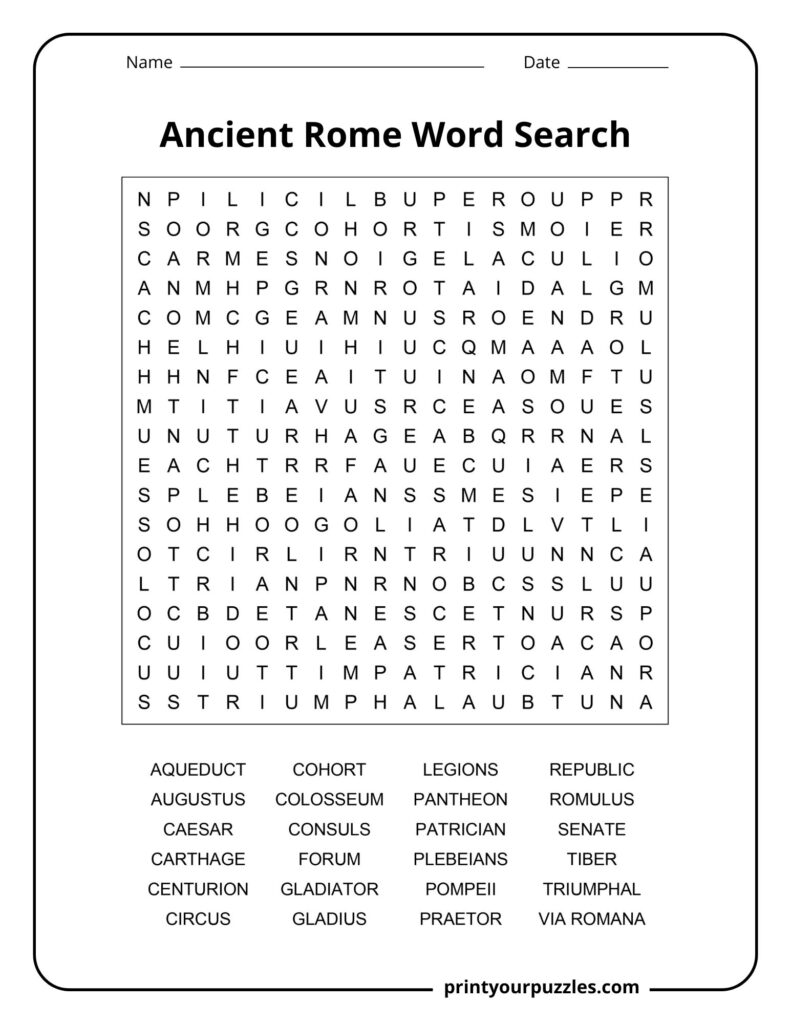
AQUEDUCT, AUGUSTUS, CAESAR, CARTHAGE, CENTURION, CIRCUS, COHORT, COLOSSEUM, CONSULS, FORUM, GLADIATOR, GLADIUS, LEGIONS, PANTHEON, PATRICIAN, PLEBEIANS, POMPEII, PRAETOR, REPUBLIC, ROMULUS, SENATE, TIBER, TRIUMPHAL, VIA ROMANA
AQUEDUCT – An engineering marvel of Ancient Rome, a channel built to transport fresh water across long distances to cities, towns, and military camps using gravity.
AUGUSTUS – The first Roman Emperor, born Gaius Octavius, who transformed Rome from a republic into an empire and ushered in the Pax Romana, a long era of peace.
CAESAR – A title used by Roman emperors derived from Julius Caesar, the legendary general and statesman whose assassination in 44 BC changed the course of Roman history forever.
CARTHAGE – A powerful city-state in North Africa and Rome’s greatest rival, destroyed after three brutal Punic Wars, with its territory eventually becoming a Roman province.
CENTURION – A professional Roman military officer commanding approximately eighty soldiers called a century, known for discipline, courage, and wearing a distinctive transverse crest on their helmet.
CIRCUS – A large open-air venue in Ancient Rome used for chariot races and public spectacles, the most famous being Circus Maximus, which could hold over two hundred thousand spectators.
COHORT – A tactical military unit of the Roman legion consisting of around four hundred to six hundred soldiers, divided into centuries and commanded by experienced senior centurions.
COLOSSEUM – Rome’s iconic amphitheatre completed in 80 AD, capable of holding fifty thousand spectators, where gladiatorial combat, animal hunts, and public executions were staged as entertainment.
CONSULS – The two highest elected magistrates of the Roman Republic, serving one-year terms, holding supreme civil and military authority and acting as checks on each other’s power.
FORUM – The central public square of a Roman city, serving as the heart of political, commercial, religious, and social life, lined with temples, basilicas, and government buildings.
GLADIATOR – A trained combatant, often a slave or prisoner of war, who fought other gladiators or wild animals in Roman amphitheatres for the entertainment of large public crowds.
GLADIUS – The short double-edged sword that was the primary weapon of the Roman legionary, ideal for close-quarters combat and largely responsible for Rome’s military dominance across centuries.
LEGIONS – The backbone of the Roman army, each legion consisting of around five thousand heavily armed infantry soldiers, renowned for their discipline, formations, and ability to conquer vast territories.
PANTHEON – A magnificent temple built in Rome dedicated to all the gods, remarkable for its perfectly preserved concrete dome with a central opening called the oculus that still stands today.
PATRICIAN – A member of the ancient privileged aristocratic class of Rome, who originally held exclusive rights to hold public office, own land, and interpret the sacred religious laws.
PLEBEIANS – The general common citizens of Ancient Rome, distinct from the aristocratic patricians, who gradually won political rights over centuries through persistent social struggle and organized political resistance.
POMPEII – A thriving Roman city near Naples catastrophically buried under volcanic ash when Mount Vesuvius erupted in 79 AD, preserving remarkably detailed evidence of everyday Roman life and culture.
PRAETOR – A senior Roman magistrate ranking just below a consul, responsible for administering justice and civil law, and sometimes commanding armies during times of military conflict and expansion.
REPUBLIC – The system of government that ruled Rome for nearly five centuries, characterized by elected magistrates, a powerful Senate, and a constitution balancing the interests of different social classes.
ROMULUS – The legendary founder and first king of Rome, said to have been raised by a she-wolf alongside his twin brother Remus, establishing the city on the Palatine Hill.
SENATE – The governing council of Ancient Rome composed of aristocratic members, advising magistrates, controlling finances, directing foreign policy, and serving as the most prestigious political institution throughout Roman history.
TIBER – The river flowing through the heart of Rome, considered sacred by the Romans, playing a crucial role in the city’s founding, trade, water supply, and religious ceremonies.
TRIUMPHAL – Referring to the grand ceremonial processions granted to victorious Roman generals marching through Rome, celebrated with crowds, music, and public displays of conquered treasures and prisoners.
VIA ROMANA – The vast network of straight paved roads built by Roman engineers connecting the entire empire, famously summarized in the saying that all roads lead to Rome, enabling trade and military movement.
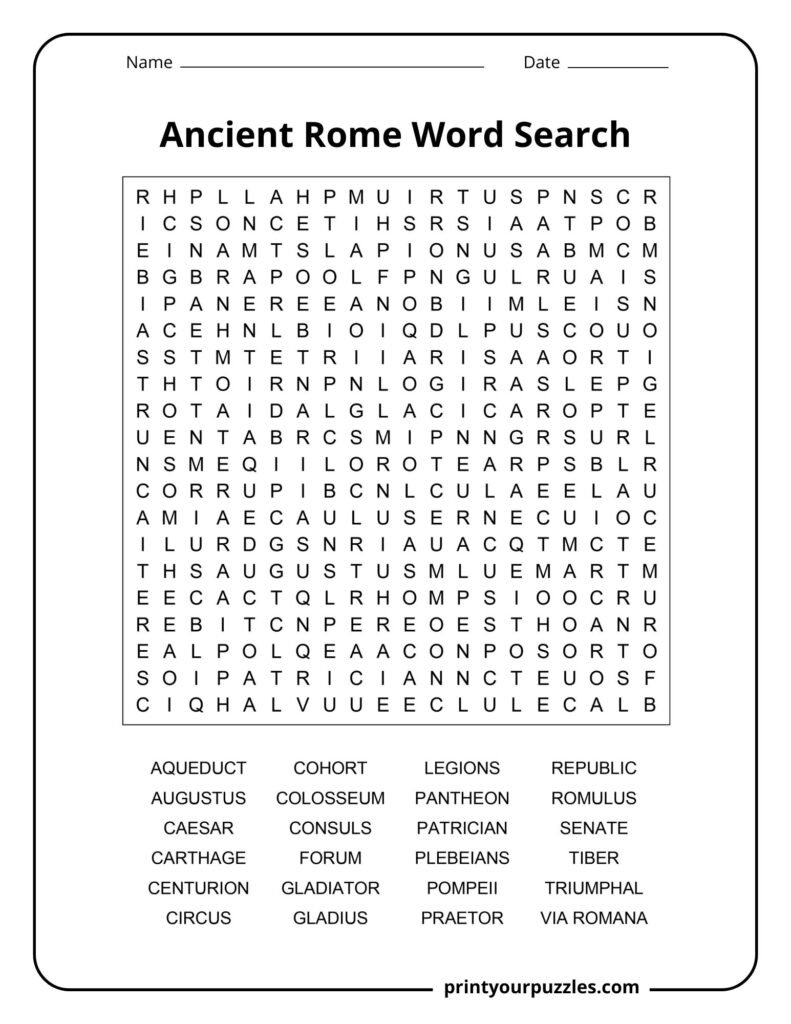
AQUEDUCT, AUGUSTUS, CAESAR, CARTHAGE, CENTURION, CIRCUS, COHORT, COLOSSEUM, CONSULS, FORUM, GLADIATOR, GLADIUS, LEGIONS, PANTHEON, PATRICIAN, PLEBEIANS, POMPEII, PRAETOR, REPUBLIC, ROMULUS, SENATE, TIBER, TRIUMPHAL, VIA ROMANA
Latin was the official language of Ancient Rome, used in law, literature, and military commands, eventually evolving into modern Romance languages like Spanish, French, Italian, and Portuguese.
The Western Roman Empire collapsed in 476 AD due to a combination of barbarian invasions, economic troubles, military weakness, political instability, and the gradual erosion of centralized imperial authority.
Romans initially practiced a polytheistic religion worshipping gods like Jupiter, Mars, and Venus. Christianity later spread throughout the empire and was declared the official state religion in 380 AD.
At its greatest extent under Emperor Trajan around 117 AD, the Roman Empire spanned approximately five million square kilometres, encompassing territories across Europe, North Africa, and the Middle East.
Most Romans lived in crowded apartment buildings called insulae, visited public baths regularly, enjoyed bread and olive oil as staple foods, and attended public spectacles for entertainment and socializing.
Rubicon: The Last Years of the Roman Republic by Tom Holland. Holland, winner of the Classical Association prize, turns Caesar, Cicero, and Rome’s fall from republic to empire into a scrupulously researched, chariot-race-paced historical thriller of the highest order.
Ancient Romans had surprisingly unusual dental hygiene habits, using mixtures containing crushed mouse brains, rabbit heads, and urine as cleaning agents, believing these ingredients effectively whitened and strengthened teeth.
Emperor Trajan built Mercati Traianei in Rome around 100 AD, a multi-storied complex housing over one hundred and fifty shops and offices, considered the world’s earliest known shopping centre.
Public Roman latrines featured a shared sponge on a stick called a xylospongium, rinsed in salt water between uses, representing a surprisingly communal approach to personal hygiene in ancient times.
The Roman calendar was packed with religious festivals, military celebrations, and public games, meaning Roman citizens enjoyed an extraordinary number of official rest days throughout the year.
Ancient Romans believed gladiator blood possessed powerful healing properties, with physicians prescribing it as a treatment for epilepsy, reflecting the deeply mystical beliefs surrounding these celebrated arena fighters.