Introduction to the Velvet Revolution Word Search
The Velvet Revolution was a largely peaceful political movement that ended Communist rule in Czechoslovakia during November and December 1989. After more than four decades of one-party government, mass demonstrations, strikes, student activism, and public pressure forced the Communist Party to surrender its monopoly on power. The revolution opened the way for democratic government and became one of the most important events in the collapse of communism across Eastern Europe.
The Communist Party had controlled Czechoslovakia since 1948. It restricted political opposition, censored the press, monitored citizens, and influenced education, employment, and public life. Those who criticized the government could lose their jobs, face surveillance, or be imprisoned. Although many people disagreed with the system, open resistance remained dangerous for decades.
An earlier attempt at reform had taken place during the Prague Spring of 1968. Led by Alexander Dubček, the movement tried to create “socialism with a human face” by allowing greater freedom of speech and political debate. In August 1968, however, Soviet-led Warsaw Pact forces invaded Czechoslovakia and ended the reforms. The government then restored censorship and removed many reformers from public positions.
Opposition continued through dissident movements such as Charter 77, which accused the government of failing to respect basic human rights. Playwright Václav Havel became one of its best-known members. By 1989, reforms in the Soviet Union, political change in Poland and Hungary, and the fall of the Berlin Wall showed that Communist governments across the region were becoming weaker.
The immediate spark came on November 17, 1989, when police violently broke up a peaceful student demonstration in Prague. News of the attack caused outrage, and much larger crowds soon gathered in Wenceslas Square and other cities. Civic Forum united students, writers, artists, workers, dissidents, and ordinary citizens around demands for political freedom and democratic reform.
The movement used strikes, theater protests, public speeches, candles, banners, and the symbolic jingling of keys. The keys suggested both opening the door to freedom and telling Communist leaders that it was time to leave. Telephones, photocopiers, typewriters, underground publications, posters, radio, television, and word-of-mouth networks helped spread information despite censorship, much as digital media does in modern protest movements.
By late November, the Communist Party had abandoned its guaranteed control of government. A new leadership was formed, and Václav Havel became president on December 29, 1989. The Velvet Revolution restored political freedoms and prepared Czechoslovakia for democratic elections.
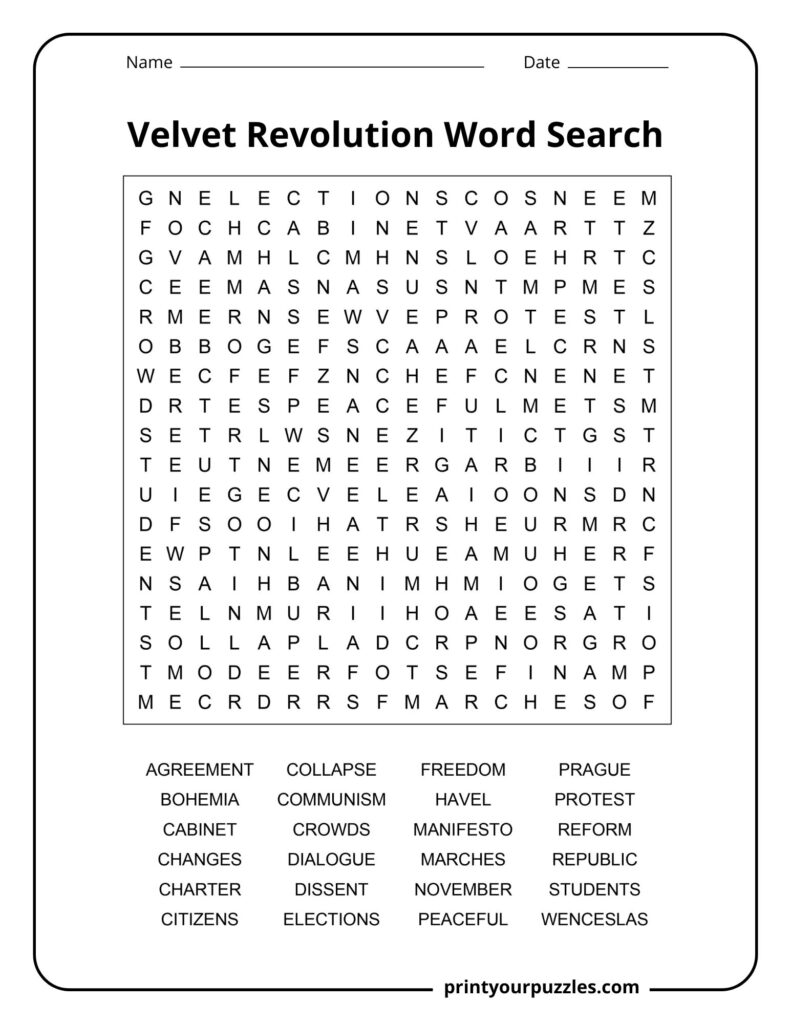
With this Velvet Revolution word search, students can explore vocabulary connected to Prague, Havel, Charter 77, Civic Forum, students, strikes, Wenceslas Square, jingling keys, democracy, and the events of 1989.
Related Word Searches:
Berlin Wall | Russian Revolution | Decolonization Era | Truman Doctrine | Marshall Plan | Arab Spring
Medium Difficulty Word Search
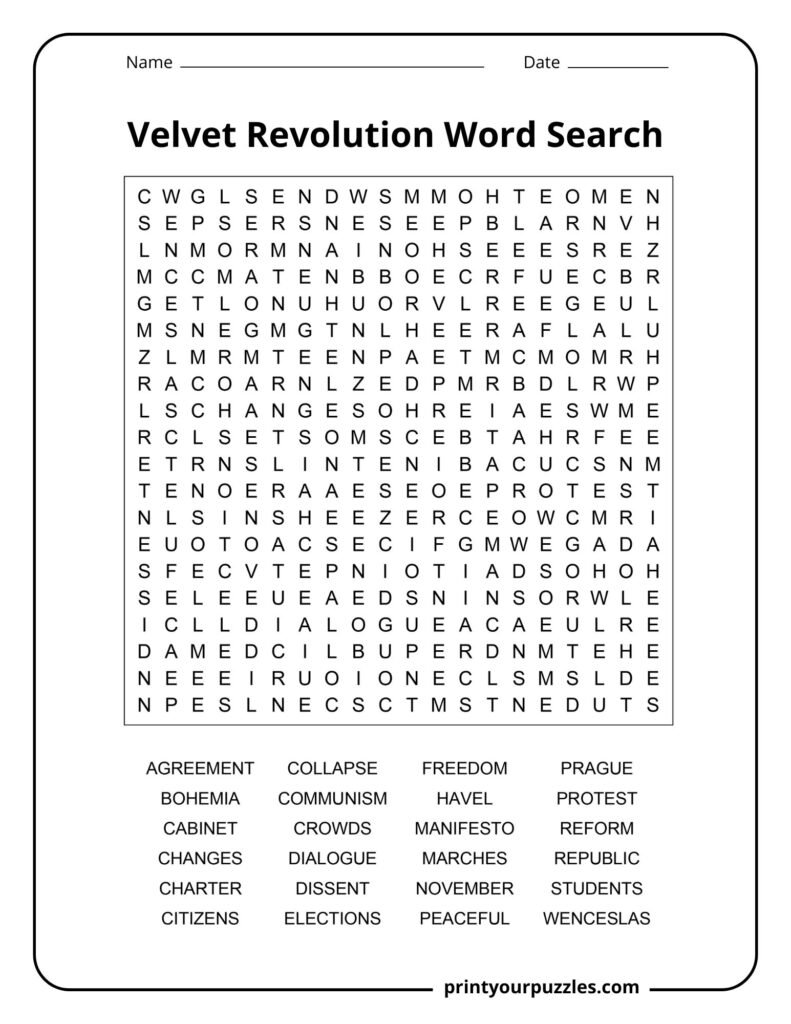
Words to Find
AGREEMENT, BOHEMIA, CABINET, CHANGES, CHARTER, CITIZENS, COLLAPSE, COMMUNISM, CROWDS, DIALOGUE, DISSENT, ELECTIONS, FREEDOM, HAVEL, MANIFESTO, MARCHES, NOVEMBER, PEACEFUL, PRAGUE, PROTEST, REFORM, REPUBLIC, STUDENTS, WENCESLAS
All Words Defined
AGREEMENT – A formal accord reached between the communist government and opposition leaders during the Velvet Revolution, enabling a peaceful transfer of political power in Czechoslovakia.
BOHEMIA – A historic region in the western part of Czechoslovakia, home to Prague, where key protests and political negotiations of the Velvet Revolution took place.
CABINET – The council of ministers that was reorganized during the Velvet Revolution, transitioning from communist-dominated governance to a more representative, democratic body of leadership.
CHANGES – The sweeping political, social, and economic transformations that reshaped Czechoslovakia during 1989, dismantling decades of communist rule and opening the path toward democracy.
CHARTER – A reference to Charter 77, the landmark human rights declaration signed by Czechoslovak dissidents, including Václav Havel, that laid the moral groundwork for the Velvet Revolution.
CITIZENS – The ordinary men and women of Czechoslovakia who bravely took to the streets, joining mass demonstrations that ultimately forced the communist regime to relinquish its grip on power.
COLLAPSE – The rapid and largely peaceful disintegration of communist authority in Czechoslovakia in November 1989, marking the end of over four decades of one-party authoritarian rule.
COMMUNISM – The oppressive single-party political ideology that governed Czechoslovakia from 1948 until the Velvet Revolution dismantled its structures and paved the way for democratic pluralism.
CROWDS – The massive gatherings of protesters that filled Wenceslas Square and other public spaces, their sheer numbers becoming a powerful and undeniable force against the communist authorities.
DIALOGUE – The crucial negotiations opened between the communist government and opposition movements like Civic Forum, making peaceful transition possible without bloodshed or prolonged conflict.
DISSENT – The courageous act of opposing communist rule through underground publications, cultural resistance, and organized activism, kept alive by brave individuals throughout decades of repression.
ELECTIONS – The free and fair democratic elections held in June 1990, the first since 1946, marking Czechoslovakia’s definitive break from communism and its return to democratic self-governance.
FREEDOM – The fundamental aspiration driving hundreds of thousands of Czechoslovak citizens into the streets, demanding civil liberties, political rights, and an end to authoritarian communist oppression.
HAVEL – Václav Havel, the celebrated playwright and fearless dissident who became the moral voice of the Velvet Revolution and was elected Czechoslovakia’s first post-communist president in December 1989.
MANIFESTO – A public declaration issued by opposition groups articulating their demands for democratic reform, human rights, and the end of communist rule during the revolutionary period of 1989.
MARCHES – The peaceful processions of students, workers, and intellectuals that moved through Czechoslovak cities, visibly demonstrating the population’s unified rejection of continued communist governance.
NOVEMBER – The pivotal month of 1989 when the Velvet Revolution erupted, beginning with a student demonstration on the 17th that rapidly escalated into a nationwide movement for democratic change.
PEACEFUL – The defining characteristic of the Velvet Revolution, distinguishing it from violent uprisings elsewhere, as Czechoslovak protesters achieved profound political transformation entirely without armed conflict.
PRAGUE – The historic capital of Czechoslovakia and epicenter of the Velvet Revolution, where Wenceslas Square became the symbolic stage for the mass protests that ended communist rule.
PROTEST – The organized public expressions of dissatisfaction with communist rule, growing rapidly from student demonstrations into a nationwide movement involving hundreds of thousands of determined Czechoslovak citizens.
REFORM – The deep structural changes demanded by opposition movements and eventually implemented, transforming Czechoslovakia’s political system from single-party communism toward multiparty parliamentary democracy.
REPUBLIC – The democratic state that emerged from the Velvet Revolution, restoring Czechoslovakia’s pre-communist republican traditions and eventually leading to the peaceful creation of two independent nations.
STUDENTS – The courageous young people whose demonstration on November 17, 1989 ignited the Velvet Revolution, their brutal suppression by police sparking nationwide outrage and mass popular mobilization.
WENCESLAS – Wenceslas Square in central Prague, the historic boulevard that served as the main gathering point for enormous protest crowds, becoming the defining symbol of the Velvet Revolution.
Hard Difficulty Word Search
Words to Find
AGREEMENT, BOHEMIA, CABINET, CHANGES, CHARTER, CITIZENS, COLLAPSE, COMMUNISM, CROWDS, DIALOGUE, DISSENT, ELECTIONS, FREEDOM, HAVEL, MANIFESTO, MARCHES, NOVEMBER, PEACEFUL, PRAGUE, PROTEST, REFORM, REPUBLIC, STUDENTS, WENCESLAS
6 Key FAQs About the Velvet Revolution
5 Curious "Did You Know?" Facts About the Velvet Revolution