
The Spanish Civil War was fought from July 1936 to April 1939 between the Republican government and Nationalist forces led by General Francisco Franco. The conflict divided Spain politically, socially, and geographically, while also attracting international attention. It became one of the most destructive European wars of the interwar period and is often viewed as a preview of World War II.
The war grew from tensions that had been increasing for years. Spain faced deep disagreements over land ownership, workers’ rights, regional autonomy, the role of the Catholic Church, military power, and the future of the monarchy. In 1931, King Alfonso XIII left the country and the Second Spanish Republic was established. Its government introduced reforms involving education, labor, land, the army, and church-state relations.
These changes created strong support among some groups and fierce opposition among others. Spanish politics became increasingly polarized between republicans, socialists, communists, anarchists, conservatives, monarchists, Falangists, and military officers. In July 1936, part of the army launched an uprising against the elected Republican government. Because the coup failed to take control of the entire country, Spain split into Republican and Nationalist zones.
The Republicans included supporters of the republic, left-wing political parties, labor movements, and regional groups. The Nationalists brought together conservative military leaders, monarchists, Falangists, landowners, and supporters of authoritarian government. Franco gradually became the principal Nationalist leader after his forces crossed from Spanish Morocco and advanced through mainland Spain.
Foreign intervention made the conflict even more dangerous. Nazi Germany and Fascist Italy supplied the Nationalists with aircraft, weapons, troops, and military assistance. The Soviet Union supported the Republicans, while volunteers from many countries joined the International Brigades. Britain, France, and other nations officially followed non-intervention policies, although the war remained part of a wider struggle between fascism, communism, and democracy.
Major battles took place around Madrid, Jarama, Guadalajara, Brunete, Teruel, and the Ebro. The bombing of Guernica became an international symbol of civilian suffering. In response, Spanish artist Pablo Picasso created “Guernica”, one of the most famous anti-war paintings in history. Aircraft, tanks, artillery, radio, photography, propaganda posters, newsreels, and international journalism shaped both warfare and public opinion. These technologies demonstrated how modern conflicts could be fought not only on battlefields but also through information and mass communication.
Madrid fell in March 1939, and Franco declared victory on April 1. His dictatorship lasted until his death in 1975. The war left hundreds of thousands dead, displaced families, political prisoners, refugees, and deep divisions that continued for generations.
This Spanish Civil War word search introduces vocabulary connected to Republicans, Nationalists, Franco, Madrid, Guernica, the International Brigades, the Falange, propaganda, dictatorship, the Ebro, and the events of 1939.
Related Word Searches:
Russian Revolution | Spanish-American War | Franklin D. Roosevelt | New Deal | Berlin Wall | Cuban Revolution
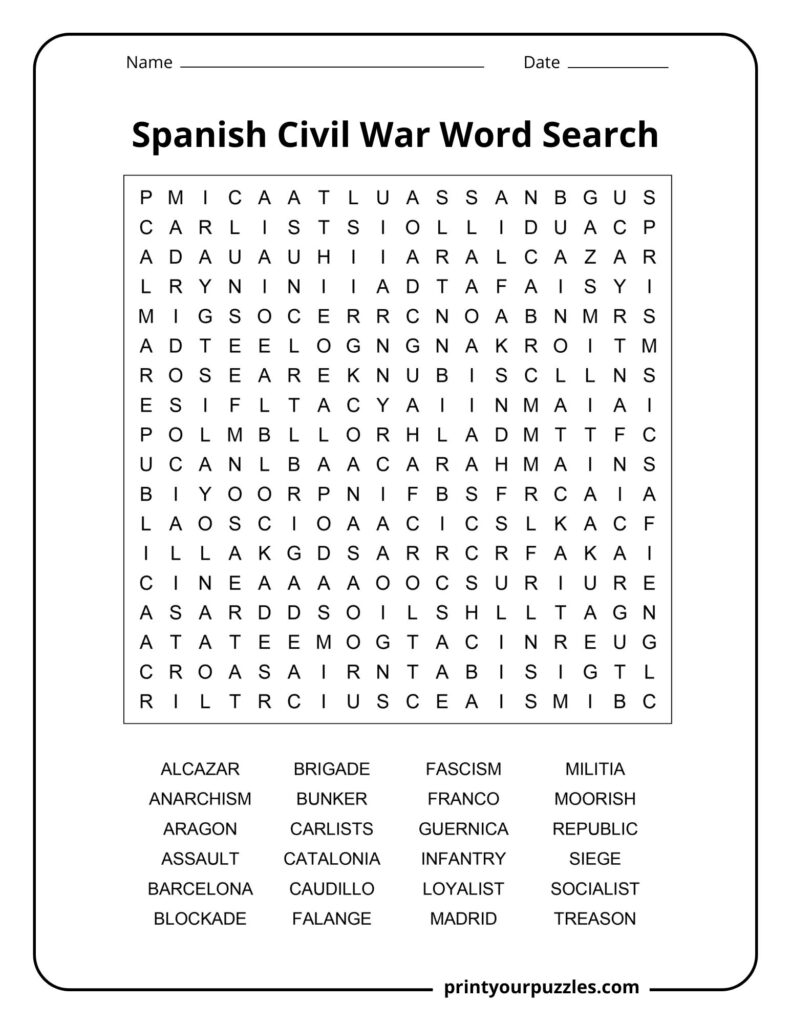
ALCAZAR, ANARCHISM, ARAGON, ASSAULT, BARCELONA, BLOCKADE, BRIGADE, BUNKER, CARLISTS, CATALONIA, CAUDILLO, FALANGE, FASCISM, FRANCO, GUERNICA, INFANTRY, LOYALIST, MADRID, MILITIA, MOORISH, REPUBLIC, SIEGE, SOCIALIST, TREASON
ALCAZAR – Medieval fortress in Toledo that became a symbol of Nationalist resistance after enduring a prolonged siege by Republican forces during the early months of the war.
ANARCHISM – Political ideology rejecting centralized authority, widely embraced by Spanish workers and peasants, particularly in Catalonia and Aragon, playing a major role in the Republican side.
ARAGON – northeastern Spanish region where significant battles were fought and where anarchist collectives were established during the war, serving as a key Republican stronghold.
ASSAULT – Tactical military offensive operations carried out by both sides throughout the conflict, often targeting cities, trenches, and strategic positions to gain territorial advantage.
BARCELONA – Capital of Catalonia and Spain’s second largest city, a major Republican stronghold and center of anarchist and socialist power, witnessing intense internal political conflicts during the war.
BLOCKADE – Naval and territorial strategy used by Nationalist forces to cut off Republican supply lines, preventing weapons, food, and reinforcements from reaching enemy-controlled zones.
BRIGADE – Military unit of several thousand soldiers. The International Brigades, composed of foreign volunteers, fought alongside Republicans against Franco’s Nationalist forces from across the world.
BUNKER – Fortified defensive structure used extensively along battle lines by both sides, providing shelter and firing positions during prolonged engagements and sieges across the Spanish territory.
CARLISTS – Traditional monarchist movement supporting a rival royal dynasty, contributing significant troops called Requetés to Franco’s Nationalist coalition, particularly from the northern Navarre region.
CATALONIA – Autonomous northeastern region with strong separatist identity, a Republican heartland and industrial powerhouse whose fall to Nationalist forces in 1939 effectively signaled the war’s end.
CAUDILLO – Spanish title meaning leader or chieftain, adopted by Francisco Franco as his official designation after consolidating absolute political and military power over the Nationalist movement.
FALANGE – Spanish fascist political party founded by José Antonio Primo de Rivera, providing ideological framework and militia forces for the Nationalist cause throughout the entire conflict.
FASCISM – Authoritarian ultranationalist ideology that shaped the Nationalist movement, supported internationally by Hitler’s Germany and Mussolini’s Italy, who provided crucial military aid to Franco.
FRANCO – General Francisco Franco, leader of the Nationalist military uprising who emerged as supreme commander, ultimately winning the war and ruling Spain as dictator until his death in 1975.
GUERNICA – Basque town tragically destroyed in April 1937 by German and Italian warplanes supporting Franco, immortalized by Pablo Picasso’s powerful painting denouncing the horrors of war.
INFANTRY – Ground combat soldiers forming the backbone of both armies, enduring brutal trench warfare, urban combat, and open battlefield engagements across Spain’s varied and challenging terrain.
LOYALIST – Term used to describe those who remained faithful to the elected Spanish Republic against the Nationalist military rebellion, including socialists, communists, anarchists, and liberal democrats.
MADRID – Spain’s capital city and powerful Republican symbol that heroically resisted Nationalist siege from 1936 to 1939, with its defense galvanizing international support for the Republican cause.
MILITIA – Irregular armed civilian groups that formed the initial Republican defense against the Nationalist uprising before being gradually integrated into the more formal Popular Army structure.
MOORISH – Referring to Moroccan soldiers from Spanish colonial territories, recruited by Franco into his elite Army of Africa, forming a feared and highly experienced core of Nationalist forces.
REPUBLIC – The democratic Spanish Second Republic, established in 1931, whose elected government the Nationalist military rebellion sought to overthrow, defended by loyalist forces throughout the war.
SIEGE – Military strategy of surrounding and isolating cities or fortifications, most notably applied to Madrid, Toledo, and other key locations, often lasting months and causing civilian suffering.
SOCIALIST – Adherents of socialist ideology formed a major component of the Republican coalition, including the powerful PSOE party and trade unions that mobilized workers against the Nationalist uprising.
TREASON – Crime officially charged against military officers who rose against the legitimate Republican government in July 1936, though Nationalists inversely accused Republicans of betraying traditional Spain.
ALCAZAR, ANARCHISM, ARAGON, ASSAULT, BARCELONA, BLOCKADE, BRIGADE, BUNKER, CARLISTS, CATALONIA, CAUDILLO, FALANGE, FASCISM, FRANCO, GUERNICA, INFANTRY, LOYALIST, MADRID, MILITIA, MOORISH, REPUBLIC, SIEGE, SOCIALIST, TREASON
Political instability, economic inequality, regional tensions, and deep ideological divisions between left-wing Republicans and right-wing Nationalists triggered the military uprising of July 1936.
The elected Republican government, supported by socialists, anarchists, and communists, fought against the Nationalist rebels led by General Franco, backed by fascist Italy and Nazi Germany.
Germany and Italy supplied Franco with troops, weapons, and aircraft, while the Soviet Union aided the Republic. Western democracies adopted a controversial non-intervention policy.
Superior foreign military support, unified leadership under Franco, internal divisions within the Republican coalition, and an effective blockade cutting off vital supplies decided the outcome.
Franco established a repressive dictatorship lasting until 1975. Hundreds of thousands died, over half a million fled into exile, and Spain suffered decades of political and economic isolation.
The Battle for Spain: The Spanish Civil War 1936–1939 by Antony Beevor. Beevor, bestselling author of Stalingrad, deploys newly opened Soviet and Spanish archives to untangle the war’s ferocious complexity — blending masterly military narrative with unflinching human tragedy and rigorous political analysis.
The painter refused to allow his iconic masterpiece to return to Spain until democracy was fully restored, keeping it at New York’s MoMA for safekeeping.
Both legendary writers were personally present during the conflict, drawing from their experiences to create powerful literary works documenting the war’s brutal human reality.
German Condor Legion planes devastated the Basque town of Guernica in April 1937, pioneering the terrifying military tactic of targeting defenseless civilian populations from the air.
Idealistic volunteers including Americans, British, French, and Canadians crossed into Spain motivated by antifascist convictions, forming one of history’s most internationally diverse fighting forces.
Although deeply sympathetic to the Axis powers, Franco skillfully avoided full involvement, sending only volunteer forces to the Eastern Front while keeping Spain formally out of the conflict.