
Google began as a university research project and developed into one of the most influential technology companies of the internet era. Larry Page and Sergey Brin met while studying at Stanford University in the 1990s and became interested in finding a better way to organize the rapidly growing number of pages on the web. Their early search project, initially called Backrub, analyzed links between websites to help determine which pages were likely to be most useful.
That idea eventually became the foundation of Google’s PageRank system. Instead of relying only on how often particular words appeared on a page, the search engine also considered links from other websites as signals of importance. The approach produced useful results and attracted growing attention. Google was officially founded in 1998, and the young company moved from university servers into its first offices as more people began using the service.
Its clean homepage and simple search box became part of the brand’s identity. While other internet portals often displayed large amounts of information, Google focused on helping users find what they wanted quickly. As search traffic increased, advertising became an important source of revenue and helped finance the company’s expansion.
Google soon moved far beyond search. Gmail, Google Maps, Google News, Google Drive, Chrome, and other services became part of everyday internet use. The acquisition of YouTube added online video, while Android gave Google a major role in smartphones and mobile technology. The company also expanded into cloud computing, artificial intelligence, translation, digital advertising, and many other areas.
A printable Google word search puzzle can reflect this journey through terms such as Stanford, PageRank, search, Chrome, Gmail, Maps, Android, YouTube, algorithms, and data. Each represents a different stage in the company’s development.
From an academic experiment designed to organize web pages to a global technology business, Google grew by making information easier to find and then building new services around that central idea. Its history shows how one improvement in internet search could become the starting point for products used across communication, navigation, entertainment, work, and modern digital life.
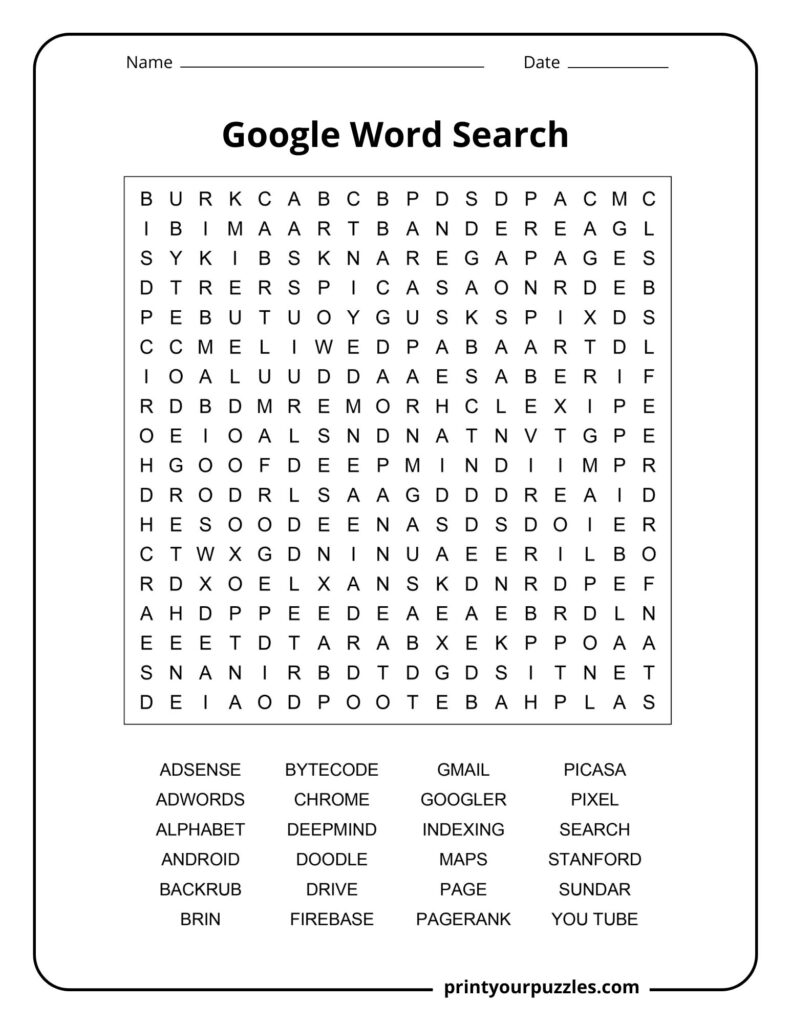
ADSENSE, ADWORDS, ALPHABET, ANDROID, BACKRUB, BRIN, BYTECODE, CHROME, DEEPMIND, DOODLE, DRIVE, FIREBASE, GMAIL, GOOGLER, INDEXING, MAPS, PAGE, PAGERANK, PICASA, PIXEL, SEARCH, STANFORD, SUNDAR, YOU TUBE
ADSENSE – Google’s advertising program launched in 2003 that allows website owners to display targeted ads and earn revenue based on clicks or impressions generated by their visitors.
ADWORDS – Google’s original online advertising platform, launched in 2000, enabling businesses to display ads in search results. It was rebranded as Google Ads in 2018 to better reflect its expanded capabilities.
ALPHABET – The parent holding company created by Google in 2015 to oversee Google and its various subsidiaries, allowing each division to operate more independently while sharing resources and strategic direction.
ANDROID – An open-source mobile operating system acquired by Google in 2005. It became the world’s most widely used smartphone platform, powering billions of devices across hundreds of manufacturers globally.
BACKRUB – The original name of Google’s search engine, developed by Larry Page and Sergey Brin at Stanford University in 1996. It analyzed backlinks to rank web pages before being renamed Google in 1997.
BRIN – Sergey Brin, Russian-American computer scientist who co-founded Google with Larry Page at Stanford in 1998. He served as President of Alphabet until stepping down from day-to-day operations in 2019.
BYTECODE – A form of compiled code used in Java-based systems that Google relied on during its early infrastructure development. It also became central to Android’s runtime environment for executing mobile applications efficiently.
CHROME – Google’s web browser launched in 2008, designed for speed, simplicity, and security. It quickly surpassed competitors to become the world’s most popular browser, forming the foundation of the Chrome OS platform.
DEEPMIND – A British artificial intelligence research lab acquired by Google in 2014. Known for groundbreaking AI systems like AlphaGo and AlphaFold, it has significantly advanced machine learning and scientific research worldwide.
DOODLE – A temporary, artistic modification of the Google logo displayed on the homepage to celebrate holidays, anniversaries, and notable figures. The first Google Doodle appeared in 1998 for the Burning Man festival.
DRIVE – Google’s cloud-based file storage and synchronization service launched in 2012. It allows users to store documents, photos, and files online, and integrates seamlessly with Google Docs, Sheets, and other workspace tools.
FIREBASE – A mobile and web application development platform acquired by Google in 2014. It provides developers with tools for real-time databases, authentication, hosting, and analytics, simplifying the process of building and scaling modern apps.
GMAIL – Google’s free email service launched on April 1, 2004. It revolutionized webmail by offering 1 GB of storage — unprecedented at the time — along with powerful search functionality and a clean interface.
GOOGLER – The informal term used to describe a Google employee. Googlers are known for working in a distinctive campus culture that emphasizes creativity, collaboration, transparency, and employee wellbeing across the company’s offices worldwide.
INDEXING – The process by which Google’s crawlers scan and catalog web pages into its massive database. Proper indexing determines whether a page appears in search results, making it fundamental to Google’s core search business.
MAPS – Google Maps, launched in 2005, is a web mapping service offering satellite imagery, street maps, and real-time navigation. It transformed how people explore and navigate the world, becoming an essential daily tool globally.
PAGE – Larry Page, co-founder of Google alongside Sergey Brin. He served as CEO from 1998 to 2001 and again from 2011 to 2015, then became CEO of Alphabet until stepping down in December 2019.
PAGERANK – The algorithm invented by Larry Page at Stanford that forms the foundation of Google Search. It ranks web pages by analyzing the quantity and quality of links pointing to them, determining their relative importance.
PICASA – A photo organizing and editing application acquired by Google in 2004. It helped users manage and share their digital photo libraries and was eventually discontinued in 2016, replaced by Google Photos.
PIXEL – Google’s line of hardware products, most notably its smartphones, first launched in 2016. Pixel devices showcase Google’s software and AI capabilities directly, offering a pure Android experience with exclusive camera and assistant features.
SEARCH – The core product that made Google famous. Launched in 1998, Google Search uses complex algorithms to index and rank billions of web pages, delivering fast and relevant results to billions of daily queries worldwide.
STANFORD – Stanford University in California, where Larry Page and Sergey Brin met as PhD students in 1995. Their research project on web link analysis at Stanford directly led to the creation of Google in 1998.
SUNDAR – Sundar Pichai, Indian-American executive who became Google’s CEO in 2015 and took on the additional role of Alphabet CEO in 2019. He has led Google through major expansions in AI, cloud computing, and hardware.
YOU TUBE – The world’s largest video-sharing platform, founded in 2005 and acquired by Google in 2006 for $1.65 billion. YouTube hosts billions of videos and has become a dominant force in entertainment, education, and media worldwide.
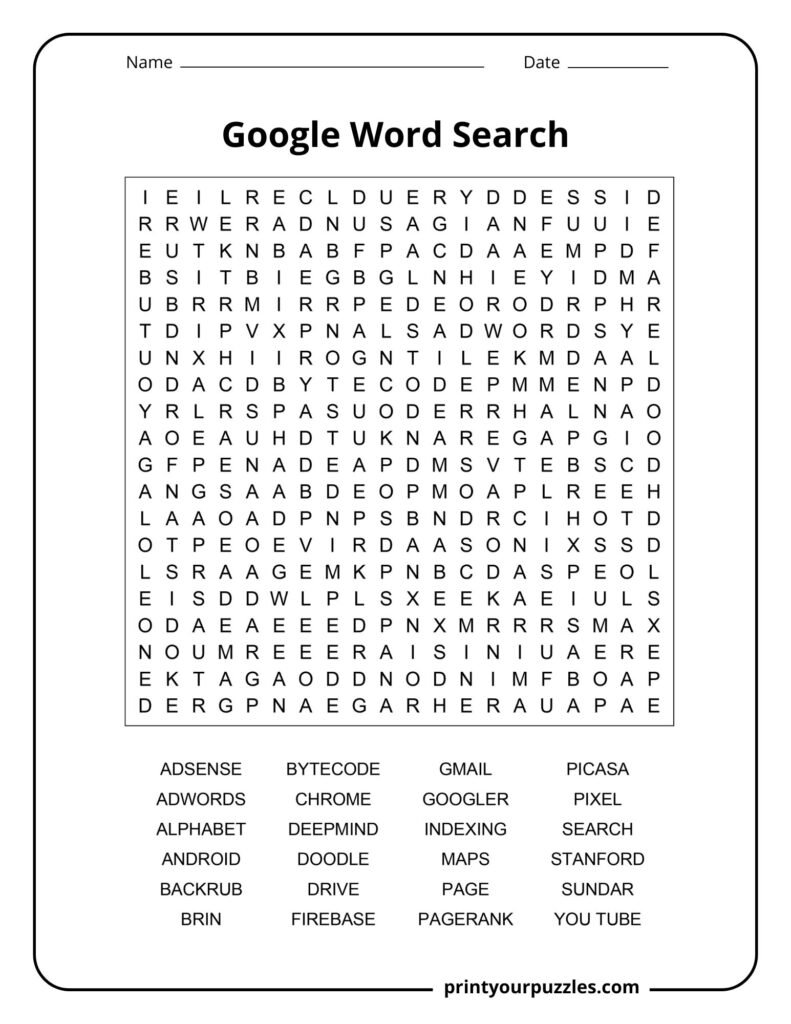
ADSENSE, ADWORDS, ALPHABET, ANDROID, BACKRUB, BRIN, BYTECODE, CHROME, DEEPMIND, DOODLE, DRIVE, FIREBASE, GMAIL, GOOGLER, INDEXING, MAPS, PAGE, PAGERANK, PICASA, PIXEL, SEARCH, STANFORD, SUNDAR, YOU TUBE
The name derives from “googol,” a mathematical term for the number 1 followed by 100 zeros, reflecting the founders’ ambition to organize the internet’s vast and seemingly infinite amount of information.
Google was officially founded on September 4, 1998, by Larry Page and Sergey Brin in a garage in Menlo Park, California, after they developed the PageRank algorithm together at Stanford University.
Alphabet was created in 2015 to separate Google’s core businesses from its more experimental ventures, allowing each division greater independence, clearer accountability, and more focused leadership under one parent company.
Before Google, the search engine was called BackRub, named after its technique of analyzing backlinks on the web. Page and Brin renamed it Google in 1997 while still working at Stanford.
Through strategic acquisitions like YouTube and Android, plus launches of Gmail, Maps, and Chrome, Google steadily expanded beyond search to become a dominant force across advertising, mobile, cloud, and artificial intelligence.
In the Plex: How Google Thinks, Works, and Shapes Our Lives by Steven Levy. Levy masterfully turns two years of unprecedented inside access into a vivid, idea-driven chronicle of how two Stanford misfits quietly built the most powerful information empire in human history.
In 1999, Page and Brin tried to sell Google to Excite CEO George Bell for $1 million. He declined, a decision widely considered one of the costliest business mistakes in tech history.
At Stanford, Page and Brin housed their early hard drives in a custom LEGO casing. It was cheap, expandable, and colorful — a fittingly playful origin for one of the world’s biggest companies.
When Google announced Gmail on April 1, 2004, offering a then-unbelievable 1 GB of free storage, many journalists and users assumed it was a prank due to the suspicious launch date.
Google’s very first Twitter post, sent in 2009, read “I’m 01100110 01100101 01100101 01101100 01101001 01101110 01100111 00100000 01101100 01110101 01100011 01101011 01111001” — which translates to “I’m feeling lucky,” referencing their iconic search button.
The Googleplex in Mountain View, California, regularly hires a herd of goats to graze and trim its hillside lawns, choosing this eco-friendly method over noisy, polluting traditional lawnmowers.