
Winter is the coldest season of the year and a time associated with shorter days, longer nights, low temperatures, and dramatic changes in the natural world. It arrives between autumn and spring, although its timing depends on the hemisphere. In the Northern Hemisphere, winter generally lasts from December through February, while in the Southern Hemisphere it usually occurs from June through August.
Astronomical winter begins with the winter solstice. Around December 21 or 22 in the Northern Hemisphere, and June 20 or 21 in the Southern Hemisphere, the region experiences its shortest day and longest night of the year. After the solstice, daylight slowly begins to increase, even though temperatures may remain cold for many weeks.
Winter weather varies greatly by location. Some regions receive heavy snow, frost, freezing rain, and icy winds, while others experience mild temperatures and frequent rain. Mountains may develop deep snowpacks, lakes can freeze, and trees often stand bare after losing their leaves in autumn. Evergreen trees remain green, providing color during the quietest part of the year.
Animals respond to winter in different ways. Some migrate to warmer areas, while others hibernate or reduce their activity to conserve energy. Many grow thicker fur or feathers, store food, or depend on shelters such as burrows, nests, and tree cavities. People can help local wildlife by protecting habitats and providing suitable food or water where appropriate.
Winter offers many seasonal activities. In snowy areas, families may enjoy sledding, skiing, snowboarding, skating, building snowmen, or taking walks through frosty landscapes. Indoors, people often spend time reading, baking, crafting, playing games, watching movies, or relaxing with blankets and hot drinks. Soups, stews, roasted foods, cocoa, and warm desserts are especially popular during cold weather.
Several important celebrations take place during winter, including Christmas, Hanukkah, Kwanzaa, New Year’s Day, and Lunar New Year in some years. These occasions bring lights, music, gifts, special meals, and family gatherings to the darkest months.
Celebrate the snow, cold weather, cozy traditions, wildlife, holidays, and outdoor adventures of the season with this printable Winter word search puzzle, featuring 24 carefully selected words inspired by frost, scarves, fireplaces, snowflakes, warm drinks, winter sports, and the peaceful beauty of cold days.
Related Word Searches:
December | January | February | Christmas | New Year’s Day
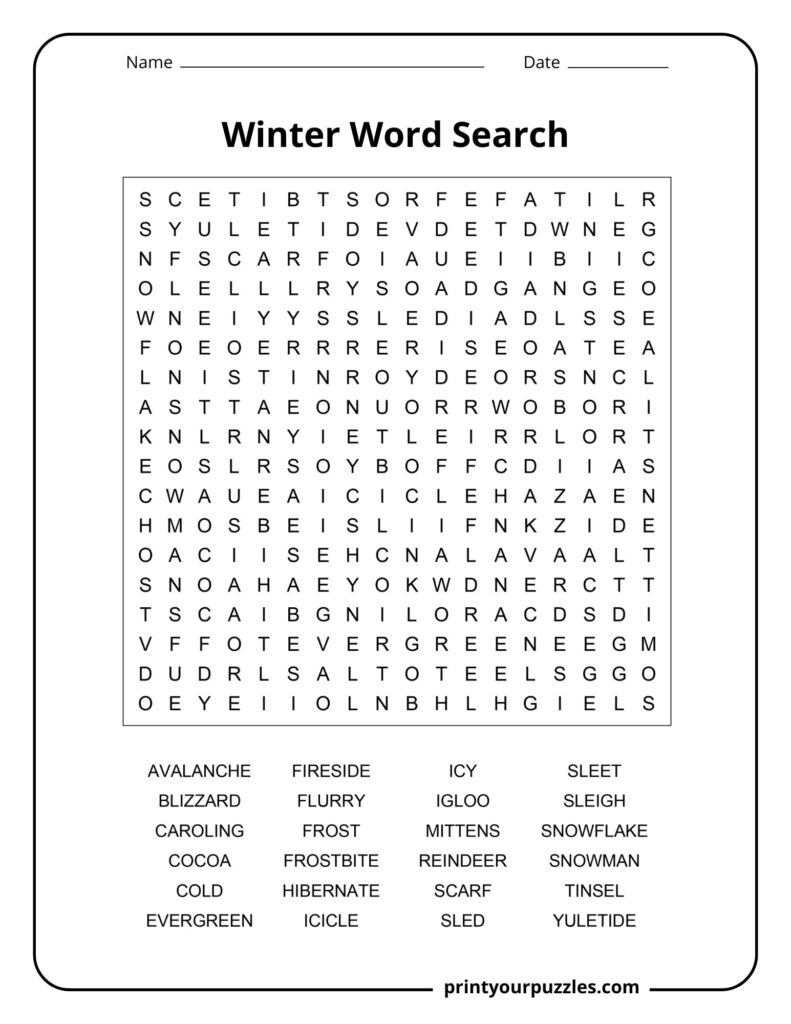
AVALANCHE, BLIZZARD, CAROLING, COCOA, COLD, EVERGREEN, FIRESIDE, FLURRY, FROST, FROSTBITE, HIBERNATE, ICICLE, ICY, IGLOO, MITTENS, REINDEER, SCARF, SLED, SLEET, SLEIGH, SNOWFLAKE, SNOWMAN, TINSEL, YULETIDE
AVALANCHE – A large mass of snow, ice, and debris that suddenly slides down a mountain slope at great speed, burying everything in its path and posing a serious danger to people nearby.
BLIZZARD – A severe snowstorm characterised by strong, biting winds, heavy snowfall, and very low visibility, making travel extremely difficult and dangerous for anyone caught outside.
CAROLING – The festive tradition of singing Christmas songs outdoors, often in groups that walk from door to door through neighbourhoods to spread holiday cheer and seasonal joy to listeners.
COCOA – A warm, comforting drink made from powdered cacao beans mixed with hot milk or water, often sweetened and topped with marshmallows, enjoyed especially on cold winter days.
COLD – A condition of low temperature that defines the winter season, causing people to wear heavy clothing, seek warmth indoors, and feel the sharp chill of the surrounding air.
EVERGREEN – A tree or shrub that retains its green leaves or needles throughout the entire year, including winter, and is widely used as a symbol of life and hope during the festive season.
FIRESIDE – The cosy area directly in front of a fireplace where people gather to enjoy warmth, share stories, and relax during cold winter evenings in the comfort of their home.
FLURRY – A brief, light burst of snowfall that dusts surfaces with a thin layer of white but passes quickly, often preceding heavier winter storms or simply adding a gentle, wintry atmosphere.
FROST – A thin, delicate layer of ice crystals that forms on outdoor surfaces when temperatures drop below freezing overnight, creating intricate white patterns on windows, grass, and leaves.
FROSTBITE – A serious medical condition caused by prolonged exposure to extreme cold, in which skin and underlying tissue freeze, most commonly affecting fingers, toes, nose, and ears.
HIBERNATE – A deep, dormant state that certain animals enter during winter to conserve energy, dramatically slowing their heartbeat, breathing, and body temperature until warmer spring conditions return.
ICICLE – A tapered spike of ice that forms when dripping water freezes in cold air, typically hanging from rooftops, branches, or cliff edges and growing longer as more water continues to freeze.
ICY – A condition describing surfaces or air that are extremely cold, slippery, or covered with a thin layer of ice, making roads hazardous and outdoor movement treacherous during winter months.
IGLOO – A dome-shaped shelter built from blocks of compacted snow, traditionally constructed by Arctic Indigenous peoples as a temporary winter dwelling that traps body heat and insulates against extreme cold.
MITTENS – Warm hand coverings with a single compartment for all four fingers and a separate one for the thumb, designed to retain more heat than gloves and keep hands comfortable in freezing temperatures.
REINDEER – A large deer native to Arctic and subarctic regions, known for its thick winter coat and impressive antlers, and celebrated in folklore as the magical animals that pull Santa Claus’s sleigh.
SCARF – A long piece of warm fabric, often knitted from wool, worn wrapped around the neck and sometimes the face to protect against cold winds and retain body heat during winter outings.
SLED – A flat, low vehicle mounted on smooth runners, used to glide across snow and ice, either pulled by animals or ridden downhill for recreational fun by children and adults alike.
SLEET – A wintry form of precipitation consisting of partially frozen raindrops or refrozen melting snowflakes that fall as small ice pellets, often creating slippery and hazardous conditions on roads and pavements.
SLEIGH – A large, elegant sled designed to carry passengers, traditionally pulled by horses over snow-covered ground, and famously associated with Christmas celebrations and the journey of Santa Claus on Christmas Eve.
SNOWFLAKE – A single crystal of snow that forms in clouds when water vapour freezes, each one displaying a unique and intricate six-sided geometric pattern that cannot be exactly replicated in nature.
SNOWMAN – A figure built outdoors by stacking and shaping large balls of packed snow, traditionally decorated with a carrot nose, button eyes, a scarf, and a hat to resemble a human form.
TINSEL – Thin, shiny strands of metallic or reflective material draped over Christmas trees and used as decorations to catch and reflect light, adding a sparkling, festive shimmer to holiday displays.
YULETIDE – An old-fashioned term for the Christmas season and the surrounding winter festivities, rooted in ancient Norse and Germanic midwinter celebrations that were later absorbed into Christian holiday traditions.
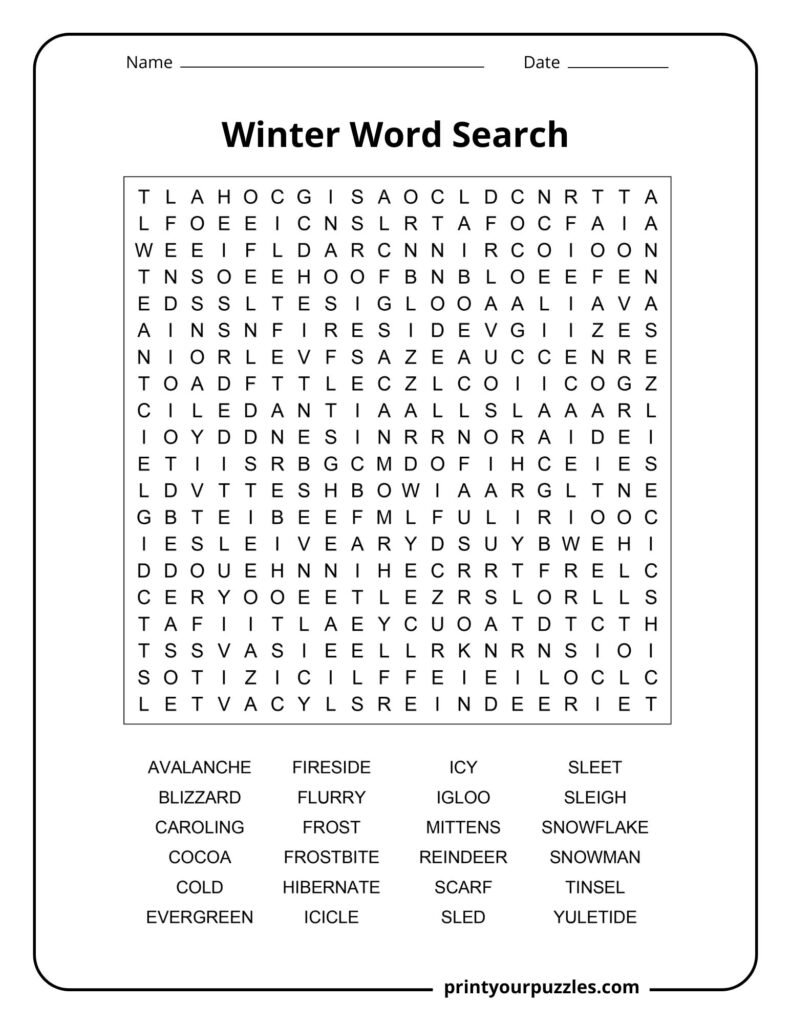
AVALANCHE, BLIZZARD, CAROLING, COCOA, COLD, EVERGREEN, FIRESIDE, FLURRY, FROST, FROSTBITE, HIBERNATE, ICICLE, ICY, IGLOO, MITTENS, REINDEER, SCARF, SLED, SLEET, SLEIGH, SNOWFLAKE, SNOWMAN, TINSEL, YULETIDE
Winter occurs when Earth’s axial tilt causes one hemisphere to receive less direct sunlight, resulting in shorter days, lower temperatures, and reduced solar energy reaching the surface.
Snow forms when water vapour in clouds freezes into ice crystals at temperatures below 0°C, clumping together into snowflakes that fall when they become heavy enough.
Bears, hedgehogs, bats, and ground squirrels are among the animals that hibernate, entering a deep sleep to conserve energy when food sources become scarce in cold months.
Layering is key — wear a moisture-wicking base layer, an insulating middle layer, and a windproof outer coat, plus mittens, a hat, and a scarf to prevent heat loss.
The winter solstice is the shortest day of the year, occurring around December 21st in the Northern Hemisphere, marking the point when the sun reaches its lowest arc across the sky.
Winter asks us to slow down, go inward, and sit with ourselves. The days are short, the darkness is real, and there is a particular kind of beauty in the stillness. These five books are perfect companions for winter’s long, quiet hours.
The Long Winter – Laura Ingalls Wilder. A family survives relentless blizzards on nothing but willpower and hope. Raw, cold, and deeply human — winter survival at its most honest and moving.
The Shining – Stephen King. A hotel buried in snow, a man slowly unraveling, madness seeping through the walls. The ultimate winter horror — isolation turned terrifying, darkness made absolute.
Stoner – John Williams. A quiet man lives a quiet life through all of winter’s seasons, and it breaks your heart completely. Still, cold, and one of the most moving books ever written.
The Snow Child – Eowyn Ivey. A childless couple in Alaska build a girl from snow — and she comes to life. Magical, tender, and quietly devastating, like a winter night full of stars and silence.
Ethan Frome – Edith Wharton. A man trapped by duty and longing in a frozen New England landscape. Spare, devastating, and as stripped back and unsparing as the coldest winter day.
Each snowflake follows a unique path through the atmosphere, experiencing different temperatures and humidity levels that shape its one-of-a-kind six-sided crystal structure as it falls.
Individual snowflakes are colourless and transparent. Snow appears white because its ice crystals scatter and reflect all wavelengths of visible light equally, creating that bright, familiar appearance.
In July 1983, Antarctica’s Vostok Station recorded minus 89.2°C, the lowest natural temperature ever measured on Earth’s surface, during the Southern Hemisphere’s deep winter season.
Reindeer eyes turn from golden in summer to deep blue in winter, boosting their sensitivity to ultraviolet light and helping them detect predators and food in Arctic darkness.
Despite being built from snow, an igloo traps body heat so effectively that the interior temperature can reach up to 16°C, even when outside temperatures plunge far below freezing.