
The New Deal was a group of programs, laws, and reforms created during the presidency of Franklin D. Roosevelt to respond to the Great Depression. It began in 1933, when Roosevelt entered the White House at a time of deep economic crisis. Banks had failed, businesses had closed, millions of people were unemployed, and many families were struggling to afford food, housing, and basic needs.
Roosevelt believed that the federal government had to take strong action to help the country recover. During his first months in office, known as the First Hundred Days, Congress passed many important measures. These laws were designed to stabilize banks, create jobs, support farmers, help the poor, and restore public confidence in the economy.
The New Deal is often explained through three main goals: Relief, Recovery, and Reform. Relief meant giving immediate help to people who were suffering. Recovery meant trying to restart the economy and get businesses, farms, and workers moving again. Reform meant changing rules and institutions so that another economic disaster would be less likely in the future.
Several New Deal programs became especially well known. The Civilian Conservation Corps, or CCC, gave jobs to young men working on parks, forests, and conservation projects. The Works Progress Administration, or WPA, created jobs building roads, schools, bridges, and public buildings. Banking reforms helped restore trust in the financial system, while the Social Security Act created support for older Americans and others in need.
The New Deal helped many people, but it did not end the Great Depression completely. Some critics argued that Roosevelt’s programs gave the federal government too much power. Others believed the New Deal did not do enough to help workers, African Americans, women, farmers, or the poorest Americans. These debates made the New Deal an important political issue during the 1930s.
Over time, the New Deal changed the relationship between citizens and the federal government. It shaped ideas about jobs, banking, retirement, public works, labor rights, and government responsibility during economic crises.
This New Deal word search helps students review vocabulary connected to Roosevelt, relief, recovery, reform, jobs, banks, Social Security, WPA, CCC, economy, and the Great Depression. A New Deal word search can make this important topic easier to understand by connecting key terms with its causes, programs, debates, and lasting impact.
Related Word Searches:
Great Depression | Franklin D. Roosevelt | 1929 Stock Market Crash | Dust Bowl | Roaring Twenties | Progressive Era
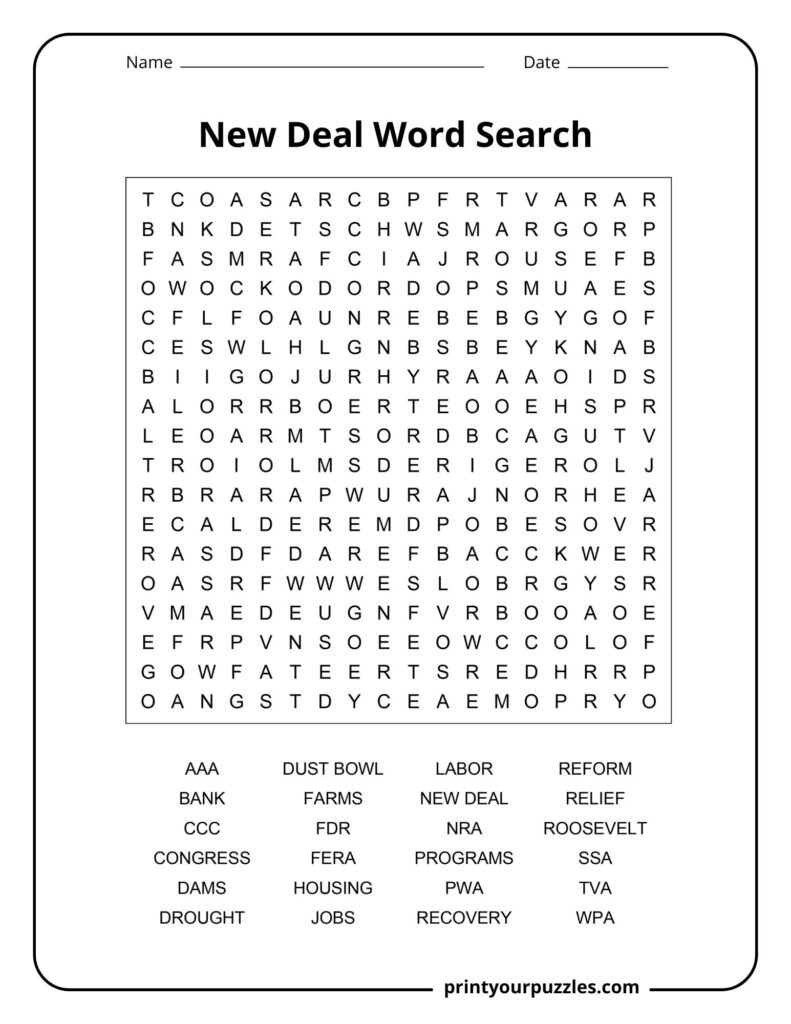
AAA, BANK, CCC, CONGRESS, DAMS, DROUGHT, DUST BOWL, FARMS, FDR, FERA, HOUSING, JOBS, LABOR, NEW DEAL, NRA, PROGRAMS, PWA, RECOVERY, REFORM, RELIEF, ROOSEVELT, SSA, TVA, WPA
AAA – Agricultural Adjustment Administration, a New Deal agency that paid farmers to reduce crop production to raise prices and stabilize farm income during the Depression.
BANK – Financial institutions that failed by thousands during the Depression, leading FDR to declare a bank holiday to restore public confidence in the system.
CCC – Civilian Conservation Corps, employed young men in environmental projects like planting trees, building parks, and conserving natural resources while providing wages for families.
CONGRESS – The United States legislative body that passed New Deal legislation proposed by President Roosevelt to address the economic crisis and reform American institutions.
DAMS – Large water control structures built through New Deal programs like the TVA, providing flood control, electricity, and jobs for thousands of workers.
DROUGHT – Severe water shortage during the 1930s that devastated farmland, particularly in the Great Plains, contributing to dust storms and agricultural collapse across America.
DUST BOWL – Environmental disaster of the 1930s when severe drought and poor farming practices created massive dust storms, forcing thousands of families to migrate westward.
FARMS – Agricultural operations that suffered greatly during the Depression, prompting New Deal programs to provide subsidies, loans, and support to stabilize rural America’s economy.
FDR – Franklin Delano Roosevelt, the thirty-second president who created the New Deal programs to combat the Great Depression and restore American economic prosperity.
FERA – Federal Emergency Relief Administration, provided direct financial assistance to states for relief programs, helping millions of unemployed Americans with food, clothing, and shelter.
HOUSING – New Deal programs addressed housing needs through construction projects, mortgage assistance, and subsidized housing developments to help Americans secure affordable, safe homes.
JOBS – Employment creation was central to New Deal programs, putting millions of unemployed Americans back to work through public projects and government-funded positions nationwide.
LABOR – Workers’ rights were strengthened through New Deal legislation, including minimum wage laws, collective bargaining rights, and protections against unfair employment practices nationwide.
NEW DEAL – Roosevelt’s comprehensive program of economic reforms and relief measures designed to combat the Great Depression through government intervention and public works projects.
NRA – National Recovery Administration, established codes for fair competition, set minimum wages and maximum hours, and displayed the Blue Eagle symbol in participating businesses.
PROGRAMS – Various government initiatives under the New Deal that provided relief, recovery, and reform to address Depression-era unemployment, poverty, and economic collapse across America.
PWA – Public Works Administration, funded large-scale construction projects like bridges, hospitals, and schools, creating jobs while improving America’s infrastructure and public facilities significantly.
RECOVERY – Economic restoration goal of New Deal programs, aiming to revive business activity, employment rates, and consumer spending after the devastating Great Depression crash.
REFORM – Structural changes to prevent future economic disasters, including banking regulations, securities laws, and social safety nets established through New Deal legislation permanently.
RELIEF – Immediate assistance provided to unemployed and suffering Americans through direct aid, work programs, and government support during the worst Depression years nationally.
ROOSEVELT – Franklin D. Roosevelt, president from 1933-1945, who led America through the Great Depression with New Deal policies and World War Two until death.
SSA – Social Security Administration, created a retirement insurance program for elderly Americans, unemployment insurance, and aid for disabled citizens and dependent children nationwide.
TVA – Tennessee Valley Authority, developed the Tennessee River basin through dam construction, electrification, flood control, and economic development across seven impoverished southern states.
WPA – Works Progress Administration, employed millions of Americans in construction, arts, writing, and theater projects, building roads, schools, and creating lasting cultural contributions nationwide.
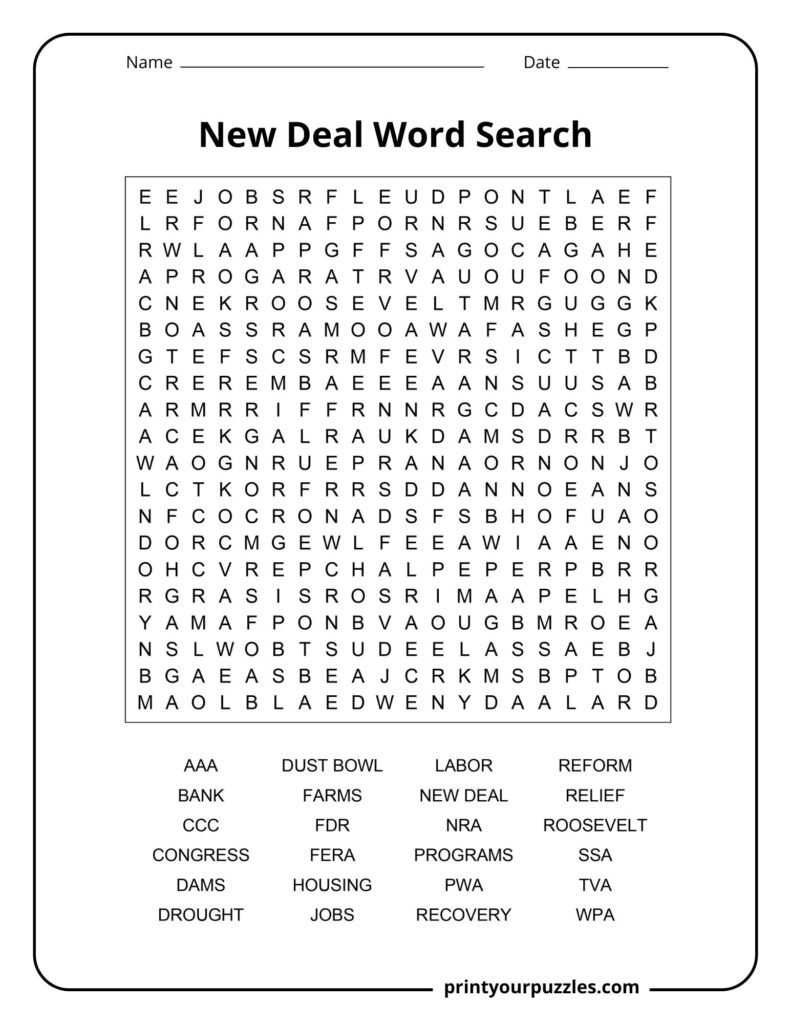
AAA, BANK, CCC, CONGRESS, DAMS, DROUGHT, DUST BOWL, FARMS, FDR, FERA, HOUSING, JOBS, LABOR, NEW DEAL, NRA, PROGRAMS, PWA, RECOVERY, REFORM, RELIEF, ROOSEVELT, SSA, TVA, WPA
The New Deal was President Franklin D. Roosevelt’s comprehensive program of economic reforms, relief measures, and public works projects designed to combat the Great Depression’s devastating effects.
The New Deal began in 1933 when Roosevelt took office and continued through the late 1930s, with some programs lasting decades, including Social Security today.
The three R’s were Relief for the unemployed and poor, Recovery of the economy to normal levels, and Reform of the financial system to prevent future depressions.
Major agencies included the CCC, WPA, TVA, SSA, and PWA, which created jobs, built infrastructure, provided electricity, established Social Security, and offered economic relief nationwide.
The New Deal reduced unemployment and provided relief, but full economic recovery didn’t occur until World War Two increased industrial production and created millions of jobs.
The Civilian Conservation Corps planted approximately three billion trees across America, combating soil erosion, creating forests, and establishing reforestation practices that transformed the nation’s landscape permanently.
The WPA’s Federal Arts Project hired thousands of creative professionals to paint murals, write guidebooks, perform theater, and document American culture during the Depression years.
When Social Security began in 1935, the nine-digit numbers were only meant to track workers’ retirement accounts, not serve as universal identification like today.
Roosevelt delivered radio addresses directly to Americans in their homes, explaining New Deal policies in simple terms and restoring public confidence through personal, conversational broadcasts nationwide.
New Deal programs constructed or improved more than 650,000 miles of roads, 125,000 public buildings, and 8,000 parks, creating infrastructure Americans still use today.