
Ulysses S. Grant (1869–1877) first became famous not as a politician, but as the Union general who helped bring the Civil War to an end. His victories at places such as Vicksburg and Appomattox made him one of the most recognizable figures in the country. When he entered the White House, Americans hoped that his determination as a military leader would help guide the nation through Reconstruction. The Ulysses S. Grant word search gives students an engaging way to connect Civil War history with the difficult years that followed.
Grant’s presidency belonged to a period when the United States was trying to define freedom after slavery. The Thirteenth Amendment had abolished slavery, but the rights and safety of formerly enslaved people were still under attack, especially in the South. Grant supported Reconstruction policies designed to protect African American citizenship and voting rights. His administration used federal power against violent groups such as the Ku Klux Klan, making civil rights one of the most important themes of his time in office.
Grant led the country from 1869 to 1877, serving two full terms during a difficult and often unstable period. During those years, the Fifteenth Amendment was ratified, protecting the right to vote regardless of race, color, or previous condition of servitude. This was a major constitutional achievement, even though many states later found ways to restrict Black voting rights through intimidation, discrimination, and unfair laws.
His presidency also faced serious problems. Several scandals involving government officials damaged public trust, although Grant himself was often seen as personally honest. The Credit Mobilier scandal, the Whiskey Ring, and other cases made many Americans question corruption in politics during the Gilded Age. Grant was loyal to friends and advisers, but that loyalty sometimes led him to trust the wrong people.
The Panic of 1873 created another major challenge. Banks failed, businesses struggled, unemployment rose, and the country entered a long economic depression. These difficulties complicated Grant’s presidency and made his administration the subject of debate for generations.
Today, Grant’s reputation is often viewed more positively than it once was, especially because historians have reexamined his commitment to Reconstruction and civil rights. This Ulysses S. Grant word search explores military victory, constitutional change, national rebuilding, political scandal, economic hardship, and the unfinished struggle for equality after the Civil War.
Complete the Civil War and Reconstruction group with our Abraham Lincoln word search, Andrew Johnson word search, James Buchanan word search, and the full US Presidents Word Searches collection.
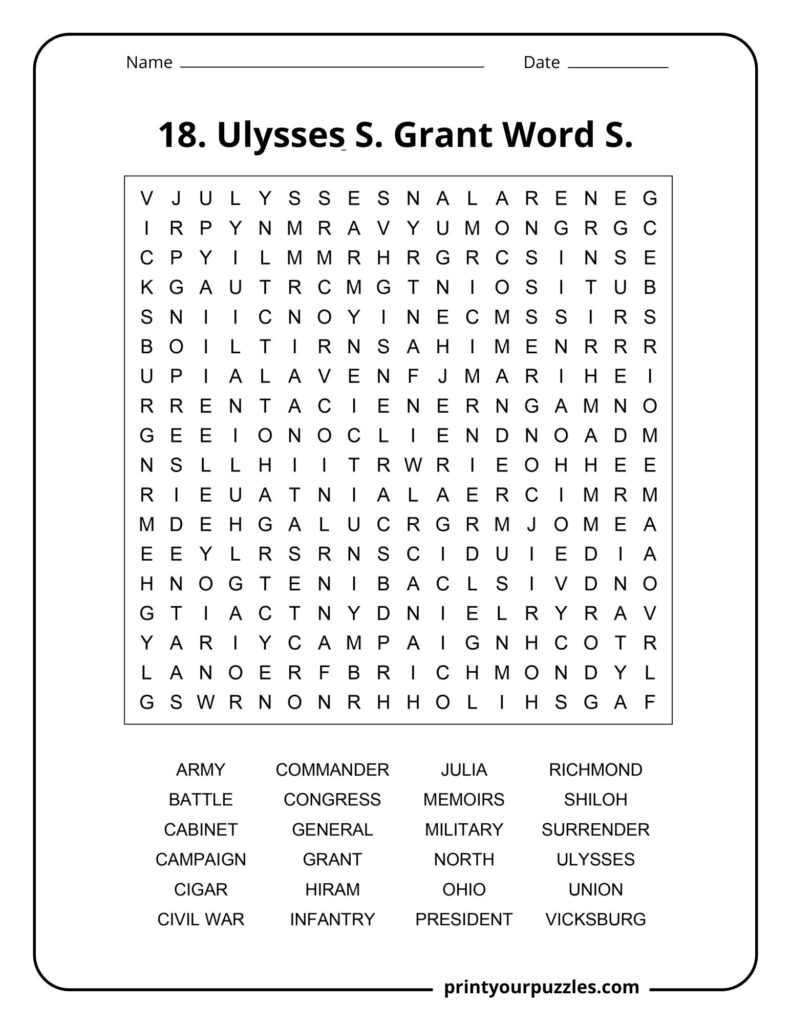
ARMY, BATTLE, CABINET, CAMPAIGN, CIGAR, CIVIL WAR, COMMANDER, CONGRESS, GENERAL, GRANT, HIRAM, INFANTRY, JULIA, MEMOIRS, MILITARY, NORTH, OHIO, PRESIDENT, RICHMOND, SHILOH, SURRENDER, ULYSSES, UNION, VICKSBURG
ARMY – Grant served in the United States Army during the Mexican-American War and rose to commanding general of all Union armies during the Civil War.
BATTLE – Grant fought in numerous major Civil War battles including Shiloh, Vicksburg, and Chattanooga, demonstrating aggressive tactics and determination that led to Union victories.
CABINET – Grant’s presidential cabinet faced several corruption scandals, including the Whiskey Ring, though Grant himself was not personally implicated in the various schemes.
CAMPAIGN – Grant led military campaigns across the western and eastern theaters, and later ran two successful presidential campaigns in eighteen sixty-eight and eighteen seventy-two.
CIGAR – Grant became famous for constantly smoking cigars, reportedly receiving thousands from admirers after Shiloh, which may have contributed to his later throat cancer.
CIVIL WAR – The eighteen sixty-one to eighteen sixty-five conflict between Union and Confederate states where Grant emerged as the North’s most successful general.
COMMANDER – Grant was promoted to lieutenant general and given command of all Union armies in eighteen sixty-four, coordinating multiple fronts against Confederate forces.
CONGRESS – As president, Grant worked with Congress on Reconstruction policies, civil rights legislation, and faced investigations into various administration scandals throughout his terms.
GENERAL – Grant achieved the rank of lieutenant general, the first since George Washington, and later became the first full general in American history.
GRANT – His family surname, adopted when Congressman Thomas Hamer mistakenly nominated him to West Point as Ulysses S. Grant instead of Hiram Ulysses Grant.
HIRAM – Grant’s birth name was Hiram Ulysses Grant, given at birth in eighteen twenty-two, but he later dropped Hiram after the West Point error.
INFANTRY – Grant commanded infantry units throughout his military career, utilizing coordinated infantry assaults and siege tactics to overwhelm Confederate positions and secure strategic victories.
JULIA – Julia Dent Grant was his devoted wife whom he married in eighteen forty-eight; she supported him through military struggles and White House years.
MEMOIRS – Grant wrote his acclaimed Personal Memoirs while dying of throat cancer, completing them days before death to provide financially for his family.
MILITARY – Grant’s military career spanned from West Point graduation in eighteen forty-three through his eighteen sixty-nine retirement as commanding general of the army.
NORTH – Grant fought for the Northern Union states, becoming their greatest military hero and helping preserve the United States during the Civil War.
OHIO – Grant was born in Point Pleasant, Ohio in eighteen twenty-two and raised in Georgetown, Ohio, maintaining connections to his home state.
PRESIDENT – Grant served as the eighteenth President of the United States from eighteen sixty-nine to eighteen seventy-seven, focusing on Reconstruction and protecting African American rights.
RICHMOND – The Confederate capital of Virginia that Grant’s armies besieged and captured in April eighteen sixty-five, effectively ending the Civil War days later.
SHILOH – The April eighteen sixty-two Tennessee battle where Grant’s forces survived a surprise Confederate attack and won a costly but strategically important Union victory.
SURRENDER – Grant accepted Confederate General Robert E. Lee’s surrender at Appomattox Court House on April ninth, eighteen sixty-five, offering generous terms to soldiers.
ULYSSES – His adopted first name, taken from his middle name after the West Point registration error, inspired by the Greek hero from Homer’s Odyssey.
UNION – The United States forces Grant commanded during the Civil War, fighting to preserve the nation and end slavery in the rebellious Southern states.
VICKSBURG – Grant’s greatest strategic victory, capturing this Mississippi River fortress in July eighteen sixty-three, splitting the Confederacy and controlling vital supply routes.
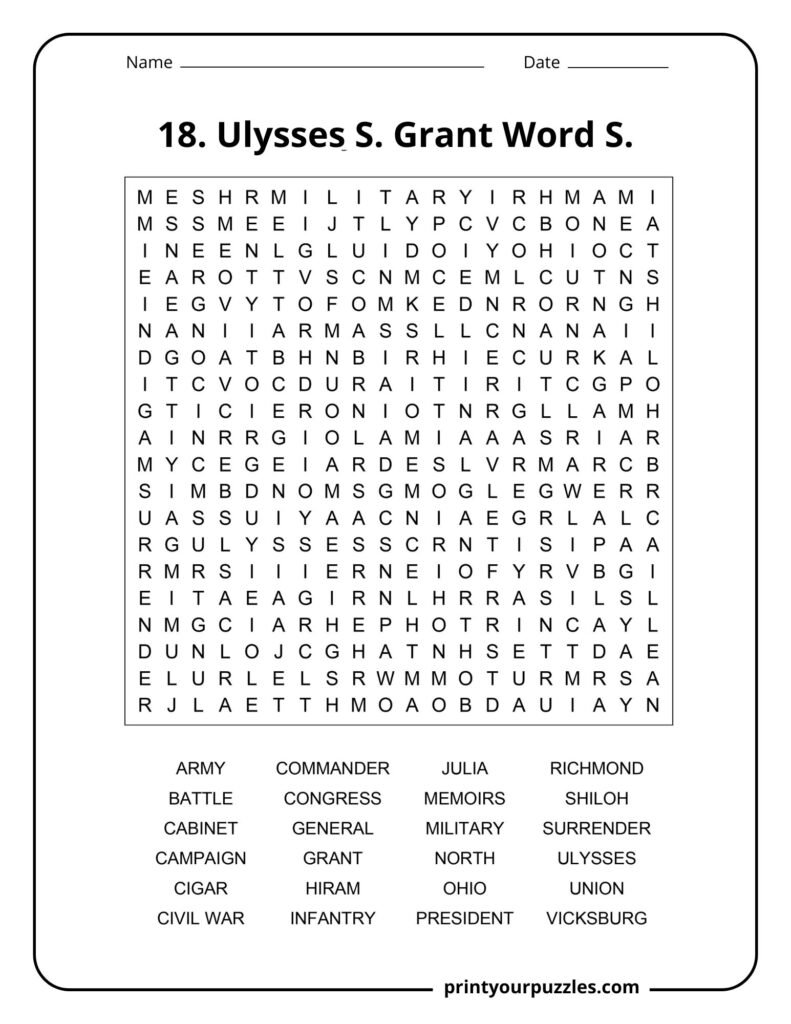
ARMY, BATTLE, CABINET, CAMPAIGN, CIGAR, CIVIL WAR, COMMANDER, CONGRESS, GENERAL, GRANT, HIRAM, INFANTRY, JULIA, MEMOIRS, MILITARY, NORTH, OHIO, PRESIDENT, RICHMOND, SHILOH, SURRENDER, ULYSSES, UNION, VICKSBURG
Grant was born Hiram Ulysses Grant in 1822. His name changed to Ulysses S. Grant due to a clerical error during his West Point nomination.
The siege and capture of Vicksburg in July 1863 was Grant’s greatest strategic triumph, splitting the Confederacy and giving the Union control of the Mississippi River.
Grant served two full terms as the eighteenth President from 1869 to 1877, winning election in 1868 and re-election in 1872 with strong support.
Dying of throat cancer and facing bankruptcy, Grant wrote his Personal Memoirs to provide financial security for his family, completing them shortly before his death.
Grant accepted Lee’s surrender at Appomattox in April 1865, offering generous terms that allowed Confederate soldiers to return home peacefully with their horses and dignity.
For official administration records and historical biography, visit the Ulysses S. Grant page in the White House Archives. If you are looking for personal papers, visit the official Ulysses S. Grant Presidential Library.
Grant by Ron Chernow. A sweeping rehabilitation of a great general and underrated president. Chernow dismantles old myths and reveals Grant’s fierce commitment to civil rights.
In 1872, Grant was stopped by police officer William West for speeding his horse and buggy in Washington D.C., paid a twenty-dollar fine, and walked home.
The “S” was part of the West Point registration error. Grant later joked it could represent his mother’s maiden name Simpson or simply nothing at all.
Racing against throat cancer, Grant completed his 300,000-word Personal Memoirs in eleven months, finishing just days before his death in 1885, creating a literary masterpiece.
Admirers sent thousands of cigars after seeing newspaper images of Grant smoking during battle. He smoked up to twenty daily, likely causing his fatal cancer.
Bad investments and a partner’s fraud left Grant bankrupt in 1884. Mark Twain published his memoirs, earning Grant’s widow nearly half a million dollars posthumously.