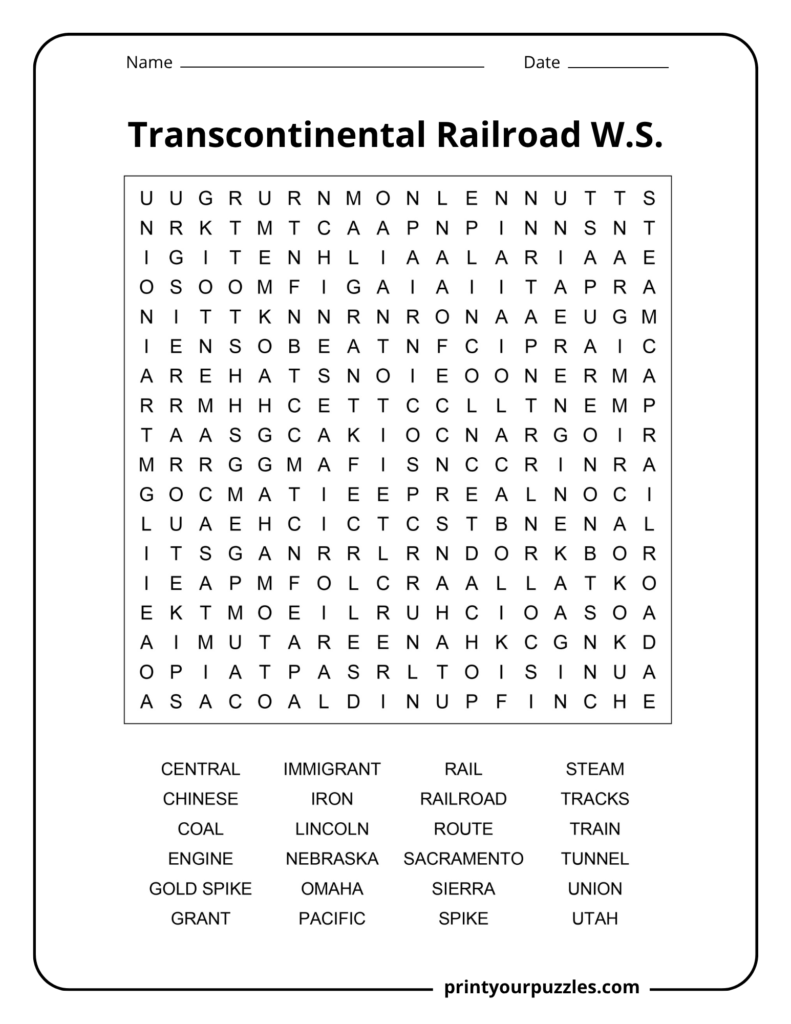
Introduction to the Transcontinental Railroad Word Search
The Transcontinental Railroad was one of the most important transportation projects in United States history. Completed in 1869, it connected the eastern railroad network with the Pacific Coast, making it possible to travel across much of the country by train. Before the railroad, crossing the continent could take several months by wagon, stagecoach, or ship. The new rail connection reduced the journey dramatically and helped transform the nation’s economy, population, and settlement patterns.
Construction officially began during the Civil War after President Abraham Lincoln signed the Pacific Railway Act of 1862. Two major companies were responsible for building the route. The Union Pacific Railroad constructed tracks westward from Omaha, Nebraska, while the Central Pacific Railroad built eastward from Sacramento, California. Thousands of workers participated, including large numbers of Chinese immigrants on the Central Pacific and Irish immigrants, Civil War veterans, and other laborers on the Union Pacific.
Building the railroad was extremely difficult. Workers crossed deserts, plains, rivers, and mountain ranges while facing dangerous weather and challenging terrain. In the Sierra Nevada, crews blasted tunnels through solid rock and worked through heavy winter snow. Farther east, railroad crews laid tracks rapidly across the Great Plains.
On May 10, 1869, the two railroad lines finally met at Promontory Summit, Utah. During a famous ceremony, officials celebrated the completion of the railroad by driving a ceremonial golden spike into the final section of track. News of the achievement quickly spread across the country.
The transcontinental railroad encouraged migration westward, expanded national markets, lowered transportation costs, and helped new towns develop along the route. Farmers, manufacturers, merchants, and travelers gained faster access to distant parts of the country. However, railroad expansion also had serious consequences for Native American nations, whose lands, resources, and traditional ways of life were increasingly threatened by western settlement.
This Transcontinental Railroad word search offers an engaging way to explore the people, places, events, and ideas connected with this remarkable project. As you discover the hidden words, you can learn how the railroad united distant regions, encouraged economic growth, changed western settlement, and became a powerful symbol of America’s rapid expansion during the nineteenth century.
Related Word Searches:
Westward Expansion | Manifest Destiny | California Gold Rush | Industrial Revolution | Gilded Age | Oregon Trail
Medium Difficulty Word Search
Words to Find:
CENTRAL, CHINESE, COAL, ENGINE, GOLD SPIKE, GRANT, IMMIGRANT, IRON, LINCOLN, NEBRASKA, OMAHA, PACIFIC, RAIL, RAILROAD, ROUTE, SACRAMENTO, SIERRA, SPIKE, STEAM, TRACKS, TRAIN, TUNNEL, UNION, UTAH
All Words Defined
CENTRAL – Railroad company that built the western section of the transcontinental railroad eastward from Sacramento, California, using thousands of workers through extremely difficult mountain terrain.
CHINESE – Chinese immigrants formed a large part of the Central Pacific workforce, performing dangerous construction work in the Sierra Nevada and helping complete the railroad.
COAL – Fuel commonly burned in steam locomotives to heat water, produce steam, and power the engines that carried passengers and freight across long railroad routes.
ENGINE – Powerful steam locomotive that pulled railroad cars along the tracks, transporting passengers, mail, livestock, and goods over increasingly long distances across the United States.
GOLD SPIKE – Ceremonial spike used during the May 10, 1869 celebration marking completion of the transcontinental railroad where the Union Pacific and Central Pacific lines met.
GRANT – Ulysses S. Grant was president when the completed transcontinental railroad began transforming western travel, commerce, settlement, and national transportation during the early years of his presidency.
IMMIGRANT – Many railroad laborers were immigrants, especially workers from China and Ireland, who performed exhausting and dangerous jobs while helping build the transcontinental railroad.
IRON – Strong metal widely used for railroad rails, spikes, tools, bridges, and equipment, making it essential to the construction and operation of nineteenth-century railroads.
LINCOLN – President Abraham Lincoln supported construction of a transcontinental railroad and signed the Pacific Railway Act of 1862, authorizing federal assistance for the enormous project.
NEBRASKA – Great Plains territory and later state containing Omaha, the eastern starting area for the Union Pacific section of the transcontinental railroad during construction.
OMAHA – Nebraska city located near the eastern beginning of the Union Pacific Railroad, which built westward across the Great Plains toward the meeting point in Utah.
PACIFIC – Word referring to the western ocean and appearing in the names of both major companies, Union Pacific and Central Pacific, involved in railroad construction.
RAIL – Metal bar forming part of a railroad track, providing a smooth surface that guided locomotive wheels and allowed trains to travel safely across long distances.
RAILROAD – Transportation system using trains running on tracks, dramatically improving nineteenth-century travel, trade, migration, communication, and movement of goods throughout the expanding United States.
ROUTE – Planned path followed by the railroad across plains, deserts, mountains, rivers, and territories, connecting distant communities while creating new transportation and settlement opportunities.
SACRAMENTO – California city where the Central Pacific began building eastward, sending workers into the Sierra Nevada as part of the effort to connect with Union Pacific.
SIERRA – Short name for the Sierra Nevada mountains, where Central Pacific workers faced granite rock, steep slopes, deep snow, avalanches, and extremely difficult construction conditions.
SPIKE – Large metal fastener driven through railroad rails into wooden ties, helping secure the track in place as construction crews steadily extended the railroad westward.
STEAM – Pressurized vapor produced by heating water inside locomotive boilers, creating the mechanical power needed to move nineteenth-century trains along railroad tracks across great distances.
TRACKS – Parallel rails secured to wooden ties that created the pathway for trains, allowing locomotives and railroad cars to travel safely between towns and distant regions.
TRAIN – Connected group of railroad cars pulled by a locomotive, carrying passengers, freight, livestock, mail, and supplies across the growing national rail network.
TUNNEL – Passage excavated through rock or mountains so railroad tracks could continue through difficult terrain, especially during Central Pacific construction in the Sierra Nevada.
UNION – Short reference to the Union Pacific Railroad, the company responsible for constructing the eastern portion of the transcontinental railroad westward from Nebraska toward Utah.
UTAH – Western territory where the Union Pacific and Central Pacific railroads finally met in 1869, completing the first continuous rail connection across the United States.
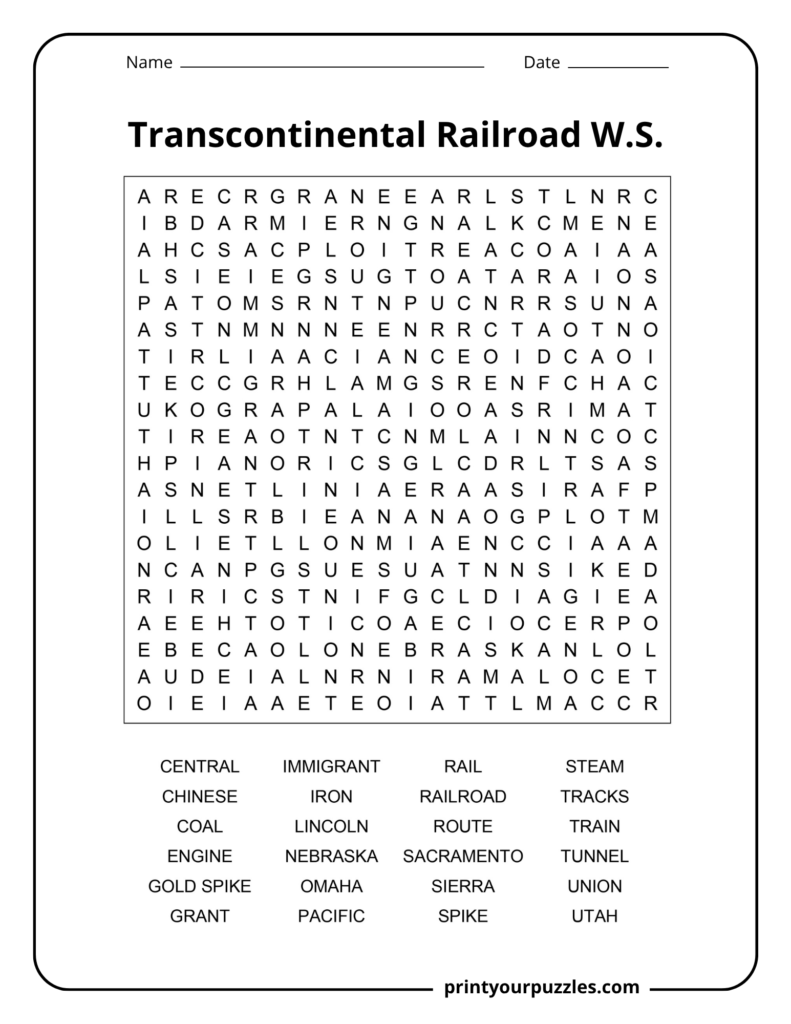
Hard Difficulty Word Search
Words to Find:
CENTRAL, CHINESE, COAL, ENGINE, GOLD SPIKE, GRANT, IMMIGRANT, IRON, LINCOLN, NEBRASKA, OMAHA, PACIFIC, RAIL, RAILROAD, ROUTE, SACRAMENTO, SIERRA, SPIKE, STEAM, TRACKS, TRAIN, TUNNEL, UNION, UTAH
5 Key FAQs About the Transcontinental Railroad
5 Curious "Did You Know?" Facts About the Transcontinental Railroad