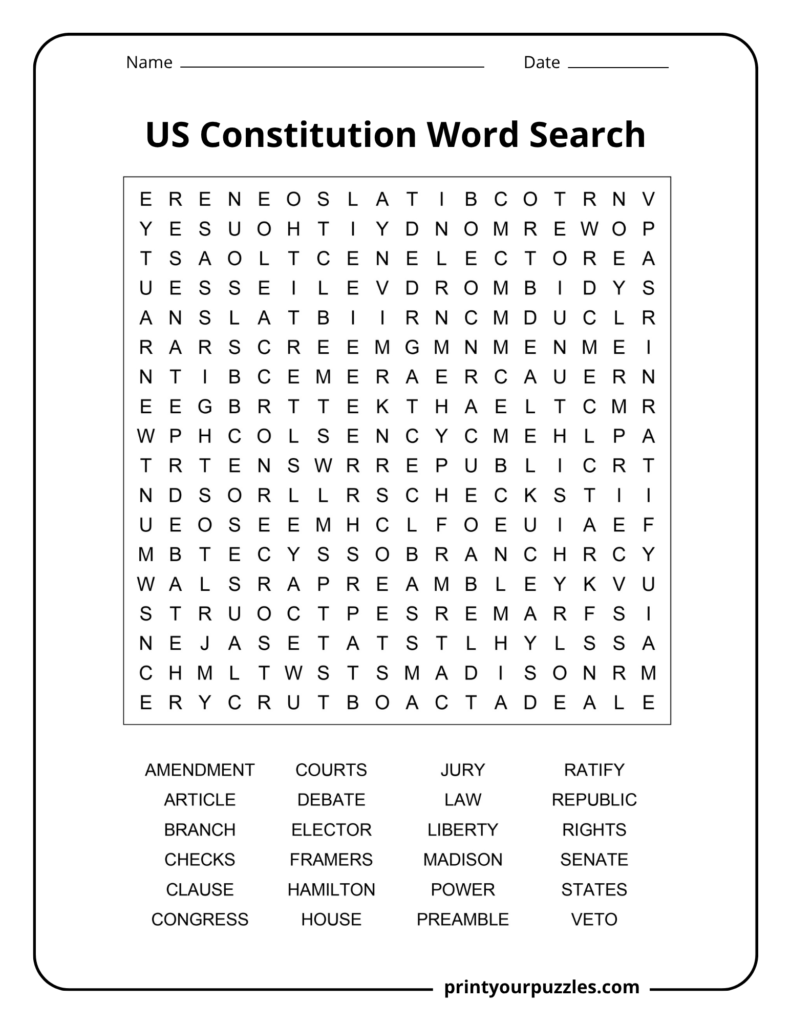
Introduction to the US Constitution Word Search
The U.S. Constitution is one of the most important documents in American history. Written in 1787, it established the basic structure of the federal government and created rules for how political power would be divided and exercised. It replaced the Articles of Confederation, an earlier system that had left the national government too weak to deal effectively with problems involving taxes, trade, defense, and disputes between states. This U.S. Constitution word search introduces key people, ideas, places, and terms connected with the creation and development of the Constitution.
In May 1787, delegates from twelve states gathered in Philadelphia for the Constitutional Convention. Rhode Island chose not to participate. The delegates originally intended to improve the Articles of Confederation, but they soon decided to design an entirely new form of government. George Washington served as president of the convention, while James Madison became especially influential because of his ideas and detailed notes. Other important figures included Benjamin Franklin, Alexander Hamilton, George Mason, and Gouverneur Morris.
The Constitution created three branches of government: legislative, executive, and judicial. Congress makes federal laws, the president leads the executive branch, and the federal courts interpret laws and the Constitution. This separation of powers was designed to prevent any one part of government from becoming too powerful. A system of checks and balances also allows each branch to limit certain actions of the others.
After the delegates approved the Constitution on September 17, 1787, it still had to be ratified by the states. Supporters, known as Federalists, argued that a stronger national government was necessary. Anti-Federalists worried that the new government could threaten individual freedoms and state authority. These debates helped lead to the addition of the Bill of Rights, the first ten amendments to the Constitution, which were ratified in 1791.
The Constitution has changed through amendments, court decisions, laws, and political traditions, but its basic framework remains in place. It continues to define the powers of the federal government, protect important rights, and shape American political life more than two centuries after it was written.
Related Word Searches:
Bill of Rights | Founding Fathers | Declaration of Independence | James Madison | George Washington | Benjamin Franklin
Medium Difficulty Word Search
Words to Find:
AMENDMENT, ARTICLE, BRANCH, CHECKS, CLAUSE, CONGRESS, COURTS, DEBATE, ELECTOR, FRAMERS, HAMILTON, HOUSE, JURY, LAW, LIBERTY, MADISON, POWER, PREAMBLE, RATIFY, REPUBLIC, RIGHTS, SENATE, STATES, VETO
All Words Defined
AMENDMENT – An official change or addition to the U.S. Constitution. Twenty-seven amendments have been ratified, including the Bill of Rights and later protections for voting and citizenship.
ARTICLE – One of the seven main sections of the U.S. Constitution. Each article explains important parts of government, including Congress, the presidency, courts, states, and amendments.
BRANCH – One of the three main divisions of the federal government: legislative, executive, and judicial. Each branch has separate responsibilities and powers under the Constitution.
CHECKS – Powers allowing one branch of government to limit another branch. These constitutional checks help prevent any single part of the federal government from becoming too powerful.
CLAUSE – A specific section or provision within the Constitution that establishes a rule, power, or limitation, such as the Commerce Clause or the Supremacy Clause.
CONGRESS – The legislative branch of the federal government, consisting of the Senate and House of Representatives. Congress creates laws, approves spending, and exercises other constitutional powers.
COURTS – Institutions forming the judicial branch of government. Federal courts interpret laws and the Constitution, resolve legal disputes, and determine whether government actions are constitutional.
DEBATE – Formal discussion in which people present different arguments and viewpoints. Debate played an important role during the Constitutional Convention and during the states’ ratification process.
ELECTOR – A person chosen to cast an official vote in the Electoral College, the constitutional system used to formally elect the president and vice president.
FRAMERS – The political leaders who helped create and shape the U.S. Constitution during the 1787 Constitutional Convention, including James Madison, George Washington, and Benjamin Franklin.
HAMILTON – Alexander Hamilton was a Constitutional Convention delegate and strong Federalist who supported a powerful national government and helped defend the Constitution in the Federalist Papers.
HOUSE – The House of Representatives is one chamber of Congress. Its membership is based on state population, and representatives are elected to two-year terms.
JURY – A group of citizens selected to hear evidence and decide certain legal cases. The Constitution and Bill of Rights protect the right to jury trials.
LAW – A rule officially established by government and enforced by public authority. Under the Constitution, Congress passes federal laws, while courts interpret their meaning and application.
LIBERTY – The freedom to live, speak, believe, and act without unnecessary government interference. Constitutional rights and later amendments provide important protections for individual liberty in America.
MADISON – James Madison played a major role in drafting the Constitution, kept detailed notes during the convention, and later helped write the influential Federalist Papers.
POWER – The legal authority given to government institutions or officials. The Constitution divides power among federal branches and also shares certain powers between national and state governments.
PREAMBLE – The opening statement of the Constitution beginning with “We the People.” It explains the document’s major purposes, including justice, defense, liberty, and the general welfare.
RATIFY – To formally approve an agreement or document. The Constitution became effective after nine states ratified it, although all thirteen original states eventually approved it.
REPUBLIC – A form of government in which citizens choose representatives to make political decisions. The Constitution established the United States as a federal constitutional republic.
RIGHTS – Freedoms and protections guaranteed to individuals by the Constitution and its amendments, including freedom of speech, religious liberty, due process, and protections for accused persons.
SENATE – One of the two chambers of Congress. Each state elects two senators, giving every state equal representation regardless of population under the constitutional system.
STATES – The individual political units that form the United States. The Constitution divides responsibilities between state governments and the federal government through a system called federalism.
VETO – The president’s constitutional power to reject legislation passed by Congress. Congress can override a presidential veto if two-thirds of both chambers vote to do so.
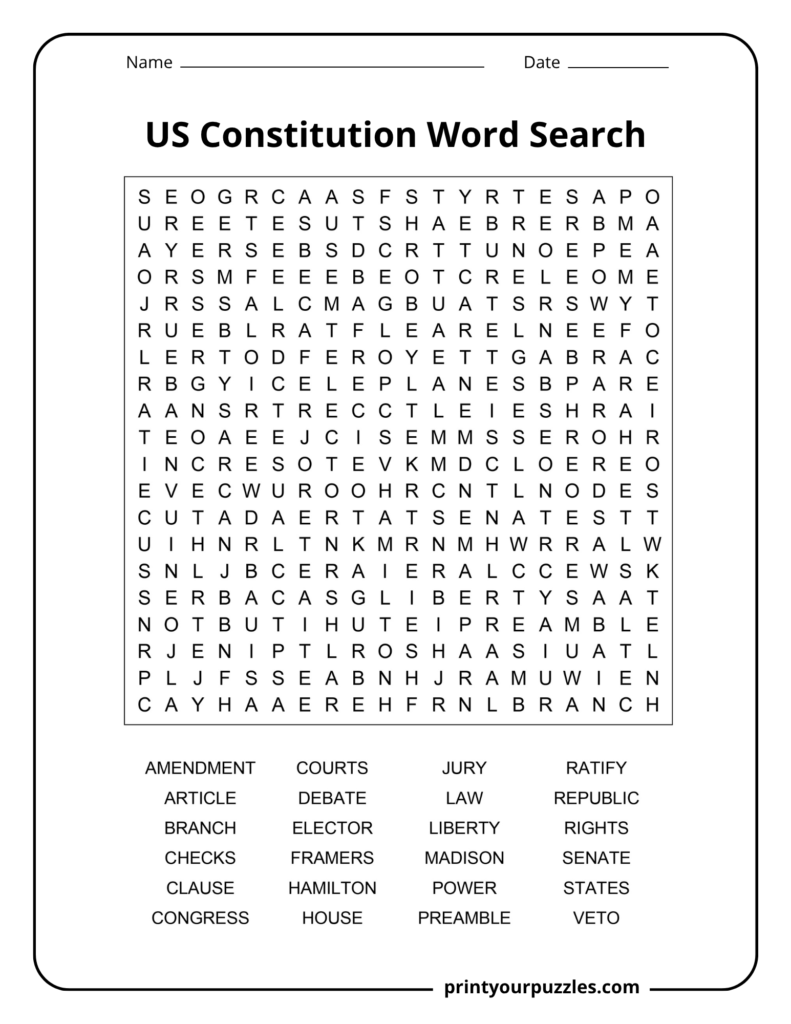
Hard Difficulty Word Search
Words to Find:
AMENDMENT, ARTICLE, BRANCH, CHECKS, CLAUSE, CONGRESS, COURTS, DEBATE, ELECTOR, FRAMERS, HAMILTON, HOUSE, JURY, LAW, LIBERTY, MADISON, POWER, PREAMBLE, RATIFY, REPUBLIC, RIGHTS, SENATE, STATES, VETO
5 Key FAQs About the US Constitution
5 Curious "Did You Know?" Facts About the US Constitution