
The Age of Exploration was a period of global discovery, navigation, trade, and conquest that transformed connections between continents. Beginning in the 15th century and continuing into the 17th century, European sailors traveled across oceans searching for new trade routes, valuable goods, and territories. These voyages brought distant parts of the world into closer contact than ever before and helped shape the modern global economy.
Portugal and Spain were among the first European nations to lead major overseas expeditions. Portuguese explorers sailed along the coast of Africa, seeking a sea route to Asia. In 1498, Vasco da Gama reached India by sailing around the Cape of Good Hope. Meanwhile, Christopher Columbus, sailing for Spain in 1492, crossed the Atlantic and reached islands in the Caribbean while attempting to find a western route to Asia. His voyages opened the way for increased European exploration and colonization of the Americas.
Other famous explorers soon followed. Ferdinand Magellan’s expedition completed the first circumnavigation of the globe, although Magellan himself died before the journey ended. John Cabot explored parts of the North American coast for England, while explorers sponsored by France and the Netherlands searched for trade routes and claimed territories of their own.
The Age of Exploration was made possible by improvements in navigation and shipbuilding. Instruments such as the compass and astrolabe helped sailors determine direction and position, while vessels such as the caravel were designed for long ocean voyages. Better maps and growing knowledge of winds and currents also encouraged explorers to travel farther from familiar shores.
Exploration brought enormous changes, but its consequences were complex. New trade networks exchanged foods, animals, plants, precious metals, and ideas between continents. This movement became known as the Columbian Exchange. At the same time, European colonization caused warfare, forced labor, cultural destruction, and devastating epidemics among Indigenous peoples. The expansion of Atlantic trade also contributed to the growth of the transatlantic slave trade.
This Age of Exploration word search introduces important explorers, places, ships, navigation tools, and ideas connected with this influential period. Understanding these terms helps explain how ocean voyages connected the world while creating lasting political, economic, cultural, and human consequences.
Related Word Searches:
Silk Road | Renaissance | Protestant Reformation | Ancient China | Inca Empire | Mayan Civilization
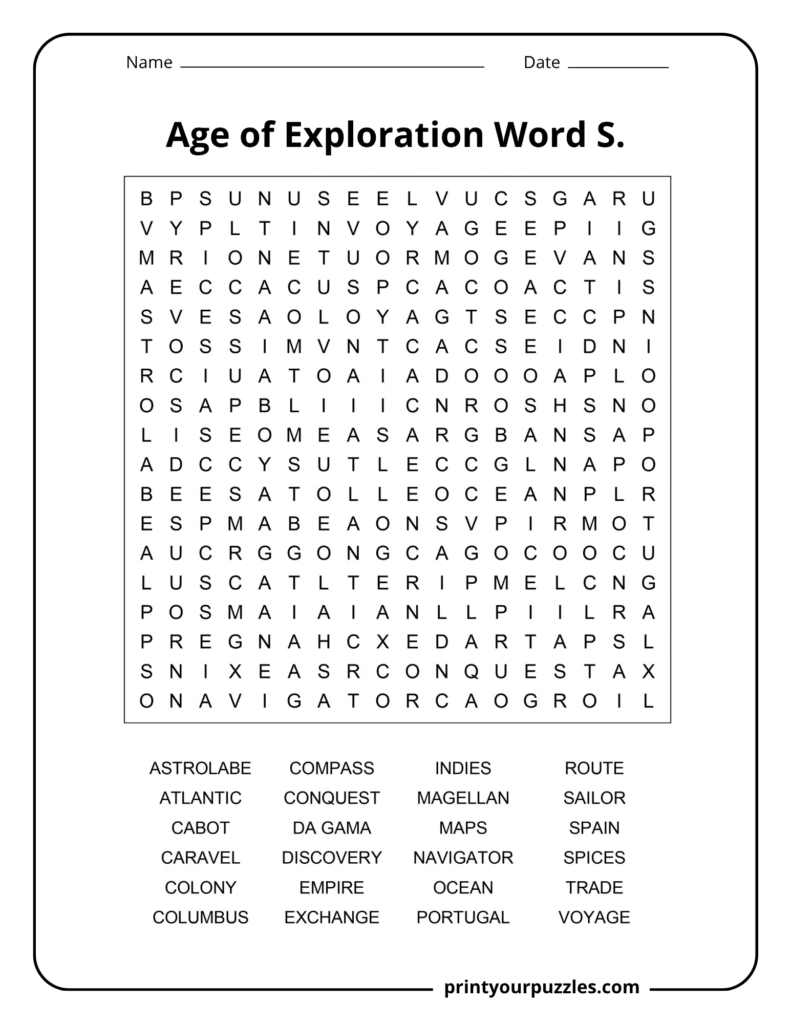
ASTROLABE, ATLANTIC, CABOT, CARAVEL, COLONY, COLUMBUS, COMPASS, CONQUEST, DA GAMA, DISCOVERY, EMPIRE, EXCHANGE, INDIES, MAGELLAN, MAPS, NAVIGATOR, OCEAN, PORTUGAL, ROUTE, SAILOR, SPAIN, SPICES, TRADE, VOYAGE
ASTROLABE – Navigation instrument used by sailors to estimate latitude by measuring the position of stars or the Sun, helping explorers travel more accurately across unfamiliar oceans.
ATLANTIC – Ocean crossed by European explorers traveling toward the Americas and around Africa, becoming a major route for exploration, trade, colonization, and migration.
CABOT – John Cabot was an Italian-born explorer sailing for England who reached the North American coast in 1497 while searching for a westward route to Asia.
CARAVEL – Small, fast, maneuverable sailing ship developed by the Portuguese and widely used during early exploration because it could travel efficiently across oceans and coastal waters.
COLONY – Territory controlled and settled by a foreign power, often established during the Age of Exploration to secure land, resources, trade routes, and political influence.
COLUMBUS – Christopher Columbus was a Genoese navigator sailing for Spain whose 1492 Atlantic voyage reached the Caribbean and began sustained European contact with the Americas.
COMPASS – Navigation tool that indicates direction using a magnetic needle, allowing sailors to maintain their course even when landmarks, the Sun, or stars were unavailable.
CONQUEST – Military takeover of lands and peoples, often involving European forces that defeated Indigenous societies and claimed territories during the expansion of overseas empires.
DA GAMA – Vasco da Gama was a Portuguese explorer who reached India by sea in 1498 after sailing around Africa, opening an important European trade route.
DISCOVERY – Term traditionally used for European voyages to unfamiliar lands, although many regions described as “discovered” were already inhabited by established Indigenous societies and cultures.
EMPIRE – Large political system controlling multiple territories and peoples, expanded by European powers through exploration, colonization, military conquest, trade, and overseas settlement during this period.
EXCHANGE – Movement of plants, animals, foods, diseases, people, and ideas between the Americas, Europe, Africa, and Asia following increased transatlantic contact after 1492.
INDIES – Historical European term for parts of South and Southeast Asia, famous for valuable spices and goods that explorers hoped to reach through new sea routes.
MAGELLAN – Ferdinand Magellan led the expedition that achieved the first circumnavigation of Earth, although he died in the Philippines before the voyage was completed in 1522.
MAPS – Essential navigation aids showing coastlines, seas, routes, and known lands, becoming increasingly accurate as explorers recorded new geographic information during long-distance voyages.
NAVIGATOR – Person skilled in planning and guiding a ship’s course using maps, stars, instruments, winds, and other information necessary for safe ocean travel.
OCEAN – Vast body of salt water crossed by explorers seeking new trade routes, territories, and connections between Europe, Africa, Asia, and the Americas.
PORTUGAL – European kingdom that became a leading maritime power, sponsoring explorers such as Vasco da Gama and developing sea routes around Africa toward India and Asia.
ROUTE – Planned path followed by ships across seas and oceans, often chosen to reach trading centers, avoid obstacles, or connect Europe with distant regions.
SAILOR – Person who worked aboard ships during exploration voyages, helping navigate, operate sails, maintain vessels, carry supplies, and survive dangerous conditions at sea.
SPAIN – European kingdom that financed major voyages including Columbus’s 1492 expedition and later built a vast colonial empire across large parts of the Americas.
SPICES – Valuable products such as pepper, cinnamon, cloves, and nutmeg that helped motivate European merchants and rulers to search for direct maritime routes to Asia.
TRADE – Exchange of goods between regions and peoples, greatly expanded during the Age of Exploration as new maritime routes connected distant markets and continents.
VOYAGE – Long journey by sea undertaken for exploration, trade, conquest, or discovery, often involving months of difficult travel through unfamiliar waters and changing weather.
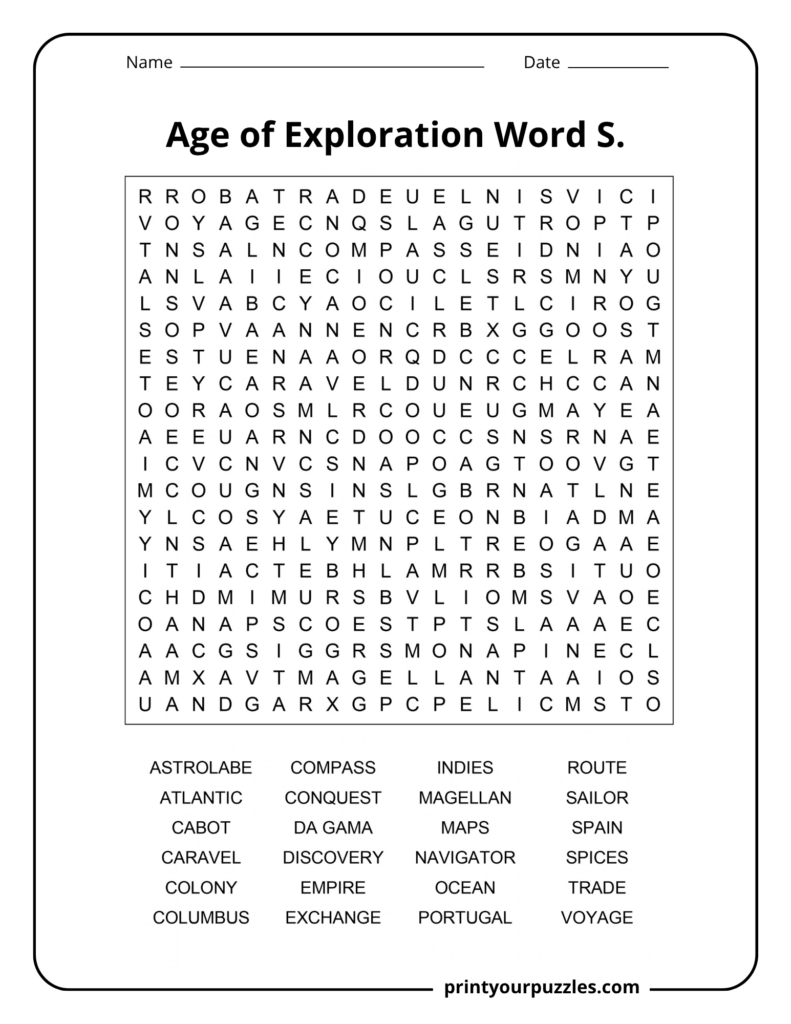
ASTROLABE, ATLANTIC, CABOT, CARAVEL, COLONY, COLUMBUS, COMPASS, CONQUEST, DA GAMA, DISCOVERY, EMPIRE, EXCHANGE, INDIES, MAGELLAN, MAPS, NAVIGATOR, OCEAN, PORTUGAL, ROUTE, SAILOR, SPAIN, SPICES, TRADE, VOYAGE
The Age of Exploration began in the 1400s, when European nations increasingly sponsored long-distance voyages to find new trade routes, resources, and territories.
Portugal and Spain initially led European exploration, followed by England, France, and the Netherlands, which also sponsored voyages and established overseas colonies.
European rulers and merchants wanted direct access to valuable Asian goods, especially spices, while also seeking wealth, political influence, and opportunities to spread Christianity.
Christopher Columbus, Vasco da Gama, Ferdinand Magellan, and John Cabot were among the best-known explorers who expanded European knowledge of global geography.
Exploration expanded global trade and cultural exchange but also caused colonization, warfare, forced labor, disease outbreaks, and severe disruption for many Indigenous societies.
Christopher Columbus sailed westward in 1492 hoping to find a new route to Asia, but instead reached islands in the Caribbean.
Ferdinand Magellan organized the expedition that first circumnavigated Earth, but he was killed in the Philippines before the journey was completed.
Spices such as pepper, cloves, cinnamon, and nutmeg were extremely valuable in Europe, encouraging merchants and rulers to seek direct sea routes to Asia.
Caravels were small, fast, maneuverable vessels that helped Portuguese and Spanish sailors travel long distances and explore unfamiliar coastlines during the Age of Exploration.
The Columbian Exchange moved foods such as potatoes, tomatoes, corn, and cacao between continents, permanently changing agriculture and diets in many parts of the world.