
Manifest Destiny was the 19th-century belief that the United States was meant to expand westward across North America. The idea became especially popular in the 1840s, but the desire for new land and western settlement had been growing for many years. Supporters believed that the nation’s future was connected to reaching from the Atlantic Ocean to the Pacific Ocean.
Many Americans supported westward expansion because they saw the West as a place of opportunity. Settlers wanted land for farming, business leaders wanted new trade routes and markets, and politicians wanted the country to become larger and more powerful. Some people also believed that expansion was part of a special national mission, an idea that helped justify actions that were often unfair or harmful to others.
Manifest Destiny was closely connected to earlier expansion, including the Louisiana Purchase of 1803, which nearly doubled the size of the United States. As more people moved west, wagon trails, pioneer settlements, rivers, forts, and new territories became part of the story. Places such as Oregon, Texas, California, and the Great Plains attracted settlers looking for land, wealth, and a new beginning.
The idea also influenced major political events. Texas was annexed by the United States in 1845, and disputes over land helped lead to the Mexican-American War. After that war, the United States gained large areas of territory in the Southwest and California. These changes helped shape the map of the modern United States, but they also created new conflicts.
For Native American nations, westward expansion brought devastating consequences. Native peoples had lived on these lands for generations, but U.S. expansion often led to broken treaties, forced removal, violence, loss of land, and cultural disruption. Understanding Manifest Destiny means looking at both the hopes of settlers and the harm caused to Native communities.
Expansion also raised major questions about slavery. As new territories were added, Americans argued over whether slavery should be allowed to spread west. These debates increased tensions between North and South and helped move the country closer to the Civil War.
This Manifest Destiny word search helps students review vocabulary connected to expansion, settlers, pioneers, Oregon, Texas, California, trails, territory, Native Americans, war, slavery, and westward movement. A Manifest Destiny word search can make this complicated topic easier to understand by connecting key terms with its causes, events, consequences, and lasting impact.
Related Word Searches:
Westward Expansion | Oregon Trail | Louisiana Purchase | Mexican-American War | California Gold Rush | Transcontinental Railroad
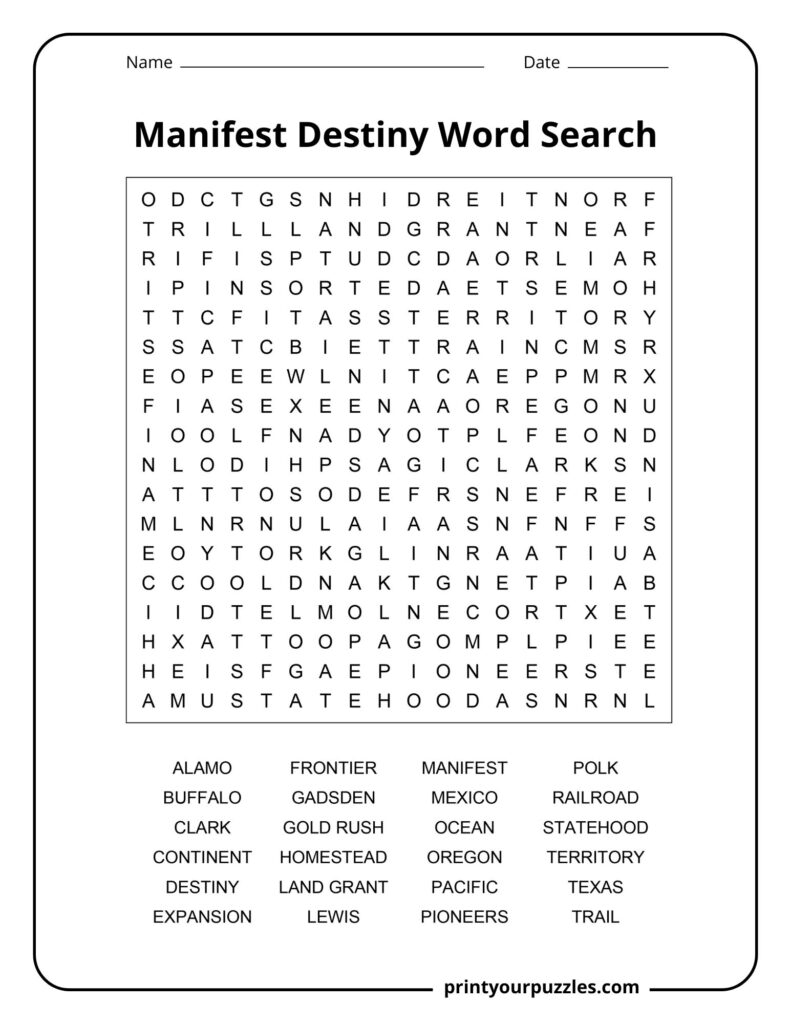
ALAMO, BUFFALO, CLARK, CONTINENT, DESTINY, EXPANSION, FRONTIER, GADSDEN, GOLD RUSH, HOMESTEAD, LAND GRANT, LEWIS, MANIFEST, MEXICO, OCEAN, OREGON, PACIFIC, PIONEERS, POLK, RAILROAD, STATEHOOD, TERRITORY, TEXAS, TRAIL
ALAMO – Famous Texas mission where American defenders died fighting Mexican forces in 1836, becoming a rallying cry for Texas independence and later American expansion into the Southwest.
BUFFALO – Massive herds of bison that roamed the Great Plains, essential to Native American survival, but nearly hunted to extinction during westward expansion by American settlers.
CLARK – William Clark, co-leader with Meriwether Lewis of the famous expedition exploring the Louisiana Purchase and routes to the Pacific Ocean, opening western territories for settlement.
CONTINENT – North American landmass that expansionists believed the United States was destined to control from the Atlantic Ocean to the Pacific Ocean, fulfilling a divine mission.
DESTINY – The belief that American territorial expansion across North America was inevitable, justified, and divinely ordained, forming the ideological foundation for westward movement and conquest.
EXPANSION – The process of United States territorial growth westward through purchase, treaty, annexation, and war, dramatically increasing the nation’s size and reaching the Pacific coast.
FRONTIER – The boundary between settled and unsettled lands that constantly moved westward as pioneers, miners, and farmers claimed new territories, shaping American culture and identity.
GADSDEN – The Gadsden Purchase of 1854 where the United States bought southern Arizona and New Mexico from Mexico, completing the continental borders and enabling railroad development.
GOLD RUSH – The 1849 California Gold Rush that attracted hundreds of thousands of prospectors westward, rapidly populating California and accelerating its path to statehood in 1850.
HOMESTEAD – The Homestead Act of 1862 offering free land to settlers willing to farm it, encouraging western migration and transforming vast territories into agricultural communities.
LAND GRANT – Government policy of giving public lands to settlers, railroads, and states to encourage development, population growth, and economic expansion across western territories.
LEWIS – Meriwether Lewis, expedition leader who explored western territories with William Clark, documenting geography, wildlife, and native peoples, paving the way for American expansion.
MANIFEST – Term meaning obvious or clear, used in “Manifest Destiny” to suggest that American expansion was an evident and undeniable right divinely predetermined for the nation.
MEXICO – The nation that lost nearly half its territory to the United States through the Texas Revolution and Mexican-American War, including California, Nevada, Utah, and Arizona.
OCEAN – The Pacific Ocean, the western boundary of continental expansion, representing the ultimate goal of Manifest Destiny to stretch America from sea to shining sea.
OREGON – Territory in the Pacific Northwest disputed between the United States and Britain, eventually divided in 1846, adding valuable lands including present-day Washington, Oregon, and Idaho.
PACIFIC – The Pacific Ocean or Pacific Northwest region, representing the western limit of expansion and the fulfillment of the continental vision spanning from Atlantic to Pacific.
PIONEERS – Early settlers who bravely traveled westward on difficult overland trails, establishing farms, towns, and communities in previously unsettled territories, embodying expansion’s human element.
POLK – President James K. Polk, strong Manifest Destiny advocate who presided over massive territorial expansion including Oregon, California, and the Southwest through negotiation and Mexican-American War.
RAILROAD – The Transcontinental Railroad completed in 1869, connecting eastern cities to the Pacific coast, revolutionizing commerce, communication, and migration, making western settlement economically viable.
STATEHOOD – The process by which western territories gained sufficient population and organization to become states, integrating conquered and settled lands into the United States.
TERRITORY – Lands controlled by the United States government but not yet organized as states, serving as transitional status for western regions before achieving full statehood.
TEXAS – Independent republic from 1836 to 1845 that joined the United States, sparking conflict with Mexico and exemplifying American expansion into formerly Mexican territories.
TRAIL – Overland routes like the Oregon Trail, Santa Fe Trail, and California Trail used by thousands of migrants traveling westward seeking land, opportunity, and new lives.
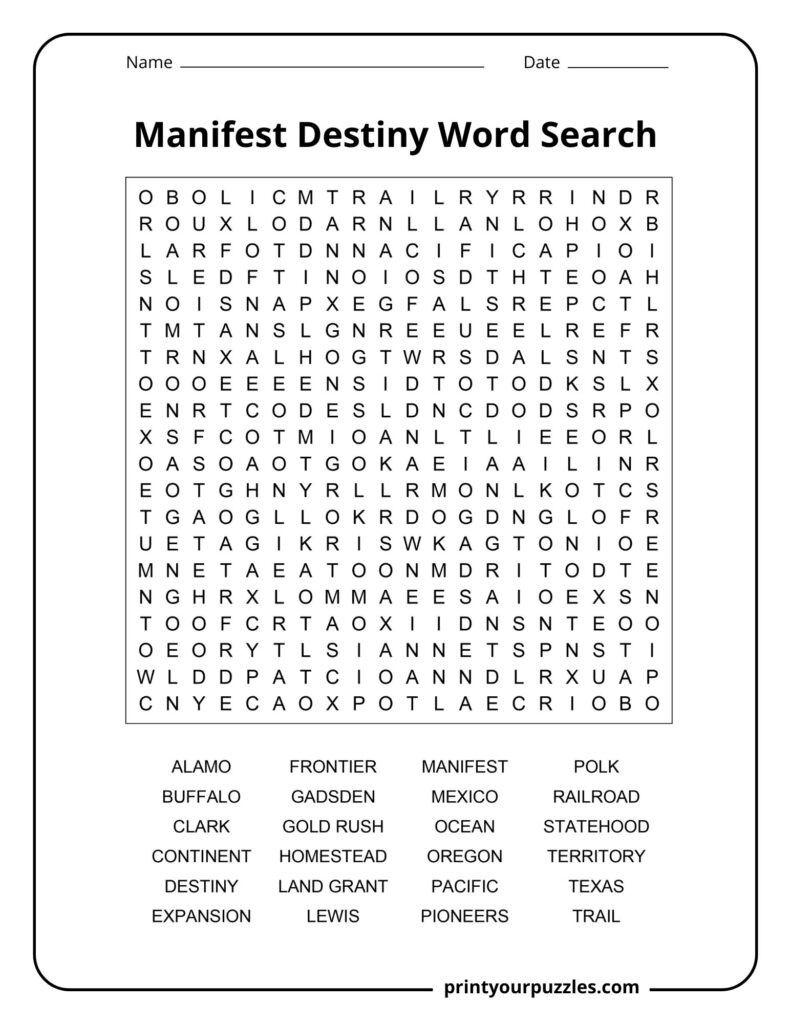
ALAMO, BUFFALO, CLARK, CONTINENT, DESTINY, EXPANSION, FRONTIER, GADSDEN, GOLD RUSH, HOMESTEAD, LAND GRANT, LEWIS, MANIFEST, MEXICO, OCEAN, OREGON, PACIFIC, PIONEERS, POLK, RAILROAD, STATEHOOD, TERRITORY, TEXAS, TRAIL
Manifest Destiny was the 19th-century belief that the United States was divinely destined to expand across North America from the Atlantic to the Pacific Ocean, justifying territorial acquisition.
Manifest Destiny primarily occurred during the 1840s-1850s, though westward expansion continued throughout the 19th century, culminating with the frontier’s official closure around 1890 by historians.
Journalist John L. O’Sullivan coined the phrase “Manifest Destiny” in 1845, writing in the Democratic Review magazine to justify America’s annexation of Texas and territorial expansion.
Consequences included massive U.S. territorial growth, the Mexican-American War, displacement and destruction of Native American tribes, increased slavery tensions, and environmental transformation of western lands.
Native Americans suffered devastating losses including forced relocations like the Trail of Tears, broken treaties, military conflicts, loss of traditional lands, cultural destruction, and dramatic population decline.
Despite its historical significance, the term “Manifest Destiny” was primarily used during the 1840s-1850s, then largely disappeared from common usage until historians revived it decades later.
The ideology extended beyond North America, justifying U.S. expansion into Hawaii, Philippines, Puerto Rico, and other territories during the late 19th and early 20th centuries.
Authors like Caroline Kirkland published books romanticizing frontier life, influencing thousands of families to move west despite the dangerous journeys and harsh conditions awaiting them.
Abolitionists, some religious groups, and politicians like Abraham Lincoln criticized expansion as immoral, fearing it would spread slavery and unjustly harm Native Americans and Mexicans.
The 1849 Gold Rush attracted fortune-seekers from China, Australia, Europe, South America, and Africa, making California remarkably diverse and cosmopolitan almost overnight.